
heart failure and types of heart failure
Reading File
Now I'll search the medical library and PubMed in parallel for comprehensive heart failure content.
Finding Sources
Searching PubMed
"heart failure" classification types
Searching Images
heart failure types classification diagram
Now let me read the key sections from Braunwald's Heart Disease and the Family Medicine textbook in parallel:
Reading File
Reading File
Finding Sources
Let me now read the key Braunwald's section on systolic/diastolic HF and the Family Medicine detailed sections:
Reading File
Reading File
Finding Sources
Let me read the key Family Medicine content on HF types and the Tintinalli's emergency medicine section:
Reading File
Reading File
Finding Sources
Let me read the remaining key Family Medicine content on clinical features and get the Braunwald's main HF chapter section:
Reading File
Finding Sources
Reading File
Finding Sources
Finding Sources
Finding Sources
Reading File
Finding Sources
Reading File
I now have comprehensive content. Let me compose the full answer.
Heart Failure
Definition
Heart failure (HF) is a clinical syndrome resulting from the inability of the heart to meet the metabolic requirements of the body at normal filling pressures. It manifests as tachycardia, decreased exercise tolerance, dyspnea, and cardiomegaly — with or without peripheral/pulmonary edema. Because congestion may be absent, the term heart failure is preferred over the older congestive heart failure.
— Textbook of Family Medicine 9e
Pathophysiology
The modern understanding has moved away from the purely hemodynamic model to emphasize left ventricular (LV) remodeling — stretching and dilation of the LV with subsequent reduction in function. This process can be triggered by:
- Coronary artery disease / myocardial infarction
- Hypertension
- Valvular heart disease
- Diabetes, anemia, alcoholism, congenital heart defects
Regardless of the precipitating injury, two key neurohormonal systems are activated:
- Renin-Angiotensin-Aldosterone System (RAAS) — Angiotensin II promotes myocyte apoptosis, hypertrophy, and fibrosis. Aldosterone further augments adverse remodeling.
- Sympathetic Nervous System (SNS) — Excess catecholamines suppress adrenergic receptors, increase oxygen demand, and precipitate arrhythmias. The baroreceptor reflex is reset toward lower sensitivity, perpetuating sympathetic drive.
At the cellular level: matrix metalloproteinase (MMP) dysregulation leads to cardiac fibrosis; altered calcium flux and β-adrenergic receptor downregulation impair contractility; cardiac metabolism shifts from fatty acid oxidation to glycolysis.
The end result is a vicious cycle: reduced cardiac output → neurohormonal activation → vasoconstriction → increased afterload → further reduced EF → worsening failure.
— Katzung's Basic and Clinical Pharmacology 16e; Textbook of Family Medicine 9e
Types / Classification of Heart Failure
Heart failure is classified by multiple overlapping frameworks:
1. By Ejection Fraction (Primary Clinical Classification)
This is the most clinically important classification because treatment trials and guideline-based therapies are stratified by EF.
| Type | Abbreviation | EF | Key Mechanism |
|---|---|---|---|
| HF with Reduced EF | HFrEF | < 40–45% | Systolic dysfunction — ventricle cannot eject blood adequately → ↑ end-diastolic volume, afterload sensitivity |
| HF with Mildly Reduced EF | HFmrEF | 40–49% | "Grey zone" — features of both; some trial evidence exists |
| HF with Preserved EF | HFpEF | ≥ 50% | Diastolic dysfunction — ventricle cannot relax/fill adequately → ↑ filling pressures, preload sensitivity |
HFrEF (systolic HF): The ventricle has difficulty ejecting blood; output is maintained only by ejecting a smaller fraction of a larger end-diastolic volume. EF progressively falls with worsening systolic function.
HFpEF (diastolic HF): Impaired ventricular relaxation creates an abnormal pressure-volume relationship. The stiff ventricle requires higher atrial pressures to fill adequately. This is more common with aging, chronic hypertension (which leads to LV hypertrophy), and coronary artery disease. Nearly 50% of all HF cases are HFpEF. Crucially, HFpEF responds poorly to inotropic agents.
The prevalence of HFrEF and HFpEF is approximately 50% each. Only trials enrolling patients with LVEF ≤35–40% have shown efficacy for most HF medications (ACEi, β-blockers, MRA). — Fuster and Hurst's The Heart 15e; Tintinalli's Emergency Medicine
2. By Output State
| Type | Mechanism | Examples |
|---|---|---|
| Low-output failure | Cardiac output below normal; typical of most HF | Ischemic cardiomyopathy, dilated cardiomyopathy, HFrEF |
| High-output failure | Cardiac output is elevated yet still cannot meet extreme peripheral demand | Hyperthyroidism, beriberi, severe anemia, large arteriovenous fistulae |
High-output failure is rare and responds poorly to standard HF drugs. Treatment is directed at the underlying cause.
— Katzung's Basic and Clinical Pharmacology 16e
3. By Side of the Heart Affected
| Type | Primary Problem | Clinical Features |
|---|---|---|
| Left-sided HF | Failure of LV → ↑ pulmonary venous pressure | Dyspnea, orthopnea, paroxysmal nocturnal dyspnea, pulmonary edema, S3 gallop |
| Right-sided HF | Failure of RV → systemic venous congestion | JVD, peripheral edema, ascites, hepatomegaly, hepatojugular reflux |
| Biventricular HF | Both ventricles affected | Features of both left and right failure |
Left-sided HF is the most common and frequently causes right-sided HF over time due to elevated pulmonary pressures.
4. By Time Course
| Type | Description |
|---|---|
| Acute HF | Rapid onset or rapid worsening; may result in cardiogenic shock; immediate hemodynamic compromise; mechanisms include acute MI, acute myocarditis, mechanical disruption |
| Chronic HF | Gradual onset with neurohormonal and renal compensation; fluid retention and cardiac remodeling occur over weeks |
| Acute-on-Chronic HF | Decompensation of previously stable chronic HF (the most common ED presentation) |
Common precipitants of acute decompensation: medication/dietary non-adherence, renal failure, uncontrolled hypertension, ACS, arrhythmias, substance use (cocaine, alcohol), new drugs (NSAIDs, CCBs).
— Tintinalli's Emergency Medicine; Guyton & Hall Medical Physiology
5. By ACC/AHA Staging (Progression of Disease)
The ACC/AHA system emphasizes disease progression and is complementary to the NYHA functional classification:
| Stage | Description | Intervention Focus |
|---|---|---|
| A | At risk for HF; no structural disease (e.g., hypertension, DM) | Risk factor modification |
| B | Structural heart disease, no HF symptoms (e.g., asymptomatic reduced EF post-MI) | Treat structural disease, prevent progression |
| C | Structural disease with current/prior HF symptoms | Reduce morbidity and mortality |
| D | Refractory HF requiring advanced therapies | Advanced therapies (LVAD, transplant, palliative care) |
6. By NYHA Functional Class (Symptom Severity)
Used alongside staging to track symptoms:
| Class | Description |
|---|---|
| I | No limitation of physical activity |
| II | Slight limitation; comfortable at rest; ordinary activity causes fatigue/dyspnea |
| III | Marked limitation; comfortable at rest; less-than-ordinary activity causes symptoms |
| IV | Symptoms at rest; unable to carry on any physical activity without discomfort |
NYHA class correlates with mortality, but importantly: among patients with cardiomyopathy who are class I–II, the ratio of sudden cardiac death to total death is paradoxically higher than in class III–IV patients (though absolute mortality is lower).
— Fuster and Hurst's The Heart 15e; Braunwald's Heart Disease 2-Vol Set
7. Hemodynamic Bedside Profile (Forrester Classification)
Clinically useful for acute HF management:
| Profile | Congestion | Perfusion | Example |
|---|---|---|---|
| A ("warm and dry") | No | Adequate | Compensated HF |
| B ("warm and wet") | Yes | Adequate | Decompensated HF with preserved output |
| L ("cold and dry") | No | Compromised | Low-volume state |
| C ("cold and wet") | Yes | Compromised | Cardiogenic shock |
Signs of congestion: orthopnea, JVD, rales, peripheral edema. Signs of impaired perfusion: narrow pulse pressure (<25%), cool extremities, pulsus alternans, impaired mentation.
— Fuster and Hurst's The Heart 15e
Key Clinical Signs
| Finding | Sensitivity | Specificity |
|---|---|---|
| Dyspnea on exertion | 84% | Moderate |
| Paroxysmal nocturnal dyspnea | Moderate | 76–84% |
| S3 gallop | Lower | Highest LR+ (4.0) |
| History of prior HF | 56% | 80% |
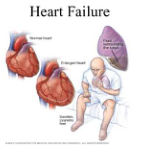
Summary Diagram
Sources
- Textbook of Family Medicine, 9e — Textbook of Family Medicine 9e
- Tintinalli's Emergency Medicine — Tintinalli's Emergency Medicine
- Katzung's Basic and Clinical Pharmacology, 16e — Katzung 16e
- Fuster and Hurst's The Heart, 15e — Fuster & Hurst 15e
- Braunwald's Heart Disease, 2-Vol Set — Braunwald's Heart Disease
- Guyton and Hall Textbook of Medical Physiology — Guyton & Hall
This is a shared conversation. Sign in to Orris to start your own chat.