
Dark adaptation
Dark adaptation is the process by which the eyes adjust to low-light conditions, primarily through the regeneration of photopigments (rhodopsin in rods, cone pigments in cones) after bleaching by bright light. Cones adapt quickly (5-10 min) but have lower sensitivity, while rods adapt slowly (20-30 min) and achieve much greater sensitivity. The "rod-cone break" at around 7-10 minutes marks when rods take over as the dominant photoreceptors in dim light.
Searching sources...
Reading File
Finding Sources
Searching the Web
dark adaptation physiology rhodopsin rod cone
Good - I have four relevant textbook sections. Let me read all the key ones in parallel.
Reading File
Reading File
Reading File
I now have excellent textbook content from Ganong's, Guyton & Hall, and Neuroscience: Exploring the Brain. Let me also fetch the dark adaptation curve image and the calcium/cGMP diagram.
Loading Image
Loading Image
I have comprehensive content from three authoritative textbooks plus both diagrams. Here is the full answer:
Dark Adaptation
Definition
Dark adaptation is the progressive increase in retinal sensitivity that occurs when the eye transitions from a brightly lit environment to darkness. The visual threshold drops continuously until it reaches a minimum (maximum sensitivity) after roughly 20-40 minutes, representing a sensitivity gain of up to ~25,000-fold. The reverse process - light adaptation - takes only about 5 minutes.
(Ganong's Review of Medical Physiology; Guyton and Hall Textbook of Medical Physiology)
The Dark Adaptation Curve
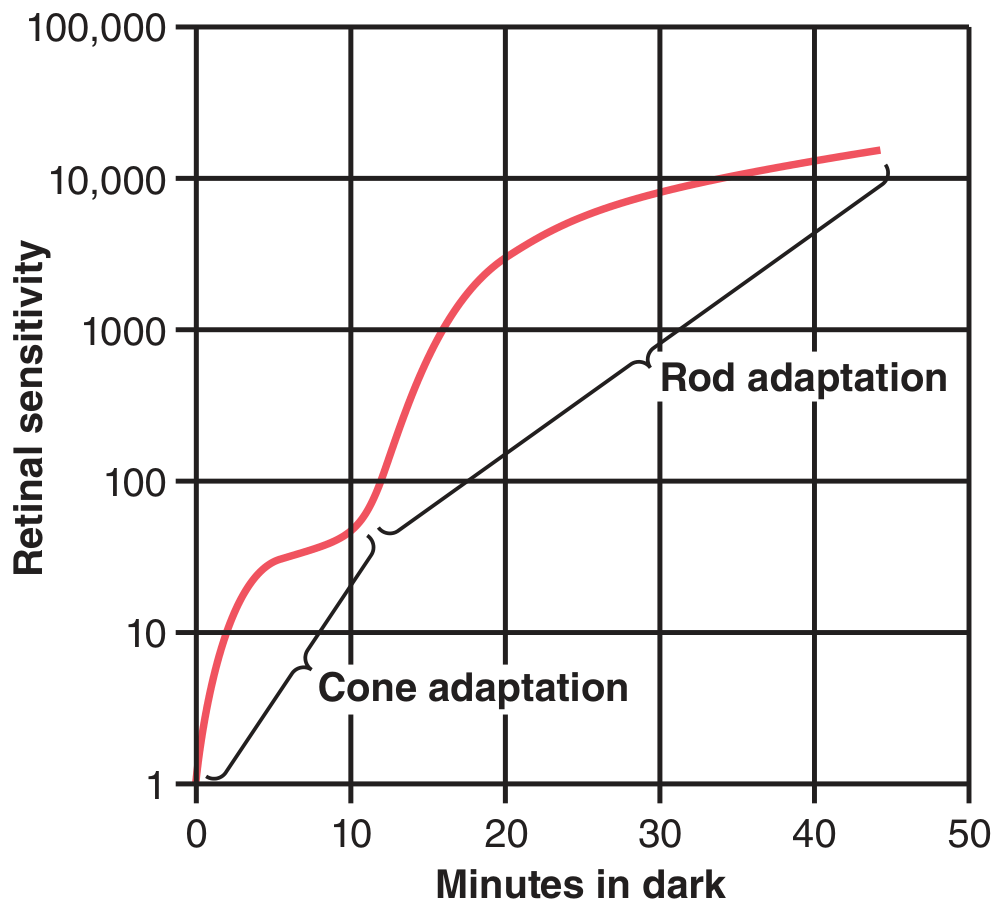
Figure 51.9 from Guyton & Hall - Dark adaptation curve showing cone vs. rod adaptation components.
The curve has two distinct phases separated by an inflection point (the rod-cone break) around 7-10 minutes:
| Phase | Receptor | Time course | Sensitivity gain |
|---|---|---|---|
| Early (fast) | Cones | Completes ~5-10 min | Modest (~30-40-fold) |
| Late (slow) | Rods | Continues 20-40+ min | Massive (~25,000-fold total) |
At 1 minute: ~10-fold sensitivity increase. At 20 minutes: ~6,000-fold. At 40 minutes: ~25,000-fold. (Guyton & Hall, p. 637)
The fovea (rod-free) shows only the first, cone-mediated phase - if only foveal vision is tested, no further threshold decline occurs. (Ganong's, p. 206)
Mechanisms
1. Photopigment Regeneration (primary mechanism)
In bright light, photopigments are continuously bleached - rhodopsin in rods and the three cone opsins are broken down into retinal + opsin, and much of the retinal is further converted to vitamin A.
In darkness, the cycle reverses:
- Retinal + opsin recombine to form photopigment
- Vitamin A is converted back to retinal
- The final limit is determined by the amount of opsin available
Cones adapt 4x faster than rods (explaining the biphasic curve), but achieve far less sensitivity change. (Guyton & Hall)
2. Pupillary Dilation
Pupil diameter increases from ~2 mm (bright light) to ~8 mm (dark), increasing light entry ~16-fold (roughly 30x sensitivity change). This happens within seconds - it is fast but relatively small in magnitude. (Neuroscience: Exploring the Brain)
3. Neural Convergence
In the dark-adapted peripheral retina, 100 or more rods converge onto a single ganglion cell. This spatial summation dramatically amplifies the signal from dim light stimuli, contributing significantly to rod sensitivity. (Guyton & Hall)
4. Calcium-mediated Adaptation in Cones
This is a key mechanism preventing photoreceptor saturation:
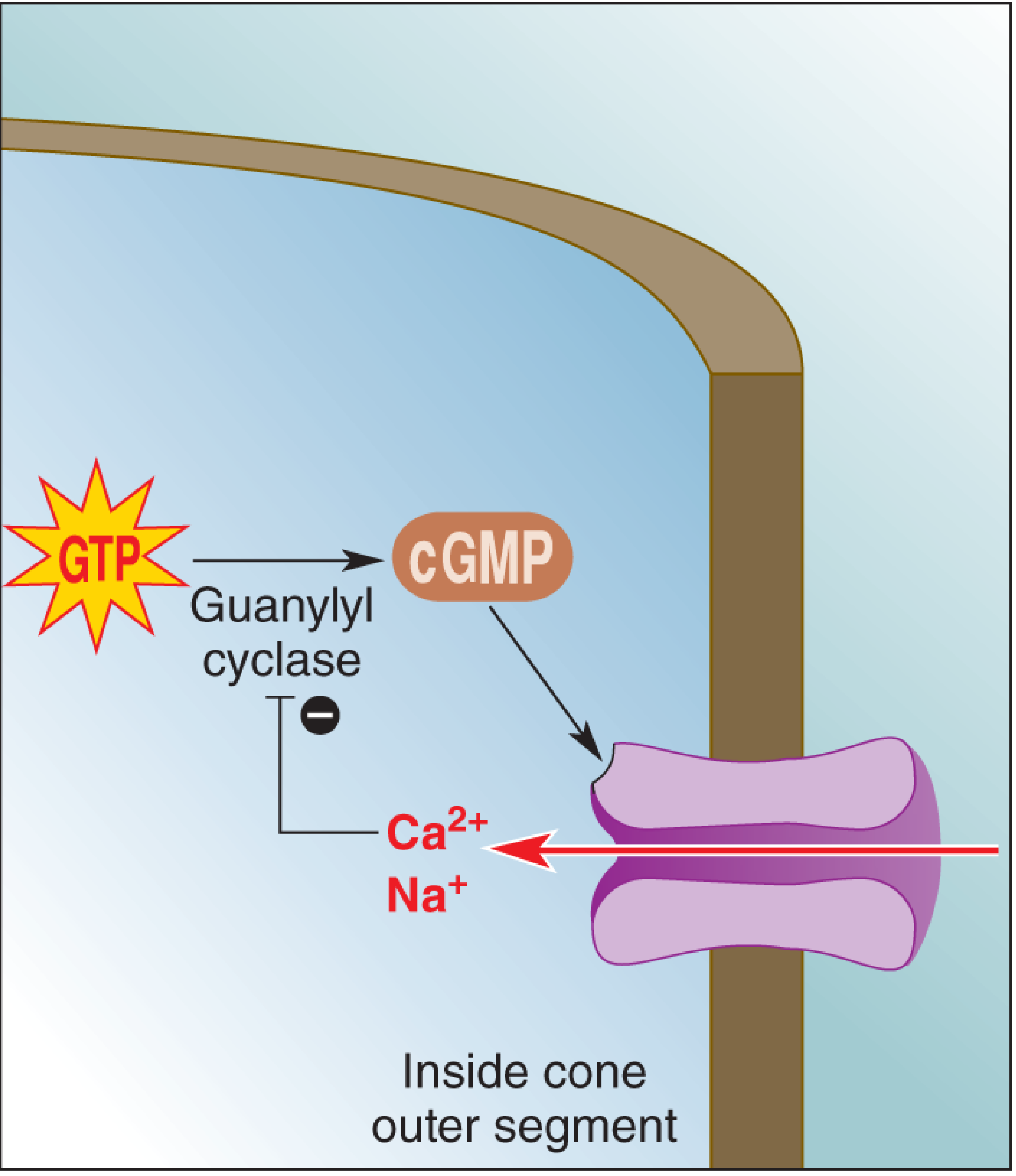
Role of calcium in light adaptation - from Neuroscience: Exploring the Brain
- In the dark, cGMP-gated channels are open and admit both Na⁺ and Ca²⁺
- Ca²⁺ inhibits guanylyl cyclase (the enzyme that synthesizes cGMP) - a negative feedback
- When light closes the cGMP-gated channels, Ca²⁺ influx stops, guanylyl cyclase inhibition is relieved, cGMP synthesis increases, and channels gradually reopen
- Net effect: the cone membrane gradually depolarizes back toward -35 mV even under sustained bright light, ensuring photoreceptors retain the ability to detect relative changes at any ambient light level (Neuroscience: Exploring the Brain, p. 882-883)
5. Neural (Synaptic) Adaptation
Neurons at successive stages of the visual pathway (retinal interneurons, lateral geniculate, visual cortex) also adapt their gain over time, contributing to the overall change in threshold. (Guyton & Hall)
Practical Implications
-
Red goggles trick: Wavelengths at the red end of the spectrum stimulate rods minimally while cones function normally. Radiologists, pilots, and military personnel wear red goggles in bright environments so rods can dark-adapt simultaneously - upon entering darkness, they are already rod-adapted without the 20-minute wait. (Ganong's, p. 206)
-
Night blindness (nyctalopia): Impaired dark adaptation is the hallmark of vitamin A deficiency (retinal is derived from vitamin A / β-carotene), and is also seen in retinitis pigmentosa and age-related macular degeneration (AMD). Measuring the "rod intercept time" on a dark adaptometer is now used as a sensitive early marker for AMD.
-
Purkinje shift: As luminance decreases from photopic to scotopic levels, peak visual sensitivity shifts from ~555 nm (cones, green-yellow) to ~505 nm (rods, blue-green) - this is explained by the switch from cone to rod photopigments during dark adaptation.
Summary Table
| Feature | Cones | Rods |
|---|---|---|
| Photopigment | Iodopsins (S, M, L opsins) | Rhodopsin |
| Adaptation speed | Fast (4x rods) | Slow |
| Maximum sensitivity | Low | Very high |
| Convergence | Low (1:1 at fovea) | High (100:1) |
| Location | Mainly fovea | Peripheral retina |
| Function | Color/detail (photopic) | Low-light (scotopic) |
Sources:
- Guyton and Hall Textbook of Medical Physiology, pp. 637-638
- Ganong's Review of Medical Physiology, 26th Ed., p. 206
- Neuroscience: Exploring the Brain, 5th Ed., pp. 882-884
This is a shared conversation. Sign in to Orris to start your own chat.