
Ippa physical examination for lungs ( respiratory system)
Reading File
Now let me search the medical library for comprehensive content on IPPA (Inspection, Palpation, Percussion, Auscultation) of the respiratory system.
Finding Sources
Finding Sources
Finding Sources
Finding Sources
Reading File
Finding Sources
Excellent — I have rich content from Murray & Nadel's Textbook of Respiratory Medicine. Let me read more to get full coverage of percussion and auscultation sections.
Reading File
Searching Images
chest percussion auscultation physical examination lung
I have extensive content. Let me read more to capture the auscultation and breath sounds classification tables.
Reading File
Loading Image
I now have comprehensive content. Let me compile the full IPPA respiratory examination answer.
IPPA Physical Examination of the Respiratory System (Lungs)
IPPA = Inspection → Palpation → Percussion → Auscultation
Source: Murray & Nadel's Textbook of Respiratory Medicine
Overview
Physical examination of the chest uses these four classic techniques in sequence. Optimal conditions require privacy, warmth, good lighting, and a quiet atmosphere. The patient is ideally seated with sufficient clothing removed to expose the entire thorax.
1. INSPECTION 👁️
The examination begins the moment the clinician first sees the patient.
What to Observe:
| Feature | Normal / Abnormal Findings |
|---|---|
| General appearance | Respiratory distress, cyanosis, accessory muscle use |
| Chest shape | Barrel chest (COPD), pectus excavatum, pectus carinatum, kyphoscoliosis, ankylosing spondylitis |
| Symmetry | Unilateral lag suggests consolidation, pleural effusion, pneumothorax |
| Scars/deformities | Previous surgeries, trauma |
| Breathing pattern | Rate, rhythm, depth (see below) |
| Accessory muscles | SCM, scalenes engaged → airway obstruction |
Classic Breathing Patterns:
- Eupnea — normal breathing
- Tachypnea — rapid, shallow (fever, anxiety, hypoxia)
- Bradypnea — slow (CNS depression, opioids)
- Kussmaul — deep, rapid (metabolic acidosis)
- Cheyne-Stokes — cyclical waxing/waning (heart failure, CNS disease)
- Biot's — irregular with apneic episodes (meningitis, brainstem lesion)
Associated Observations:
- Cyanosis — central (tongue) vs. peripheral
- Clubbing of fingers — chronic hypoxia (bronchiectasis, lung cancer, fibrosis)
- JVP elevation — cor pulmonale, tension pneumothorax
- Odors — tobacco stains, ketones (diabetic ketoacidosis), foul smell (anaerobic abscess), Pseudomonas (sweet odor)
2. PALPATION ✋
Tracheal Position
- Palpate trachea at the suprasternal notch
- Midline = normal
- Deviated toward lesion = collapse/fibrosis/atelectasis
- Deviated away from lesion = large effusion, tension pneumothorax
Chest Wall Assessment
- Feel for point tenderness (rib fracture, pleurisy)
- Subcutaneous emphysema — crepitus like Rice Krispies under skin (pneumothorax, trauma)
- Fluctuant areas — empyema necessitans
- Cervical rib / bony abnormalities
Chest Expansion
Place both hands symmetrically over opposite hemithoraces (anteriorly at costal margins, posteriorly at lower thorax). Ask patient to breathe deeply.
- Equal expansion = normal
- Reduced on one side = consolidation, collapse, effusion, pneumothorax on that side
Vocal Fremitus (Tactile Fremitus)
Ask patient to say "ninety-nine" or "one-two-three" while palpating with ulnar border/palm moving systematically top to bottom bilaterally:
| Finding | Cause |
|---|---|
| Increased fremitus | Consolidation (pneumonia) — better sound transmission |
| Decreased fremitus | Pleural effusion, pneumothorax, COPD — impaired transmission |
| Absent fremitus | Blocked bronchus, large effusion |
Cardiac Palpation
- Apical impulse, heaves, thrills
- In severe COPD: cardiac movements better felt at the subxiphoid (due to hyperinflation)
3. PERCUSSION 🎵
Technique
The pleximeter (middle finger of non-dominant hand) is placed flat on the chest wall; the plexor (middle finger of dominant hand) strikes it with a sharp, free wrist stroke. Move systematically comparing left and right sides at each level.
Percussion Notes:
| Sound | Quality | Cause |
|---|---|---|
| Resonant | Hollow, low-pitched | Normal air-containing lung |
| Hyperresonant | Booming, very low-pitched | Emphysema, pneumothorax |
| Tympanitic | Drum-like | Tension pneumothorax, gas-filled bowel |
| Dull | Short duration, higher pitch, low intensity | Consolidation (pneumonia), pleural effusion |
| Flat | Non-resonant, high-pitched | Massive effusion, solid tissue (like percussing liver) |
Clinical Pearls:
- Large pleural effusion: 3 zones from top to bottom — resonant → dull → flat
- Pneumothorax: hyperresonant → tympanitic if tension
- Consolidation/pneumonia: dull
4. AUSCULTATION 🔊
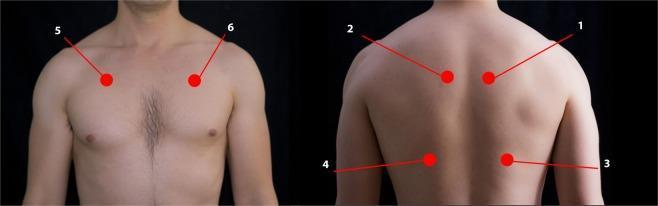
Use the diaphragm for higher-pitched sounds (breath sounds, normal); use the bell lightly for lower-pitched sounds. Auscultate anterior, lateral, and posterior chest systematically, comparing sides.
Auscultation positions — anterior, posterior (arms crossed to protract scapulae), and lateral (hands behind head):
A. Normal Breath Sounds
| Type | Location | Character |
|---|---|---|
| Normal (vesicular) | Peripheral lung fields | Soft, low-pitched; inspiration > expiration (3:1); no gap |
| Bronchovesicular | Around main bronchi (1st/2nd ICS, between scapulae) | Medium pitch; inspiration = expiration |
| Bronchial (tracheal) | Over trachea/manubrium | Loud, high-pitched, hollow; expiration > inspiration; gap between phases |
Note: "Vesicular" is a historical misnomer — normal breath sounds arise from turbulent airflow in lobar/segmental bronchi, not alveoli.
B. Adventitious (Abnormal) Sounds
(Standardized by American Thoracic Society)
| Sound | Character | Timing | Significance |
|---|---|---|---|
| Fine crackles | Soft, high-pitched, short discontinuous pops | Mid-to-late inspiratory | Fibrosis, pulmonary edema, early pneumonia — opening of collapsed distal airways |
| Coarse crackles | Loud, low-pitched, longer discontinuous | Early inspiratory or expiratory | Secretions in distal airways; may change after coughing |
| Wheeze | Continuous, high-pitched (≥400 Hz), hissing, >250 ms | Predominantly expiratory | Airway narrowing — asthma, COPD (diffuse); focal lesion (unilateral) |
| Rhonchi | Continuous, low-pitched (<200 Hz), snoring, >250 ms | Expiratory | Secretions in large airways; often clear with cough |
| Stridor | High-pitched, inspiratory, loudest over neck | Inspiratory | Extrathoracic/upper airway obstruction — urgent (anaphylaxis, epiglottitis, foreign body) |
| Bronchial sounds in periphery | Like tracheal sounds heard peripherally | Both phases | Consolidation, atelectasis — airless alveoli around patent bronchus |
| Pleural rub | Creaking, leathery, grating | Both phases | Pleuritis — inflamed pleural surfaces rubbing |
C. Voice-Transmitted Sounds (Vocal Resonance)
Ask patient to say "ninety-nine" while auscultating:
| Test | Normal | Abnormal | Cause |
|---|---|---|---|
| Bronchophony | Muffled "ninety-nine" | Clearly heard "99" | Consolidation |
| Whispered pectoriloquy | Inaudible whisper | Clearly heard whispered "1-2-3" | Consolidation |
| Egophony | Normal voice | "ee" sounds like "ay" (nasal, bleating) | Consolidation or effusion margin |
Summary: Findings by Condition
| Condition | Inspection | Palpation | Percussion | Auscultation |
|---|---|---|---|---|
| Consolidation (Pneumonia) | Reduced expansion | ↑ fremitus, lag | Dull | Bronchial breathing, crackles, ↑ vocal resonance |
| Pleural Effusion | Reduced expansion | ↓ fremitus, lag | Stony dull | Absent/reduced breath sounds; egophony at upper border |
| Pneumothorax | Reduced expansion | ↓/absent fremitus, lag, tracheal deviation away | Hyperresonant | Absent breath sounds |
| COPD/Emphysema | Barrel chest, ↑RR | ↓ fremitus | Hyperresonant | ↓ breath sounds, prolonged expiration, wheeze |
| Asthma (acute) | Accessory muscles, tachypnea | ↓ expansion | Resonant/hyperresonant | Diffuse wheeze, ↓ breath sounds |
| Fibrosis | Clubbing, tachypnea | ↓ expansion | Normal/dull | Fine "Velcro" crackles (bibasal) |
| Atelectasis/Collapse | Lag, tracheal deviation toward | ↓ fremitus, lag | Dull | Bronchial/absent breath sounds |
Murray & Nadel's Textbook of Respiratory Medicine, Chapter 18 — "Examination of the Chest"
This is a shared conversation. Sign in to Orris to start your own chat.