
What is neoplasm?
A neoplasm is an abnormal, uncontrolled growth of cells that forms a tissue mass (tumor). It can be benign (non-invasive, well-defined) or malignant (invasive, capable of spreading). The key feature is that growth persists even after the stimulus that triggered it is removed. Neoplasms arise due to genetic mutations affecting cell growth, differentiation, and death.
Searching sources...
Reading File
Finding Sources
Searching the Web
neoplasm definition classification pathology
Finding Sources
Finding Sources
Reading File
Finding Sources
Robbins Pathology is the authoritative source here. Let me read the core neoplasia sections.
Reading File
Reading File
Reading File
I now have excellent content from Robbins, Cotran & Kumar Pathologic Basis of Disease. Let me read a bit more to cover characteristics of malignant tumors.
Reading File
I now have comprehensive textbook content. Let me compile the full answer.
Neoplasm
Definition
Neoplasia means "new growth." A neoplasm is defined as a disorder of cell growth triggered by acquired (or, less commonly, inherited) mutations affecting a single cell and its clonal progeny. These mutations alter genes regulating fundamental cellular processes - growth, survival, and senescence - giving neoplastic cells a growth advantage, resulting in excessive proliferation that is independent of normal physiologic growth signals and controls.
The classic definition by Sir Rupert Willis (1952) states:
"A neoplasm is an abnormal mass of tissue, the growth of which exceeds and is uncoordinated with that of the normal tissues, and persists in the same excessive manner after cessation of the stimuli which evoked the change."
The word tumor (originally meaning any swelling) is now used as a synonym for neoplasm. The study of tumors is called oncology (Greek oncos = tumor).
Structure of a Neoplasm
All tumors are composed of two components:
- Parenchyma - the neoplastic cells themselves. The classification and biologic behavior of a tumor are based primarily on this component.
- Reactive stroma - supportive connective tissue, blood vessels, and immune cells. Growth and spread are critically dependent on the stroma (it supplies the blood supply).
- Some tumors have scant connective tissue and are soft/fleshy.
- Others stimulate abundant collagen formation (called desmoplasia), making them stony hard (e.g., some breast cancers, called scirrhous tumors).
Classification: Benign vs. Malignant
| Feature | Benign | Malignant |
|---|---|---|
| Local invasion | No - stays localized | Yes - invades adjacent tissues |
| Metastasis | No | Yes (hallmark feature) |
| Growth rate | Slow | Often rapid |
| Differentiation | Well-differentiated, resembles tissue of origin | Variable; may be poorly differentiated |
| Nuclear features | Normal | Pleomorphism, hyperchromasia, abnormal mitoses |
| Effect on patient | Usually survives; location-dependent exceptions | Often fatal if untreated |
Benign Tumors
Remain localized and are generally curable by surgical removal. Named with the suffix "-oma" attached to the cell/tissue of origin (e.g., fibroma, chondroma, adenoma, papilloma).
Malignant Tumors ("Cancer")
Can invade and destroy adjacent structures and metastasize (spread to distant sites via lymphatics, blood, or body cavities). Named based on origin:
- Carcinomas - from epithelial cells (e.g., adenocarcinoma, squamous cell carcinoma)
- Sarcomas - from mesenchymal/solid connective tissues (e.g., fibrosarcoma, chondrosarcoma)
- Leukemias/Lymphomas - from blood-forming cells and lymphocytes
Key Molecular Concepts
Cancer is fundamentally a genetic disorder caused by DNA mutations:
- Mutations may be from mutagen exposure, spontaneous replication errors, or inheritance.
- Epigenetic changes (altered DNA methylation, histone modification) also play a role.
- Genetic alterations are heritable (passed to daughter cells), so cells with growth advantages outcompete neighbors - a process of Darwinian selection / clonal evolution.
- Individual tumors begin as clonal (progeny of a single mutated cell).
Special Types
- Mixed tumors - contain more than one cell lineage (e.g., pleomorphic adenoma of the salivary gland, with both epithelial and myxoid/cartilaginous components).
- Teratoma - arises from totipotential germ cells; contains cells from more than one germ layer (ectoderm, mesoderm, endoderm), potentially forming bone, hair, teeth, nerve tissue, etc.
- Undifferentiated malignant neoplasm - ~2% of cancers; cells of unknown origin.
Precursor / Pre-neoplastic Changes
Before frank neoplasia, cells often show abnormal growth patterns:
- Metaplasia - replacement of one cell type by another
- Dysplasia - disordered but not yet autonomous growth
- These can progress to neoplasia with further mutations.
Sources: Robbins, Cotran & Kumar - Pathologic Basis of Disease, Nomenclature section; Robbins & Kumar Basic Pathology (Robbins Pathology)
Define tumor and classify them based on their nature.
A tumor (neoplasm) is an abnormal mass of tissue resulting from uncontrolled cell proliferation. Based on their nature, tumors are broadly classified as benign (localized, non-invasive) or malignant (invasive, capable of metastasis). A third intermediate category - borderline/potentially malignant - also exists.
Searching sources...
Finding Sources
Searching the Web
tumor classification benign malignant borderline pathology Robbins
Finding Sources
Finding Sources
Reading File
Finding Sources
Reading File
Reading File
Reading File
Reading File
Reading File
Reading File
Excellent - I now have a very thorough set of textbook content. Let me also fetch the histology images to enrich the answer visually.
Loading Image
Loading Image
I now have all the material needed for a complete, well-illustrated answer. Here it is:
Tumor: Definition and Classification by Nature
Definition
A tumor (from Latin tumor = swelling) originally meant any swelling, but in modern medicine the term is equated with neoplasm - an abnormal mass of tissue resulting from uncontrolled, autonomous cell proliferation. Three features are used to distinguish tumor types:
- Differentiation and anaplasia
- Local invasion
- Metastasis
Growth rate also offers a clue, though it is not a reliable sole discriminator.
Classification Based on Nature
Tumors are classified into three broad categories based on their biologic behavior:
1. Benign Tumors
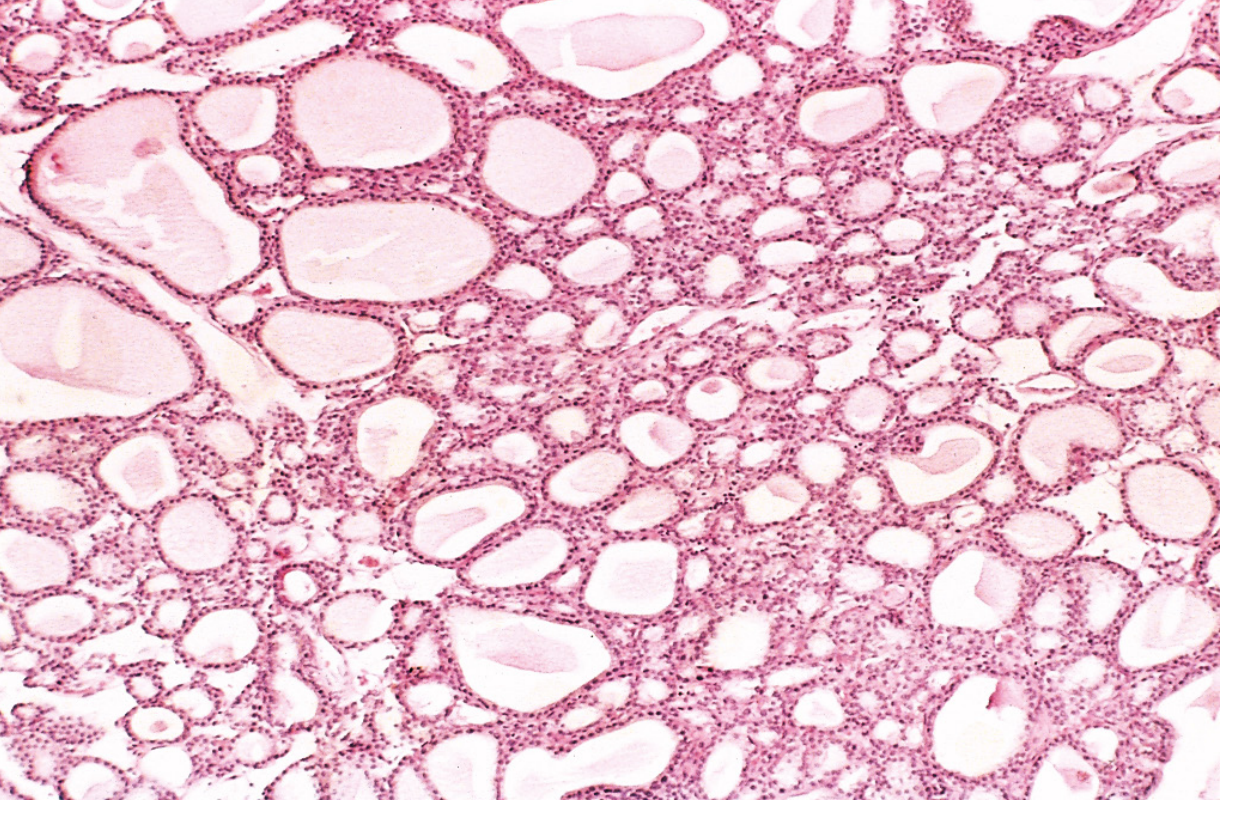
Benign tumors remain localized at their site of origin, do not invade surrounding tissue, and do not metastasize. They are generally curable by surgical excision.
Key features:
- Well-differentiated - cells closely resemble their normal tissue of origin, both morphologically and functionally
- Slow growth - mitoses are rare and of normal configuration
- Encapsulated - usually surrounded by a fibrous capsule, clearly demarcating them from surrounding tissue
- Non-invasive - pushing borders, not infiltrating
- No metastasis
- Usually not fatal - exceptions occur when located in critical areas (e.g., a benign brain tumor can still be life-threatening due to mass effect)
Histologic example:
2. Malignant Tumors (Cancer)
Malignant tumors can invade adjacent structures and spread to distant sites (metastasize). They are collectively referred to as "cancers," derived from the Latin word for crab - reflecting their tendency to adhere to and grasp surrounding tissue.
Key features:
- Variable differentiation - from well-differentiated to poorly differentiated (anaplastic)
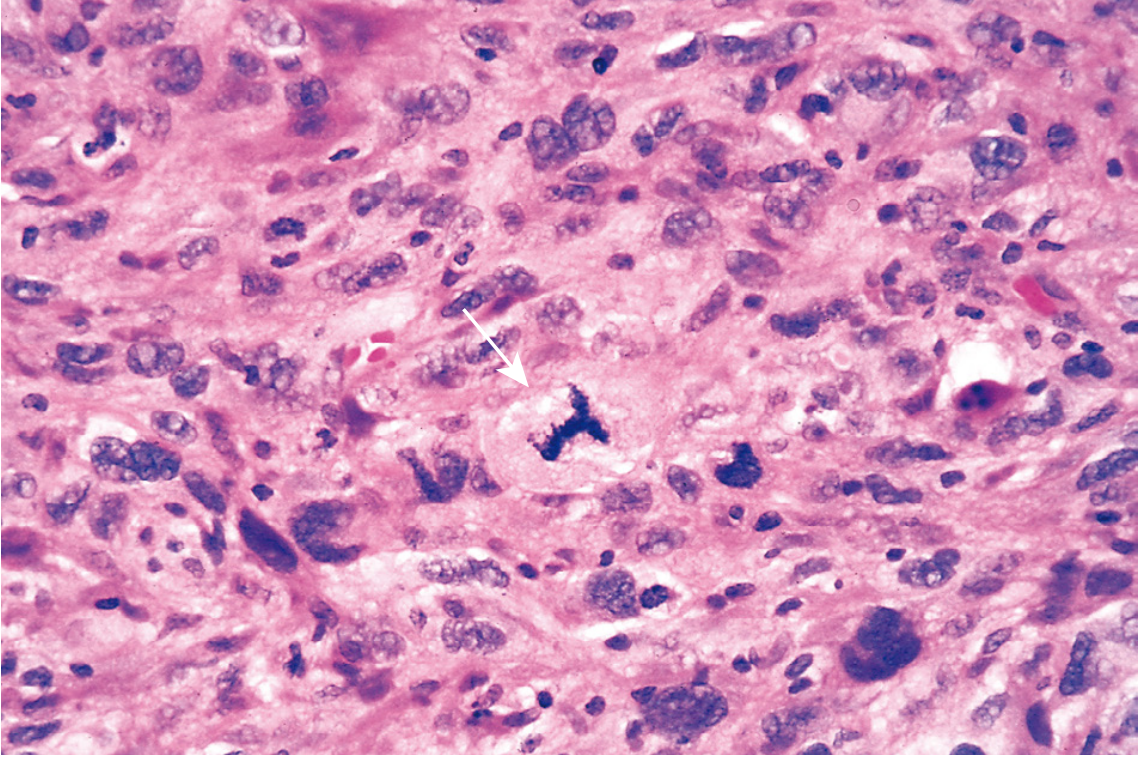
- Anaplasia - loss of differentiation; reliable indicator of malignancy. Features include:
- Pleomorphism - variation in cell size and shape
- Abnormal nuclear morphology - large, hyperchromatic nuclei; increased nuclear:cytoplasm ratio (approaches 1:1 vs normal 1:4 to 1:6); irregular nuclear shape
- Abnormal mitoses - atypical, bizarre mitotic figures (tripolar, quadripolar spindles)
- Loss of polarity - disorganized cell arrangement relative to each other and basement membranes
- Tumor giant cells - single huge polymorphic nucleus or multiple large hyperchromatic nuclei
- Invasive - infiltrating, irregular borders; destroys adjacent tissue
- Metastasis - spread via lymphatics, blood vessels, or body cavities
- Areas of necrosis - due to rapid growth outpacing vascular supply
Histologic example:
3. Borderline / Intermediate Tumors
Some tumors occupy an uncertain middle ground - they show features of both benign and malignant behavior but do not clearly fit either category. They are called borderline, low malignant potential, or intermediate-grade tumors.
- Show nuclear abnormalities and mitotic activity exceeding benign tumors but lack frank stromal invasion
- Classic example: borderline epithelial tumors of the ovary (serous borderline tumor / tumor of low malignant potential)
- Behavior is unpredictable - they may recur locally or, rarely, metastasize
Comparison Table: Benign vs. Malignant
| Feature | Benign | Malignant |
|---|---|---|
| Differentiation | Well-differentiated | Variable; may be anaplastic |
| Growth rate | Slow | Usually rapid; may vary |
| Encapsulation | Often encapsulated | Rarely encapsulated |
| Local invasion | No - expansile, pushing | Yes - infiltrating |
| Metastasis | Never | Often (hallmark feature) |
| Mitoses | Rare, normal | Frequent, often atypical |
| Nuclear features | Normal | Pleomorphism, hyperchromasia |
| Necrosis | Rare | Common (rapidly growing tumors) |
| Recurrence after excision | Rare | More common |
| Effect on patient | Usually non-fatal | Often fatal if untreated |
Nomenclature Summary by Tissue of Origin
| Tissue | Benign | Malignant |
|---|---|---|
| Fibrous tissue | Fibroma | Fibrosarcoma |
| Fat | Lipoma | Liposarcoma |
| Cartilage | Chondroma | Chondrosarcoma |
| Bone | Osteoma | Osteosarcoma |
| Blood vessels | Hemangioma | Angiosarcoma |
| Smooth muscle | Leiomyoma | Leiomyosarcoma |
| Striated muscle | Rhabdomyoma | Rhabdomyosarcoma |
| Squamous epithelium | Squamous cell papilloma | Squamous cell carcinoma |
| Glandular epithelium | Adenoma | Adenocarcinoma |
| Melanocytes | Nevus | Melanoma |
| Hematopoietic cells | - | Leukemia |
| Lymphoid tissue | - | Lymphoma |
| Placenta | Hydatidiform mole | Choriocarcinoma |
Note on exceptions: Some malignant tumors carry names ending in -oma (misleadingly suggesting benign): lymphoma, melanoma, mesothelioma, and seminoma are all malignant. These exceptions are firmly entrenched in medical terminology.
Sources: Robbins, Cotran & Kumar - Pathologic Basis of Disease; Robbins & Kumar Basic Pathology (Robbins Pathology)
Define genes, write the difference between tumor suppressor gene and oncogenes.
A gene is a segment of DNA that encodes a functional product (usually a protein). Oncogenes are mutated/overactive versions of normal growth-promoting genes (proto-oncogenes) that drive uncontrolled cell proliferation. Tumor suppressor genes normally restrain cell growth; when both copies are inactivated, the brake on proliferation is lost.
Searching sources...
Finding Sources
Searching the Web
oncogenes vs tumor suppressor genes differences mechanisms cancer pathology
Reading File
Reading File
Finding Sources
Finding Sources
Reading File
Reading File
Finding Sources
Reading File
Finding Sources
Finding Sources
Reading File
Reading File
I now have comprehensive textbook material. Let me also quickly fetch the signal transduction diagram for visual enrichment.
Loading Image
I now have everything needed for a thorough, well-sourced answer. Here it is:
Genes, Oncogenes, and Tumor Suppressor Genes
1. Definition of a Gene
A gene is the fundamental unit of heredity - a specific sequence of DNA (deoxyribonucleic acid) that encodes a functional product, most commonly a protein. Genes regulate every aspect of cell structure, function, growth, differentiation, and death.
Key points:
- Humans have approximately 20,000–25,000 protein-coding genes, located on 23 pairs of chromosomes.
- DNA exists as a double helix held together by complementary base pairing (A-T, G-C).
- Each gene has two copies called alleles - one inherited from each parent.
- Gene expression follows the central dogma: DNA → mRNA (transcription) → Protein (translation).
- Mutations (changes in DNA sequence) can alter gene function - the foundation of cancer biology.
2. Oncogenes
Definition
An oncogene is a mutated, overactive form of a normal cellular gene called a proto-oncogene. Proto-oncogenes are normal genes that positively regulate cell growth, proliferation, survival, and differentiation. When a proto-oncogene is mutated or overexpressed, it becomes an oncogene - driving uncontrolled cell division.
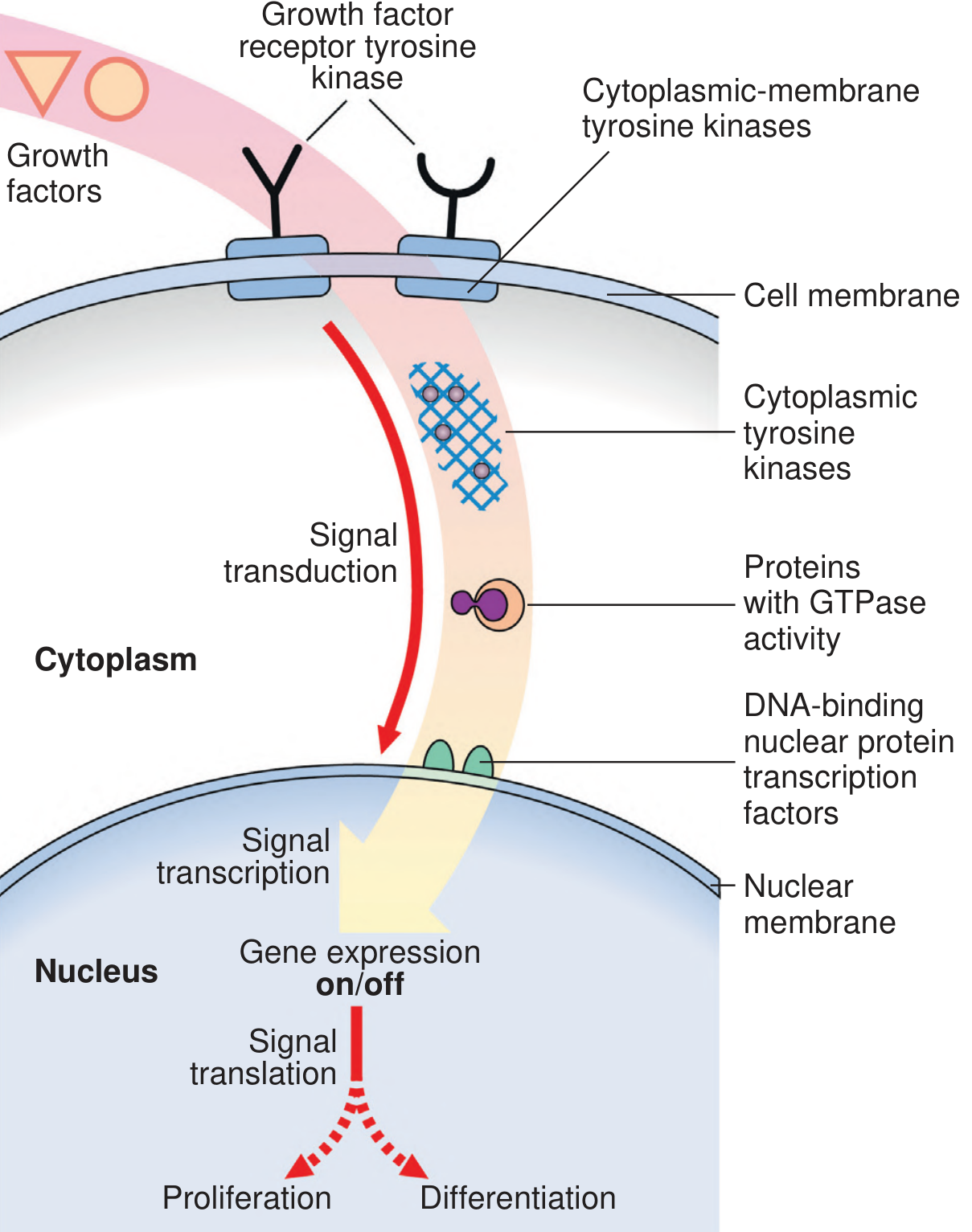
"Proto-oncogenes encode growth factors, growth factor receptors, signal transducers, transcription factors, or cell cycle components. The corresponding oncogenes encode oncoproteins with functions like their normal counterparts, with the important difference that they are usually constitutively active and thereby relieve cells of their normal dependency on growth factors."
- Robbins, Cotran & Kumar - Pathologic Basis of Disease
How Proto-oncogenes Become Oncogenes
| Mechanism | Example |
|---|---|
| Point mutation | RAS mutations in 15-20% of all human tumors (90% of pancreatic cancer) |
| Gene amplification | MYC amplification in neuroblastoma; HER2/ERBB2 in breast/gastric cancer |
| Chromosomal translocation | BCR-ABL fusion in chronic myeloid leukemia (CML); MYC in Burkitt lymphoma |
| Insertional mutagenesis | Viral promoter activates nearby proto-oncogene |
Genetic behavior
- Dominant - only one mutated allele is sufficient to drive oncogenesis (gain-of-function)
- The normal allele cannot compensate for the hyperactive mutant
Types of Oncogene Products (Proto-oncogene categories)
| Category | Function | Examples |
|---|---|---|
| Growth factors | Stimulate cell proliferation via receptors | SIS (PDGF-B subunit), FGF-related genes |
| Growth factor receptors | Transmit proliferative signals; have tyrosine kinase domains | ERBB (EGFR), ERBB2/HER2, KIT, PDGFRA |
| Signal transducers | Relay signals from membrane to nucleus via GTPase activity | RAS (HRAS, KRAS, NRAS), BRAF |
| Transcription factors | Drive expression of genes needed for cell cycle entry | MYC, FOS, JUN |
| Cell cycle regulators | Promote cell cycle progression | Cyclin D1, CDK4 |
3. Tumor Suppressor Genes (TSGs)
Definition
Tumor suppressor genes are normal genes that negatively regulate cell proliferation, promote DNA repair, and trigger apoptosis when needed. They act as "brakes" on the cell cycle. Loss of both functional alleles removes this brake, allowing uncontrolled growth.
"The products of most tumor suppressor genes act as negative regulators of cell proliferation, and loss of their function therefore leads to excessive growth. Tumor suppressor proteins control a series of checkpoints that prevent uncontrolled growth."
- Robbins, Cotran & Kumar - Pathologic Basis of Disease
Knudson's "Two-Hit" Hypothesis
Loss of TSG function typically requires mutations on both alleles (both copies must be inactivated):
- First hit - mutation/deletion of one allele (may be germline/inherited or somatic)
- Second hit - loss or mutation of the remaining normal allele (somatic event)
This explains why:
- Familial cases (e.g., familial retinoblastoma) - inherit one defective allele; only one somatic hit needed → earlier, bilateral tumors
- Sporadic cases - both hits must occur somatically → later, usually unilateral tumors
Mechanisms of TSG Inactivation
| Mechanism | Description |
|---|---|
| Homozygous gene deletion | Both alleles deleted |
| Point mutation + loss of second allele | One allele mutated, other lost (LOH) |
| Epigenetic silencing | Promoter methylation silencing one or both alleles |
| miRNA-mediated translational silencing | Post-transcriptional suppression |
| Dominant-negative mutation | Mutant protein inhibits the normal protein (e.g., TP53 dimers) |
| Haploinsufficiency | Loss of one allele produces insufficient protein (e.g., CDKN1B/p27) |
Key Tumor Suppressor Genes
| Gene | Protein | Function | Associated Cancer |
|---|---|---|---|
| RB1 | pRb | Cell cycle checkpoint (G1/S); first TSG discovered | Retinoblastoma, osteosarcoma |
| TP53 | p53 ("Guardian of the genome") | DNA damage response; cell cycle arrest, senescence, apoptosis | Most common mutated gene in human cancer (~50% of all cancers) |
| APC | APC protein | Wnt/β-catenin pathway regulator | Colorectal cancer |
| BRCA1/BRCA2 | BRCA1/2 | DNA double-strand break repair | Breast, ovarian cancer |
| CDKN2A | p16 (INK4a) | CDK4/CDK6 inhibitor | Melanoma, pancreatic cancer |
| NF1 | Neurofibromin | RAS-GAP (negatively regulates RAS) | Neurofibromatosis type 1 |
| VHL | VHL protein | Regulates hypoxia-inducible factors | Renal cell carcinoma |
p53 and MDM2: In unstressed cells, p53 has a short half-life (~20 min) because MDM2 targets it for destruction. DNA damage activates kinases (e.g., ATM) that release p53 from MDM2, stabilizing it to activate hundreds of target genes that induce cell cycle arrest, senescence, or apoptosis.
4. Key Differences: Oncogenes vs. Tumor Suppressor Genes
| Feature | Oncogenes | Tumor Suppressor Genes |
|---|---|---|
| Normal counterpart | Proto-oncogene (promotes growth) | Tumor suppressor gene (inhibits growth) |
| Effect on cell growth | Accelerates / promotes proliferation | Inhibits / brakes proliferation |
| Type of mutation | Gain-of-function | Loss-of-function |
| Alleles required | Only 1 mutant allele (dominant) | Both alleles must be inactivated (recessive) |
| Analogy | "Accelerator pedal stuck in the ON position" | "Brake pedal cut" |
| Mechanism | Constitutively active signaling | Loss of growth checkpoints, impaired DNA repair, impaired apoptosis |
| Examples | RAS, MYC, HER2/ERBB2, BRAF, BCR-ABL | RB1, TP53, APC, BRCA1/2, VHL, CDKN2A |
| Inheritance in cancer | Generally not inherited (somatic) | Can be inherited (germline first hit → familial cancer syndromes) |
| Cancer types | Any carcinoma/sarcoma with activating mutations | Hereditary cancer syndromes + sporadic cancers |
Key Concept: Cancer generally requires both mechanisms - oncogene activation to press the accelerator, and tumor suppressor gene inactivation to cut the brakes. This is why carcinogenesis is a multi-step process requiring accumulation of multiple genetic "hits" over time.
Sources: Robbins, Cotran & Kumar - Pathologic Basis of Disease; Thompson & Thompson Genetics and Genomics in Medicine; Emery's Elements of Medical Genetics; Campbell Walsh Wein Urology
This is a shared conversation. Sign in to Orris to start your own chat.