
Make a note on Brachial artery
Reading File
Now let me search the medical library for brachial artery content in parallel:
Finding Sources
Finding Sources
Excellent results. Now let me read the key sections in parallel:
Reading File
Reading File
Reading File
Now let me read the Fischer's Surgery section on brachial artery and the clinical procedures section, plus grab the course of the artery section:
Reading File
Reading File
Reading File
Now let me fetch the key anatomical diagram and also read the brachial artery injury section:
Loading Image
Loading Image
Reading File
I now have rich, comprehensive content from multiple authoritative textbooks. Let me compile the full note.
Brachial Artery - Anatomy & Clinical Note
Overview
The brachial artery is the major arterial supply to the arm. It is the direct continuation of the axillary artery, beginning at the inferior border of the teres major muscle, and terminates in the cubital fossa (antecubital fossa) by dividing into the radial and ulnar arteries at the level of the neck of the radius.
- Imaging Anatomy - Bones, Joints, Vessels & Nerves, p. 159
- Gray's Anatomy for Students, p. 875
Course
| Segment | Relations |
|---|---|
| Origin | Inferior border of teres major - continuation of axillary artery |
| Proximal arm | Lies on the medial side of the humerus, in the medial bicipital groove; related to the ulnar and median nerves |
| Distal arm | Courses anteriorly, moving to a position midway between the medial and lateral epicondyles |
| Cubital fossa | Lies between the biceps brachii tendon (lateral) and the median nerve (medial), covered by the bicipital aponeurosis |
| Termination | Divides into radial and ulnar arteries at the level of the neck of the radius |
Important landmark: The pulse of the brachial artery is palpable all along the ulnar border of the biceps brachii muscle throughout its course.
In the proximal arm, the artery can be compressed against the medial side of the humerus - useful for haemostasis.
- Fischer's Mastery of Surgery, 8th ed.
- THIEME General Anatomy & Musculoskeletal System, p. 408
Nerve Relations
- Proximally: Median nerve is lateral and the ulnar nerve is medial to the artery
- Distally: The median nerve crosses the brachial artery (from lateral to medial), so in the antecubital fossa it lies medial and deep to the artery
- The ulnar nerve runs alongside the superior ulnar collateral artery
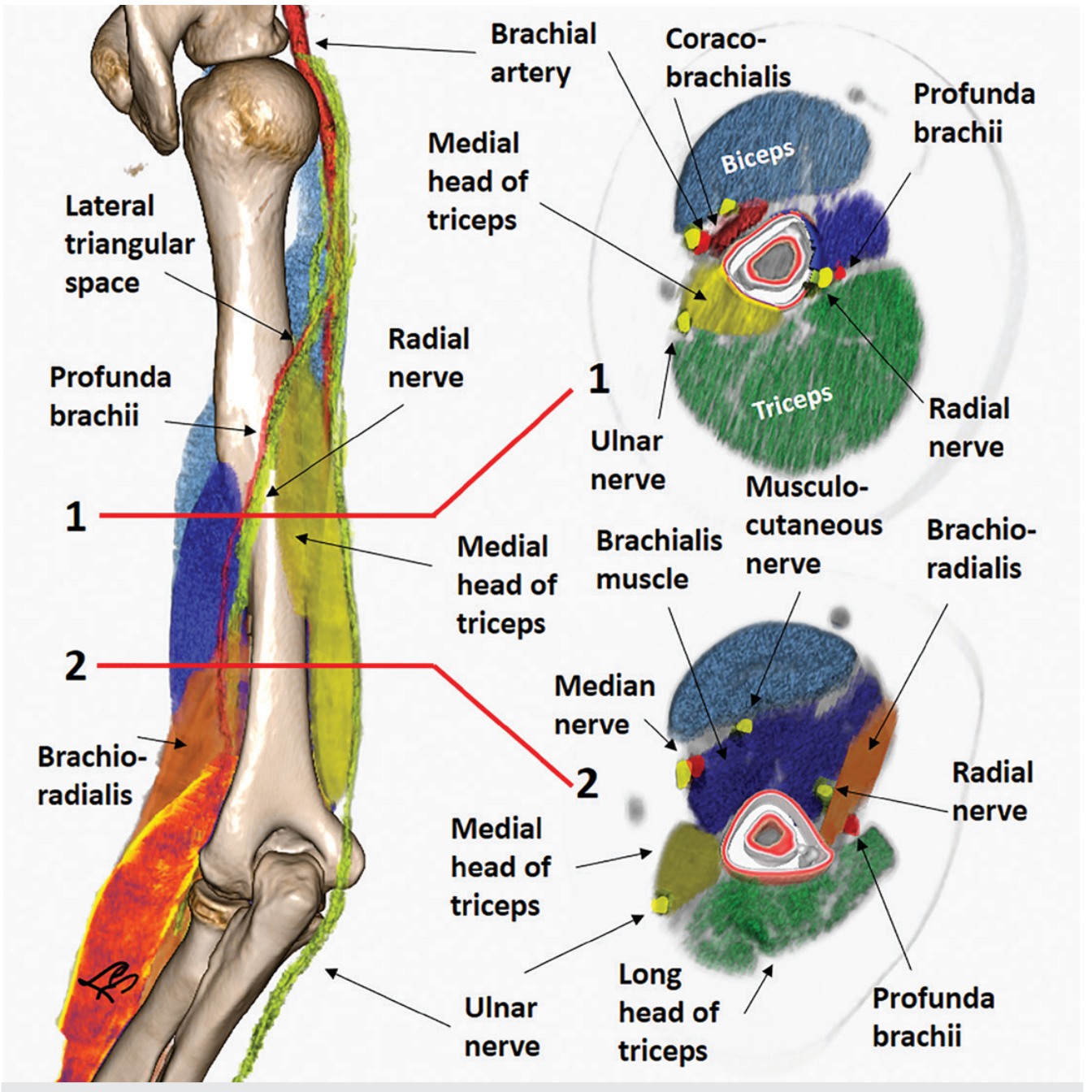
Branches
| Branch | Notes |
|---|---|
| Profunda brachii (deep brachial artery) | Largest branch; courses with the radial nerve through the triangular interval and along the radial groove on the posterior surface of the humerus; divides into the radial collateral and middle collateral arteries - contributes to arterial anastomosis around the elbow |
| Superior ulnar collateral artery | Runs with the ulnar nerve; anastomoses with the posterior ulnar recurrent artery at the elbow |
| Inferior ulnar collateral artery | Contributes to elbow anastomosis |
| Nutrient arteries | Pass through the anteromedial surface of the humeral shaft |
| Muscular branches | Supply adjacent muscles |
Branches of the brachial artery (listed):
-
Deep artery of the arm (profunda brachii)
-
Radial collateral artery
-
Medial collateral artery
-
Superior ulnar collateral artery
-
Inferior ulnar collateral artery
-
THIEME General Anatomy & Musculoskeletal System
-
Gray's Anatomy for Students, p. 876
Anastomosis Around the Elbow
The brachial artery and its branches form an important arterial anastomosis around the elbow joint through:
- Radial and middle collateral arteries (from profunda brachii) + radial recurrent artery
- Superior and inferior ulnar collateral arteries + ulnar recurrent arteries
Clinical implication: The brachial artery can be ligated safely distal to the origin of the profunda brachii (e.g., to control post-traumatic haemorrhage) because the elbow anastomosis can establish adequate collateral circulation.
Variations
- Superficial brachial artery (4-12%): Courses superficial to (instead of deep to) the median nerve. More vulnerable to injury due to its superficial location.
- High division (~20-25%): The artery bifurcates early in the arm, before the cubital fossa:
- High-branching radial artery (~10%)
- High-branching ulnar artery (~3%)
- Both radial and ulnar arise from brachial, with brachial continuing as common interosseous (~7%)
- Duplicated brachial artery (rare): The axillary artery bifurcates into superficial and deep branches
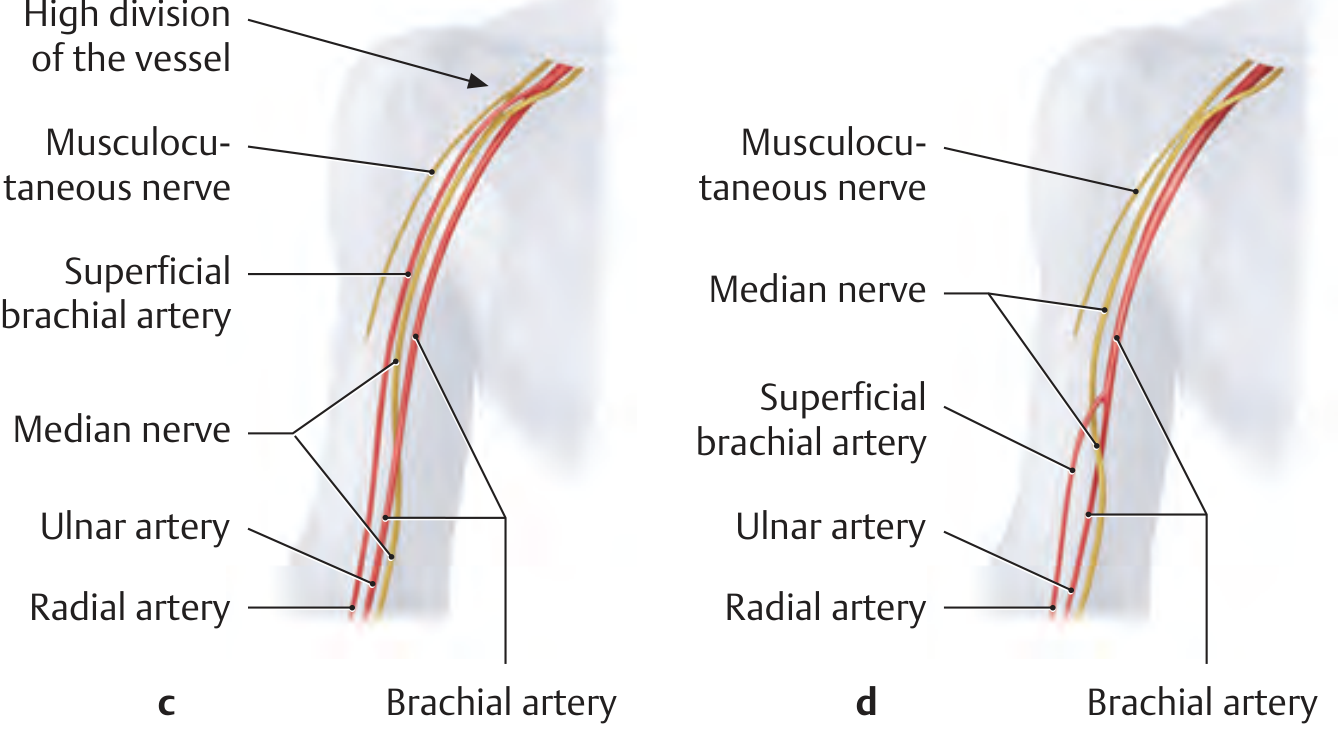
- Imaging Anatomy - Bones, Joints, Vessels & Nerves, p. 159
- Fischer's Mastery of Surgery, 8th ed.
Clinical Significance
1. Blood Pressure Measurement
The brachial artery is the standard site for BP measurement. A sphygmomanometer cuff compresses the brachial artery against the humerus. A stethoscope placed over the artery in the cubital fossa detects Korotkoff sounds - the thumping becomes audible as cuff pressure falls below systolic (>120 mmHg) and disappears at diastolic pressure. Normal range: 90-120 / 60-80 mmHg.
- Gray's Anatomy for Students, p. 876
2. Arterial Puncture / Cannulation
The brachial artery in or just proximal to the antecubital fossa is used when radial or axillary access is unavailable. However:
-
Lacks the collateral circulation advantage of the wrist (radial + ulnar dual supply)
-
Higher risk of ischaemic complications compared to radial artery
-
Requires arm maintained in extension
-
Needs a longer catheter (10 cm) to span the elbow joint
-
Safe cannulation has been demonstrated; one study of >3,000 catheterisations over 3 years found only one minor thrombotic complication
-
Roberts and Hedges' Clinical Procedures in Emergency Medicine
3. Brachial Artery Injury
-
Accounts for 14-30% of all arterial injuries and up to 60% of upper extremity arterial injuries
-
Proximal control: Manual compression of the artery against the humerus
-
Surgical approach: Longitudinal incision in the palpable groove on the medial side of the upper arm between biceps and triceps
-
The bicipital aponeurosis must be divided distally to expose the artery
-
Injuries distal to the profunda brachii origin may or may not cause critical ischaemia depending on the degree of collateral circulation damage
-
Low-velocity injuries: primary repair possible
-
High-velocity / blunt injuries: require more extensive reconstruction; spatulated anastomosis required to prevent narrowing
-
Fischer's Mastery of Surgery, 8th ed.
4. Supracondylar Fracture of the Humerus
The brachial artery is at risk of injury with supracondylar fractures in children, as it lies immediately anterior to the distal humerus in the cubital fossa. This is a surgical emergency requiring urgent assessment of distal pulses, capillary refill, and hand perfusion.
Summary Diagram (Cross-section, arm)
| Lateral | Medial |
|---|---|
| Musculocutaneous nerve | Ulnar nerve |
| Biceps brachii | Triceps brachii |
| Brachioradialis (distally) | Medial head of triceps |
| Radial nerve (posterior) | Brachial artery |
| Median nerve (crosses distally) | |
| Basilic vein |
Sources: Gray's Anatomy for Students; Imaging Anatomy Vol. 3 - Bones, Joints, Vessels & Nerves; THIEME General Anatomy & Musculoskeletal System; Fischer's Mastery of Surgery, 8th ed.; Roberts and Hedges' Clinical Procedures in Emergency Medicine
Systemic anatomy book
Asking for Preferences
What would you like to do with a systemic anatomy book?
Finding Sources
Here are the anatomy books available in the library:
Anatomy Books in the Library
General / Systemic Anatomy
| # | Title | ISBN |
|---|---|---|
| 1 | Gray's Anatomy for Students | 9780323934237 |
| 2 | General Anatomy and Musculoskeletal System (THIEME Atlas of Anatomy) | 9781626237186 |
| 3 | Netter's Atlas of Human Anatomy | 9780323547048 |
Color Atlases (THIEME - Sobotta series)
| # | Title | ISBN |
|---|---|---|
| 4 | Color Atlas of Human Anatomy Vol. 1 (Locomotor System) | 9783132424432 |
| 5 | Color Atlas of Human Anatomy Vol. 2 (Internal Organs) | 9783132424487 |
| 6 | Color Atlas of Human Anatomy Vol. 3 (Nervous System & Sensory Organs) | 9783132424517 |
Imaging & Ultrasound Anatomy
| # | Title | ISBN |
|---|---|---|
| 7 | Color Atlas of Ultrasound Anatomy, 3e | 9783132422049 |
| 8 | Imaging Anatomy Vol. 3 - Bones, Joints, Vessels & Nerves | 9781626239845 |
Neuroanatomy
| # | Title | ISBN |
|---|---|---|
| 9 | Neuroanatomy through Clinical Cases, 3rd Edition | 9781605359625 |
The most widely used for systemic/regional anatomy are Gray's Anatomy for Students and the THIEME Atlas series. For visual learners, Netter's Atlas and the Color Atlas (Sobotta) volumes are excellent references. Just let me know which book or topic you'd like to explore and I'll pull the relevant sections for you.
This is a shared conversation. Sign in to Orris to start your own chat.