
How to read a cardiotocography easily
I'll start with a quick overview while I pull detailed information from the medical library.
CTG (cardiotocography) reads two things simultaneously: the fetal heart rate (FHR) and uterine contractions. The classic mnemonic is DR C BRAVaDO - use it to systematically assess every trace. Key features are baseline rate, variability, accelerations, and decelerations, interpreted against the contraction pattern.
Searching sources...
Reading File
Now let me search the library for CTG content in parallel:
Finding Sources
Searching the Web
how to read cardiotocography CTG interpretation guide DR C BRAVaDO
Finding Sources
Reading Web Page
https://geekymedics.com/how-to-read-a-ctg
Now let me pull the detailed textbook content on FHR monitoring patterns:
Reading File
Finding Sources
Finding Sources
Reading File
Reading File
Reading File
Loading Image
Loading Image
Reading File
I now have excellent content from the medical textbooks and web sources. Let me compile a thorough, well-organized answer.
How to Read a CTG (Cardiotocography)
A CTG records two things simultaneously on the same paper strip:
- Upper channel (FHR): Fetal heart rate in bpm - the wavy line you interpret
- Lower channel (UC): Uterine contractions - shown as hills/peaks
The paper runs at 3 cm/minute (standard). Each large square = 1 minute.
The Mnemonic: DR C BRaVADO
Work through every CTG in this order - never skip steps.
| Letter | Stands For | What to Do |
|---|---|---|
| DR | Define Risk | Is this a high-risk or low-risk pregnancy? (affects threshold for action) |
| C | Contractions | Count contractions per 10 minutes |
| BRa | Baseline Rate | What is the average FHR? |
| V | Variability | How much does the FHR fluctuate around the baseline? |
| A | Accelerations | Are there any heart rate spikes? |
| D | Decelerations | Are there dips in FHR, and what type are they? |
| O | Overall impression | Normal / Suspicious / Pathological / Needs urgent action |
Step 1 - Define Risk (DR)
Before you even look at the trace, ask: what clinical context am I reading this in?
High-risk features that lower your threshold for concern:
- Pre-eclampsia, diabetes, IUGR/FGR
- Prolonged pregnancy (>41 weeks), VBAC, multiple pregnancy
- Maternal medications (opioids, magnesium sulphate can alter the trace)
- Meconium-stained liquor, antepartum haemorrhage
Step 2 - Contractions (C)
Count peaks on the lower channel in any 10-minute window.
- Normal: up to 5 contractions per 10 minutes
- Tachysystole (hyperstimulation): >5 contractions per 10 minutes - this can cause fetal compromise by reducing uteroplacental perfusion time
Step 3 - Baseline Rate (BRa)
The mean FHR rounded to 5 bpm, assessed over a 10-minute window, excluding accelerations and decelerations.
| Category | Rate |
|---|---|
| Normal (reassuring) | 110-160 bpm |
| Non-reassuring (bradycardia) | 100-109 bpm |
| Abnormal | <100 bpm or >160 bpm |
- Tachycardia (>160 bpm): fever, chorioamnionitis, fetal anaemia, maternal drugs (betamimetics), fetal hypoxia
- Bradycardia (<110 bpm): cord prolapse, abruption, maternal hypotension, post-epidural, prolonged deceleration
Step 4 - Variability (V)
This is arguably the most important feature. It reflects normal autonomic nervous system function and is a sign the fetus is not acidotic.
Variability = the bandwidth of fluctuation around the baseline (measure the amplitude of the oscillations in bpm).
| Category | Amplitude | Meaning |
|---|---|---|
| Reassuring | 5-25 bpm | Normal, active fetal CNS |
| Non-reassuring | <5 bpm for 30-50 min | Suspicious; could be fetal sleep, opioids, or early hypoxia |
| Abnormal | <5 bpm for >50 min OR >25 bpm (saltatory) | Requires urgent review |
Causes of reduced variability: fetal sleep cycle (most common, lasts ~20-40 min), opioids, magnesium sulphate, fetal acidosis/hypoxia, extreme prematurity.
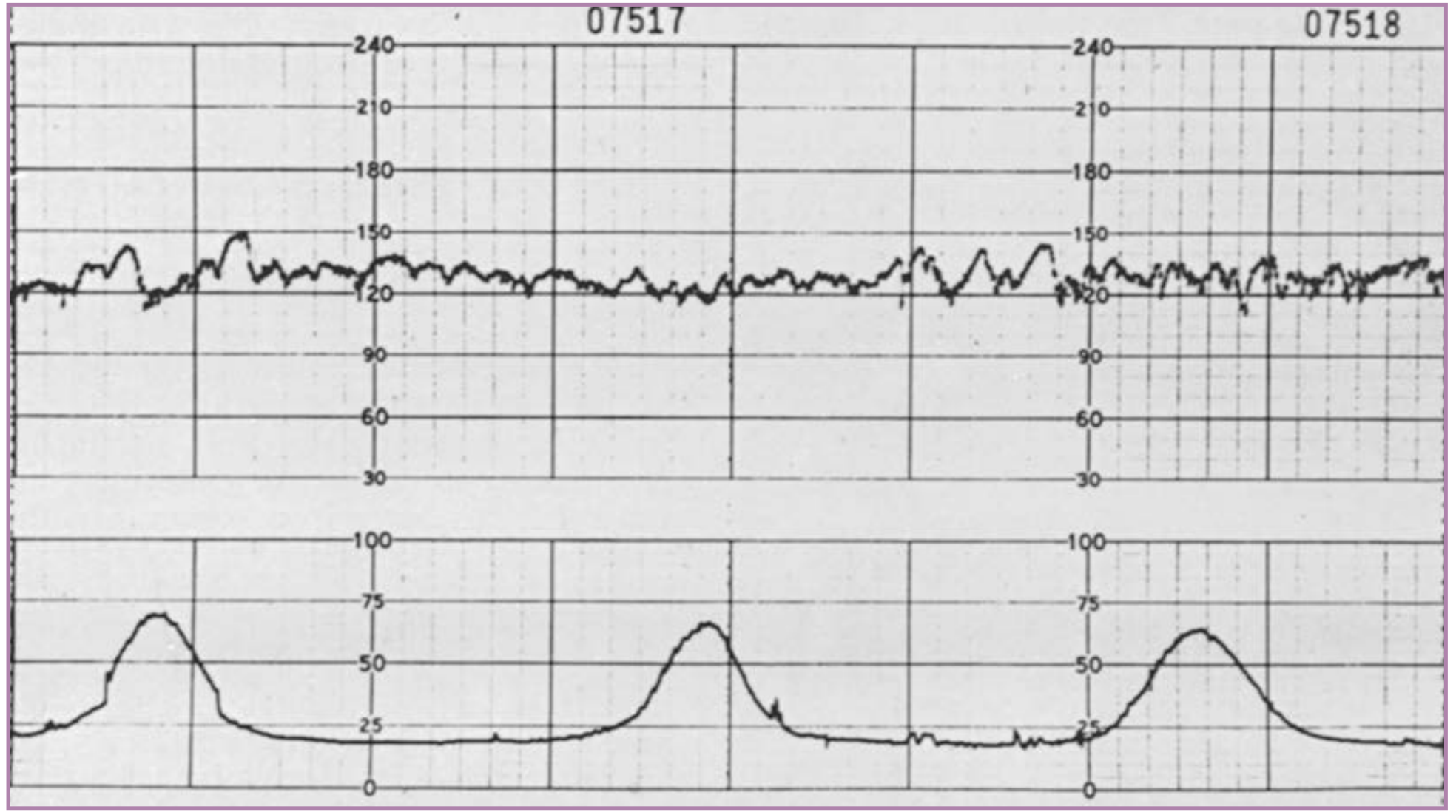
The normal CTG below shows a baseline ~120-130 bpm with good variability (5-25 bpm oscillations) and regular contractions:
Step 5 - Accelerations (A)
An acceleration = abrupt rise in FHR of ≥15 bpm above baseline, lasting ≥15 seconds (but <2 minutes), occurring in <30 seconds from onset to peak.
- Presence of accelerations = reassuring - almost always indicates absence of fetal acidaemia at that moment
- Two or more accelerations in 20 minutes = reactive (non-stress test positive)
- Absence of accelerations alone is not necessarily abnormal, but combined with other features becomes significant
For preterm fetuses (<32 weeks), smaller criteria apply: ≥10 bpm rise lasting ≥10 seconds.
Step 6 - Decelerations (D)
This is where most clinical decisions are made. There are three main types, defined by their timing relative to contractions:
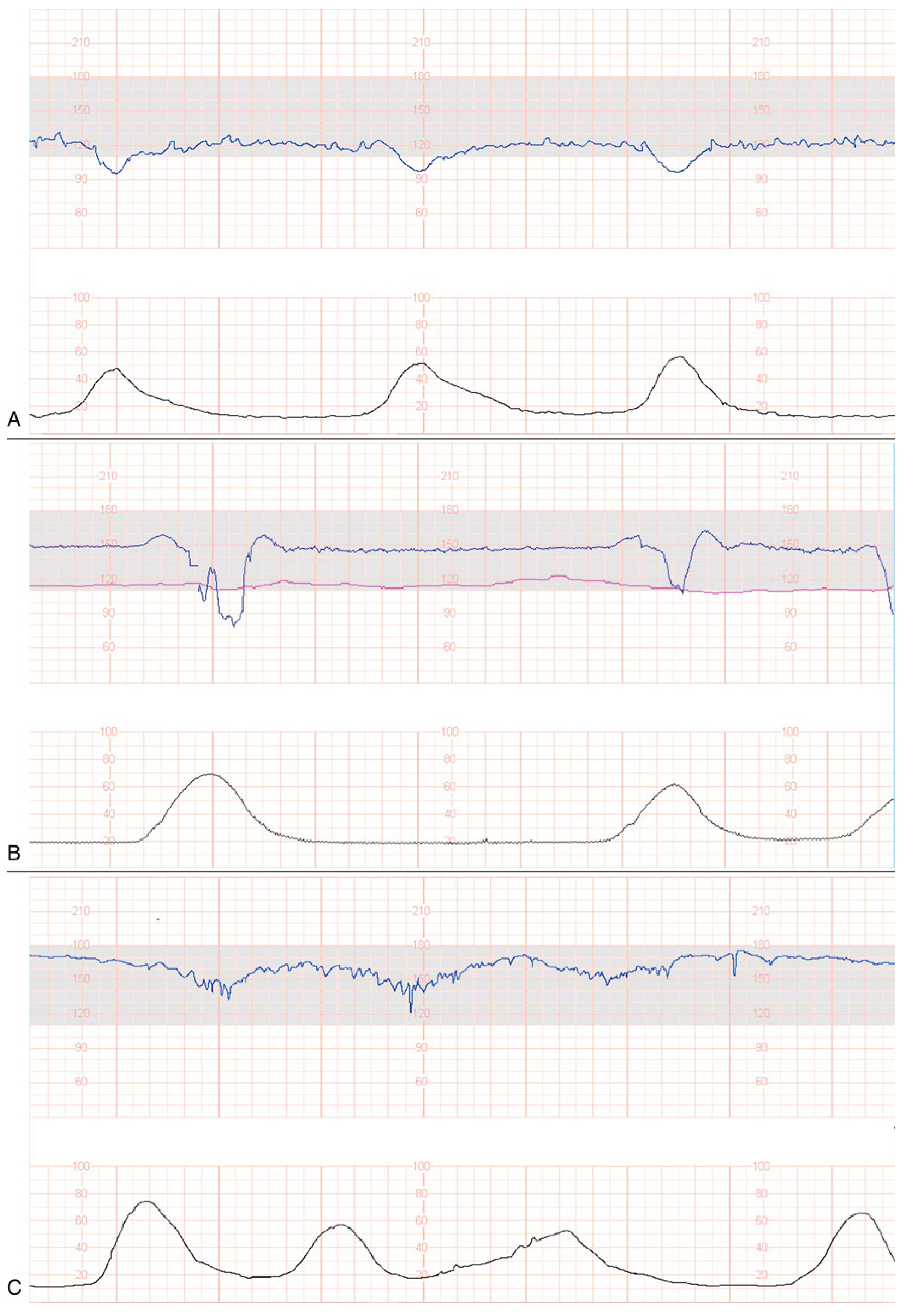
Early Decelerations (Panel A above)
- Timing: Mirror the contraction - onset, nadir and recovery match the beginning, peak and end of contraction
- Mechanism: Vagal reflex from fetal head compression
- Significance: Benign - not associated with hypoxia or acidosis
- Shape: Uniform, gradual, symmetric
Variable Decelerations (Panel B above)
- Timing: Variable - onset, depth and duration change with each contraction
- Mechanism: Umbilical cord compression (most common cause)
- Significance: Common, usually benign, but concerning if: lasting >60 sec, dropping <60 bpm, slow recovery, no shoulders (biphasic pattern), reduced variability between decelerations
- Shape: Abrupt fall (<30 sec from onset to nadir), V-shaped or W-shaped
Late Decelerations (Panel C above)
- Timing: Nadir occurs AFTER the peak of the contraction; onset, nadir and recovery are all delayed
- Mechanism: Uteroplacental insufficiency causing relative fetal hypoxia; can also indicate myocardial depression
- Significance: Always concerning - even if shallow. Recurrent late decelerations = abnormal
- Key rule: If the dip starts after the contraction peaks = late = bad
Prolonged Decelerations
- FHR drops ≥15 bpm for 2-10 minutes = prolonged deceleration
- Drop lasting >3 minutes = needs urgent intervention
- Drop <70 bpm for >60 seconds = extremely ominous, especially without variability
Step 7 - Overall Impression (O)
Classify the CTG using NICE 2017 categories:
| Category | Criteria | Action |
|---|---|---|
| Normal | All features reassuring | Continue monitoring |
| Suspicious | 1 non-reassuring feature | Review, consider further assessment |
| Pathological | 2+ non-reassuring OR 1 abnormal feature | Urgent review, consider conservative measures or delivery |
| Needs urgent action | Acute bradycardia or prolonged deceleration >3 min | Immediate intervention |
The three-tier NICHD system used in the US categorises as:
- Category I (normal): baseline 110-160, moderate variability, no late/variable decels, accelerations may or may not be present
- Category II (indeterminate): all tracings not I or III - continue monitoring, reassess
- Category III (abnormal): sinusoidal pattern, OR absent variability WITH late/variable decels or bradycardia - requires prompt intervention
(Miller's Anesthesia, 10e; Creasy & Resnik's Maternal-Fetal Medicine)
Quick Reference: Red Flags on a CTG
| Feature | Red Flag Finding |
|---|---|
| Baseline | <100 or >160 bpm |
| Variability | <5 bpm for >50 min |
| Accelerations | Absent after fetal stimulation |
| Decelerations | Late decelerations (any depth), variable decels lasting >60 sec or dropping <60 bpm, prolonged decel >3 min |
| Pattern | Sinusoidal pattern (smooth sine wave 5-15 bpm amplitude) = severe fetal anaemia |
| Contractions | >5 in 10 min (hyperstimulation) |
A Practical Memory Tip for Decelerations
"Early = OK, Variable = Maybe, Late = Late for lunch (bad)"
Or put spatially:
- Early dip mirrors the contraction hill - same shape, same time
- Variable dip is unpredictable - changes shape and timing each time
- Late dip lags behind - the heart rate only drops after the contraction peaks
Sources: Creasy & Resnik's Maternal-Fetal Medicine (Principles and Practice), Miller's Anesthesia 10e, Rosen's Emergency Medicine; Geeky Medics CTG guide; Zero to Finals CTG
This is a shared conversation. Sign in to Orris to start your own chat.