
Bisgard regime for management of venous ulcer R
The Bisgaard regime (note: spelled "Bisgaard") is a conservative management protocol for venous leg ulcers combining compression, exercise, and skin care.
Searching sources...
Reading File
Finding Sources
Searching the Web
Bisgaard regime venous ulcer management components
Finding Sources
Reading Web Page
https://www.wikidoc.org/index.php/Venous_ulcer
Reading File
Finding Sources
I have enough information to provide a thorough answer. Let me also fetch the varicose ulcer image from the textbook.
Loading Image
Bisgaard Regimen for Venous Ulcer Management
The Bisgaard regimen is a conservative, well-established protocol for managing venous leg ulcers. It is best remembered by the mnemonic "4 E's":
The 4 E's
1. Education
- Patient education is the foundation of the regimen
- Patients must understand the nature of chronic venous insufficiency - that it is a lifelong condition requiring ongoing self-management
- Teach the importance of limb elevation during rest, compliance with compression, daily skin inspection, and recognition of infection signs
- Education on weight reduction, regular walking, and avoidance of prolonged standing or sitting
- Poor compliance is the single biggest cause of recurrence; addressing it through education directly reduces relapse rates
2. Elevation
- The leg should be elevated above the level of the heart during rest periods to abolish the high venous pressure that underlies ulcer formation
- Bed rest with the foot elevated remains the most effective acute measure - most venous ulcers will heal rapidly under these conditions provided arterial circulation is intact (Pye's Surgical Handicraft, 22nd Ed.)
- During the day, patients should elevate the legs for 30 minutes, 3-4 times daily
- A retrospective study of 122 patients with healed venous ulcers showed statistically significantly lower recurrence rates with a combination of compression therapy and longer leg elevation times (median 33 min) (Sabiston Textbook of Surgery)
- Avoidance of dependency position (legs hanging down) is particularly important
3. Elastic (Graduated) Compression
- This is the cornerstone of active and ambulatory management
- When prolonged bed rest is not practical (most outpatient scenarios), compression elastic bandaging achieves healing by emptying the dilated superficial veins and assisting the calf muscle pump (Pye's Surgical Handicraft)
- Below-knee graduated compression is the standard approach - it counteracts reflux and venous pump failure
- Compression reduces blood vessel diameter and pressure, lowers capillary leakage, and reduces venous edema
- Also modulates the inflammatory milieu - increases release of anti-inflammatory cytokines and reduces thrombin activation
- Bandages are replaced at regular intervals until ulcer healing; after healing, the patient is fitted with a firm graduated pressure stocking to prevent recurrence
- ABI (ankle-brachial index) must be >0.8 before applying compression to rule out significant arterial disease
- Options: multilayer elastic bandaging, short-stretch (inelastic) bandaging, compression stockings (class II/III), intermittent pneumatic compression as an adjunct
4. Evaluation (Examination/Follow-up)
- Regular, structured follow-up to monitor healing progress and identify complications early
- Wound assessment at each visit: size, depth, exudate, granulation tissue, signs of infection, surrounding skin condition
- Swab for culture if infection is suspected; systemic antibiotics for secondary bacterial infection (topical antibiotics are largely avoided as they induce sensitization and can worsen the ulcer)
- Doppler/duplex ultrasound to assess venous anatomy and rule out deep venous disease - ascending venogram or ambulatory venous pressure measurements if deep venous damage is suspected
- Evaluation also includes periodic reassessment of arterial circulation (ABI) and response to conservative therapy
- If conservative management fails, surgical options are considered: ligation of incompetent perforating veins, stripping of varicosities, venous reconstruction or ablation
Additional Supportive Measures (Outside the Core 4 E's)
| Measure | Details |
|---|---|
| Wound care | Non-adherent/hydrocolloid dressings; type of dressing matters less than compression |
| Pentoxifylline | Effective adjunct to compression (Cochrane meta-analysis confirmed benefit) |
| Skin care | Emollients for surrounding dry/eczematous skin; avoid sensitizing topical agents |
| Exercise | Calf muscle pump exercises (ankle dorsiflexion/plantar flexion) |
| Artificial skin / skin grafts | For large, non-healing ulcers |
| Surgery | Perforator ligation, variceal stripping for recurrent/refractory cases |
Venous Ulcer - Clinical Image
Typical varicose ulceration with pigmentation above the medial malleolus:
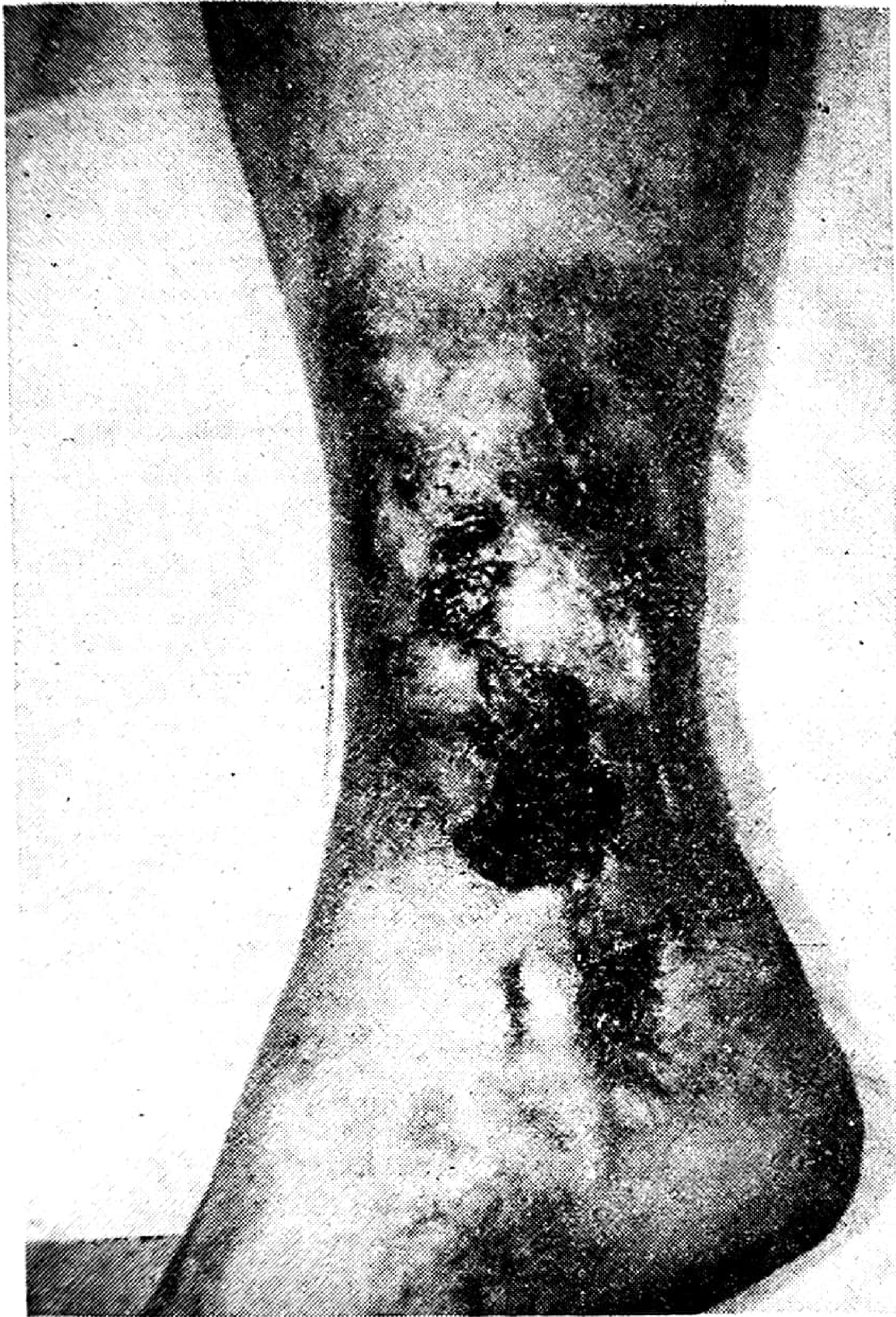
Varicose ulceration with surrounding hyperpigmentation at the gaiter area (medial malleolus) - the classic site for venous ulcers. - Pye's Surgical Handicraft, 22nd Ed.
Key Points to Remember
- The regimen targets the underlying pathophysiology - elevated venous pressure - rather than just the wound surface
- Up to 48% of venous ulcers recur within 5 years of healing; the regimen (especially compression stockings long-term) is equally important for prevention as for healing
- Antibiotics are reserved for clinically infected ulcers only - not used routinely
- Surgical intervention is considered when conservative measures fail or when large incompetent perforators/varicosities are demonstrated on imaging
This is a shared conversation. Sign in to Orris to start your own chat.