A 23-year-old patient come in OPD with complaint of nausea and 5 to 6 episodes of vomiting with blood and having vertigo mild, and vitals of the patients are 130 over 80 and saturation was 98 and the pulse rate was 84. The patient is come with vomiting with blood. What was the main correlation with having no history of, the patient having no history of alcoholism or any kind of drug-induced hypertension or no other kind of blood thinners he is consuming. The patient having blood in the vomiting. Please tell me the exact diagnose and the treatment and the drugs which are contraindicated in bleeding in vomiting

Reading File
Finding Sources
Finding Sources
Finding Sources
Reading File
Reading File
Finding Sources
Finding Sources
Reading File
Finding Sources
Finding Sources
Reading File
Searching PubMed

Mallory-Weiss syndrome hematemesis management

Loading Image
Now I have everything needed. Here is the complete, detailed clinical answer.

Diagnosis: Mallory-Weiss Syndrome (Mallory-Weiss Tear)

This is the most fitting diagnosis given the clinical picture: a young patient (23 years), multiple forceful vomiting episodes followed by blood in vomit (hematemesis), mild vertigo (from transient blood loss or vagal response), stable vitals (BP 130/80, SpO2 98%, PR 84) - and critically, NO history of alcoholism, drug-induced causes, blood thinners, or liver disease.

What Is It?

Mallory-Weiss syndrome is a longitudinal mucosal or submucosal laceration at the gastroesophageal junction (GEJ), caused by the shearing forces generated during forceful or repeated vomiting. The sequence is classic:
Repeated forceful vomiting → rise in intra-abdominal pressure → gastric contents reflux against the GEJ → the mucosa tears longitudinally → bright red hematemesis appears.
A common misconception is that retching must precede the bleed - in fact, a history of retching before hematemesis is present in only about one-third of cases (Symptom to Diagnosis, 4th ed.). In this patient's case, the non-bloody vomiting episodes (5-6 episodes) followed by hematemesis is the textbook sequence.
The absence of alcohol use, NSAIDs, liver disease, or coagulopathy makes varices, peptic ulcer disease, and erosive gastritis less likely, pointing strongly to a mechanical cause - the Mallory-Weiss tear.

Endoscopic Appearance

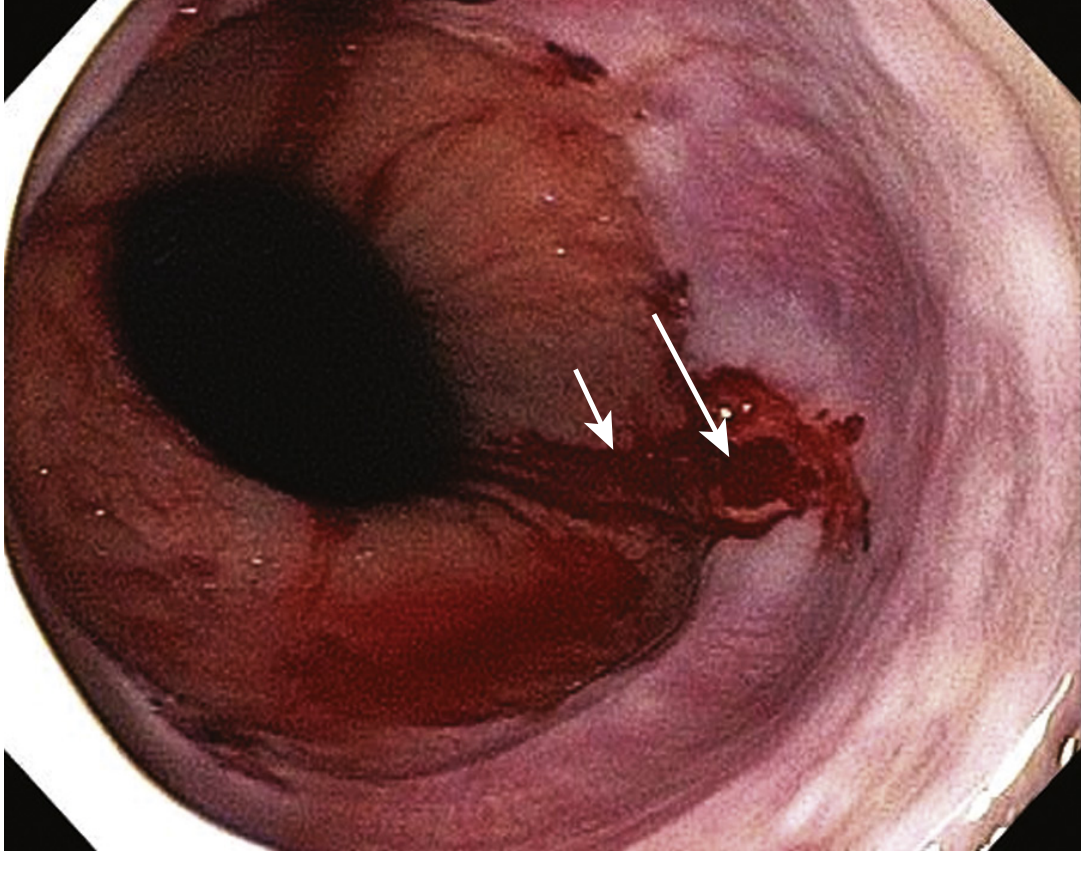
Endoscopic view of a Mallory-Weiss tear with mild oozing at the gastroesophageal junction
Endoscopic image showing a Mallory-Weiss tear - the tear starts at the GEJ (long arrow) and extends distally into the hiatal hernia sac (short arrow). (Sleisenger & Fordtran's Gastrointestinal and Liver Disease)

Pathophysiology

The tear results from the combination of:
  1. Increased intra-abdominal pressure during forceful vomiting
  2. Negative intrathoracic pressure above the diaphragm simultaneously
  3. This pressure differential shears the mucosa at the GEJ
The tear is typically single, located along the lesser curvature of the cardia, and extends a few millimeters distally. Superficial (mucosal-only) tears can begin healing within hours and heal completely within 48 hours.

Treatment

Step 1 - Stabilize and Monitor
  • IV access, blood typing and crossmatch
  • Vitals monitoring (this patient is currently stable)
  • NPO (nil by mouth)
  • Fluid resuscitation if needed
Step 2 - Pharmacological
DrugRole
IV/Oral Proton Pump Inhibitor (omeprazole, pantoprazole, esomeprazole)Accelerates mucosal healing; suppress acid to allow clot stabilization
Antiemetics (ondansetron, metoclopramide)Stop ongoing vomiting - this is critical to prevent further tearing
Tranexamic acidMay be considered if bleeding is significant (antifibrinolytic)
IV fluids / Blood transfusionIf significant blood loss (Hb monitoring needed)
Step 3 - Endoscopy (Upper GI Endoscopy)
This is the gold standard - both diagnostic and therapeutic:
  • Confirms the tear and its location
  • Rules out other co-existing lesions (peptic ulcer, varices, gastritis - found in >1/3 of cases)
  • If active bleeding is seen at endoscopy, endoscopic therapy is performed:
    • Endoscopic hemoclip placement (preferred method)
    • Epinephrine injection (1:10,000 solution)
    • Multipolar electrocoagulation (MPEC)
    • Band ligation
    • Injection of polidocanol (sclerosant)
Important: Most Mallory-Weiss tears are self-limited (bleeding stops spontaneously in the majority). The rebleeding rate is approximately 10%, and risk factors for rebleeding include shock at presentation and active bleeding seen at endoscopy.
Step 4 - If Endoscopy Fails
  • Angiographic embolization through the left gastric artery
  • Surgical intervention (very rare - last resort)
(Source: Sleisenger and Fordtran's Gastrointestinal and Liver Disease; Tintinalli's Emergency Medicine)

Drugs That Are CONTRAINDICATED or Must Be AVOIDED in This Patient

These drugs must not be given to any patient with active upper GI bleeding / hematemesis:
Drug / Drug ClassWhy Contraindicated
NSAIDs (ibuprofen, diclofenac, naproxen, ketorolac)Inhibit COX-1 → reduce prostaglandin-mediated mucosal protection → worsen mucosal injury and impair platelet aggregation → increase and worsen GI bleeding
Aspirin (all doses)Irreversibly inhibits platelet thromboxane A2 → impairs platelet plug formation at the tear site → prolongs bleeding
Anticoagulants (warfarin, heparin, enoxaparin, rivaroxaban, apixaban, dabigatran)Directly impair the coagulation cascade → prevent clot formation at the tear → uncontrollable bleeding
Antiplatelet agents (clopidogrel, ticagrelor, prasugrel)Block platelet aggregation → bleeding cannot be controlled
Thrombolytics (streptokinase, alteplase, tenecteplase)Lyse existing clots actively → catastrophic re-bleeding
Glucocorticoids (prednisolone, dexamethasone, methylprednisolone)Reduce mucosal prostaglandin synthesis → impair mucosal repair; increase risk of GI ulceration
SSRIs / SNRIs (fluoxetine, sertraline, venlafaxine)Inhibit serotonin reuptake in platelets → reduce platelet activation and aggregation → increased bleeding risk
Alcohol (ethanol)Direct mucosal toxin; induces vasodilation; impairs clotting factor synthesis - if patient ever consumes it during recovery, must be stopped
Iron / Bismuth (these are not contraindicated for bleeding, but can mask assessment - stools turn dark, mimicking melena)Note: these are diagnostic confounders, not causes of more bleeding

Why NOT Peptic Ulcer Disease?

PUD is still on the differential for any young patient with hematemesis. However, PUD:
  • Usually presents with epigastric pain preceding the bleed
  • Is strongly associated with H. pylori or NSAID use (both absent here)
  • Does not typically follow a pattern of multiple vomiting episodes followed by blood
Still, if endoscopy is done and a peptic ulcer is found, management changes (H. pylori testing, longer PPI course, biopsy).

Summary

Primary Diagnosis: Mallory-Weiss Syndrome Confirm with: Urgent upper GI endoscopy (EGD) Immediate Treatment: IV PPI (pantoprazole 40 mg IV) + antiemetic (ondansetron 4 mg IV) + NPO + IV access + endoscopy Endoscopic Hemostasis: Hemoclip or epinephrine injection if active bleeding seen Strictly Contraindicated: NSAIDs, aspirin, anticoagulants, antiplatelet drugs, thrombolytics, glucocorticoids, SSRIs/SNRIs
The prognosis in this young, hemodynamically stable patient (vitals are good: BP 130/80, SpO2 98%, PR 84) is excellent. Most tears heal within 48 hours with conservative management and a single endoscopic session.

References: Sleisenger and Fordtran's Gastrointestinal and Liver Disease; Tintinalli's Emergency Medicine: A Comprehensive Study; Symptom to Diagnosis: An Evidence-Based Guide, 4th ed.; Robbins & Cotran Pathologic Basis of Disease

A 23-year-old patient come in OPD with complaint of nausea and 5 to 6 episodes of vomiting with blood and having vertigo mild, and vitals of the patients are 130 over 80 and saturation was 98 and the pulse rate was 84. The patient is come with vomiting with blood. What was the main correlation with having no history of, the patient having no history of alcoholism or any kind of drug-induced hypertension or no other kind of blood thinners he is consuming. The patient having blood in the vomiting. Please tell me the exact diagnose and the treatment and the drugs which are contraindicated in bleeding in vomiting

This is a repeat of the previous question, which I already answered in full detail. Here is the complete answer again for reference:

Diagnosis: Mallory-Weiss Syndrome (Mallory-Weiss Tear)

This is the most fitting diagnosis given the clinical picture: a young patient (23 years), multiple forceful vomiting episodes (5-6) followed by blood in vomit (hematemesis), mild vertigo (from transient blood loss/vagal response), stable vitals (BP 130/80, SpO2 98%, PR 84) - and critically, NO history of alcoholism, NSAIDs, blood thinners, or liver disease.

What Is It?

Mallory-Weiss syndrome is a longitudinal mucosal/submucosal laceration at the gastroesophageal junction (GEJ), caused by shearing forces during forceful or repeated vomiting.
The classic sequence:
Repeated forceful vomiting → rise in intra-abdominal pressure → stomach herniates against the diaphragm → GEJ mucosa tears → bright red hematemesis appears after initially non-bloody vomiting
This patient's story (5-6 non-bloody vomiting episodes followed by blood) is the textbook presentation.
A common misconception is that retching must always precede the bleed - in reality, only about one-third of patients recall a prodrome of retching before the hematemesis. The bleeding is typically self-limited in the majority of patients.

Endoscopic Appearance

Mallory-Weiss tear at GEJ with mild oozing - the tear begins at the gastroesophageal junction and extends distally into the hiatal hernia sac
Upper GI endoscopy showing a Mallory-Weiss tear: long arrow marks the start of the tear at the GEJ; short arrow shows extension into the hiatal hernia. (Sleisenger & Fordtran's GI and Liver Disease)

Pathophysiology

The tear results from:
  1. High intra-abdominal pressure during forceful vomiting
  2. Simultaneous negative intrathoracic pressure above the diaphragm
  3. This pressure differential shears the mucosa at the weakest point - the GEJ
The tear is usually single, along the lesser curvature of the cardia. Superficial tears can begin healing within hours and resolve completely within 48 hours.

Why NOT Other Diagnoses?

DiagnosisWhy Less Likely in This Patient
Peptic Ulcer DiseaseUsually presents with epigastric pain; strongly linked to H. pylori or NSAIDs (absent here)
Esophageal VaricesRequires portal hypertension from liver disease or alcoholism (absent here)
Erosive GastritisLinked to NSAIDs, alcohol, stress (absent here)
Boerhaave SyndromeTransmural esophageal rupture - presents with severe chest pain, sepsis, shock; vitals would be critically unstable
Dieulafoy LesionPossible but rare; presents as massive GI bleeding without prodromal vomiting

Treatment Plan

Step 1 - Immediate Stabilization
  • IV access (two large-bore cannulas)
  • Blood samples: CBC, coagulation profile, blood group and crossmatch, LFT, RFT
  • NPO (nil by mouth)
  • IV fluid resuscitation (Normal saline / Ringer's lactate)
  • Continuous vital signs monitoring
Step 2 - Pharmacological Treatment
DrugDoseRole
Pantoprazole (IV PPI)40 mg IV bolus, then 8 mg/hr infusionRaises gastric pH, stabilizes clot, promotes mucosal healing
Ondansetron (antiemetic)4 mg IV every 8 hoursStops ongoing vomiting - prevents further tearing
Metoclopramide (alternative antiemetic)10 mg IVStops vomiting, promotes gastric motility
Tranexamic acid1g IV over 10 minAntifibrinolytic - prevents clot breakdown at tear site
Blood transfusionTarget Hb >8 g/dLIf significant hemorrhage (check CBC urgently)
Step 3 - Urgent Upper GI Endoscopy (EGD)
This is the gold standard - both diagnostic AND therapeutic:
  • Confirms the tear and its exact location
  • Rules out co-existing lesions (peptic ulcer, varices, gastritis - found in >1/3 of cases alongside a Mallory-Weiss tear)
  • If active bleeding is seen: endoscopic hemostasis is performed
Endoscopic Hemostasis Options (if active bleeding):
MethodNotes
Endoscopic hemoclip placementPreferred; mechanically closes the tear
Epinephrine injection (1:10,000)Vasoconstricts the bleeding vessel
Multipolar electrocoagulation (MPEC)12-14W, light pressure
Band ligationEquivalent to injection therapy in trials
Polidocanol injectionSclerosant; shown to reduce transfusion requirement
Step 4 - If Endoscopy Fails
  • Angiographic embolization via the left gastric artery
  • Surgical intervention (extremely rare - last resort)

Drugs CONTRAINDICATED / Must Be AVOIDED

Drug / Drug ClassReason
NSAIDs (ibuprofen, diclofenac, naproxen, ketorolac, indomethacin)Inhibit COX-1 → reduce protective prostaglandins → worsen mucosal injury + impair platelet aggregation → worsen/prolong bleeding
Aspirin (all doses, including low-dose)Irreversibly inhibits platelet thromboxane A2 → impairs platelet plug at the tear → bleeding continues
Anticoagulants (warfarin, heparin, enoxaparin, rivaroxaban, apixaban, dabigatran)Directly impair coagulation cascade → prevent clot formation → uncontrollable hemorrhage
Antiplatelet agents (clopidogrel, ticagrelor, prasugrel)Block platelet ADP receptor → platelet aggregation fails → bleeding cannot be controlled
Thrombolytics (streptokinase, alteplase, tenecteplase, reteplase)Actively lyse existing clots → catastrophic re-bleeding
Glucocorticoids (prednisolone, dexamethasone, methylprednisolone)Reduce mucosal prostaglandin synthesis → impair mucosal repair; increase ulceration risk
SSRIs / SNRIs (fluoxetine, sertraline, venlafaxine, duloxetine)Deplete platelet serotonin stores → impair platelet activation and aggregation → increased bleeding risk
Alcohol / EthanolDirect mucosal toxin; causes vasodilation; impairs hepatic synthesis of clotting factors
Iron supplements / BismuthNot strictly contraindicated for bleeding, but darken stools and mask re-bleeding assessment

Prognosis in This Patient

This patient's prognosis is excellent because:
  • Vitals are stable (BP 130/80, SpO2 98%, PR 84 - no shock)
  • No alcoholism, coagulopathy, or portal hypertension
  • Young age (23 years)
  • Most Mallory-Weiss tears are self-limited and heal within 48 hours
  • Rebleeding rate is approximately 10%; risk factors for rebleeding are shock at presentation and active spurting seen at endoscopy - neither is present here

Summary

ParameterAnswer
DiagnosisMallory-Weiss Syndrome
Confirm withUrgent upper GI endoscopy (EGD)
Immediate drugsIV Pantoprazole + IV Ondansetron + IV Tranexamic acid + IV fluids
Definitive treatmentEndoscopic hemoclip or epinephrine injection if active bleed
Strictly contraindicatedNSAIDs, Aspirin, Anticoagulants, Antiplatelets, Thrombolytics, Steroids, SSRIs/SNRIs

References: Sleisenger and Fordtran's Gastrointestinal and Liver Disease; Tintinalli's Emergency Medicine: A Comprehensive Study; Symptom to Diagnosis: An Evidence-Based Guide, 4th ed.; Robbins & Cotran Pathologic Basis of Disease
This is a shared conversation. Sign in to Orris to start your own chat.