
I want proper notes of all branches of arteries of upper limb and lower limb with images
Reading File
Finding Sources
Finding Sources
Reading File
Reading File
Reading File
Reading File
Reading File
Finding Sources
Reading File
Reading File
Reading File
Reading File
Reading File
Reading File
Loading Image
Loading Image
Loading Image
Loading Image
Loading Image
Loading Image
Loading Image
I now have all the data and images needed to compile comprehensive notes. Let me put together the full structured notes.
Arteries of the Upper Limb and Lower Limb - Complete Notes
Sources: THIEME Atlas of Anatomy - General Anatomy & Musculoskeletal System; Color Atlas of Human Anatomy Vol. 2
PART I: ARTERIES OF THE UPPER LIMB
Overview - Arterial Segments
The arterial supply of the upper limb is a continuous chain:
Aorta → Subclavian artery → Axillary artery → Brachial artery → Radial + Ulnar arteries → Palmar arches → Digital arteries
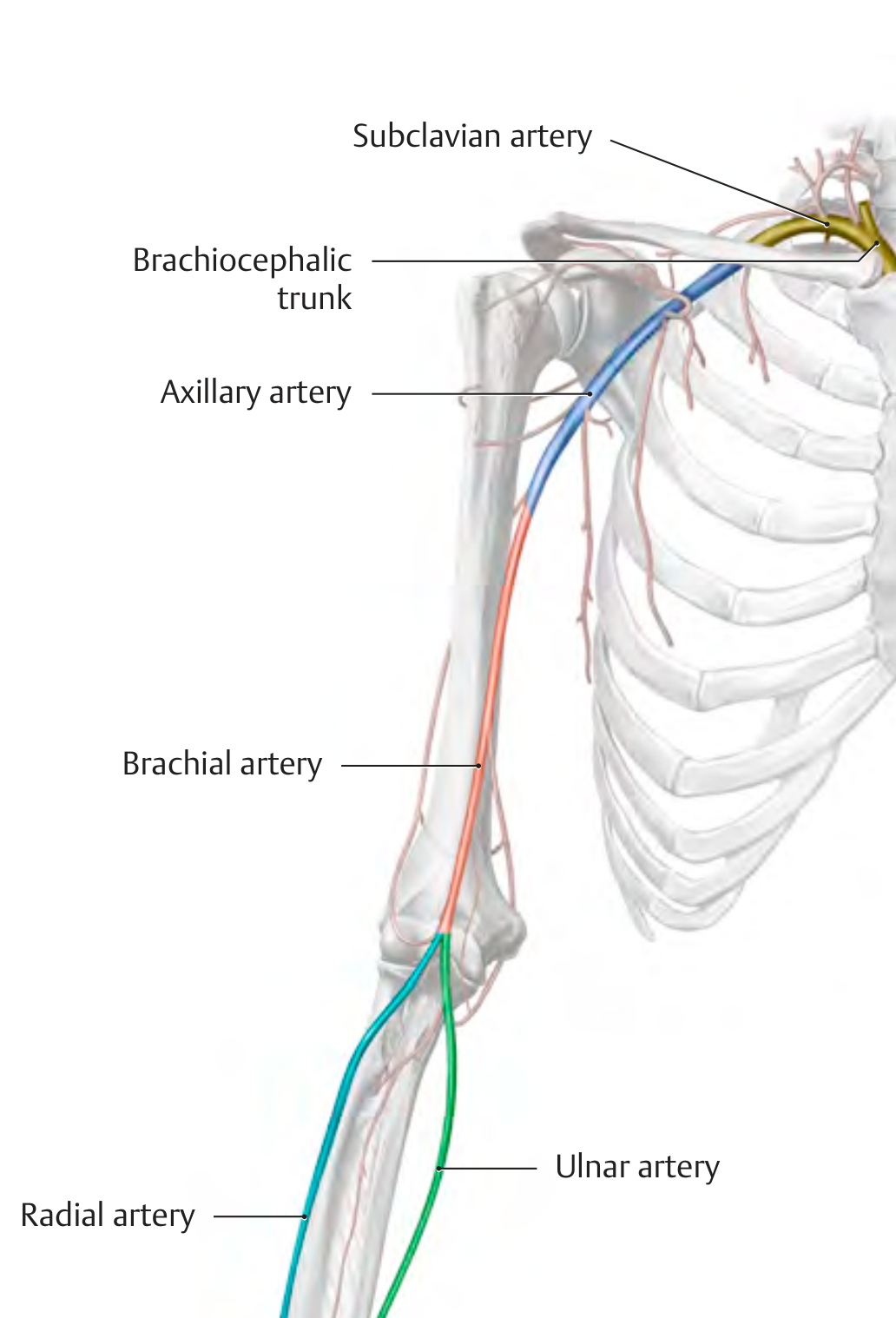
1. SUBCLAVIAN ARTERY
Origin:
- Right side: from the brachiocephalic trunk
- Left side: directly from the aortic arch
Course: Runs over the 1st rib between the anterior and middle scalene muscles (interscalene space), then continues as the axillary artery at the lateral border of the 1st rib.
Note: Unlike other upper limb arteries, the subclavian also supplies the neck, cerebral circulation, and anterior chest wall.
Branches of the Subclavian Artery
| Branch | Supply/Notes |
|---|---|
| Vertebral artery | Ascends through transverse foramina, supplies brain and spinal cord |
| Internal thoracic artery (internal mammary a.) | Anterior chest wall, breast |
| Thyrocervical trunk | Divides into 4 branches (see below) |
| - Inferior thyroid artery | Thyroid gland |
| - Ascending cervical artery | Neck muscles |
| - Suprascapular artery | Supraspinatus, infraspinatus; anastomoses with circumflex scapular a. |
| - Transverse cervical artery | Trapezius, posterior neck |
| Costocervical trunk | Divides into: |
| - Deep cervical artery | Deep posterior neck muscles |
| - Supreme intercostal artery | 1st and 2nd intercostal spaces |
2. AXILLARY ARTERY
Origin: Continuation of the subclavian artery from the lateral border of the 1st rib.
Termination: Becomes the brachial artery at the inferior border of the teres major (or pectoralis major tendon).
Relation: Covered anteriorly by pectoralis minor, which divides it into three parts.
Branches of the Axillary Artery
| Part | Branch | Supply/Notes |
|---|---|---|
| 1st part (medial to pec. minor) | Superior thoracic artery | 1st and 2nd intercostal spaces, upper serratus anterior |
| 2nd part (behind pec. minor) | Thoracoacromial artery | Divides into 4 branches: |
| - Acromial branch | Acromial anastomosis | |
| - Clavicular branch | Clavicular region | |
| - Deltoid branch | Deltoid + pectoralis major | |
| - Pectoral branch | Pectoralis major and minor | |
| 2nd part | Lateral thoracic artery | Serratus anterior, mammary glands (thicker in females) |
| 3rd part (lateral to pec. minor) | Subscapular artery | Largest branch; divides into: |
| - Circumflex scapular artery | Through triangular space; anastomoses with suprascapular a. in infraspinous fossa | |
| - Thoracodorsal artery | Latissimus dorsi, teres major, subscapularis, serratus anterior | |
| 3rd part | Anterior circumflex humeral artery | Passes anterior to surgical neck of humerus; supplies shoulder joint |
| 3rd part | Posterior circumflex humeral artery | Passes posterior through quadrangular space; supplies shoulder joint and deltoid |
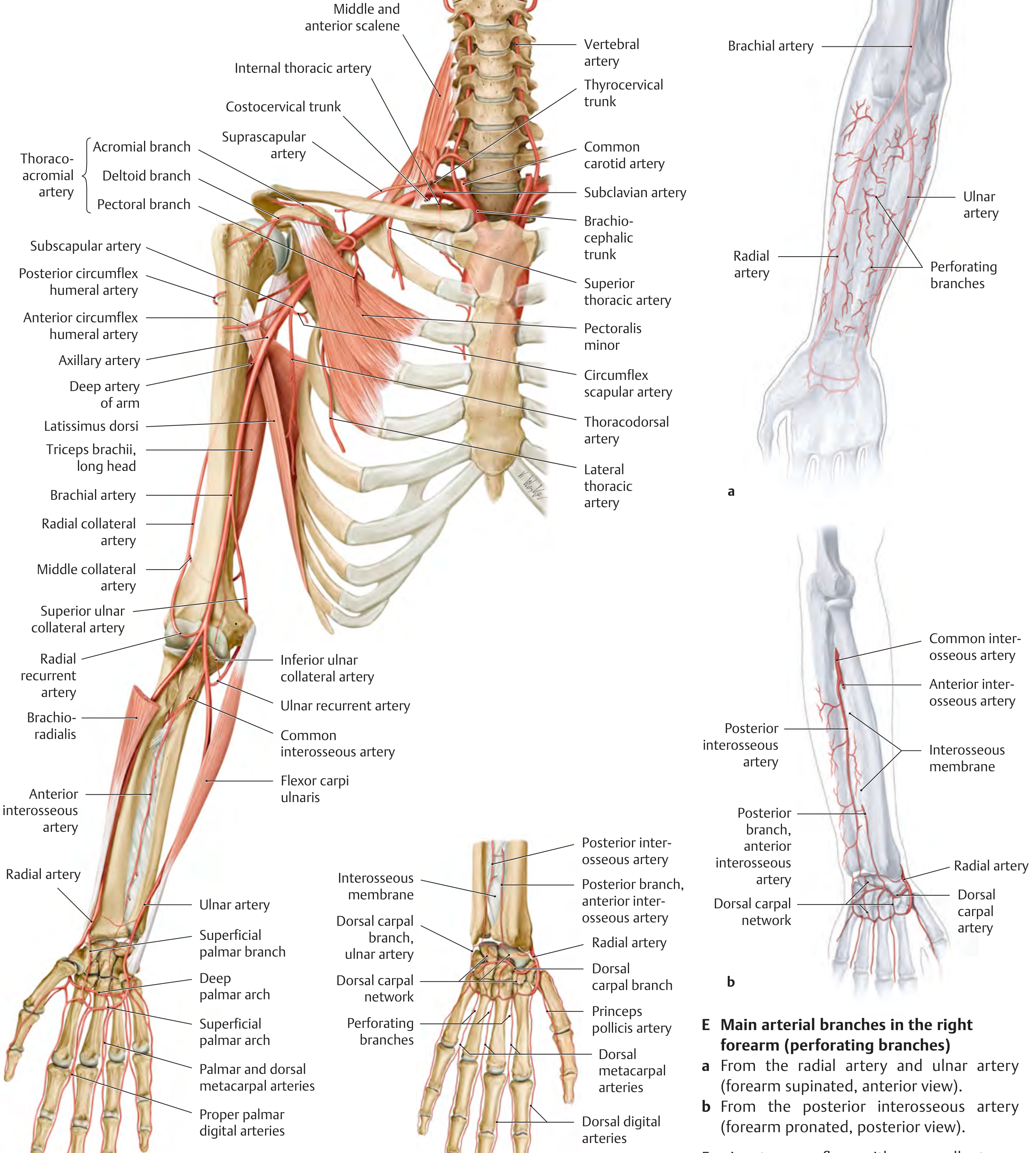
3. BRACHIAL ARTERY
Origin: Continuation of the axillary artery from the inferior border of teres major.
Course: Runs along the medial bicipital groove, where its pulse is palpable (can be compressed against the humerus in emergency).
Termination: Divides into radial and ulnar arteries at the elbow (neck of radius level).
Branches of the Brachial Artery
| Branch | Supply/Notes |
|---|---|
| Deep artery of the arm (profunda brachii / deep brachial artery) | Originates at lower border of teres major; passes posteriorly with radial nerve in the spiral groove |
| - Medial collateral artery | Part of cubital anastomosis (elbow arterial network) |
| - Radial collateral artery | Part of cubital anastomosis; anastomoses with radial recurrent a. |
| Superior ulnar collateral artery | Runs with ulnar nerve; part of cubital anastomosis |
| Inferior ulnar collateral artery | Above medial epicondyle; part of cubital anastomosis |
| Nutrient artery of humerus | Enters humeral shaft |
| Muscular branches | Supply biceps, brachialis, coracobrachialis |
Cubital Anastomosis (elbow arterial network): Formed by descending branches from the deep brachial and brachial arteries (superior ulnar collateral, inferior ulnar collateral, radial collateral, medial collateral) and ascending branches from the radial and ulnar arteries (radial recurrent, ulnar recurrent, interosseous recurrent). Allows collateral circulation if brachial artery is occluded above the elbow.
4. RADIAL ARTERY
Origin: Lateral terminal branch of brachial artery, at level of neck of radius.
Course: Runs between brachioradialis and flexor carpi radialis, then crosses the "anatomical snuffbox" to reach the dorsum of the hand, then plunges through 1st dorsal interosseous to form the deep palmar arch.
Clinical note: Radial pulse is palpable at the wrist just lateral to the flexor carpi radialis tendon.
Branches of the Radial Artery
| Branch | Notes |
|---|---|
| Radial recurrent artery | Ascending branch; part of cubital anastomosis |
| Palmar carpal branch | Contributes to palmar carpal network |
| Superficial palmar branch | Contributes to superficial palmar arch (with ulnar artery) |
| Dorsal carpal branch | Contributes to dorsal carpal network |
| - Dorsal metacarpal arteries | From dorsal carpal network |
| - Dorsal digital arteries | From dorsal metacarpal arteries |
| Princeps pollicis artery | Main supply to thumb |
| Radialis indicis artery | Radial side of index finger |
| Deep palmar arch | Main terminal branch; lies on metacarpal bases |
| - Palmar metacarpal arteries | Deep arch gives 3-4 palmar metacarpal arteries |
| - Perforating branches | Connect deep and superficial arches |
5. ULNAR ARTERY
Origin: Medial terminal branch of brachial artery.
Course: Passes under pronator teres, runs on the ulnar side of the forearm under flexor carpi ulnaris, then crosses the wrist through Guyon's canal to form the superficial palmar arch.
Branches of the Ulnar Artery
| Branch | Notes |
|---|---|
| Ulnar recurrent artery | Ascending branch; part of cubital anastomosis |
| Common interosseous artery | Short trunk that quickly divides into: |
| - Anterior interosseous artery | Runs on anterior surface of interosseous membrane; supplies deep flexors |
| - Posterior interosseous artery | Passes through interosseous membrane; supplies extensor compartment |
| - Recurrent interosseous artery | Part of cubital anastomosis |
| Palmar carpal branch | Contributes to palmar carpal network |
| Dorsal carpal branch | Contributes to dorsal carpal network |
| Deep palmar branch | Contributes to deep palmar arch |
| Superficial palmar arch | Main terminal branch; lies deep to palmar aponeurosis |
| - Common palmar digital arteries | 3 vessels running along web spaces |
| - Proper palmar digital arteries | Supply individual fingers on each side |
Palmar Arches Summary:
| Arch | Formed by | Depth |
|---|---|---|
| Superficial palmar arch | Mainly ulnar artery + superficial palmar branch of radial | Superficial (deep to palmar aponeurosis) |
| Deep palmar arch | Mainly radial artery (deep palmar arch) + deep palmar branch of ulnar | Deep (on metacarpal bases) |
PART II: ARTERIES OF THE LOWER LIMB
Overview - Arterial Segments
Abdominal aorta → Common iliac → External iliac → Femoral → Popliteal → Anterior tibial + Posterior tibial → Foot arteries → Plantar arch → Digital arteries
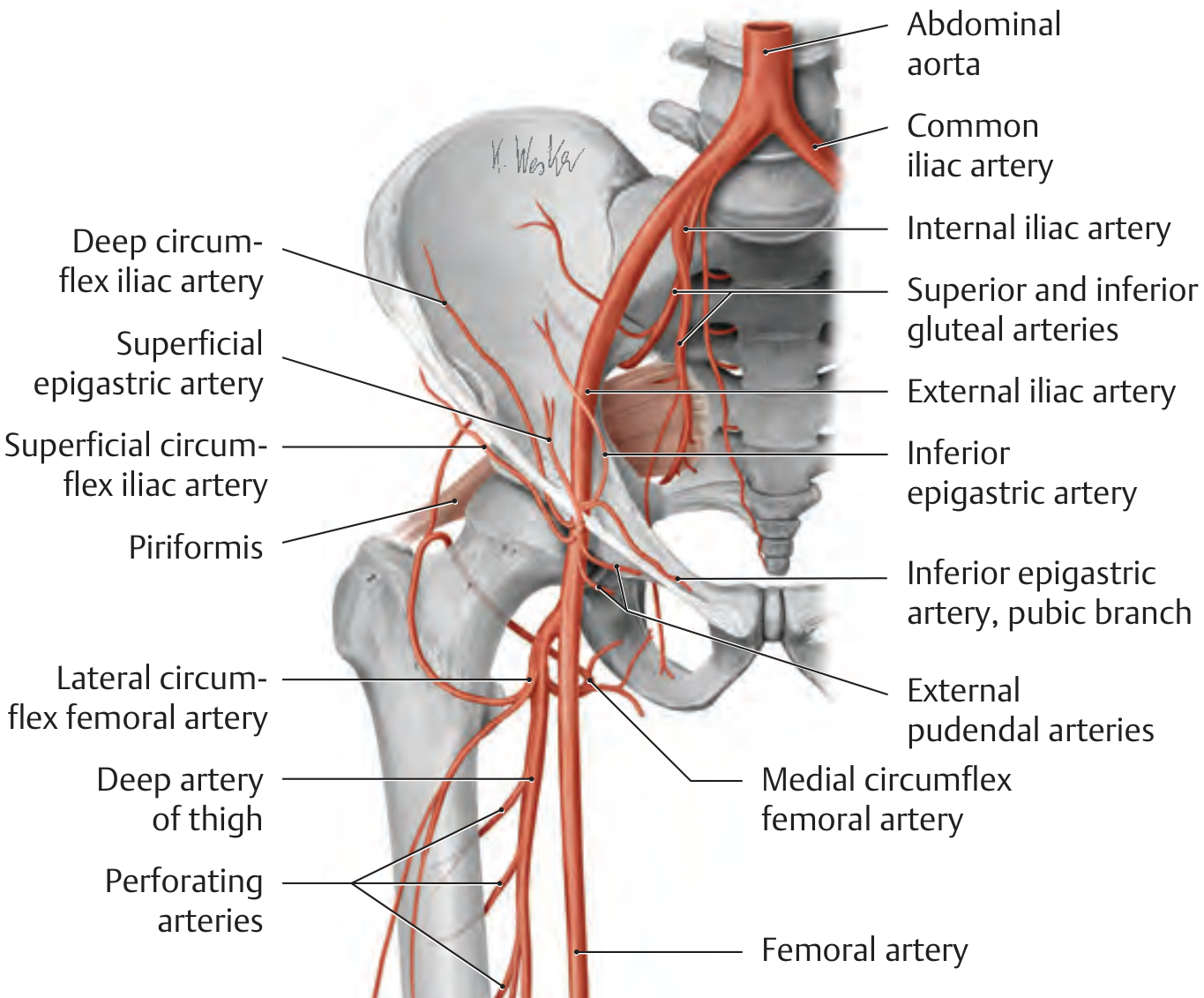
1. EXTERNAL ILIAC ARTERY
Origin: From common iliac artery (at bifurcation of abdominal aorta in front of L4).
Course: Descends along the medial border of psoas major, passes through the lacuna vasorum (deep to inguinal ligament), then becomes the femoral artery.
Branches of the External Iliac Artery
| Branch | Notes |
|---|---|
| Inferior epigastric artery | Ascends to posterior rectus sheath; anastomoses with superior epigastric a. |
| - Cremasteric artery | Supplies cremaster muscle and testis |
| - Artery of the round ligament of uterus | Female equivalent of cremasteric a. |
| - Pubic branch | Anastomoses with obturator artery's pubic branch |
| Deep circumflex iliac artery | Runs laterally along inguinal ligament to iliac crest |
2. FEMORAL ARTERY
Origin: Continuation of external iliac artery, begins at the inguinal ligament.
Course: Enters the femoral triangle (lateral to femoral vein and nerve), passes through the adductor canal (Hunter's canal) via the adductor hiatus, then becomes the popliteal artery behind the knee.
Clinical note: Femoral pulse palpable at the mid-inguinal point (midpoint between ASIS and pubic symphysis).
Branches of the Femoral Artery
| Branch | Notes |
|---|---|
| Superficial epigastric artery | Ascends toward umbilicus; supplies lower abdominal skin |
| Superficial circumflex iliac artery | Runs toward ASIS; supplies overlying skin |
| Superficial external pudendal artery | Supplies scrotum/labia majora |
| Deep external pudendal artery | Supplies perineal skin |
| Deep artery of the thigh (profunda femoris) | Largest branch; main supply to thigh muscles |
| - Medial circumflex femoral artery | Passes posteriorly; main blood supply to femoral head; enters joint via ligament of femoral head |
| - Lateral circumflex femoral artery | Passes laterally between rectus femoris and vastus lateralis; divides into ascending, descending, and transverse branches |
| - Perforating branches (1st-4th) | Pierce adductor magnus; supply posterior thigh and hamstrings |
| Descending genicular artery | Descends to knee; contributes to genicular anastomosis |
Clinical note: The medial circumflex femoral artery is the primary blood supply to the femoral head. Femoral neck fractures can disrupt this vessel, causing avascular necrosis of the femoral head.
3. POPLITEAL ARTERY
Origin: Continuation of femoral artery after it passes through the adductor hiatus.
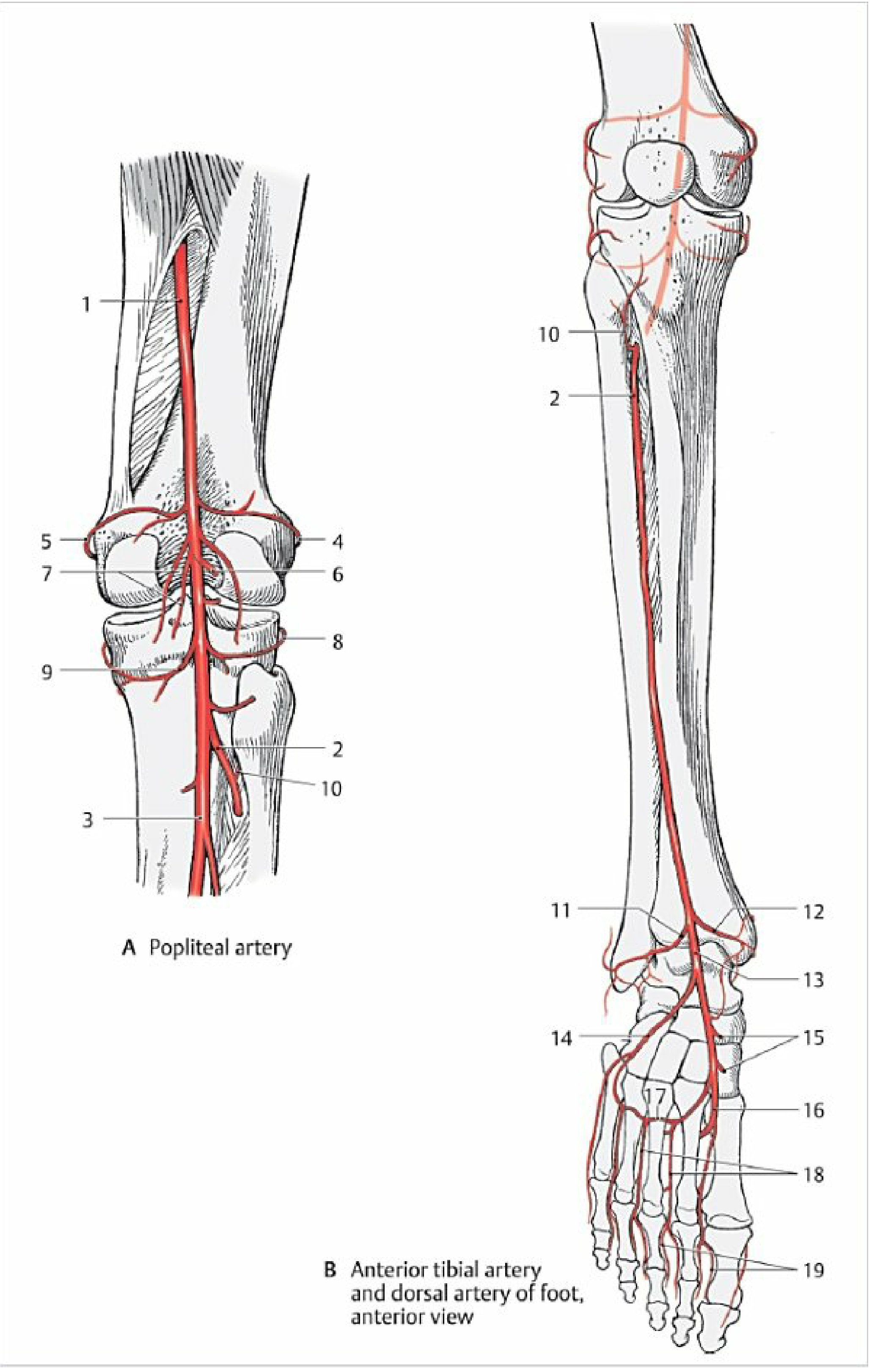
Course: Runs through the popliteal fossa (the deepest structure in the fossa), ends at the inferior border of popliteus by dividing into anterior and posterior tibial arteries.
Clinical note: The popliteal artery must not be ligated - collateral circulation through genicular arteries is insufficient.
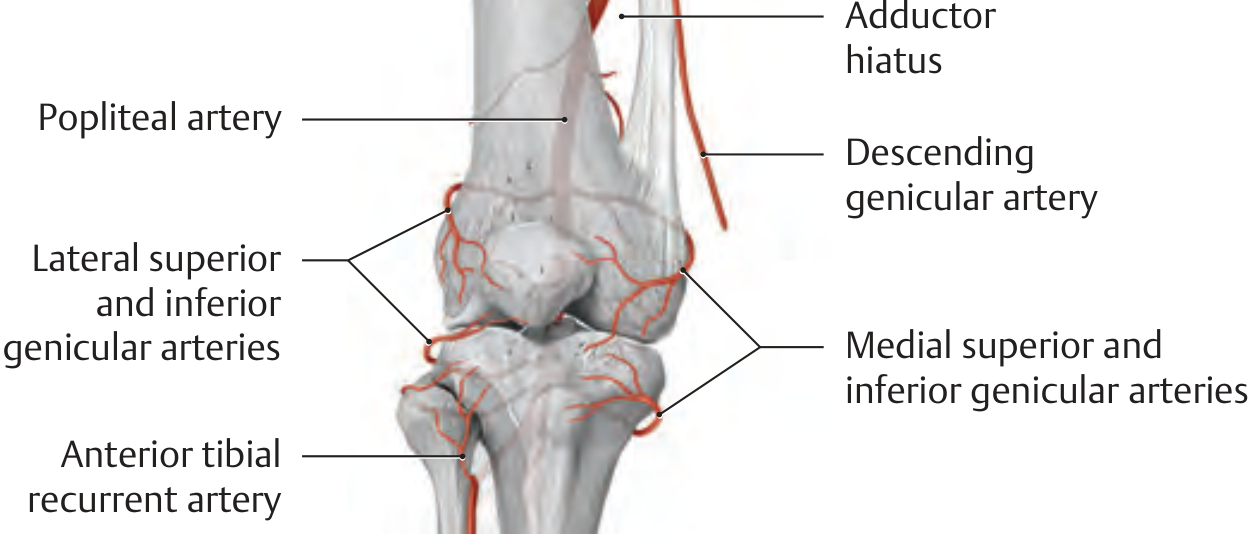
Branches of the Popliteal Artery
| Branch | Notes |
|---|---|
| Posterior tibial recurrent artery | Inconstant; passes to popliteal fossa (part of genicular anastomosis) |
| Medial superior genicular artery | Passes above medial femoral condyle; genicular anastomosis |
| Lateral superior genicular artery | Passes above lateral femoral condyle; genicular anastomosis |
| Sural arteries (2) | Supply gastrocnemius and soleus |
| Middle genicular artery | Pierces posterior capsule; supplies cruciate ligaments and synovial membrane |
| Medial inferior genicular artery | Passes below medial tibial condyle; genicular anastomosis |
| Lateral inferior genicular artery | Passes below lateral tibial condyle; genicular anastomosis |
Genicular Anastomosis: Forms an arterial network around the knee. Receives descending contributions from the femoral artery (descending genicular a.) and ascending contributions from the tibial arteries (anterior tibial recurrent a., circumflex fibular branch). Allows limited collateral flow if popliteal is slowly occluded.
4. ANTERIOR TIBIAL ARTERY
Origin: Terminal branch of popliteal artery at inferior border of popliteus.
Course: Pierces the interosseous membrane at its upper border, enters the extensor (anterior) compartment of the leg, runs between tibialis anterior and extensor hallucis longus, then crosses the ankle to become the dorsal pedal (dorsalis pedis) artery.
Clinical note: Compression from blunt trauma can cause extensor compartment syndrome with muscle necrosis.
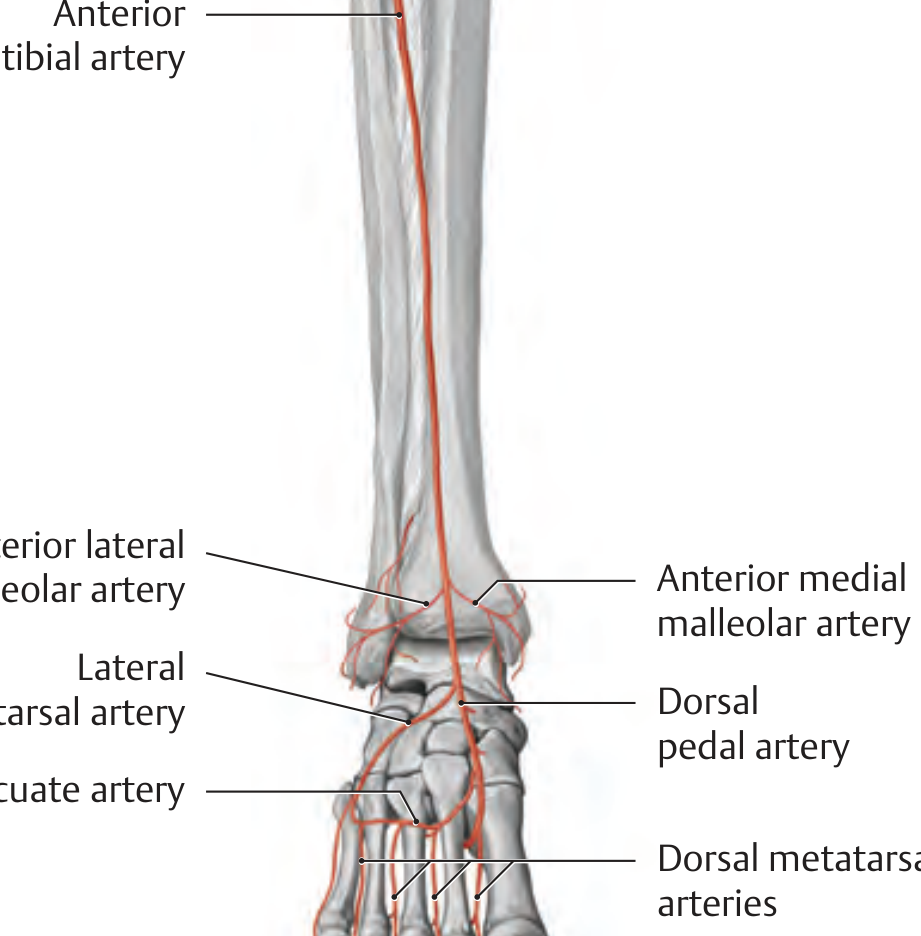
Branches of the Anterior Tibial Artery
| Branch | Notes |
|---|---|
| Posterior tibial recurrent artery | Inconstant; passes to popliteal fossa |
| Anterior tibial recurrent artery | Ascending; contributes to genicular anastomosis |
| Anterior lateral malleolar artery | Lateral malleolar network |
| Anterior medial malleolar artery | Medial malleolar network |
| Dorsal pedal artery (dorsalis pedis) | Continuation on dorsum of foot (from ankle joint level) |
| - Lateral tarsal artery | Posterolateral tarsus |
| - Medial tarsal arteries | Posteromedial tarsus |
| - Arcuate artery (inconstant) | Runs along metatarsal bases |
| -- Dorsal metatarsal arteries | From arcuate artery; run in intermetatarsal spaces |
| -- Dorsal digital arteries | From dorsal metatarsal arteries; to toes |
| - Deep plantar artery | Passes through 1st intermetatarsal space to plantar deep arch |
Clinical note: Dorsal pedal pulse is palpable between tendons of extensor hallucis longus and extensor digitorum longus on the dorsum of the foot.
5. POSTERIOR TIBIAL ARTERY
Origin: Direct continuation of popliteal artery at inferior border of popliteus.
Course: Enters the flexor (posterior) compartment deep to the soleus, passes behind the medial malleolus (where pulse is palpable), then divides into medial and lateral plantar arteries.
Clinical note: Posterior tibial pulse palpated 2 cm anterior to medial border of Achilles tendon, behind medial malleolus.
Branches of the Posterior Tibial Artery
| Branch | Notes |
|---|---|
| Fibular (peroneal) artery | Largest branch; runs along the medial border of fibula |
| - Perforating branch | Pierces interosseous membrane to join anterior tibial territory |
| - Communicating branch | Connects with posterior tibial artery |
| - Lateral malleolar branches | Lateral malleolar network |
| - Calcaneal branches | To the heel |
| Medial malleolar branch | Medial malleolar network |
| Calcaneal branches (direct) | To heel from posterior tibial |
| Medial plantar artery | Runs along medial side of sole |
| - Superficial branch | Superficial sole structures |
| - Deep branch | Contributes to deep plantar arch |
| Lateral plantar artery | Runs across sole to form deep plantar arch |
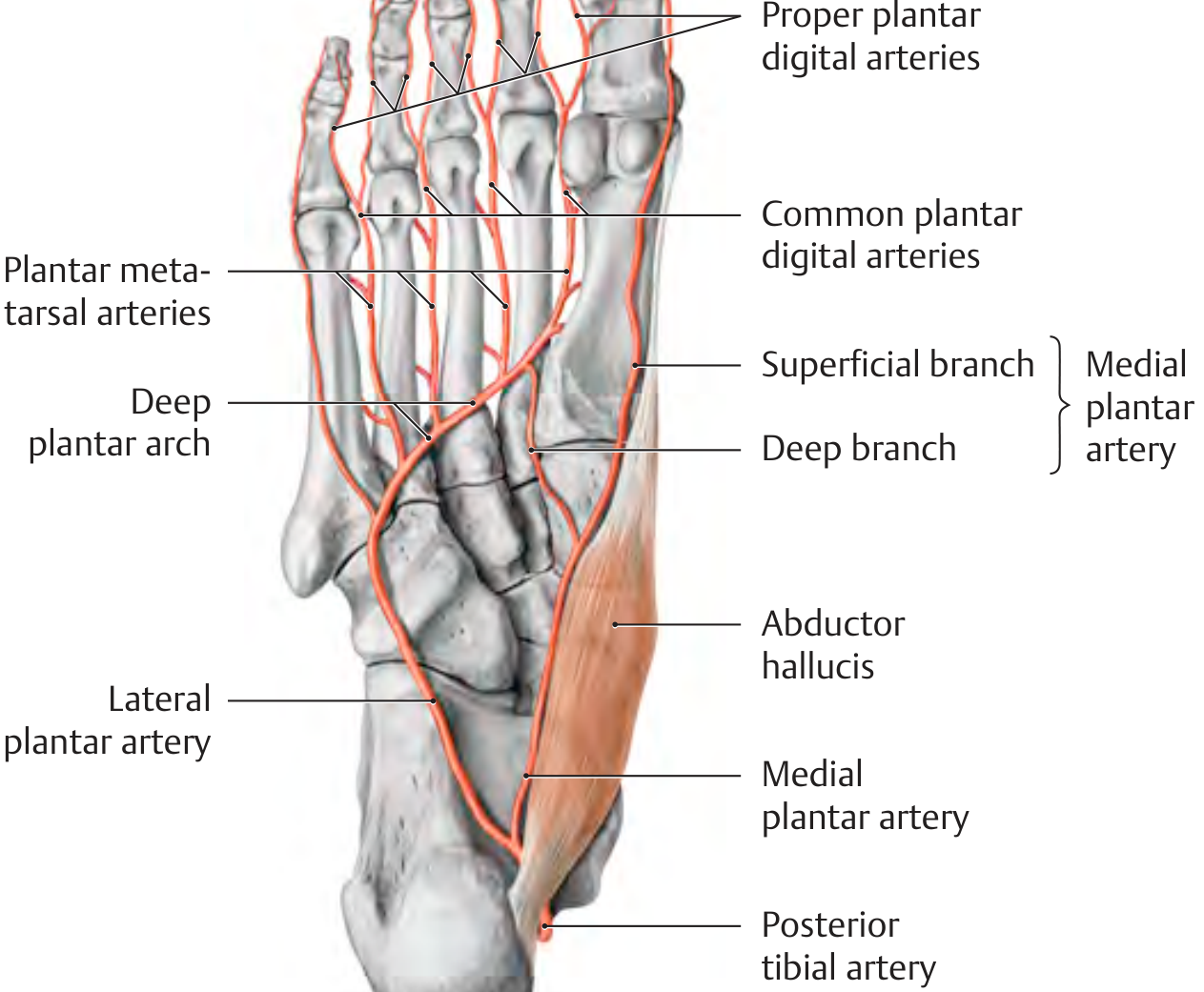
Plantar Arch: The lateral plantar artery curves medially across the sole to form the deep plantar arch, which is completed by the deep plantar branch of the dorsalis pedis artery. From the arch arise:
- Plantar metatarsal arteries (4 vessels)
- Common plantar digital arteries - divide into proper plantar digital arteries to each toe
Quick Reference Tables
Upper Limb - Artery Sequence
Subclavian
└── Axillary (lateral border of 1st rib)
└── Brachial (inferior border of teres major)
├── Radial artery (lateral)
│ └── Deep palmar arch
└── Ulnar artery (medial)
└── Superficial palmar arch
└── Common palmar digital arteries
└── Proper palmar digital arteries
Lower Limb - Artery Sequence
Abdominal aorta (L4)
└── Common iliac
├── Internal iliac (pelvic viscera + gluteal muscles)
└── External iliac
└── Femoral (at inguinal ligament)
├── Profunda femoris (deep artery of thigh)
└── Popliteal (at adductor hiatus)
├── Anterior tibial
│ └── Dorsalis pedis
│ └── Deep plantar artery → Deep plantar arch
└── Posterior tibial
├── Fibular (peroneal) artery
├── Medial plantar artery
└── Lateral plantar artery → Deep plantar arch
└── Plantar metatarsal arteries
└── Plantar digital arteries
Clinically Important Pulse Points
| Pulse | Artery | Location |
|---|---|---|
| Radial pulse | Radial artery | Lateral to flexor carpi radialis, at wrist |
| Ulnar pulse | Ulnar artery | Medial wrist, lateral to FCU tendon |
| Brachial pulse | Brachial artery | Medial bicipital groove, used for BP measurement |
| Femoral pulse | Femoral artery | Mid-inguinal point (between ASIS and pubic symphysis) |
| Popliteal pulse | Popliteal artery | Deep in popliteal fossa, knee flexed |
| Posterior tibial pulse | Posterior tibial artery | Behind medial malleolus |
| Dorsalis pedis pulse | Dorsalis pedis artery | Between EHL and EDL tendons on dorsum of foot |
Key Anastomoses
| Anastomosis | Arteries Involved | Clinical Significance |
|---|---|---|
| Cubital (elbow) anastomosis | Radial/medial collateral, ulnar collateral, radial recurrent, ulnar recurrent, interosseous recurrent | Collateral flow if brachial artery ligated above elbow |
| Scapular anastomosis | Suprascapular + circumflex scapular (subscapular) | Collateral flow in subclavian/axillary occlusion |
| Genicular anastomosis | Descending genicular, all 4 genicular arteries, anterior tibial recurrent | Some collateral at knee; insufficient if popliteal ligated acutely |
| Plantar arch | Lateral plantar (dominant) + deep plantar branch of dorsalis pedis | Complete arch ensures foot perfusion from both tibial sources |
Sources: THIEME Atlas of Anatomy - General Anatomy and Musculoskeletal System (ISBN 9781626237186); Color Atlas of Human Anatomy Vol. 2 - Internal Organs (ISBN 9783132424487)
This is a shared conversation. Sign in to Orris to start your own chat.