
Drug profile of diazepam
Reading File
Now let me search the medical library for diazepam in parallel.
Finding Sources
Finding Sources
Searching PubMed
diazepam pharmacology clinical use
Excellent results. Now let me read the key sections from the most authoritative pharmacology sources in parallel.
Reading File
Reading File
Reading File
Good data so far. Now let me get the full Harriet Lane pediatric dosing and the Miller's Anesthesia section, plus the Maudsley deprescribing section and search for the core pharmacology/mechanism sections.
Reading File
Reading File
Finding Sources
Now let me get the Goodman & Gilman section on diazepam mechanism/anxiolytic and the Maudsley deprescribing pharmacokinetics, plus the Neuroscience textbook anxiolytic section.
Reading File
Reading File
Reading File
I now have comprehensive information from multiple authoritative textbooks. Let me also fetch the GABA-receptor mechanism diagram to include visually.
Loading Image
I now have all the information needed to write a thorough drug profile. Here is the complete answer:
Drug Profile: Diazepam
Brand names: Valium, Diastat, Diastat AcuDial, Valtoco, and many generics (Antenex, Apaurin, Stesolid, Vival, etc.)
Drug class: Benzodiazepine - anxiolytic, anticonvulsant, sedative-hypnotic, muscle relaxant
Schedule: Schedule IV controlled substance
Mechanism of Action
Diazepam is a positive allosteric modulator of the GABA-A receptor. It binds to a distinct benzodiazepine binding site on the pentameric GABA-A receptor complex (separate from the GABA binding site), making the receptor far more responsive to GABA. This increases the frequency of chloride (Cl⁻) channel opening, causing neuronal hyperpolarization and CNS depression.
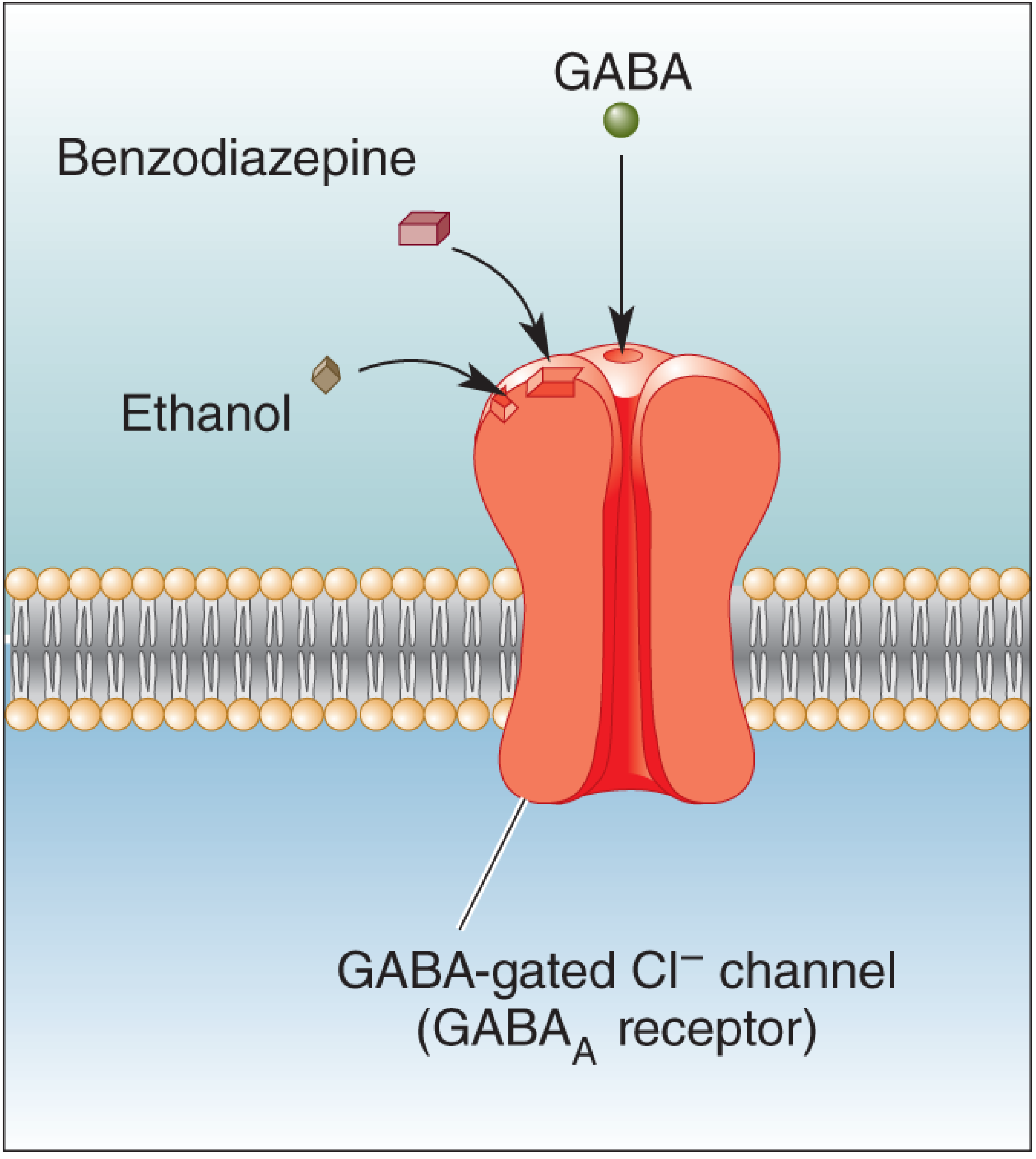
The anxiolytic effects are specifically mediated via GABA-A receptor subunits α2, α3, and α5. The antiseizure effect is at least partly spinal cord-mediated (effective even after cord transection). - Goodman & Gilman's, Chapter 22; Katzung Basic & Clinical Pharmacology, 16e
Pharmacokinetics
| Parameter | Details |
|---|---|
| Bioavailability (oral) | ~94% |
| Time to peak plasma | ~1-1.5 hours (oral) |
| Protein binding | Extensively bound to plasma proteins |
| Volume of distribution | 0.7-4.7 L/kg |
| Plasma clearance | 0.2-0.5 mL/kg/min |
| Half-life (parent) | 1-2 days (24-48 hours) |
| Half-life (N-desmethyldiazepam) | Up to 100-200 hours |
| Metabolism | Hepatic - primarily CYP2C19 and CYP3A4 |
Active metabolites (a unique and clinically important feature):
- N-desmethyldiazepam (nordiazepam) - via CYP2C19; very long t½ (up to 200 h), pharmacodynamically active
- Temazepam - via CYP3A4; further metabolized to oxazepam
- Oxazepam - final active metabolite; glucuronidated and excreted in urine
The elimination half-life increases by approximately 1 hour per year of age over 20, meaning elderly patients accumulate the drug significantly. Obesity and liver dysfunction also reduce clearance. Because of prolonged half-life, less frequent dosing (even every-other-day) may be feasible. - Miller's Anesthesia, 10e; Maudsley Deprescribing Guidelines; Kaplan & Sadock's
Indications / Clinical Uses
| Indication | Notes |
|---|---|
| Generalized anxiety disorder | Effective for acute and situational anxiety; SSRIs/SNRIs preferred long-term |
| Panic disorder | Effective; benzodiazepine binding sites reduced in frontal cortex hyperactivity |
| Status epilepticus | First-line IV/rectal/intranasal for acute seizure termination; must follow with long-acting anticonvulsant |
| Seizure prophylaxis | Used in febrile seizures, alcohol-withdrawal seizures |
| Alcohol withdrawal | First-line; long half-life makes it preferred (smooth taper effect) |
| Muscle spasm / spasticity | Acts at spinal cord level; somewhat less preferred than baclofen due to sedation |
| Procedural sedation | IV/IM sedation (midazolam now more common) |
| Pre-anesthetic medication | Anxiolysis before procedures |
| Acute agitation | IV/IM in emergency settings |
| Tetanus / eclampsia | Adjunct management |
- Katzung Basic & Clinical Pharmacology, 16e; Roberts & Hedges' Clinical Procedures; Rosen's Emergency Medicine
Dosing
Adult Doses
| Indication | Route | Dose |
|---|---|---|
| Anxiety | PO | 2-10 mg, 2-4×/day |
| Alcohol withdrawal | PO/IV | 5-10 mg initially; titrate |
| Muscle relaxant | PO | Initial 4 mg/day, up to 60 mg/day |
| Status epilepticus | IV | 5-10 mg IV; max 30 mg |
| Rectal gel | PR | 0.2 mg/kg/dose (≥12 yr & adult) |
Pediatric Doses (Harriet Lane Handbook, 23e)
| Route | Dose |
|---|---|
| IV or IM (sedative) | 0.05-0.2 mg/kg/dose Q6-12h; max 0.6 mg/kg in 8 hours |
| PO (sedative) | 0.12-0.8 mg/kg/24h ÷ Q6-12h; max 10 mg/dose |
| Rectal (IV form used PR) | 0.5 mg/kg followed by 0.25 mg/kg in 10 min PRN; max 20 mg |
| Rectal gel | 2-5 yr: 0.5 mg/kg; 6-11 yr: 0.3 mg/kg; ≥12 yr: 0.2 mg/kg |
| Nasal spray (Valtoco) | Available as 5, 7.5, 10 mg/0.1 mL |
IV administration: Give undiluted, no faster than 2 mg/min. Do not mix with IV fluids.
Onset of anticonvulsant effect: 1-3 min (IV), 2-10 min (rectal), <5 min (intranasal)
Formulations
- Tablets: 2, 5, 10 mg
- Oral solution: 1 mg/mL, 5 mg/mL (contains 19% alcohol)
- Injection: 5 mg/mL (contains propylene glycol, benzyl alcohol, sodium benzoate)
- IM auto-injector: 5 mg/mL
- Rectal gel (Diastat): pediatric (2.5 mg) and adult (10 mg, 20 mg) formulations
- Nasal spray (Valtoco): 5, 7.5, 10 mg/0.1 mL
Adverse Effects
| System | Effects |
|---|---|
| CNS | Sedation, ataxia, dizziness, headache, anterograde amnesia, cognitive impairment, slowed reaction time |
| Respiratory | Respiratory depression (especially with opioids or other CNS depressants) |
| Cardiovascular | Hypotension (IV/IM) |
| Paradoxical reactions | Increased anxiety, agitation, aggression, behavioral disinhibition (especially in children and elderly) |
| Route-specific | Nasal: discomfort, dysgeusia, epistaxis; Rectal: ataxia, rash |
| Chronic use | Tolerance, physical dependence, cognitive decline, fall risk (elderly) |
Drug Interactions
| Interaction | Effect |
|---|---|
| Opioids | Profound sedation, respiratory depression, coma, death (Black Box Warning) |
| CNS depressants / alcohol | Additive CNS/respiratory depression |
| Cimetidine, erythromycin, itraconazole | Enhance diazepam effects (CYP inhibition) |
| Valproic acid | May enhance diazepam effects |
| Protease inhibitors | Contraindicated - risk of extreme sedation |
| CYP450 substrates/inhibitors | Diazepam is a substrate for CYP2B6, 2C8, 2C9, 3A5-7; minor substrate/inhibitor of CYP2C19, 3A3/4 |
Contraindications
- Myasthenia gravis
- Severe respiratory insufficiency / COPD (use with caution or avoid)
- Severe hepatic failure
- Sleep apnea syndrome
- First trimester of pregnancy (risk of fetal craniofacial defects; neonatal withdrawal)
- Concurrent use with protease inhibitors
Use with caution in: Hepatic/renal dysfunction, angle-closure glaucoma, shock, depression, elderly patients (fall risk).
Dependence, Tolerance, and Withdrawal
Diazepam carries an FDA Boxed Warning for physical dependence and withdrawal. Dependence can develop even with therapeutic doses over days to weeks.
- Abrupt cessation can cause seizures (life-threatening)
- Other withdrawal symptoms: anxiety, tremors, muscle twitching, insomnia, hallucinations, hyperhidrosis
- Symptoms can persist for "several weeks to more than 12 months" post-discontinuation (FDA)
- Tolerance to the anxiolytic effect develops with chronic use, leading to dose escalation
- Dose reduction must be gradual and hyperbolic (not linear) - equal reductions in receptor occupancy require progressively smaller absolute dose reductions
Use in Special Populations
| Population | Consideration |
|---|---|
| Elderly | t½ increases ~1 h/year over age 20; high fall and fracture risk; use Beers Criteria guidance |
| Hepatic impairment | Reduced clearance; use with caution |
| Obesity | Increased Vd, altered pharmacokinetics |
| Pregnancy | Avoid (fetal risk, neonatal sedation/withdrawal; FDA Category D) |
| Breastfeeding | Excreted in breast milk; avoid |
| Neonates/infants | Benzyl alcohol in IV formulation is a concern |
Role in Deprescribing / Switching
Diazepam's long half-life makes it the preferred agent for switching from shorter-acting benzodiazepines (lorazepam, alprazolam, clonazepam, oxazepam) before a gradual taper:
- 1 mg lorazepam ≈ 10 mg diazepam
- 1 mg alprazolam ≈ 15 mg diazepam (each dose)
- 1 mg clonazepam ≈ 20 mg diazepam
This "Ashton method" uses diazepam's smooth plasma-level curve to minimize inter-dose withdrawal during taper. - Maudsley Deprescribing Guidelines
Sources:
- Katzung's Basic and Clinical Pharmacology, 16e - muscle relaxant mechanism
- Goodman & Gilman's The Pharmacological Basis of Therapeutics - anxiolytic pharmacology
- Miller's Anesthesia, 10e - pharmacokinetics
- Kaplan & Sadock's Comprehensive Textbook of Psychiatry - metabolism/metabolites
- The Harriet Lane Handbook, 23e - pediatric dosing
- The Maudsley Deprescribing Guidelines - t½, withdrawal, deprescribing
- Neuroscience: Exploring the Brain, 5e - GABA-A mechanism diagram
- Rosen's Emergency Medicine - alcohol withdrawal/seizure use
This is a shared conversation. Sign in to Orris to start your own chat.