
Give exam notes for forceps and vaccum delivery
Reading File
Now let me search the medical library for forceps and vacuum delivery content in parallel.
Finding Sources
Finding Sources
Finding Sources
Finding Sources
Good. Now let me read all key sections in parallel:
Reading File
Reading File
Reading File
Reading File
Reading File
Reading File
I now have comprehensive information to compile thorough exam notes. Let me also fetch the relevant images to include.
Loading Image
Loading Image
Finding Sources
I have sufficient information for comprehensive exam notes. Let me compile them now.
Forceps and Vacuum (Ventouse) Delivery - Exam Notes
PART 1: OBSTETRIC FORCEPS DELIVERY
Historical Background
- First used by the Chamberlen family in the 17th century; not widely accepted until ~100 years later
- William Smellie was the first to systematically teach the principles of forceps deliveries
- ACOG issued new classification criteria in 1988, incorporated into the 1991 Technical Bulletin on Operative Vaginal Delivery
ACOG Classification of Forceps Deliveries
| Type | Criteria |
|---|---|
| Outlet forceps | Scalp visible at introitus without separating labia; skull at pelvic floor; sagittal suture in AP diameter or ROA/LOA/ROP/LOP; head at or on perineum; rotation ≤ 45° |
| Low forceps | Leading point of skull at station +2 cm or lower, not on pelvic floor; rotation ≤ 45° (LOA/ROA → OA or LOP/ROP → OP); OR rotation > 45° |
| Mid-forceps | Station above +2 cm but head is engaged |
Key point: High forceps (unengaged head) - no longer considered acceptable in modern obstetrics.
Indications for Forceps Delivery
- Arrest of labor in the second stage
- Maternal conditions requiring shortening of second stage: cardiovascular disease, cerebrovascular disease, maternal exhaustion
- Fetal distress
- Elective low-pelvic delivery (when appropriate)
- Unique to forceps (not vacuum):
- Breech presentation - for the aftercoming head
- Face presentation
- Rotational delivery (if clinician experienced)
Prerequisites ("ABCDE" - same for both forceps and vacuum)
The ALSO (Advanced Life Support in Obstetrics) curriculum uses the ABCDEF-GHIJ acronym:
| Letter | Requirement |
|---|---|
| A | Adequate anesthesia (local/pudendal block); ask for help |
| B | Bladder empty (straight catheterize if needed) |
| C | Cervix completely dilated |
| D | Determine position of fetal head (anterior fontanelle = cross shape; posterior fontanelle = Y shape; locate the ear) |
| E | Equipment ready (suction bulb, cord clamp, instrument table) |
Forceps Application Procedure (Letters F-J)
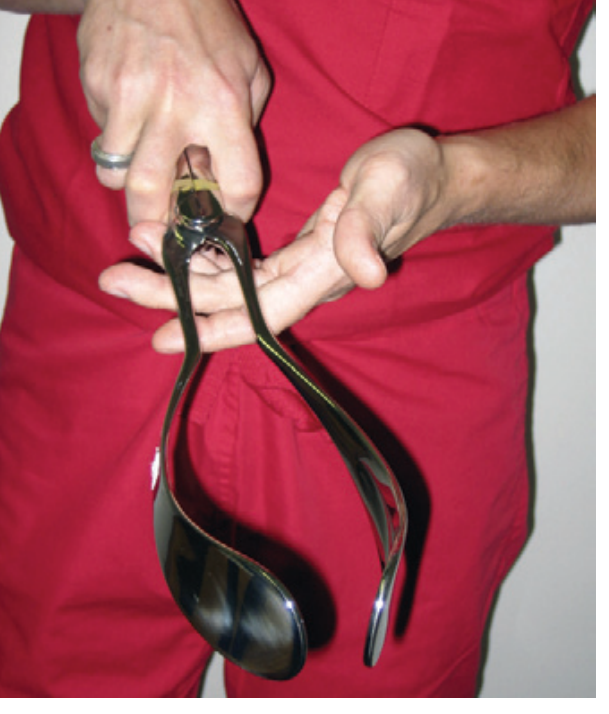
- F (Forceps ready):
- Articulate forceps first to check fit
- Left blade in left hand, inserted along left side of fetal head (right hand protects maternal sidewall)
- Right blade in right hand, along right side; left hand guides
- Handles should lock easily if correctly placed
- Check application: Posterior fontanelle midway between shanks and 1 cm above plane of shanks; fenestrations admit no more than one fingertip
- G (Gentle traction):
- One hand pulls handles horizontally outward; other hand on shaft pushes downward
- Vector sum = outward-and-downward force
- As crown moves from under symphysis, traction shifts upward
- H (Handle elevated) to follow the J-shaped pelvic curve
- I (Incision/Episiotomy) - evaluate based on perineal distension; OP deliveries require larger episiotomy
- J (remove forceps) when the infant's jaw is reachable
Contraindications to Forceps
- Cephalopelvic disproportion (CPD)
- Unengaged fetal head
- Unknown fetal head position
- Incomplete cervical dilatation
- Fetal coagulation defect (relative)
Maternal and Neonatal Complications
Maternal:
- Cervical, vaginal, and perineal lacerations (more than vacuum)
- Requires more anesthesia than vacuum
Neonatal:
- Craniofacial injuries
- Intracranial hemorrhage (more than vacuum in same circumstances)
Long-term outcomes: Most studies after 1970 show no significant difference in IQ scores or neurodevelopmental outcomes between forceps-delivered and spontaneously delivered infants (Wesley et al., Seidman et al.) - Creasy & Resnik's Maternal-Fetal Medicine
PART 2: VACUUM EXTRACTION (VENTOUSE)
Historical Background
- Malmström introduced the vacuum extractor into modern obstetrics in 1954
- Has largely replaced forceps in Scandinavia and continental Europe
Indications (same as forceps)
- Arrest of labor in the second stage
- Maternal indication to shorten second stage (cardiovascular/cerebrovascular disease, exhaustion)
- Fetal distress
- Elective low-pelvic delivery
Contraindications
- CPD
- Face or brow presentation
- Breech presentation
- Unengaged fetal head
- Premature infant (< 34 weeks - increased risk of subgaleal/intracranial hemorrhage)
- Incompletely dilated cervix
- Suspected fetal coagulation defect
Vacuum Application Procedure (ABCDEF-GHIJ - letters F & G differ from forceps)
- F (Fix cup):
- Wipe vertex clean; spread labia; compress and insert cup
- Place cup over posterior fontanelle, or over sagittal suture up to 3 cm in front of the posterior fontanelle toward the face
- Sweep finger around cup edge to check for trapped maternal tissue
- Set vacuum: yellow dial = 10 mmHg (resting suction); red dial = 50 mmHg (traction during contractions)
- G (Gentle traction):
- Apply traction at right angles to the plane of the applied cup surface
- Pull only with contractions (this increases total time but is safer)
- Follow the J-shaped pelvic curve
Cup types:
- Rigid cups (Malmström metal, Bird modification): higher success rate, more maternal/fetal trauma
- Soft cups (polyethylene/silicone): lower success rate, less trauma; currently preferred in most US residency programs
Complications of Vacuum
Maternal: Cervical and vaginal trauma (generally less frequent and less severe than forceps)
Neonatal:
- Cephalhematoma (more common than forceps)
- Retinal hemorrhage (more common than forceps)
- Subgaleal hemorrhage (~4%)
- Intracranial hemorrhage (~2.5%) - usually associated with prolonged labor and fetal asphyxia
PART 3: FORCEPS vs. VACUUM - COMPARISON TABLE
| Feature | Forceps | Vacuum |
|---|---|---|
| Success rate | Higher | Lower |
| Speed | Faster (useful for acute fetal distress) | Slower (pull with contractions) |
| Anesthesia needed | More | Less |
| Maternal trauma | More (lacerations, vaginal injury) | Less |
| Neonatal craniofacial injury | More (facial nerve palsy, marks) | Less |
| Intracranial hemorrhage risk | Higher | Lower |
| Cephalhematoma/retinal hemorrhage | Less | More |
| Breech/face presentation | Yes (useful) | No |
| Rotation ability | Yes (if experienced) | Autorotation possible (OP/OT) |
| Learning curve | Steeper | Easier to learn |
| Presentations | Cephalic + face/breech | Vertex only |
PART 4: SEQUENTIAL USE (VACUUM THEN FORCEPS)
Avoid sequential use. This is one of the most exam-tested points.
- Towner et al. found that combined vacuum + forceps resulted in intracranial hemorrhage at a rate 7.4x greater than spontaneous delivery, and 3.4x greater than vacuum alone
- Gardella et al.: significant increase in both neonatal and maternal injury with sequential instruments
- ACOG recommends avoiding vacuum extraction followed by forceps - Creasy & Resnik's Maternal-Fetal Medicine
PART 5: LIMITS OF THE SECOND STAGE OF LABOR (Before Intervention)
| Parity | Without Regional Anesthetic | With Regional Anesthetic |
|---|---|---|
| Nullipara | 2 hours | 3 hours |
| Multipara | 1 hour | 2 hours |
(Pfenninger & Fowler's Procedures for Primary Care)
PART 6: HIGH-YIELD EXAM POINTS SUMMARY
- Mid-forceps = station above +2 cm but head engaged - associated with lower cord pH, higher fetal injury risk vs. outlet/low forceps
- Vacuum is preferred by most authorities as the instrument of first choice for operative vaginal delivery
- Forceps is preferred when rapid delivery is needed (acute fetal distress), for breech aftercoming head, or face presentation
- NEVER apply vacuum in preterm < 34 weeks
- The posterior fontanelle (Y-shaped, smaller) is the landmark for cup placement in vacuum
- Forceps cup check: posterior fontanelle 1 cm above the plane of the shanks
- Sequential instrument use significantly increases morbidity - avoid
- Both instruments require fully dilated cervix, engaged head, known position, empty bladder, adequate anesthesia
- Vacuum allows autorotation from OP/OT positions - forceps requires active rotation by operator
- Forceps delivery results in less morbidity in subsequent pregnancies compared to cesarean section (Patel & Murphy 2004)
Sources: Creasy & Resnik's Maternal-Fetal Medicine: Principles and Practice; Pfenninger and Fowler's Procedures for Primary Care, 3rd ed.
This is a shared conversation. Sign in to Orris to start your own chat.