
Crp
CRP (C-Reactive Protein) is an acute-phase reactant protein produced by the liver in response to inflammation, infection, or tissue injury. It rises within hours of an inflammatory stimulus and is one of the most widely used inflammatory markers in clinical medicine. Normal levels are typically <10 mg/L, while high-sensitivity CRP (hsCRP) measures lower levels (0.5-10 mg/L) for cardiovascular risk assessment.
Searching sources...
Reading File
Finding Sources
Finding Sources
Reading File
Reading File
Reading File
Reading File
Reading File
Reading File
Reading File
Loading Image
Here is a thorough overview of C-Reactive Protein (CRP) drawn from multiple authoritative textbooks:
C-Reactive Protein (CRP)
History & Structure
CRP was first isolated in 1930 from plasma of patients with pneumococcal pneumonia. It was named because it binds to the C-polysaccharide of Streptococcus pneumoniae. It belongs to the pentraxin family - a 115 kDa pentamer of five non-covalently linked 23 kDa subunits arranged in cyclic symmetry. With Ca²⁺ ions, it binds phosphocholine, phospholipids, fibronectin, chromatin, and histones - all exposed at sites of tissue damage. This structure has been highly conserved over hundreds of millions of years of evolution. - Firestein & Kelley's Textbook of Rheumatology
Synthesis & Kinetics
-
Produced primarily by hepatocytes, stimulated by cytokines - chiefly interleukin-6
-
Rises within 6-12 hours of the initial inflammatory insult
-
Peaks at 2-3 days, reflecting the extent of tissue injury
-
Half-life ~19 hours - drops rapidly once the stimulus is removed
-
Levels may be affected by underlying liver dysfunction (single-organ origin)
-
Persistent elevations are seen in chronic inflammatory/infectious states (e.g., active RA, pulmonary TB) and extensive malignancy
-
Tietz Textbook of Laboratory Medicine, 7th Edition & Firestein & Kelley's Textbook of Rheumatology
Functions
CRP has both pro- and anti-inflammatory roles:
Pro-inflammatory:
- Activates the classical complement pathway
- Interacts with immune cells via Fcγ receptors
- Induces inflammatory cytokines and tissue factors
- Sheds IL-6 receptor, leading to complement-dependent tissue damage
Anti-inflammatory:
-
Promotes non-inflammatory clearance of apoptotic cells
-
Prevents neutrophil adhesion to the endothelium
-
Opsonizes particles for phagocytosis
-
Firestein & Kelley's Textbook of Rheumatology
Normal Values & Interpretation
| Level | Interpretation |
|---|---|
| Median ~1 mg/L (normal population) | Normal baseline |
| <1 mg/dL (10 mg/L) | Normal or minor elevation |
| 1-10 mg/dL | Moderate elevation |
| >10 mg/dL | Marked elevation |
| Up to 300+ mg/L | Acute severe illness |
Most healthy adults have levels <0.3 mg/dL. Concentrations >1 mg/dL reflect clinically significant inflammatory disease. - Henry's Clinical Diagnosis and Management by Laboratory Methods
hsCRP for Cardiovascular Risk (AHA/CDC Joint Recommendations):
- <1 mg/L - Low cardiovascular risk
- 1-3 mg/L - Intermediate cardiovascular risk
- >3 mg/L - High cardiovascular risk
- Results should ideally be averaged from two specimens ~2 weeks apart
- If >10 mg/L: search for infection/inflammation, discard result, retest in 2 weeks
Conditions Associated With Elevated CRP
| Degree of Elevation | Conditions |
|---|---|
| Normal/Minor (<1 mg/dL) | Vigorous exercise, common cold, pregnancy, gingivitis, seizures, depression, insulin resistance/diabetes, obesity |
| Moderate (1-10 mg/dL) | MI, malignancies, pancreatitis, mucosal infections (bronchitis, cystitis), most systemic autoimmune diseases, rheumatoid arthritis |
| Marked (>10 mg/dL) | Acute bacterial infection (80-85%), major trauma, systemic vasculitis |
- Firestein & Kelley's Textbook of Rheumatology
CRP Levels Across Rheumatic Diseases:
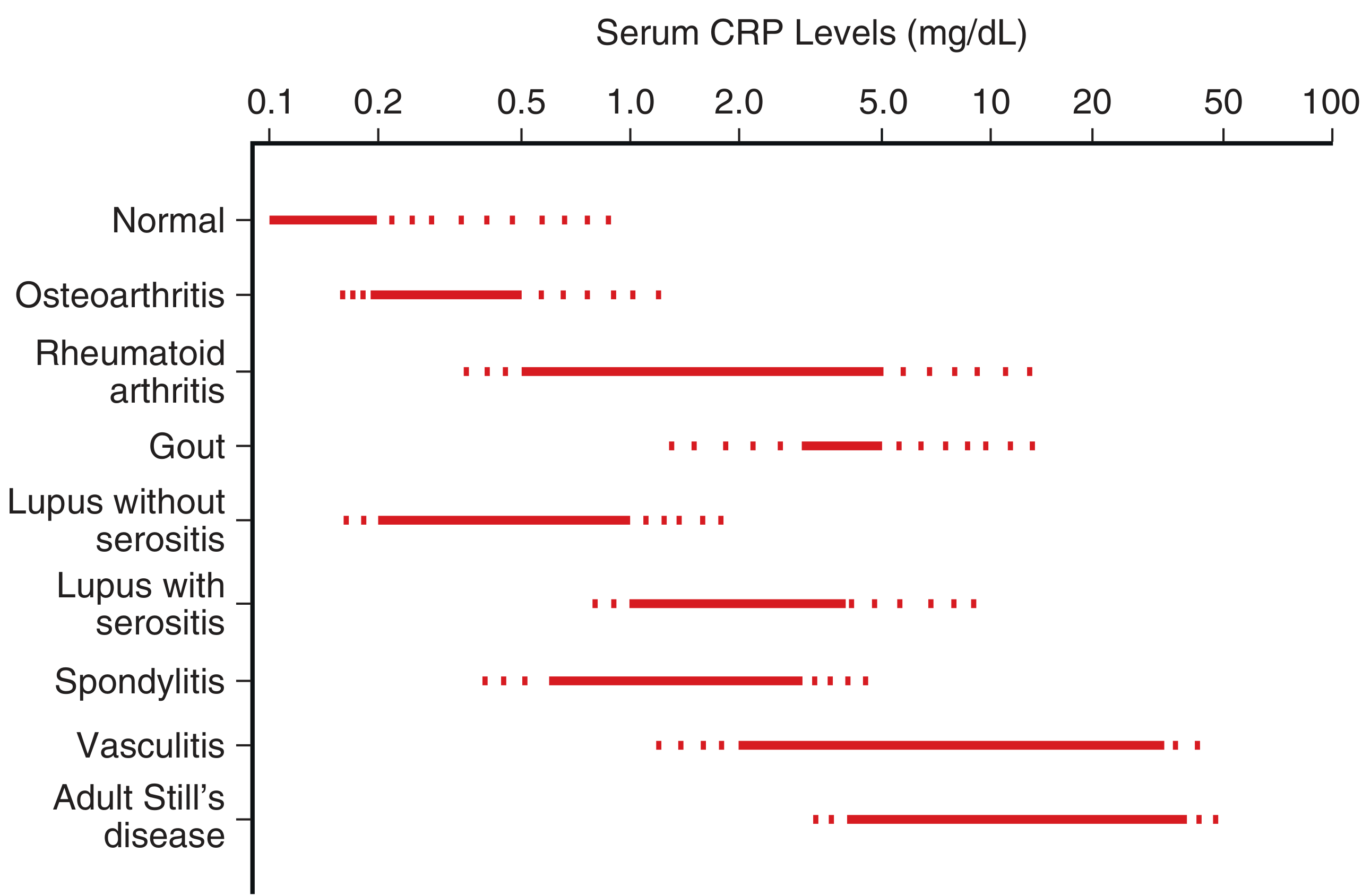
Note: SLE without serositis characteristically shows only modest CRP elevation - a very useful clinical pearl. Vasculitis and Adult Still's disease can push CRP to 50+ mg/dL.
CRP vs. ESR
| Feature | ESR | CRP |
|---|---|---|
| Response time | Slow | Rapid |
| Affected by age/sex | Yes | Relatively unaffected |
| Affected by anemia/polycythemia | Yes | No |
| Reproducibility | Lower | High |
| Requires fresh sample | Yes | Can use stored sera |
| Disadvantage | Reflects many proteins | Not sensitive to SLE disease activity |
- Firestein & Kelley's Textbook of Rheumatology
CRP in Infection
-
Estimated pooled sensitivity 75%, specificity 67% for differentiating bacterial from non-bacterial inflammation
-
CRP >500 mg/L: bacterial infection present in ~88% of cases
-
Used to guide antibiotic therapy decisions (e.g., COPD exacerbations, bone & joint infections in children)
-
CRP-guided antibiotic discontinuation (discontinue at 75% reduction from peak): shown to be non-inferior to fixed 7- or 14-day courses in gram-negative bacteremia
-
CRP improves with appropriate antibiotic therapy; persistently elevated levels associated with poor outcomes
-
Tietz Textbook of Laboratory Medicine, 7th Edition
CRP and Cardiovascular Disease
-
Higher baseline CRP is associated with increased risk of ASCVD and stroke
-
The Physicians' Health Study showed CRP averaged 1.51 mg/L in MI patients vs. 1.13 mg/L in controls
-
The 2019 ACC/AHA primary prevention guideline identifies CRP ≥2.0 mg/L as an "ASCVD risk enhancer" that may influence therapeutic decisions
-
Universal hs-CRP screening is not recommended
-
Most useful in patients with intermediate 10-year risk (10-20%) where additional information may guide therapy
-
Henry's Clinical Diagnosis and Management by Laboratory Methods
Measurement
- Measured by immunoassay or laser nephelometry
- High-sensitivity CRP (hs-CRP) methods are needed to accurately measure concentrations in the 0.3-1 mg/dL range
- No uniform reporting exists across labs (values may be in mg/L, μg/mL, or mg/dL - be careful with units)
- Population differences exist across sex and racial-ethnic groups in the US
This is a shared conversation. Sign in to Orris to start your own chat.