
from Guyton and Hall textbook of medical physiology, 4th South Asia edition write a 5 mark short note on Parathyroid hormone-functions,regulation
Reading File
Finding Sources
Finding Sources
Reading File
Reading File
Reading File
Reading File
Loading Image
Here is a complete 5-mark short note on Parathyroid Hormone - Functions and Regulation, drawn directly from Guyton and Hall Textbook of Medical Physiology (4th South Asia / 14th International Edition).
Parathyroid Hormone (PTH) - Functions and Regulation
(Guyton and Hall Textbook of Medical Physiology, pp. 988-990)
Introduction
Parathyroid hormone (PTH) is a polypeptide hormone synthesized and secreted by the chief cells of the four parathyroid glands, which lie immediately behind the thyroid gland. PTH is first synthesized as a preprohormone (110 amino acids), successively cleaved to a prohormone (90 amino acids) and then the active hormone (84 amino acids, MW ~9500). Fragments as small as 34 amino acids from the N-terminus retain full biological activity. PTH is the principal regulator of extracellular calcium and phosphate homeostasis.
Functions of PTH
PTH acts on three main target organs - bone, kidney, and intestine - to raise plasma calcium and lower plasma phosphate.
1. Effects on Bone
PTH mobilizes calcium and phosphate from bone by two phases:
- Rapid phase (osteolysis): Within minutes, PTH activates the osteocytic membrane system - a network of osteocytes and osteoblasts connected by long filmy processes. The osteocytic pump transfers calcium from bone fluid into extracellular fluid, rapidly raising plasma calcium.
- Slow phase (osteoclastic resorption): Over days to weeks, PTH stimulates proliferation and activity of osteoclasts, leading to bone resorption. This involves osteoclastic secretion of proteolytic enzymes and acids (via the cAMP-PKA pathway), dissolving bone matrix and releasing calcium and phosphate into the circulation.
With prolonged excess PTH, both osteoclastic resorption and secondary osteoblastic activity increase, but net resorption predominates.
2. Effects on the Kidney
- Increases calcium reabsorption: PTH enhances calcium reabsorption, mainly in the thick ascending loop of Henle and distal tubules, thereby reducing urinary calcium loss.
- Decreases phosphate reabsorption: PTH causes a strong phosphaturic effect by decreasing proximal tubular phosphate reabsorption, leading to increased urinary phosphate excretion (phosphaturia). This lowers plasma phosphate.
- PTH also increases reabsorption of magnesium while decreasing reabsorption of sodium, potassium, and amino acids.
3. Effects on the Intestine (Indirect - via Vitamin D)
PTH stimulates the renal enzyme 1-alpha-hydroxylase to convert 25-hydroxycholecalciferol to 1,25-dihydroxycholecalciferol (active vitamin D/calcitriol). This active form then greatly increases intestinal absorption of both calcium and phosphate.
4. Second Messenger Mechanism
The effects of PTH are largely mediated through the cAMP second messenger system. PTH binds its receptor on target cells, activates adenylyl cyclase, raises intracellular cAMP, and activates protein kinase A - which drives osteoclastic enzyme secretion and 1,25-dihydroxycholecalciferol synthesis in the kidney.
Regulation of PTH Secretion
PTH secretion is controlled primarily by plasma ionized calcium concentration via a classic negative feedback loop.
Calcium-Sensing Receptor (CaSR)
Parathyroid cell membranes contain a calcium-sensing receptor (CaSR), a G protein-coupled receptor. When plasma calcium rises, CaSR is stimulated and activates phospholipase C, increasing inositol triphosphate (IP₃) and diacylglycerol (DAG), which raises intracellular calcium from internal stores - this suppresses PTH secretion. When plasma calcium falls, CaSR is inhibited, PTH secretion increases.
Key Regulatory Points
| Stimulus | Effect on PTH |
|---|---|
| Low plasma Ca²⁺ | Strong increase in PTH |
| High plasma Ca²⁺ | Suppression of PTH |
| Prolonged hypocalcemia | Parathyroid gland hypertrophy (up to 5-fold) |
| Rickets, pregnancy, lactation | Gland enlargement due to mild Ca²⁺ fall |
Even a small decrease in plasma calcium (a fraction of 1 mg/dL) can double PTH secretion acutely, and with chronic hypocalcemia (via gland hypertrophy), this response is amplified further. This forms the basis of an extremely potent feedback system for long-term calcium homeostasis.
Summary Diagram
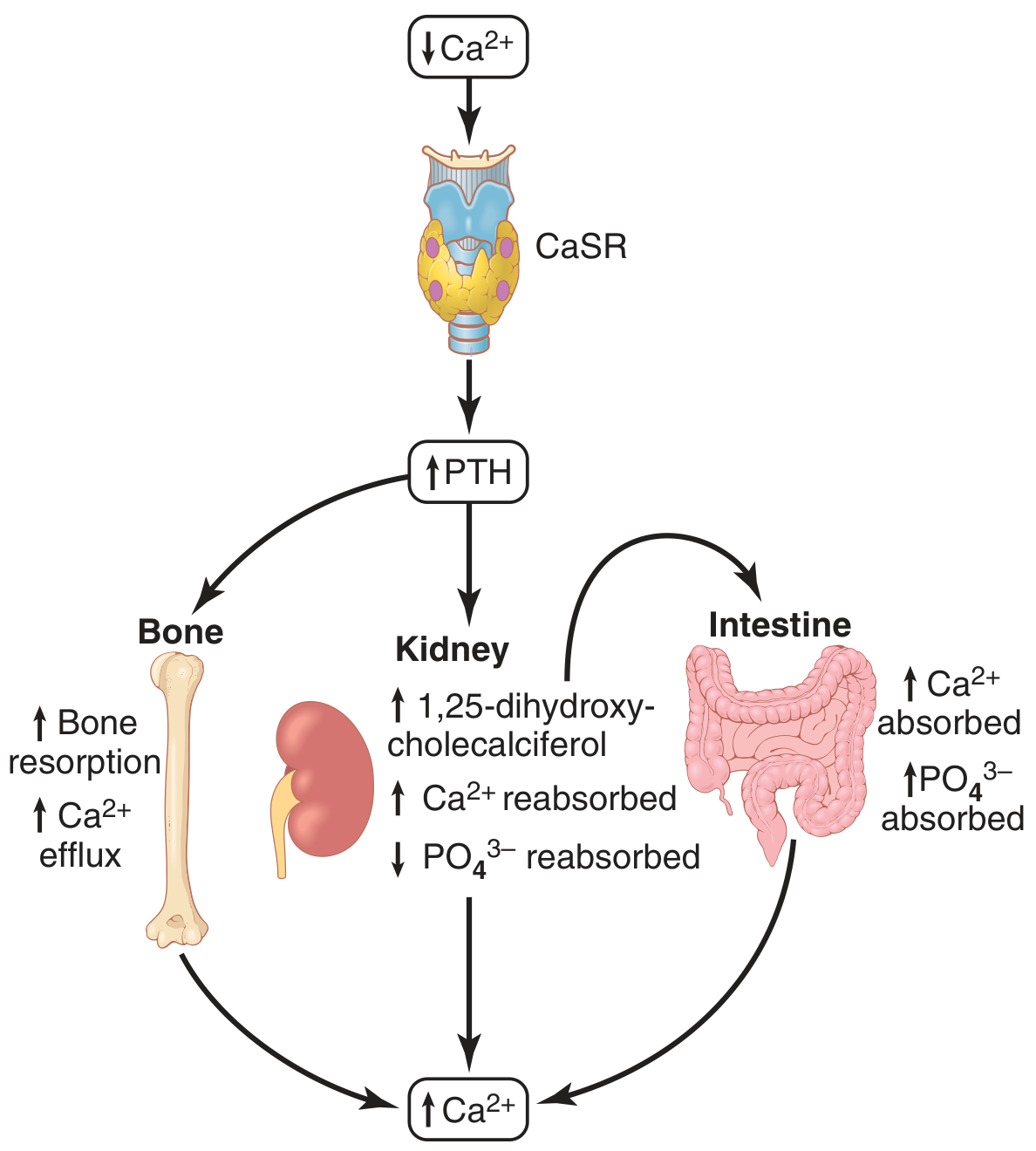
Fig. 80.15: When plasma Ca²⁺ falls, the parathyroid glands detect this via CaSR and secrete PTH. PTH then acts on bone (releases Ca²⁺), kidney (retains Ca²⁺, excretes PO₄³⁻, activates vitamin D), and intestine (absorbs Ca²⁺ and PO₄³⁻) to restore plasma calcium.
Key Points for 5 Marks
- PTH - 84 amino acid polypeptide from chief cells; raises plasma Ca²⁺, lowers plasma PO₄³⁻.
- Bone: Rapid osteolysis (osteocyte pump) + slow osteoclastic resorption - both release Ca²⁺.
- Kidney: Increases Ca²⁺ reabsorption (distal tubule/loop of Henle) + phosphaturia (proximal tubule); also activates vitamin D.
- Intestine: Indirect effect via 1,25-dihydroxycholecalciferol - increases Ca²⁺ and PO₄³⁻ absorption.
- Regulation: CaSR on parathyroid cells detects plasma Ca²⁺; low Ca²⁺ stimulates PTH, high Ca²⁺ suppresses it - tight negative feedback loop.
- Guyton and Hall Textbook of Medical Physiology, Chapter 80, pp. 988-990
This is a shared conversation. Sign in to Orris to start your own chat.