
Fraility index and its anaesthetic implications
frailty index perioperative anaesthesia outcomes
frailty perioperative outcomes surgery
frailty anesthesia postoperative delirium cognitive
frailty assessment Clinical Frailty Scale perioperative
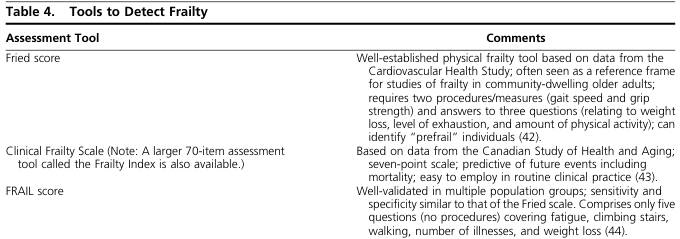
Table 4. Tools to Detect Frailty <table><thead><tr><th>Assessment Tool</th><th>Comments</th></tr></thead><tbody><tr><td>Fried score</td><td>Well-established physical frailty tool based on data from the Cardiovascular Health Study; often seen as a reference frame for studies of frailty in community-dwelling older adults; requires two procedures/measures (gait speed and grip strength) and answers to three questions (relating to weight loss, level of exhaustion, and amount of physical activity); can identify "prefrail" individuals (42).</td></tr><tr><td>Clinical Frailty Scale (Note: A larger 70-item assessment tool called the Frailty Index is also available.)</td><td>Based on data from the Canadian Study of Health and Aging; seven-point scale; predictive of future events including mortality; easy to employ in routine clinical practice (43).</td></tr><tr><td>FRAIL score</td><td>Well-validated in multiple population groups; sensitivity and specificity similar to that of the Fried scale. Comprises only five questions (no procedures) covering fatigue, climbing stairs, walking, number of illnesses, and weight loss (44).</td></tr></tbody></table>

<table><thead><tr><th>COR</th><th>LOE</th><th>RECOMMENDATION</th></tr></thead><tbody><tr><td>2a</td><td>B-NR</td><td>1. In all patients ≥65 years of age and in those <64 years with perceived frailty who are undergoing elevated-risk NCS, preoperative frailty assessment using a validated tool can be useful for evaluating perioperative risk and guiding management.<sup>1-5</sup></td></tr></tbody></table>
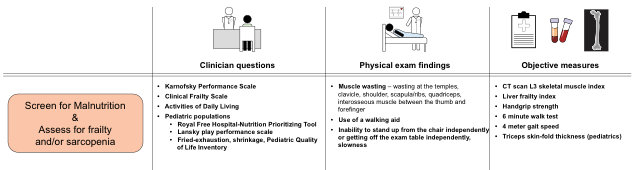
Summary : This figure outlines a structured approach for screening malnutrition and assessing frailty and/or sarcopenia, categorizing assessment methods into clinician questions, physical exam findings, and objective measures. flowchart: # Central Node : • "Screen for Malnutrition & Assess for frailty and/or sarcopenia" (rounded rectangle, orange background) # Assessment Categories : ## Clinician questions : • Karnofsky Performance Scale • Clinical Frailty Scale • Activities of Daily Living • Pediatric populations: – Royal Free Hospital-Nutrition Prioritizing Tool – Lansky play performance scale – Fried-exhaustion, shrinkage, Pediatric Quality of Life Inventory ## Physical exam findings : • Muscle wasting – wasting at the temples, clavicle, shoulder, scapula/abs, quadriceps, interosseous muscle between the thumb and forefinger • Use of a walking aid • Inability to stand up from the chair independently or getting off the exam table independently, slowness ## Objective measures : • CT scan L3 skeletal muscle index • Liver frailty index • Handgrip strength • 6 minute walk test • 4 meter gait speed • Triceps skin-fold thickness (pediatrics) # Layout : • The central node is on the left, with three columns to the right, each headed by an icon and a category title. • Each column lists specific tools or findings under its category. Analysis : • The figure provides a comprehensive, multi-modal framework for assessing malnutrition, frailty, and sarcopenia, integrating subjective clinician assessments, physical examination findings, and objective quantitative measures. The inclusion of pediatric-specific tools highlights adaptability for different populations. The structure encourages a systematic, multi-pronged evaluation.
frailty preoperative assessment surgical outcomes meta-analysis
Frailty Index and Its Anaesthetic Implications
1. Definition and Conceptual Framework
a) Fried Phenotype Model (Physical Frailty)
| Criterion | Operational Definition |
|---|---|
| Unintentional weight loss | >4.5 kg in the past year |
| Self-reported exhaustion | Positive answer on CES-D depression scale |
| Low physical activity | Lowest quintile of kcal/week expended |
| Slowness of gait | Slowest quintile for 15-foot walk |
| Reduced grip strength | Lowest quintile by gender and BMI |
- Pre-frail: 1-2 criteria present
- Frail: 3 criteria present
- This model predicts surgical outcomes including postoperative complications, length of stay, and discharge to skilled/assisted-living facilities, and augments ASA score, RCRI, and Eagle's cardiac risk index. (Miller's Anesthesia, 10e)
b) Deficit Accumulation Model (Rockwood Frailty Index)
FI = (number of deficits present) / (total deficits assessed)
2. Prevalence
- Frailty prevalence is <5% below age 70 years
- Rises steeply to >30% above age 80 years
- More common in women than men across all age groups
- More prevalent in populations with high rates of chronic disease and sociodemographic disadvantage
- In orthopedic surgery populations: ~33% of hip OA and ~24% of knee OA patients are frail; ~4% of spine surgery patients are frail (Miller's Anesthesia, 10e)
- A 2025 meta-analysis (PMID 41137434) found a significant prevalence of frailty among cardiac surgery patients
3. Frailty Assessment Tools Used Perioperatively
| Tool | Description | Time | Best Use |
|---|---|---|---|
| Clinical Frailty Scale (CFS) | 9-level pictorial scale (1=very fit, 9=terminally ill). Score ≥4 = frail | <1 min | Preferred - most feasible preoperatively |
| Modified Frailty Index (mFI) | 11-item index derived from the Canadian Study of Health & Aging | 5-10 min | Widely validated in surgical databases |
| FRAIL Scale | 5 questions: Fatigue, Resistance, Ambulation, Illness, Loss of weight | <3 min | Simple screening, no procedures needed |
| Edmonton Frail Scale | 11-item including clock drawing + Timed Up and Go | 5 min | Can be administered by non-medical staff |
| Robinson Criteria | Mini-Cog ≤3 + albumin ≤30 g/L + falls + HCT <35%; OR TUG ≥15s + ADL dependence + Charlson ≥3 | 5-10 min | Validated specifically for surgical patients |
| Groningen Frailty Indicator (GFI) | 15-item questionnaire | 5 min | Validated for arthroplasty patients |
4. Impact of Frailty on Surgical/Anaesthetic Outcomes
- Major postoperative complications (OR 1.58)
- Prolonged hospital stay (OR 1.89)
- Discharge to higher level of care (OR 2.29)
- 30-day mortality (OR 2.05 per 0.1 increase in frailty score) in spine surgery patients
- All studies in elderly orthopaedic patients report significant associations between frailty and adverse postoperative outcomes: surgical complications, length of stay, institutional discharge, and 30-day readmission
- Frailty is associated with 7.7% one-year mortality after elective orthopaedic surgery
- A 2024 meta-analysis (PMID 39725933) confirmed frailty significantly worsens outcomes after CABG
- A 2024 systematic review (PMID 39268763) confirmed preoperative frailty predicts postoperative complications after non-cardiac surgery
5. Pathophysiology Relevant to Anaesthesia
Pharmacokinetic Changes in Frail/Elderly Patients (Morgan & Mikhail, 7e)
- Onset of inhalation anaesthesia is faster when cardiac output is depressed
- Recovery may be prolonged due to increased volume of distribution (increased body fat) and decreased pulmonary gas exchange
- Sevoflurane and desflurane preferred for faster emergence
| Drug | Change in Frail/Elderly | Clinical Implication |
|---|---|---|
| Propofol | Nearly 50% lower blood levels needed; reduced rapidly-equilibrating peripheral compartment volume; reduced systemic clearance | Higher risk of apnoea and hypotension; reduce induction dose significantly |
| Etomidate | Decreased initial volume of distribution with aging | Lower doses required |
| Fentanyl/Alfentanil/Sufentanil | Primarily pharmacodynamic enhancement; dose requirements 50% lower | Reduce opioid doses by ~50% |
| Benzodiazepines | Increased volume of distribution (more body fat); prolonged elimination half-lives; enhanced pharmacodynamic sensitivity | Midazolam requirements ~50% less; half-life prolonged ~50%; avoid if possible due to delirium risk |
| Succinylcholine | Response not significantly altered | Standard dosing |
| Pancuronium | Decreased renal clearance | Prolonged recovery; avoid |
| Rocuronium/Vecuronium | Decreased hepatic excretion; prolonged elimination half-life | Prolonged duration |
| Atracurium/Cisatracurium | Not significantly affected by age | Preferred choice in frail patients |
- Epidural local anaesthetic spreads more extensively in older/frail patients
- Longer duration of action expected from a given dose of spinal local anaesthetic
6. Postoperative Delirium - The Most Critical Frailty-Anaesthesia Intersection
| Risk Group | Score | POD Incidence |
|---|---|---|
| Low | 0 | 3.8% |
| Intermediate | 1-2 | 11.1% |
| High | 3-4 | 37.1% |
- Increasing age, male gender
- Impaired cognition / dementia / mild cognitive impairment
- Frailty itself (predicts POD independently)
- Preoperative memory complaints
- Atherosclerosis, prior stroke/TIA
- Diabetes, hypertension, atrial fibrillation
- Low albumin, electrolyte abnormalities
- Benzodiazepine administration
- Prolonged hypotension
- Blood transfusion
- Long duration of anaesthesia
- Pain (undertreated OR overtreated with opioids)
- Hypoxaemia, low haematocrit
- Infection
- Sleep-wake disturbance
- Iatrogenic complications
- Avoid or minimise: Anticholinergic drugs, benzodiazepines, meperidine, metoclopramide, antidopaminergic antiemetics
- May be protective: A single bolus of ketamine 0.5 mg/kg has been suggested in one trial to reduce delirium incidence
7. Postoperative Cognitive Dysfunction (POCD)
- Up to 30% of older adult patients demonstrate abnormal neurobehavioral testing within the first week after surgery
- Frailty predicts POCD independently
- POCD may be independent of the type of anaesthesia or surgery at 3 months postoperatively
- 20% of older adults presenting for elective total joint arthroplasty demonstrate preoperative cognitive impairment (Morgan & Mikhail, 7e)
8. Comprehensive Geriatric Assessment (CGA)
- Burden of comorbidity - polypharmacy review
- Physical function - activities of daily living, instrumental ADLs
- Psychological status - depression screening (PHQ-2: up to 11% of those >71 years have depression)
- Nutrition - weight, albumin, BMI, sarcopenia assessment
- Risk of postoperative delirium - cognitive testing (Mini-Cog, clock drawing)
- Social support - post-discharge planning, caregiver availability
- Anxiety and substance use - common underdiagnosed conditions in older adults
9. Prehabilitation - Frailty as a Modifiable Risk Factor
- Preoperative rehabilitation (prehabilitation) programs have been introduced to reduce frailty and improve surgical outcome
- Evidence in TKA: decreased length of stay but not enhanced postoperative recovery
- Evidence in THA: improved outcomes though not yet robust
- A 2025 meta-analysis (PMID 40464827) found prehabilitation in frail patients undergoing cancer surgery improved outcomes
- A 2024 systematic review (PMID 38671345) evaluated multicomponent perioperative interventions to improve outcomes for frail patients
- Resistance and aerobic exercise
- Nutritional optimisation (protein supplementation, caloric enhancement)
- Psychological preparation
- Smoking cessation, alcohol reduction
10. Anaesthetic Management Principles in Frail Patients
| Domain | Key Recommendation |
|---|---|
| Preoperative | Use CFS or validated frailty tool; perform CGA; optimise nutrition (albumin); review polypharmacy; stop unnecessary anticholinergics and benzodiazepines preoperatively |
| Choice of technique | Regional anaesthesia preferred where feasible to reduce delirium, opioid requirements, and haemodynamic instability |
| Induction | Reduce propofol induction dose (~50% of standard); slower titration; anticipate hypotension |
| Maintenance | Prefer rapidly-eliminated volatiles (sevoflurane/desflurane) or TIVA with careful titration; use processed EEG monitoring (BIS/entropy) to avoid over-anaesthesia |
| Muscle relaxants | Prefer atracurium or cisatracurium; use quantitative neuromuscular monitoring; ensure full reversal |
| Opioids | Reduce doses by ~50%; use multimodal analgesia; minimise opioid burden postoperatively |
| Benzodiazepines | Avoid premedication with benzodiazepines; strong delirium risk |
| Temperature | Active warming - frail patients are more susceptible to hypothermia |
| Haemodynamics | Avoid prolonged hypotension; target organ-protective MAP; judicious fluid therapy |
| Postoperative | Non-pharmacological delirium prevention bundles (HELP protocol); early mobilisation; adequate pain control; optimise sleep |
| Palliative/Goals of care | Frailty supports earlier palliative care involvement and shared decision-making about the goals of surgery (Miller's Anesthesia, 10e) |
Summary
- Identifies high-risk patients who need CGA, optimisation, and individualised plans
- Predicts specific complications: POD, POCD, prolonged stay, ICU admission, discharge to care, mortality
- Demands pharmacological adjustment: reduced doses of nearly all anaesthetic drugs, preference for short-acting agents
- Guides technique selection: regional anaesthesia preferred; processed EEG monitoring for depth of anaesthesia
- Is potentially modifiable through prehabilitation prior to elective surgery
- Informs goals-of-care conversations when risk-benefit ratios are unfavourable