
Explain aetcom 2.8 in detail
AETCOM 2.8 module medical education India ethics
https://www.nmc.org.in/wp-content/uploads/2020/01/AETCOM_boo…
https://www.ijbcp.com/index.php/ijbcp/article/view/6266
AETCOM Module 2.8 - "What Does It Mean to Be a Family Member of a Sick Patient?"
Overview
Background and Rationale
- Understanding the support systems of patients
- Recognizing the priorities, coping mechanisms, and emotions of families
- Clarifying the role of the doctor in relation to the family
- Exploring the difference between empathy and equanimity
- Understanding the distinction between healing and curing
Competency Addressed
| Competency | Level |
|---|---|
| Demonstrate empathy in patient encounters | SH (Skill with Help) |
Learning Experience
Session Structure:
- Hospital visit and interviews - 2 hours
- Self-Directed Learning (SDL) - 2 hours
- Small group discussion - 1 hour
- Closure/debrief session - 1 hour
Core Conceptual Themes
1. Empathy vs. Equanimity
-
Empathy is the ability to understand and share the feelings of another - to feel with someone. In a medical context, it means recognizing the emotional and psychological burden of a caregiver, not just the clinical condition of the patient.
-
Equanimity is mental calmness and composure, especially in difficult situations. It is the ability to remain emotionally regulated and professionally steady while still being empathetic. Without equanimity, a doctor can become overwhelmed or burned out; without empathy, a doctor becomes detached and cold.
2. Healing vs. Curing
- Curing is the biomedical goal: eradicating disease, restoring normal function.
- Healing is broader: addressing psychological, social, and spiritual dimensions of suffering.
3. The Caregiver's Perspective
- Emotional burden - fear, grief, helplessness, hope
- Financial burden - cost of hospitalization, medicines, lost income
- Physical burden - sleeplessness, neglecting their own health
- Informational burden - not understanding medical jargon, unclear prognosis
- Relational burden - role changes within the family
4. The Doctor's Role Toward the Family
- Providing clear, jargon-free updates on the patient's condition
- Acknowledging the family's emotional state
- Involving the family appropriately in care decisions
- Being honest about prognosis without being cruel
Learning Activities in Detail
Hospital Visit and Interviews (2 hours)
- What brought the family member to the hospital?
- How long have they been accompanying the patient?
- What has been most difficult?
- What do they wish the doctors would do differently?
Self-Directed Learning (2 hours)
- Caregiver burden scales and literature
- Palliative care and family-centered care
- Narratives written by family members of sick patients (illness narratives)
- Cultural differences in family roles during illness in India
Small Group Discussion (1 hour)
- How they felt during the interviews
- What surprised them
- Ethical dilemmas around truth-telling to families
- How cultural and socioeconomic factors shape the caregiver experience
Discussion and Closure (1 hour)
Assessment
- Reflective journals or written narratives post-hospital visit
- Observed participation in role-plays depicting doctor-family communication
- Portfolio entries
- Structured questionnaires measuring empathy and equanimity (e.g., validated Likert-scale tools)
- Overall empathy scores increased significantly from 57.9 to 62.7 (p<0.001)
- Improvements in understanding caregivers' challenges: +1.3 points
- Improvements in communication and professionalism: +0.9 points
- Improvements in equanimity: +1.3 points
- Neutral and negative responses decreased by over 35%
- Qualitative reflections showed increased awareness of caregivers' holistic burdens
Why This Module Matters
- Building professional empathy before it can be eroded by clinical desensitization
- Teaching students to see the family as part of the care unit, not a logistical obstacle
- Developing communication skills specific to family interactions - different from patient communication
- Fostering reflective practice through experiential learning rather than passive lectures
Position Within the AETCOM Curriculum
Diagram of candidia from apurva essential of microbiology
Detailed labeled scientific diagram of Candida albicans showing all morphological forms: blastoconidia (budding yeast cells, oval 3-6 micrometers), pseudohyphae (elongated buds pinched at septa), true hyphae (parallel walls with true septa), germ tube (short tube projecting from yeast cell without constriction at base), and terminal chlamydospores (large thick-walled round spores at tips of pseudohyphae). Also show the life cycle dimorphism: yeast form at room temperature and hyphal form at 37 degrees Celsius in serum. Include arrows indicating germ tube test. Clear white background, medical textbook style, black line art with labels pointing to each structure. Title: "Candida albicans - Morphological Forms"
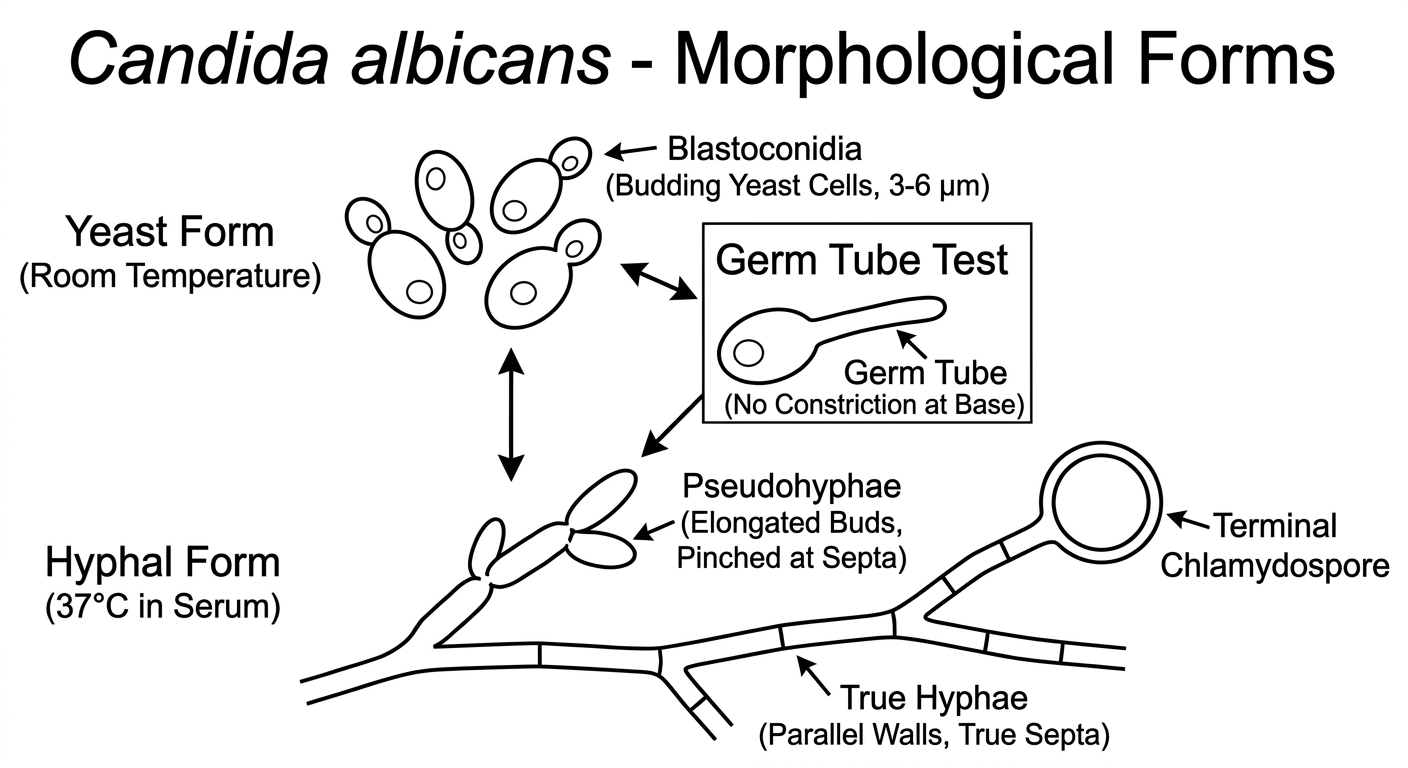
Candida albicans - Morphological Forms
1. Blastoconidia (Budding Yeast Cells)
- Oval to round cells, 3-6 µm in diameter
- Reproduce by budding
- Predominant form at room temperature (25°C)
- Found on routine culture and in vaginal/oral infections
- Gram-positive staining (purple on Gram stain)
2. Pseudohyphae
- Formed when blastoconidia elongate and remain attached end to end without fully separating
- Show constrictions (pinching) at the septa - key distinguishing feature from true hyphae
- Irregular diameter throughout length
- Most Candida species (except C. glabrata) can form pseudohyphae
3. True Hyphae
- Parallel walls with no constriction at septa
- C. albicans is unique among pathogenic Candida in forming true hyphae
- Seen in invasive tissue infections
- Represent the invasive, virulent form
4. Germ Tube (Reynold-Braude Phenomenon)
- A short, tube-like projection from the yeast cell
- No constriction at the base - distinguishes it from pseudohyphae
- Produced when C. albicans is incubated in human serum at 37°C for 60-90 minutes
- Germ tube test is positive only for C. albicans (and rarely C. dubliniensis)
- Forms the basis of the germ tube test for rapid presumptive identification
5. Chlamydospores (Chlamydoconidia)
- Large, round, thick-walled spores (8-12 µm)
- Located terminally (at tips) or intercalary on pseudohyphae
- Produced on nutritionally deficient media (cornmeal agar with Tween 80) at 25°C
- Seen only in C. albicans and C. dubliniensis among pathogenic species
- Used for identification on cornmeal agar
Dimorphism Summary Table
| Condition | Form |
|---|---|
| 25°C, normal nutrients | Blastoconidia (yeast) |
| 37°C in serum (90 min) | Germ tube → true hyphae |
| Cornmeal agar, 25°C | Pseudohyphae + chlamydospores |
| Host tissue (invasive) | True hyphae + pseudohyphae |
Key Points for Exams (Apurva-style)
- C. glabrata - only yeast forms, no pseudohyphae
- Germ tube test distinguishes C. albicans from other Candida spp.
- Chlamydospores = confirmatory identification on cornmeal agar
- Candida is the only endogenous opportunistic fungal pathogen (part of normal flora)
- CHROM agar: C. albicans produces green colonies; C. tropicalis blue; C. krusei pink