
Explain Mobitz Type 1 block.
Reading File
Finding Sources
Searching PubMed
"Mobitz Type I" AND "atrioventricular block"
Searching the Web
Mobitz type I second degree AV block Merck Manual Wenckebach
Reading File
Mobitz type I block, also called Wenckebach phenomenon, is a form of second-degree atrioventricular (AV) block.
What happens?
The AV node progressively delays conduction of atrial impulses to the ventricles until one impulse fails to conduct.
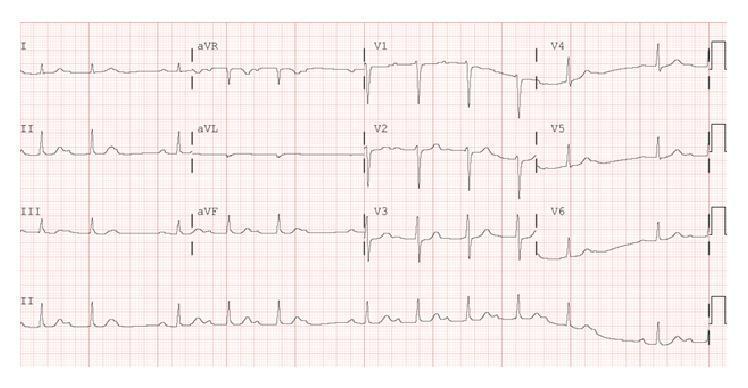
On ECG, this produces the repeating pattern:
- PR interval gets progressively longer
- A P wave occurs without a following QRS complex: a dropped ventricular beat
- The next conducted beat has the shortest PR interval
- The sequence repeats
Example:
PR 0.18 s → 0.22 s → 0.28 s → P wave with no QRS → PR resets to 0.18 s.
PR 0.18 s → 0.22 s → 0.28 s → P wave with no QRS → PR resets to 0.18 s.
Where is the block?
Usually at the AV node. The PR interval largely reflects AV nodal delay, so progressively worsening nodal conduction produces the characteristic ECG pattern. Goldman-Cecil Medicine, p. 559.
Common settings and causes
It can be a normal, transient finding, particularly with high vagal tone:
- Sleep
- Young healthy people and endurance athletes
- Increased vagal stimulation
- AV nodal blocking medicines: beta-blockers, verapamil/diltiazem, digoxin
- Inferior myocardial ischemia/infarction
- Myocarditis, including Lyme carditis
Clinical importance
Mobitz I is often benign, especially if the QRS complex is narrow and the person has no symptoms. It may cause no symptoms, or may cause fatigue, dizziness, presyncope, or syncope if the ventricular rate becomes too slow. A Merck Manual review notes that it often requires no treatment unless symptomatic bradycardia occurs.
Management in principle
- Look for and correct a reversible cause, especially AV nodal blocking drugs or ischemia.
- Observe if asymptomatic and stable.
- If symptomatic bradycardia occurs, urgent clinical assessment is needed; atropine may be used in an acute setting.
- Permanent pacing is usually not needed for asymptomatic AV nodal Mobitz I, but may be considered if block is symptomatic, persistent, or suspected to be below the AV node.
Distinguish it from Mobitz II
| Feature | Mobitz I | Mobitz II |
|---|---|---|
| PR interval | Progressively lengthens | Constant before dropped beat |
| Usual site | AV node | His-Purkinje system |
| QRS | Usually narrow | Often broad |
| Risk of complete heart block | Lower | Higher |
| Pacemaker requirement | Usually no | Often yes |
A simple mnemonic: “Longer, longer, longer, drop, then reset” = Mobitz I.
This is a shared conversation. Sign in to Orris to start your own chat.