
/handwritten notes of jacobson relaxation technique
Jacobson progressive muscle relaxation technique steps
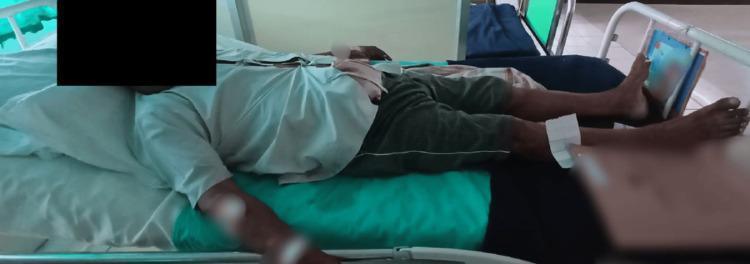
This clinical photograph illustrates a patient performing Jacobson's Progressive Muscle Relaxation (PMR) technique as part of a pulmonary or cardiac rehabilitation program. The patient is positioned supine in a hospital bed, with a white pillow under the head and a turquoise moisture-wicking pad beneath the torso. The arms are extended along the sides of the body with palms facing upward to facilitate full muscle relaxation. A white medical dressing is visible on the right lower leg, just below the knee, and a clinical chart is positioned at the foot of the bed. This visual demonstrates the application of non-pharmacological interventions for managing anxiety and respiratory stress in an inpatient setting. The technique focuses on the systematic tensing and subsequent relaxing of specific muscle groups to reduce physiological arousal. This image is relevant for physical therapy, cardiopulmonary rehabilitation, and psychiatric nursing education regarding stress-management protocols in clinical environments.
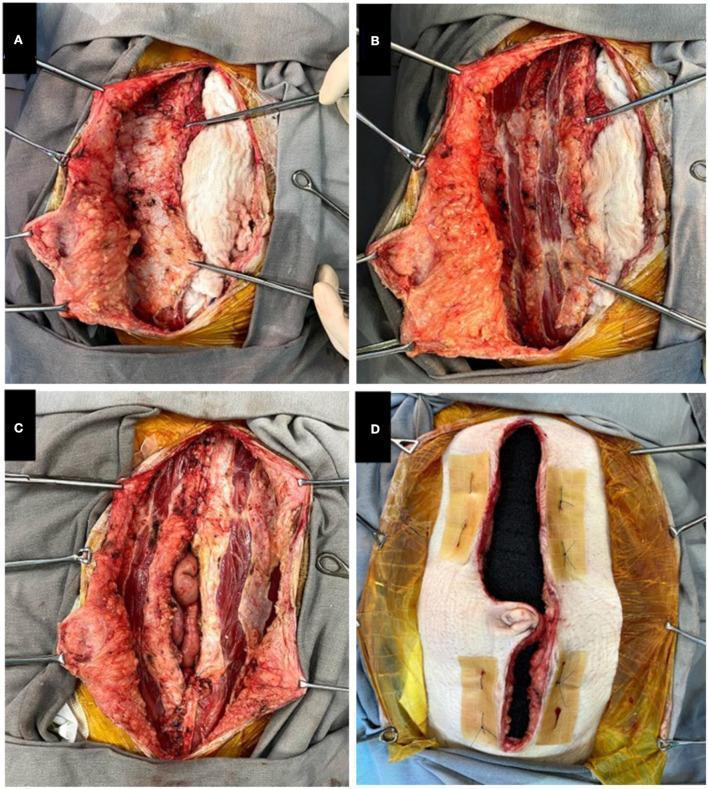
A series of four intraoperative clinical photographs (Panels A–D) documenting a surgical technique for abdominal wall closure, likely following intestinal transplantation. Panel A illustrates the initial 'components separation' technique, where the skin and subcutaneous fat are dissected away from the underlying musculature. Panel B shows 'relaxation incisions' made in the anterior sheath of the rectus abdominis muscle to increase fascia mobility. Panel C demonstrates the progressive approximation of the midline aponeurotic and skin edges using non-absorbable sutures, reducing the central defect. Panel D displays the application of a vacuum-assisted closure (VAC) system; black polyurethane foam is placed in the remaining wound defect, and the surrounding skin is protected by hydrocolloid plaques. Tension-relieving 'U' stitches are visible, along with clear adhesive drapes used to maintain a negative pressure seal. This sequence teaches a staged approach to complex abdominal wall reconstruction, emphasizing the management of large defects and the integration of negative pressure wound therapy (NPWT).
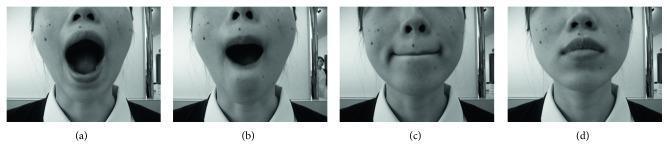
This sequence of four clinical photographs (a-d) demonstrates a specific therapeutic exercise for the relaxation of the masticatory system, commonly used in the management of temporomandibular disorders (TMD) and orofacial pain. The series illustrates a progressive movement protocol: (a) maximally wide mouth opening (abduction of the mandible) during inhalation; (b) partial closure with the lips rolled inward over the teeth; (c) complete mouth closure with the lips maintaining an inward-rolled position; and (d) a final neutral resting state where the jaw, masticatory muscles, and tongue are relaxed, ensuring there is no occlusal contact (teeth not clenching). The images serve as an educational guide for patients to perform neuromuscular re-education of the jaw, focusing on controlled movement and muscle de-tensioning. This procedural clinical imaging highlights the anatomical positioning of the perioral region and the functional range of motion of the mandible during rehabilitative therapy.
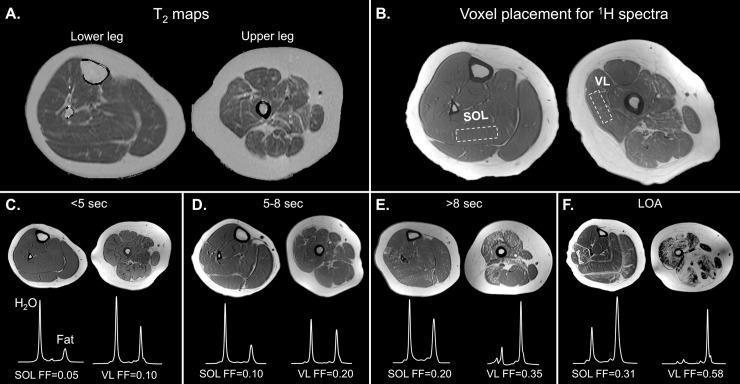
This composite diagnostic image demonstrates muscle pathology in the lower extremities using MRI and proton Magnetic Resonance Spectroscopy (1H MRS). Panel A displays axial T2 maps of the lower leg (calf) and upper leg (thigh), showcasing muscle segmentation for T2 relaxation time analysis. Panel B shows T1-weighted images identifying voxel placement for 1H MRS within the soleus (SOL) and vastus lateralis (VL) muscles. Panels C-F illustrate a progressive clinical spectrum of Duchenne Muscular Dystrophy (DMD) or similar myopathy, organized by functional ambulatory status (10m walk/run times: <5s, 5-8s, >8s, and Loss of Ambulation/LOA). These panels correlate T1-weighted anatomical imaging with MR spectra and Fat Fraction (FF) values. Visually, there is a clear progression of high-intensity signal within the muscle compartments, representing fibrofatty replacement. This infiltration is confirmed by the 1H MRS peaks, where the fat-to-water ratio increases significantly from panel C (FF 0.05-0.10) to panel F (FF 0.31-0.58), correlating increased fatty infiltration with decreased ambulatory function.
Handwritten-style study notes on "Jacobson's Progressive Muscle Relaxation (PMR) Technique" on a lined paper background. Include these sections neatly written with headings, subheadings, arrows, and bullet points: TITLE (underlined): Jacobson's Progressive Muscle Relaxation (PMR) Section 1 - HISTORY: • Developed by Edmund Jacobson in 1929 • Observed: even at "rest," patients have residual muscle tension • Coined "tenseness" (patient's active role) vs "tension" • Original method: 50+ sessions, one muscle group per session Section 2 - PRINCIPLE (with a small brain/muscle icon): • Relaxation = opposite of tension • 4 elements of relaxation: 1. Immobility of body 2. Control of attention 3. Low muscle tone 4. Contemplative, nonjudgmental mindset • Relaxation ↑ parasympathetic activity → ↓ sympathetic arousal Section 3 - TECHNIQUE (boxed): Step 1: Tense a specific muscle group (5–6 seconds) Step 2: Release / Relax (20–30 seconds) Step 3: Notice the difference between tension and relaxation Step 4: Repeat with the next muscle group SESSION 1: Hands → Arms → Face → Neck → Shoulders SESSION 2: Back → Chest → Stomach → Hips → Legs → Feet Section 4 - WOLPE'S MODIFICATION (abbreviated): • Shortened to 20 minutes (practical for desensitization) • All major muscle groups in 2 sessions • Used in Systematic Desensitization Section 5 - ADVANCED STAGES (Applied Relaxation by Öst): 1. Progressive relaxation 2. Release-only relaxation (omit tension phase; 5–7 min) 3. Cue-controlled relaxation (word "Relax" on exhalation) 4. Differential relaxation (relax while moving) 5. Rapid relaxation (1–3 breaths, 20–30 sec) 6. Application training 7. Maintenance Section 6 - INDICATIONS: • Anxiety disorders (GAD, Panic disorder) • Insomnia / Sleep disorders • Headache, chronic pain • Stress, hypertension • Systematic desensitization Section 7 - SIDE EFFECTS (red pen): • Muscle soreness/strain • Depersonalization (if prolonged) • Relaxation-induced panic (in panic disorder patients) Use blue and red ink colors on white lined paper, with neat handwriting style, boxes around key steps, and small doodles/icons for visual learning
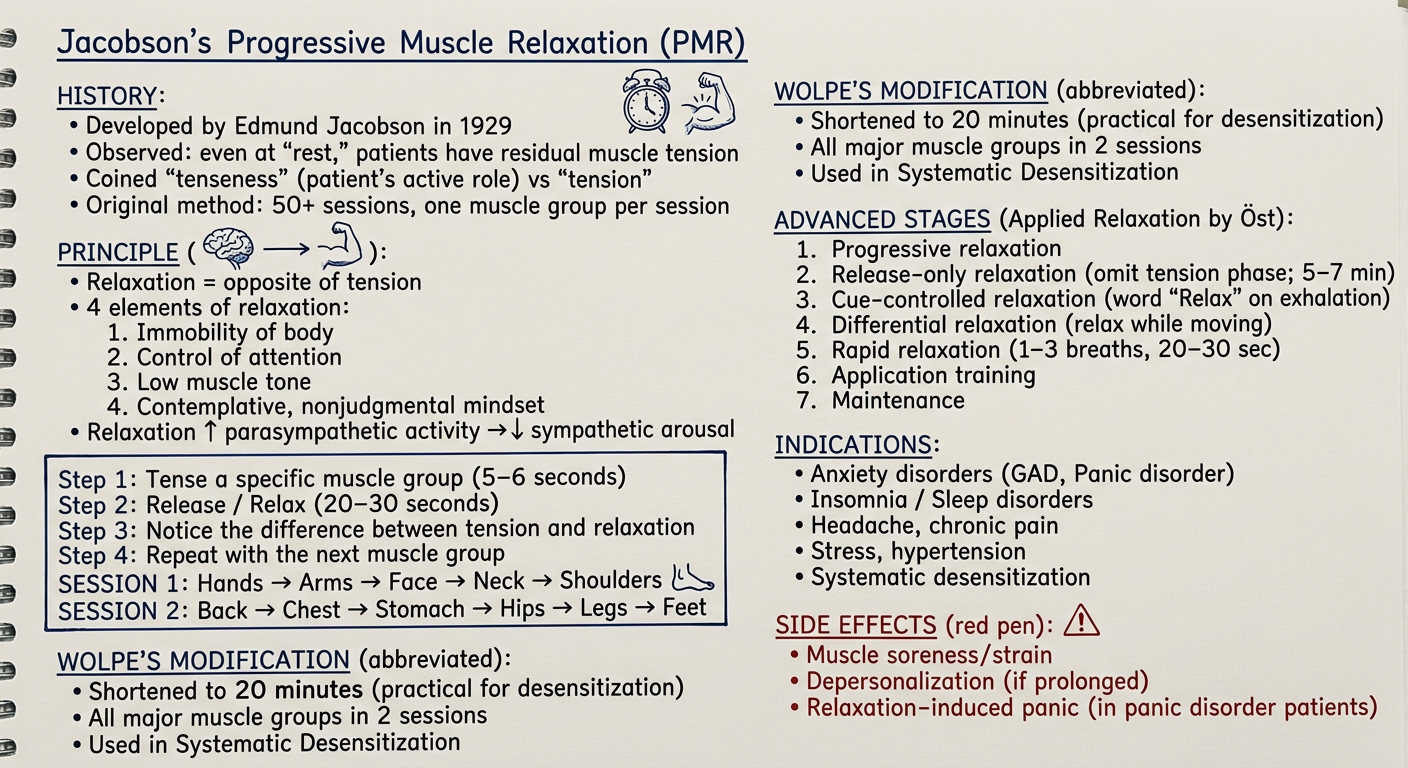
Jacobson's Progressive Muscle Relaxation (PMR)
History & Background
- Developed by Edmund Jacobson in 1929
- He observed that even when lying "relaxed," patients show signs of residual muscle tension (irregular respiration, elevated pulse, eye movements)
- Jacobson used the term "tenseness" (rather than tension) to emphasize the patient's active role in contracting muscles
- Original method was extensive: up to 50+ sessions, with entire sessions dedicated to a single muscle (e.g., just the biceps)
Core Principle
"Making an effort is being tense - therefore it is not relaxing."
- Immobility of the body
- Control over the focus of attention
- Low muscle tone
- A contemplative, nonjudgmental, mindful frame of mind
Basic Technique (Tense-Relax Cycle)
| Step | Action | Duration |
|---|---|---|
| 1 | Tense the target muscle group | 5-6 seconds |
| 2 | Release/Relax the muscle | 20-30 seconds |
| 3 | Notice the contrast between tension and relaxation | - |
| 4 | Move to the next muscle group | - |
- Session 1: Hands → Arms → Face → Neck → Shoulders
- Session 2: Back → Chest → Stomach → Breathing → Hips → Legs → Feet
Wolpe's Abbreviated Modification
- Joseph Wolpe adapted PMR for use in Systematic Desensitization
- Shortened to 20 minutes per session (practical for clinical use)
- All major muscle groups covered in just 2 sessions
- PMR serves as a response incompatible with anxiety
Applied Relaxation - Öst's 7-Phase Program
- Progressive relaxation - classic tense-relax
- Release-only relaxation - omit the tension phase; achieves relaxation in 5-7 min
- Cue-controlled relaxation - associate the word "Relax" with exhalation; conditioned response
- Differential relaxation - remain relaxed while moving; relax muscles not involved in the activity
- Rapid relaxation - 1-3 slow breaths thinking "relax"; achieves relaxation in 20-30 seconds
- Application training - practice entering stressful situations while applying relaxation
- Maintenance
Clinical Indications
- Anxiety disorders (GAD, Panic Disorder)
- Insomnia and sleep disorders
- Headache and chronic pain
- Stress management
- Hypertension
- As a component of Systematic Desensitization
- Postsurgical distress
Side Effects (Rare)
- Muscle soreness or strain
- Depersonalization (if practiced many hours continuously)
- Relaxation-induced panic attacks (in patients with Panic Disorder who are sensitized to physical sensations)
Give me in detail handwritten notes chart
Detailed handwritten medical study notes chart on cream/off-white lined notebook paper. Title at the top in large bold blue ink with double underline: "JACOBSON'S PROGRESSIVE MUSCLE RELAXATION (PMR) — PART 1" Use blue ink for main text, red ink for headings and important words, pencil-style for boxes and arrows. Neat student handwriting style. --- SECTION 1: HISTORY (red heading, underlined) --- • Edmund Jacobson (1929) — American physiologist • Observed: even when "relaxed," patients show RESIDUAL TENSION: - Irregular respiration - Eye movements during mental activity - Slight muscle contractions • Key term: "TENSENESS" (not tension) → patient's active role • Quote: "This is your doing! What we wish is the reverse — simply NOT doing." • Original program: 50+ sessions, one muscle group per session (e.g., entire session = only biceps) • Used instruments: No feedback devices; relied purely on patient's muscle sense --- SECTION 2: THEORETICAL BASIS (red heading) --- Draw small diagram: Brain → ANS • PMR ↑ Parasympathetic activity • ↓ Sympathetic arousal → ↓ Heart rate, ↓ BP, ↓ muscle tension • Operant conditioning of the autonomic nervous system • Reciprocal Inhibition: relaxation is physiologically incompatible with anxiety 4 ELEMENTS OF RELAXATION (boxed): ① Immobility of the body ② Control over focus of attention ③ Low muscle tone ④ Contemplative, nonjudgmental, mindful state --- SECTION 3: BASIC TECHNIQUE (red heading) --- Draw a simple flowchart: [Assume comfortable position] → [Focus on muscle group] → [TENSE 5-6 sec] → [RELEASE → RELAX 20-30 sec] → [Notice the contrast] → [Next muscle group] Key notes: • No effort required — "Effort = tension = NOT relaxing" • Patient lies supine, eyes closed • Therapist speaks tersely to not distract patient's focus • Patients often left alone to focus on sensations --- SECTION 4: MUSCLE GROUP SEQUENCE (red heading) --- Draw a simple body outline with arrows: SESSION 1 (Head downward): Hands (fist) → Forearms → Upper arms (biceps) → Face (forehead, eyes, jaw) → Neck → Shoulders SESSION 2 (Trunk & lower body): Back → Chest → Abdomen/Stomach → Breathing (diaphragm) → Hips/Buttocks → Thighs → Legs → Feet (curl toes) --- SECTION 5: WOLPE'S MODIFICATION (red heading, star symbol) --- ★ Joseph Wolpe adapted PMR for SYSTEMATIC DESENSITIZATION • Shortened to 20 min/session • All muscle groups in just 2 sessions • PMR = response INCOMPATIBLE with anxiety • Used as anxiety counterconditioning agent Add a small note box: "Systematic Desensitization = PMR + Anxiety Hierarchy + Graduated Exposure" Use consistent handwriting, draw small stars ★ and arrows →, underline key terms, circle important numbers. Leave some margin doodles of a brain and muscle arm icon.
Detailed handwritten medical study notes chart on cream/off-white lined notebook paper. Title at the top in large bold blue ink with double underline: "JACOBSON'S PMR — PART 2: ADVANCED STAGES, APPLICATIONS & CLINICAL NOTES" Use blue ink for main text, red ink for headings and important words, green ink for indications, neat student handwriting style with boxes, stars, arrows. --- SECTION 1: ÖST'S APPLIED RELAXATION (7 PHASES) (red heading, boxed) --- "Applied Relaxation = eliciting relaxation IN the stressful situation itself" Developed by Lars-Göran Öst (Sweden) — proven for Panic Disorder & GAD Draw numbered steps like a staircase going up: PHASE 1 — Progressive Relaxation • Classic tense-relax all muscle groups • Takes 15–20 min PHASE 2 — Release-Only Relaxation • OMIT the tension phase • Patient learns to relax without tensing first • Achieves relaxation in 5–7 min PHASE 3 — Cue-Controlled Relaxation • Associate word "RELAX" with exhalation • Therapist says "inhale" before breath in, "relax" before breath out • After ~5 cycles, patient self-cues • Conditioned relaxation response PHASE 4 — Differential Relaxation • Relax muscles NOT involved in a movement • Practice: lifting arm while keeping rest of body relaxed • Then: writing, talking on phone, walking — while staying relaxed PHASE 5 — Rapid Relaxation • 1–3 slow breaths, think "RELAX" on each exhale • Scan body for tension • Achieves full relaxation in 20–30 seconds • Practice 15–20 times/day at natural cues (looking at watch, phone ringing) • Tip: Colored dot stickers as reminders → change color periodically to keep fresh PHASE 6 — Application Training • Enter the feared/stressful situation while relaxed • Stay 10–15 min, use relaxation as coping • Therapist may accompany initially • For panic: induce feared sensations via imagery/exercise → apply relaxation PHASE 7 — Maintenance • Continue daily practice • Generalize to all life situations --- SECTION 2: CLINICAL INDICATIONS (green heading with checkmarks) --- ✓ Generalized Anxiety Disorder (GAD) ✓ Panic Disorder ✓ Insomnia / Sleep disturbances ✓ Chronic headache & migraine ✓ Chronic pain management ✓ Hypertension ✓ Postsurgical distress ✓ Dysmenorrhea ✓ Athletic performance enhancement ✓ Stress management ✓ As part of Systematic Desensitization --- SECTION 3: SIDE EFFECTS (red heading with exclamation mark !) --- ⚠ Muscle soreness or strain ⚠ Depersonalization — if practiced continuously for many hours/day ⚠ Relaxation-induced panic attacks — in Panic Disorder patients sensitized to physical sensations ⚠ Trauma re-experiencing — during general relaxation or visualization --- SECTION 4: COMPARISON TABLE (red heading) --- Draw a small hand-drawn table with 3 columns: | Feature | Jacobson's Original | Wolpe's Modified | |---------|-------------------|-----------------| | Sessions | 50+ | 2 sessions | | Duration | Very long | 20 min | | Focus | 1 muscle/session | All groups | | Use | Standalone | Desensitization | --- SECTION 5: MEMORY AID (boxed, star) --- ★ MNEMONIC: "T-R-C-D-R-A-M" T = Tense-relax (Progressive) R = Release-only C = Cue-controlled D = Differential R = Rapid A = Application training M = Maintenance --- SECTION 6: RELATED TECHNIQUES (blue heading) --- • Autogenic Training — self-suggestion: "My arm is heavy/warm" • Biofeedback-assisted relaxation — real-time physiologic feedback • Guided imagery — visualize pleasant scenes • Deep breathing / Diaphragmatic breathing • Self-hypnosis — relaxation by verbal/nonverbal cue Source note at bottom: Kaplan & Sadock's Synopsis of Psychiatry, pp. 2337–2343 Use consistent neat handwriting, colored headings, small icons, arrows, stars ★ and checkmarks ✓ throughout. Staircase diagram for the 7 phases.
📋 Chart 1 — History, Theory, Basic Technique & Muscle Sequence
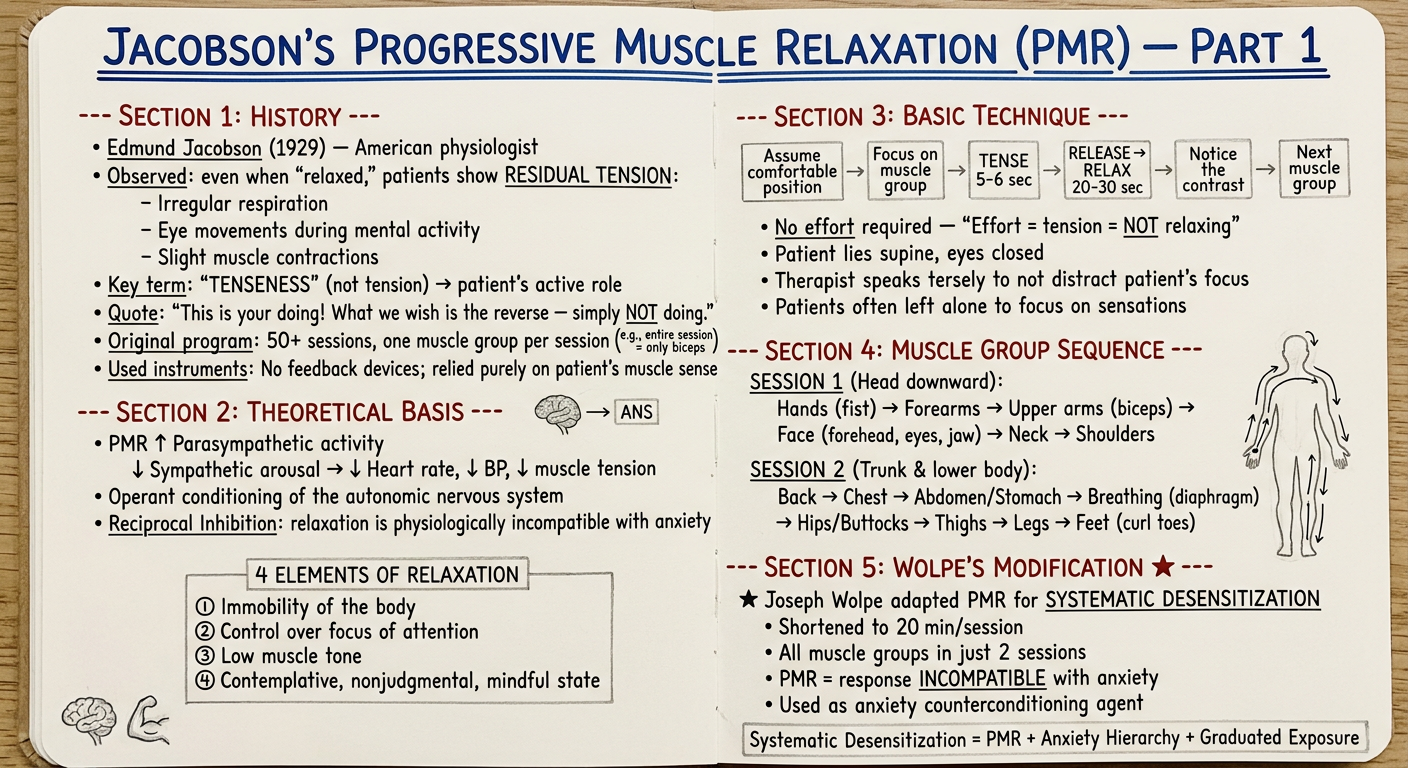
📋 Chart 2 — Öst's 7 Phases, Indications, Side Effects & Comparison
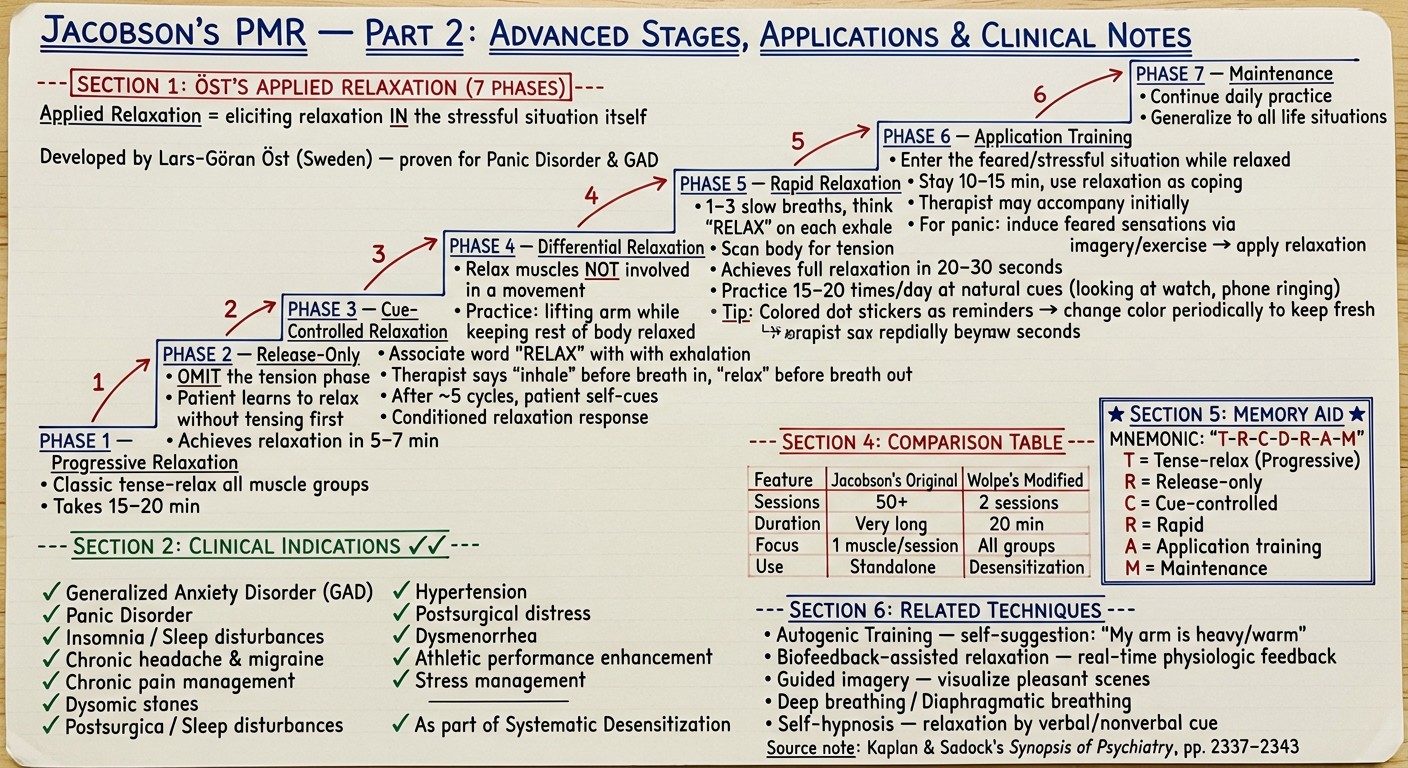
What's covered across both charts:
- Edmund Jacobson's history (1929), his observations, and original 50+ session method
- The "tenseness" concept and his key quote
- Theoretical basis - parasympathetic activation, reciprocal inhibition
- 4 elements of relaxation (boxed)
- Basic tense-relax flowchart (5-6 sec tense → 20-30 sec relax)
- Full muscle group sequence (Session 1 + Session 2)
- Wolpe's abbreviated modification for Systematic Desensitization
- Öst's 7-phase Applied Relaxation (staircase diagram)
- All 7 phases in detail: Progressive → Release-only → Cue-controlled → Differential → Rapid → Application → Maintenance
- Clinical indications (13 conditions with checkmarks)
- Side effects with warnings
- Comparison table: Jacobson Original vs Wolpe Modified
- Mnemonic "T-R-C-D-R-A-M" for the 7 phases
- Related relaxation techniques