
Raised liver enzymes diffential diagnosis
Reading File
Raised liver enzymes (transaminitis/elevated LFTs) have a broad differential spanning hepatic, biliary, and systemic causes. Let me search the textbooks now for comprehensive coverage.
Searching sources...
Finding Sources
Finding Sources
Searching PubMed
elevated liver enzymes differential diagnosis
Finding Sources
Finding Sources
Good - found relevant sections. Let me read the most comprehensive ones now in parallel.
Reading File
Reading File
Reading File
I found a flowchart image and rich content. Let me fetch the key image and read more of the Frameworks for Internal Medicine content for the full differential.
Loading Image
Reading File
Excellent - I now have rich content. Let me read the hereditary/other causes and the Sleisenger section on elevated enzymes for a complete picture.
Reading File
Reading File
I now have comprehensive data to compile a full, well-structured answer. Let me also read the hereditary causes section quickly.
Reading File
I now have all I need for a thorough, well-organized answer. Here it is:
Raised Liver Enzymes - Differential Diagnosis
The pattern of enzyme elevation guides the diagnosis. There are two main patterns:
- Hepatocellular pattern: predominantly elevated ALT and AST (reflects hepatocyte damage)
- Cholestatic pattern: predominantly elevated ALP and GGT (reflects biliary obstruction or cholestasis)
Mixed patterns are also common.
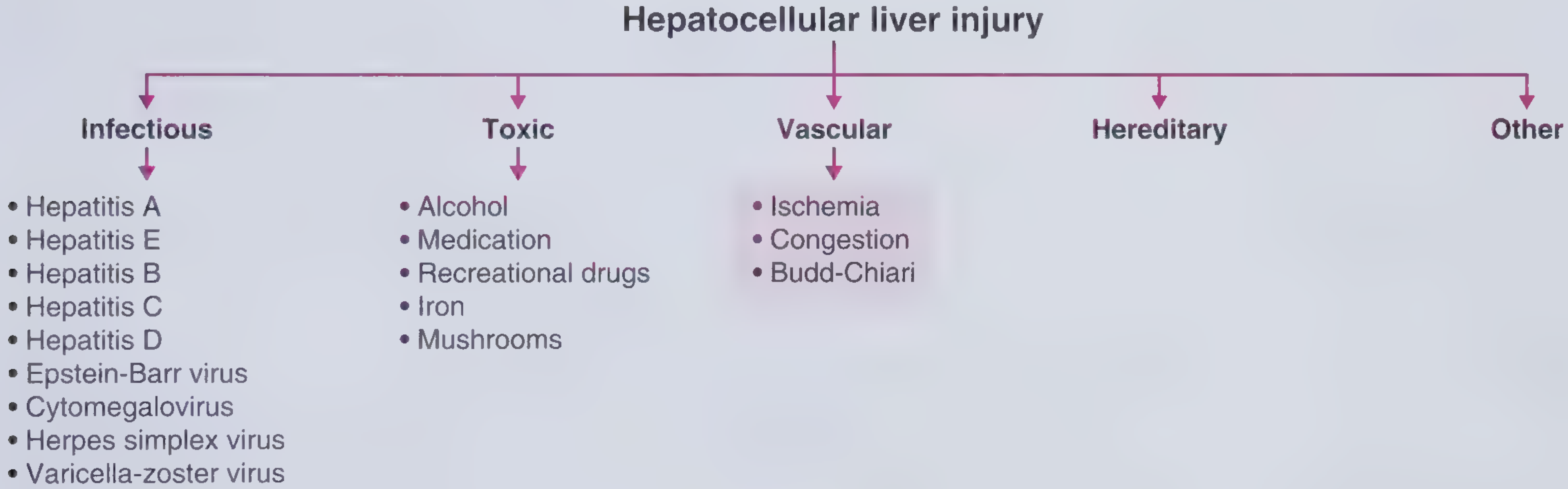
Frameworks for Internal Medicine
1. Hepatocellular Causes (ALT/AST predominant)
Infectious
| Pathogen | Notes |
|---|---|
| Hepatitis A (HAV) | Acute, self-limited; ALT often >1000 U/L; fecal-oral transmission |
| Hepatitis B (HBV) | Acute or chronic; sexual/blood-borne; risk of chronicity in neonates |
| Hepatitis C (HCV) | Mostly chronic, mild elevation; leading cause of chronic transaminitis |
| Hepatitis D (HDV) | Only in HBV co-infection or superinfection |
| Hepatitis E (HEV) | Acute; severe in pregnancy (risk of acute liver failure) |
| Epstein-Barr virus | Infectious mononucleosis; heterophile antibody test positive |
| Cytomegalovirus (CMV) | Mononucleosis-like syndrome; "owl's eye" inclusions on biopsy |
| Herpes simplex virus (HSV) | Life-threatening in pregnancy (3rd trimester) and immunocompromised |
| Varicella-zoster virus | Disseminated in immunocompromised; vesicular skin lesions |
Toxic/Drug-Induced
| Agent | Clue |
|---|---|
| Alcohol | AST:ALT ratio >2:1 (typically); AST rarely >300 U/L |
| Paracetamol (acetaminophen) overdose | Massive elevation (>1000 U/L); coagulopathy; often intentional or accidental |
| Medications (statins, isoniazid, rifampicin, methotrexate, amiodarone, antiepileptics, NSAIDs, nitrofurantoin) | Drug-induced liver injury (DILI) |
| Recreational drugs (cocaine, MDMA, anabolic steroids) | High-risk weekends, body builders |
| Iron overload | Secondary hemochromatosis; repeated transfusions, haemoglobinopathies |
| Mushroom poisoning | Amanita phalloides ("death cap"); delayed-onset acute liver failure |
Note: With the exception of alcoholic hepatitis, toxic causes are generally associated with ALT:AST ratio >1 - Frameworks for Internal Medicine
Vascular
| Cause | Context |
|---|---|
| Ischemic hepatitis ("shock liver") | Hypotension/shock; AST may exceed 75x ULN; rapid normalization on recovery |
| Congestive hepatopathy ("nutmeg liver") | Right heart failure, raised JVP |
| Budd-Chiari syndrome | Hepatic vein thrombosis; young women on OCP, thrombophilia; acute abdominal pain |
Vascular causes: AST:ALT ratio typically >1 - Frameworks for Internal Medicine
Hereditary/Metabolic
| Disease | Key Features |
|---|---|
| NAFLD/MAFLD/MASLD | Most common cause of chronic mild transaminitis in the West; metabolic syndrome |
| Alcoholic steatohepatitis | AST:ALT >2:1; GGT often elevated |
| Hereditary haemochromatosis | Iron overload; transferrin saturation >45%; HFE gene (C282Y); aminotransferases often only mildly elevated |
| Wilson's disease | Young patient; copper overload; Kayser-Fleischer rings; low ceruloplasmin; haemolytic anaemia |
| Alpha-1 antitrypsin deficiency | Liver + lung disease; intrahepatic protein accumulation |
| Autoimmune hepatitis | Young women; positive ANA/ASMA; responds to steroids |
2. Cholestatic Causes (ALP/GGT predominant)
Extrahepatic Biliary Obstruction
- Choledocholithiasis (common bile duct stone) - often colicky pain, jaundice
- Pancreatic cancer (painless jaundice in the elderly)
- Biliary/ampullary cancer
- Choledochal cyst, biliary stricture, parasitic infection (Ascaris)
Intrahepatic Cholestasis
- Primary biliary cholangitis (PBC) - middle-aged women, anti-mitochondrial antibody (AMA) positive
- Primary sclerosing cholangitis (PSC) - young men, associated with IBD; beaded bile ducts on MRCP
- Intrahepatic cholestasis of pregnancy
- Drug-induced cholestasis (co-amoxiclav, chlorpromazine, oral contraceptive pill)
- Sarcoidosis, lymphoma (infiltrative disease)
- Metastatic liver disease
3. Non-Hepatic (Extrahepatic) Causes
These are often overlooked and cause mild-moderate elevations:
| Cause | Enzyme Pattern | Clue |
|---|---|---|
| Skeletal muscle disease / rhabdomyolysis | AST elevated, ALT usually normal | CK markedly elevated; AST>ALT; no ALP rise |
| Cardiac muscle injury (MI, myocarditis) | AST elevated | Troponin elevated; ECG changes |
| Hypothyroidism | Mild AST elevation (myopathy source) | TSH elevated |
| Hyperthyroidism | Mild ALP elevation | TSH suppressed |
| Coeliac disease | Mild ALT/AST | Anti-tTG antibodies; responds to gluten-free diet |
| Strenuous exercise | Mild transient AST/ALT | Resolves with rest |
| Macro-AST | Chronically elevated AST | AST-immunoglobulin complex; benign |
| Adrenal insufficiency | Mild transaminitis | Cortisol low |
"When AST is elevated without elevation of ALT, one should consider extrahepatic causes, particularly myocardial or skeletal muscle sources." - Textbook of Family Medicine 9e
4. Degree of Elevation as a Diagnostic Clue
Based on Sleisenger & Fordtran's Gastrointestinal and Liver Disease:
| Pattern | Typical Causes |
|---|---|
| Mild chronic elevation (<5x ULN), ALT > AST | NAFLD, chronic viral hepatitis (B, C, D), autoimmune hepatitis, haemochromatosis, Wilson's, alpha-1-AT deficiency, medications/toxins, coeliac disease, hyperthyroidism |
| Mild chronic elevation (<5x ULN), AST > ALT | Alcohol-associated liver injury (AST/ALT >2:1, AST <300 U/L), cirrhosis, hypothyroidism, myopathy, strenuous exercise, macro-AST |
| Severe acute elevation (>20-25x ULN), ALT > AST | Acute viral hepatitis, ischemic hepatitis, acute Budd-Chiari, acute bile duct obstruction, drugs/toxins, autoimmune hepatitis, Wilson's disease |
| Severe acute elevation (>20-25x ULN), AST > ALT | Medications/toxins in pre-existing alcohol liver disease, acute rhabdomyolysis |
5. Key Diagnostic Ratios
| Ratio | Interpretation |
|---|---|
| AST:ALT >2:1 (AST rarely >300 U/L) | Alcoholic liver disease |
| ALT:AST >1, toxic agent | Drug/toxin-induced (except alcohol) |
| AST:ALT >1 in acute setting | Vascular causes (ischemia, Budd-Chiari) |
| ALP elevation > transaminases | Cholestatic pattern |
| GGT elevated with ALP | Hepatic source of ALP confirmed |
| ALT elevated alone (no AST rise) | Unlikely to be skeletal/cardiac muscle source |
Investigations to Consider
- Viral serology: Hep A IgM, HBsAg, HBcore IgM, HCV RNA, HEV IgM, EBV/CMV monospot
- Autoimmune: ANA, ASMA, AMA, immunoglobulins, LKM antibody
- Metabolic: Ferritin + transferrin saturation (haemochromatosis), caeruloplasmin + 24h urine copper (Wilson's), alpha-1-AT level + phenotype
- Thyroid: TSH
- Muscle: CK (rhabdomyolysis, myopathy)
- Coeliac: Anti-tTG IgA
- Imaging: Liver ultrasound (fatty liver, biliary dilatation, mass), MRCP (biliary tree), FibroScan
- Alcohol: History, GGT, AST:ALT ratio, CDT
Sources: Frameworks for Internal Medicine; Sleisenger and Fordtran's Gastrointestinal and Liver Disease; Textbook of Family Medicine 9e; Henry's Clinical Diagnosis and Management by Laboratory Methods
Management of nafld
NAFLD (now increasingly termed MASLD - metabolic dysfunction-associated steatotic liver disease) management centers on lifestyle modification, cardiovascular risk reduction, and treating metabolic comorbidities. Weight loss of 5-10% improves steatosis, and >10% can reverse fibrosis. Resmetirom (Rezdiffra) was the first FDA-approved drug specifically for NASH/MASH in 2024.
Searching sources...
Finding Sources
Searching PubMed
"nonalcoholic fatty liver disease" AND management
Finding Sources
Finding Sources
Searching PubMed
MASLD NAFLD resmetirom pharmacotherapy guideline
Excellent - found the EASL-EASD-EASO 2024 guidelines and an AASLD 2026 update. Let me read the textbook content and get details from the landmark guideline.
Reading File
Reading Article
PMID: 38851997
Reading Article
PMID: 41201884
Finding Sources
Finding Sources
Reading File
Reading File
I now have extensive and up-to-date information from textbooks and two major guidelines (EASL-EASD-EASO 2024, AASLD 2025/2026). Here is the comprehensive answer:
Management of NAFLD / MASLD
Nomenclature update: In 2023, international consensus renamed NAFLD to MASLD (Metabolic dysfunction-Associated Steatotic Liver Disease) and NASH to MASH (Metabolic dysfunction-Associated SteatoHepatitis). These terms are now used interchangeably in current guidelines.
Overview of the Spectrum
MASLD spans a spectrum: steatosis → MASH (with ballooning + inflammation) → fibrosis → cirrhosis → HCC. Fibrosis stage is the single most important determinant of long-term liver-related mortality. Cardiovascular disease is the leading cause of death overall in MASLD patients.
1. Lifestyle Modification (Cornerstone of Treatment)
Lifestyle modification is the first-line treatment for all stages of NAFLD/MASLD.
Weight Loss
| Weight Loss Target | Benefit |
|---|---|
| ≥5% | Reduces hepatic steatosis |
| ≥7-10% | Improves steatohepatitis and inflammation |
| ≥10% | Can lead to fibrosis regression |
| ~80% resolution rate | Bariatric surgery (discussed below) |
- Gradual weight loss is recommended; rapid weight loss can paradoxically worsen hepatic inflammation
- Target of 10% body weight loss is the general recommendation - Goldman-Cecil Medicine
Diet
- Mediterranean diet is preferred - high in unsaturated fats, fibre, vegetables; shown to reduce hepatic steatosis
- Avoid refined sugars (fructose and sucrose), particularly fructose-containing beverages (soft drinks, fruit juices)
- Restrict saturated fat and processed foods
- Low-calorie diet (500-1000 kcal/day deficit) is effective for weight reduction
- Avoid alcohol even in MASLD (worsens fibrosis)
Exercise
- Both aerobic exercise and resistance training independently reduce hepatic steatosis
- At least 150-200 minutes/week of moderate-intensity aerobic exercise recommended
- Physical activity reduces liver fat independent of weight loss
Multidisciplinary Approach
A team-based approach (dietitian, exercise physiologist, behavioural therapist) is more effective than prescriptive advice alone - Goldman-Cecil Medicine
2. Management of Metabolic Comorbidities
MASLD is tightly linked to metabolic syndrome. Treating comorbidities improves liver outcomes:
| Comorbidity | Management |
|---|---|
| Type 2 diabetes | GLP-1 receptor agonists preferred (dual benefit - see below); metformin, SGLT2 inhibitors |
| Dyslipidaemia | Statins are safe in NAFLD/MASLD and should not be withheld; atorvastatin 20 mg shown to improve liver tests; also reduce dominant risk of CVD death |
| Hypertension | Renin-angiotensin system (RAS) blockade preferred (some anti-fibrotic benefit) |
| Obesity | GLP-1 agonists, bariatric surgery |
| OSA | Screen and treat (associated with greater fibrosis severity) |
| Hypothyroidism | Screen and treat |
| Coeliac disease | Screen (associated condition) |
3. Pharmacotherapy
3a. First FDA/EMA-Approved MASH-Specific Drug: Resmetirom (Rezdiffra)
- Resmetirom (a selective thyroid hormone receptor-β agonist, 80 mg orally once daily)
- FDA approval: March 2024 for non-cirrhotic MASH with significant fibrosis (stage F2-F3)
- From the EASL-EASD-EASO 2024 guidelines: "Adults with non-cirrhotic MASH and significant liver fibrosis (stage ≥2) should be considered for MASH-targeted treatment with resmetirom, which demonstrated histological effectiveness on steatohepatitis and fibrosis with an acceptable safety and tolerability profile" - EASL-EASD-EASO 2024 guideline (PMID: 38851997)
- Not recommended in cirrhotic MASH
3b. GLP-1 Receptor Agonists (Major Recent Development)
Semaglutide (Wegovy formulation):
- FDA approval in August 2025 for MASH with moderate-to-advanced fibrosis (F2-F3), based on Phase 3 ESSENCE trial
- ESSENCE trial results at 72 weeks (semaglutide 2.4 mg/week SC):
- Resolution of MASH without worsening fibrosis: 62.9% vs 34.3% placebo (p<0.001)
- ≥1 stage fibrosis reduction: 36.8% vs 22.4% placebo (p<0.001)
- Patient selection: MASH F2-F3 identified by non-invasive tests (VCTE 8-15 kPa, MRE 3.1-4.4 kPa, or ELF 9.2-10.5) - liver biopsy not required
- Common adverse effects: nausea, diarrhoea, constipation (generally mild, improve with titration)
- Monitor for: gallbladder disease, pancreatitis, thyroid C-cell tumours, AKI from dehydration
- Not approved for MASH cirrhosis (VCTE >20 kPa)
- AASLD Practice Guidance, November 2025 (PMID: 41201884)
Liraglutide: 1.8 mg SC daily - shown to resolve NASH histologically in RCTs; used off-label
Tirzepatide (GLP-1/GIP dual agonist): SURPASS-NASH data show significant MASH resolution; included in EASL 2024 guidance for those with T2D or obesity
3c. Other Pharmacological Agents
| Drug | Evidence/Notes |
|---|---|
| Vitamin E (α-tocopherol 800 IU/day) | Improves histology in non-diabetic NASH; guideline-supported for non-diabetic, non-cirrhotic NASH. Concerns: prostate cancer risk (men), haemorrhagic stroke |
| Pioglitazone (thiazolidinedione) | Improves steatosis, inflammation, ballooning; possibly fibrosis; useful in T2D + NASH. Side effects: weight gain (~4.5 kg), fluid retention, fracture risk, bladder cancer concerns |
| SGLT2 inhibitors (empagliflozin, dapagliflozin) | Reduce liver fat; benefit in patients with T2D; ongoing trials for MASH |
| Statins | Do NOT worsen liver disease; reduce CVD mortality (dominant cause of death in NAFLD); atorvastatin safe and beneficial |
| Omega-3 fatty acids | Reduce hepatic steatosis; modest benefit in small trials |
| Pentoxifylline 400 mg TDS | May improve liver enzymes and histology in NASH |
| Obeticholic acid (FXR agonist) | Some histologic improvement; not yet approved for MASH; awaiting long-term data |
| Lanifibranor (pan-PPAR agonist) | Improves NASH components and may reduce fibrosis |
Note: Metformin - does not improve liver histology in NAFLD, not recommended as a MASH-specific therapy
3d. Summary: Who Gets What Drug?
| Patient | Preferred Agent |
|---|---|
| Non-cirrhotic MASH + F2-F3 fibrosis (any metabolic status) | Resmetirom OR Semaglutide |
| MASH + T2D or obesity | GLP-1 agonist (semaglutide, liraglutide, tirzepatide) |
| Non-diabetic NASH + no contraindication | Vitamin E 800 IU/day |
| MASH + T2D + obesity | Pioglitazone ± GLP-1 agonist |
| Dyslipidaemia in MASLD | Statin (do not withhold) |
| Cirrhotic MASH | No MASH-targeted pharmacotherapy; manage complications |
4. Bariatric/Metabolic Surgery
- Indicated for morbidly obese patients (BMI ≥35) with NASH and significant metabolic comorbidities
- Achieves ~80% resolution of NASH on liver biopsy with progressive fibrosis reduction - Goldman-Cecil Medicine
- Must exclude portal hypertension before surgery
- Types: Roux-en-Y gastric bypass, sleeve gastrectomy
- EASL 2024 recommends considering bariatric surgery as an option in MASLD with obesity
5. Monitoring and Fibrosis Assessment
Per EASL-EASD-EASO 2024:
- FIB-4 score (using age, AST, ALT, platelets) as initial non-invasive test
- FIB-4 < 1.30: low risk (rule out advanced fibrosis)
- FIB-4 > 2.67: high risk (refer for further evaluation)
- Sequential transient elastography (VCTE/FibroScan) to stage fibrosis
- MR elastography (MRE) if VCTE inconclusive
- Liver biopsy: reserve for cases where diagnosis is uncertain or to assess before starting pharmacotherapy when NITs are equivocal
- Surveillance for HCC: 6-monthly ultrasound ± AFP in MASLD cirrhosis
6. End-Stage Disease
| Stage | Management |
|---|---|
| Compensated MASH cirrhosis | Lifestyle, metabolic drug adjustments, HCC surveillance, variceal screening |
| Decompensated MASH cirrhosis | Liver transplantation; recurrence is common post-transplant |
| MASH-related HCC | Surgical resection, ablation, transplantation (Milan criteria), systemic therapy |
Key Sources
- Goldman-Cecil Medicine, Treatment section on NAFLD
- Sleisenger and Fordtran's Gastrointestinal and Liver Disease, Ch. 87
- EASL-EASD-EASO Clinical Practice Guidelines on MASLD 2024 (PMID: 38851997)
- AASLD Practice Guidance update: Semaglutide for MASH, November 2025 (PMID: 41201884)
This is a shared conversation. Sign in to Orris to start your own chat.