
defination of thyroid gland
The thyroid gland is a butterfly-shaped endocrine gland located in the anterior neck, wrapping around the trachea just below the larynx. It consists of two lobes connected by an isthmus and produces the hormones T3 (triiodothyronine) and T4 (thyroxine), which regulate metabolism, growth, and development, as well as calcitonin, which helps regulate calcium levels.
Searching sources...
Reading File
Finding Sources
Searching the Web
thyroid gland anatomy definition structure function
Reading File
Reading File
Reading File
Reading File
Now I have rich textbook content from multiple authoritative sources. Let me fetch the key anatomical diagram and histology image to include in the answer.
Loading Image
Loading Image
Here is a thorough, textbook-based definition and overview of the thyroid gland:
The Thyroid Gland
Definition
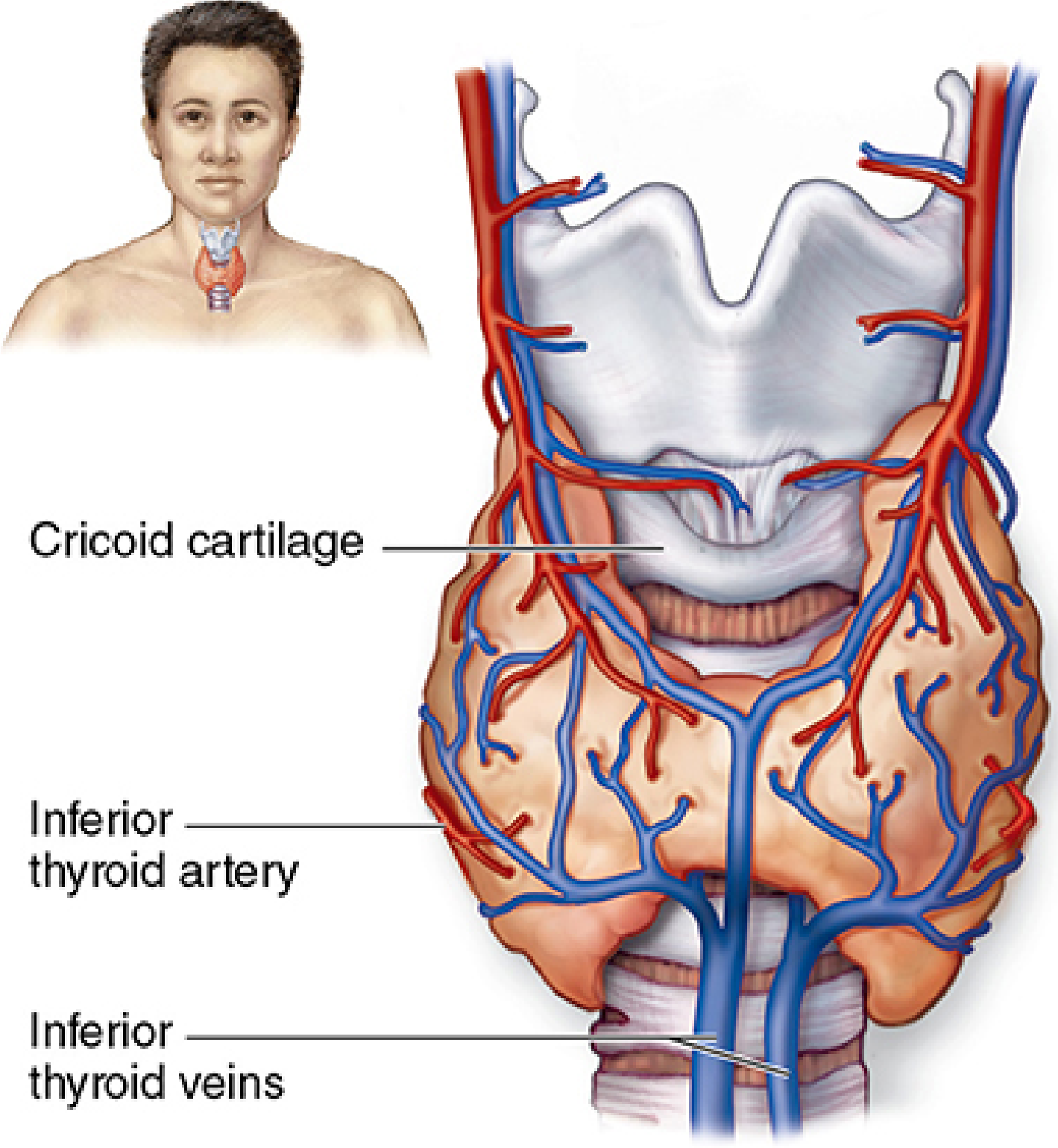
The thyroid gland is a highly vascular, butterfly-shaped endocrine gland located in the anterior neck, inferior to the larynx and anterior to the trachea. It consists of two lateral lobes connected by a central bridge of tissue called the isthmus. It is the only endocrine gland that stores a large quantity of its secretory product outside its cells.
"The thyroid gland, located anterior and inferior to the larynx, consists of two lobes united by an isthmus... It synthesizes the thyroid hormones thyroxine (T4) and triiodothyronine (T3), which help control the basal metabolic rate in cells throughout the body, as well as the polypeptide hormone calcitonin."
- Junqueira's Basic Histology, 17e
Location & Relations
- Spans vertebral levels C5 to T1
- Lies within the visceral compartment of the neck, enclosed by pretracheal fascia
- The lateral lobes wrap around the anterolateral surfaces of the trachea, cricoid cartilage, and lower thyroid cartilage
- The isthmus crosses the anterior surface of the 2nd and 3rd tracheal cartilages
- Lies deep to the sternohyoid, sternothyroid, and omohyoid muscles
- Anchored to the trachea by the Berry (lateral suspensory) ligament
Embryological Origin
- Develops as a median outgrowth from the floor of the pharynx (foregut endoderm) near the base of the tongue (foramen cecum)
- Descends to the anterior neck via the thyroglossal duct, which normally disappears
- Remnants may persist as a thyroglossal cyst or fistula
- Ectopic thyroid tissue may appear as a lingual thyroid or along the path of migration
- A pyramidal lobe may extend upward from the isthmus in about 50% of people
Structure
Gross Anatomy
- Two lobes (right and left) + isthmus
- Weight: approximately 25-30 g in adults
- Covered by a fibrous capsule from which septa extend inward, dividing the gland into lobules
Microscopic (Histology)
The parenchyma is composed of millions of thyroid follicles, each consisting of:
- A simple cuboidal to low columnar epithelium (follicular cells / thyrocytes)
- A central lumen filled with gelatinous acidophilic colloid
- Colloid contains thyroglobulin (660 kDa glycoprotein) - the precursor for thyroid hormones
- Sufficient stored hormone to supply the body for up to 3 months
Two cell types:
| Cell Type | Also Called | Product |
|---|---|---|
| Follicular cells | Thyrocytes | T3 and T4 |
| Parafollicular cells | C cells | Calcitonin |
Follicular cell activity is regulated by TSH from the anterior pituitary:
- Active glands: tall columnar follicular epithelium
- Hypoactive glands: squamous follicular epithelium
Blood Supply
| Artery | Origin |
|---|---|
| Superior thyroid artery | First branch of the external carotid artery |
| Inferior thyroid artery | Branch of the thyrocervical trunk (from subclavian artery) |
Venous drainage is via the superior, middle, and inferior thyroid veins.
Hormones Produced
| Hormone | Type | Function |
|---|---|---|
| T4 (Thyroxine / Tetra-iodothyronine) | Iodinated amino acid | ~80% of secretion; prohormone |
| T3 (Triiodothyronine) | Iodinated amino acid | ~20%; 10x more potent than T4 |
| Calcitonin | Polypeptide (from C cells) | Lowers blood calcium |
T4 is deiodinated in peripheral tissues to the more active T3, which binds nuclear receptors and upregulates gene expression throughout the body.
Hormonal Regulation (HPT Axis)
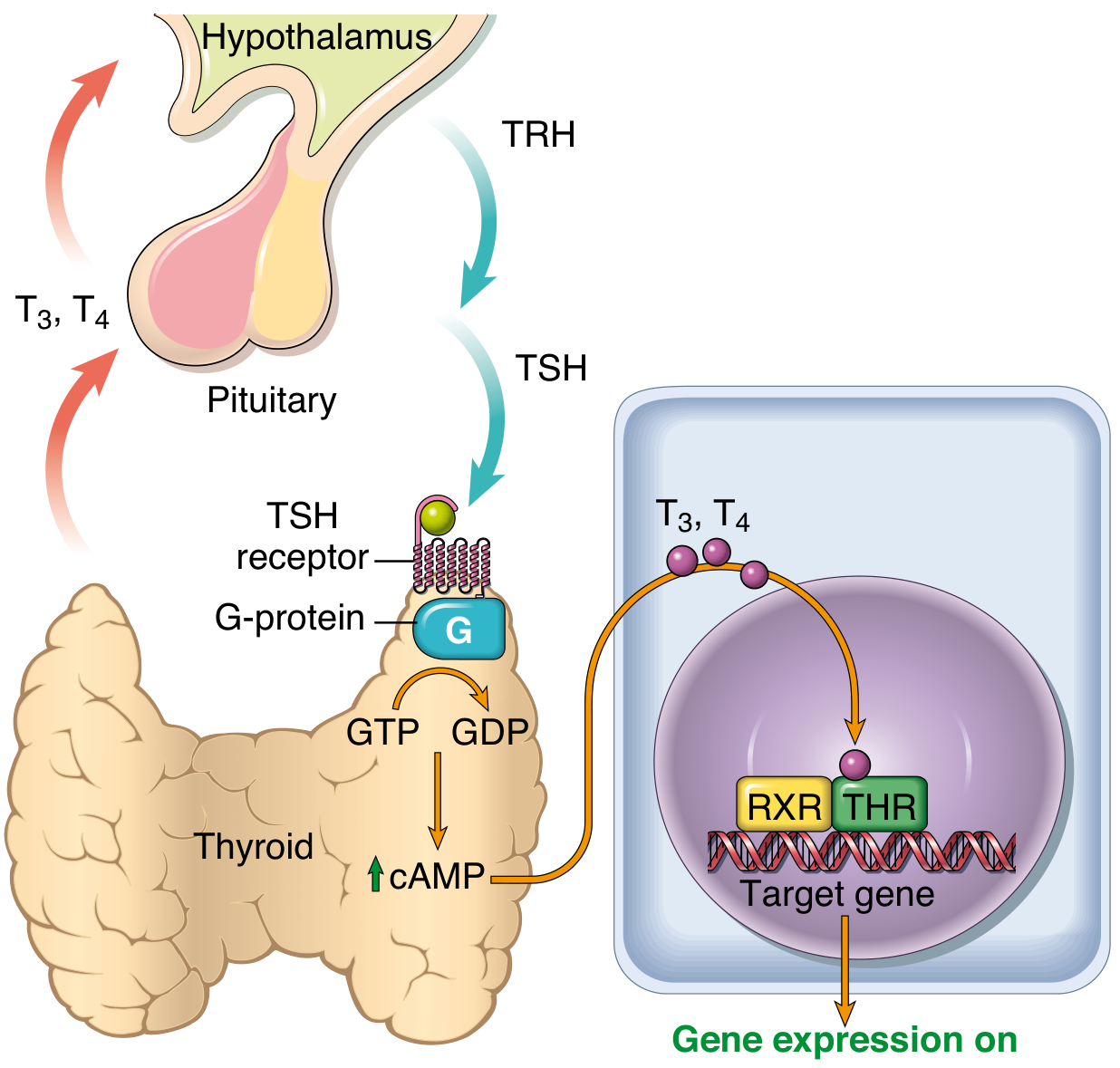
The Hypothalamic-Pituitary-Thyroid (HPT) axis controls thyroid activity:
- Hypothalamus releases TRH (thyrotropin-releasing hormone)
- Anterior pituitary releases TSH (thyroid-stimulating hormone) in response
- TSH binds to receptors on thyrocytes → activates Gs protein → increases cAMP → stimulates thyroid hormone synthesis and release
- T3/T4 feed back negatively to inhibit TRH and TSH secretion
Physiological Effects of Thyroid Hormones
- Increase basal metabolic rate (stimulate carbohydrate and lipid catabolism, protein synthesis)
- Regulate heart rate, body temperature, and bowel function
- Critical for brain development in fetuses and neonates
- Affect virtually all cells in the body
Sources:
- Gray's Anatomy for Students, p. 1157-1158
- Junqueira's Basic Histology - Text and Atlas, 17e, p. 1034-1035
- Robbins, Cotran & Kumar Pathologic Basis of Disease, p. 994-995
This is a shared conversation. Sign in to Orris to start your own chat.