
postmortem findings of drowning
Reading File
The postmortem findings in drowning span both external and internal changes. Key findings include frothy fluid from airways, waterlogged lungs (emphysema aquosum), diatom identification, and wash-out pallor. Let me search the medical library for detailed, authoritative content.
Searching sources...
Finding Sources
Finding Sources
Excellent - I found a dedicated section in P C Dikshit's Textbook. Let me read that section along with the Essentials of FMT section on drowning.
Reading File
Reading File
Good content. Let me read more from both sources to get the internal findings, diatom test, and Gettler test details.
Reading File
Reading File
Let me continue reading the external/internal findings from Dikshit and get the diatom/Gettler test details from Essentials:
Reading File
Finding Sources
Reading File
Reading File
Reading File
Finding Sources
Reading File
Reading File
I now have comprehensive content. Let me fetch the diatom image for the answer:
Loading Image
I now have all the material needed for a comprehensive answer. Here is the full, structured response:
Postmortem Findings in Drowning
Drowning is one of the most difficult modes of death to prove at autopsy. Findings are often minimal, obscure, or completely absent - especially when the body is not examined fresh. The diagnosis is essentially one of exclusion, corroborated by circumstances and laboratory tests.
Signs of Immersion (Not Specific to Drowning)
These indicate the body was in water but do not prove the person drowned:
1. Maceration / "Washerwoman's Hands"
- Starts within minutes in warm water (e.g., bathtub); visible after 4-5 hours in cold water
- Skin at fingertips, palms, and soles becomes wrinkled, pale, and sodden
- After days to weeks, the thick keratin of hands and feet detaches in a "glove and stocking" pattern
- Nails and hair become loosened simultaneously
2. Cutis Anserina (Goose Flesh)
- Granular, puckered skin appearance due to contraction of erector pilae muscles
- More common in cold water; also occurs in post-mortem cold exposure generally
- Retraction of scrotum and penis is also seen
3. Postmortem Hypostasis
- Difficult to recognize due to swelling and loss of skin translucency
- Pattern is variable as the body may roll with water movements
- In decomposed bodies, lividity appears in the head, neck, and chest
4. Algae Growth
- Algae attach to exposed skin within 3-4 days in summer; scraping may remove superficial skin and mimic abrasions
5. Adipocere Formation
- Common in victims of prolonged submersion
Duration of Immersion (Approximate Guide)
| Finding | Estimated Duration |
|---|---|
| No wrinkling of fingerpads | <few hours |
| Wrinkled fingers, palms, feet | 0.5 - 3 days |
| Early decomposition (head, neck, abdomen) | 4-10 days |
| Bloating, marbling of veins, peeling epidermis | 2-4 weeks |
| Gross skin shedding, muscle loss, partial liquefaction | 1-2 months |
External Signs of Drowning (at Autopsy)
- Clothing and skin: Wet, cold, clammy, pale due to vasoconstriction
- Postmortem staining: Pink due to oxygenation; may be dusky and cyanotic
- Head, neck, face: Congested, cyanotic; petechial hemorrhages in conjunctiva
- Pupils: May be dilated; tongue swollen and protruded
- Froth at mouth and nostrils: Fine, white, leathery, tenacious; may be blood-stained. Created by churning of inhaled water + mucus + air. Projects as a small balloon or mushroom-like mass. Does NOT easily collapse when touched with a knife. Absent in dry drowning.
- Cutis anserina (see above)
- Cadaveric spasm: Hands may grasp weeds, sand, mud, or gravel - a vital reaction indicating the person was alive when they entered the water. Damaged nails and abraded fingertips from struggling may accompany this.
- Rigor mortis: Appears early when violent struggle occurred before death
- Washerwoman's hands (see maceration above)
Internal Signs of Drowning
Lungs - the Key Organ
Macroscopic (Emphysema Aquosum / "Drowning Lung"):
- Lungs are voluminous and waterlogged, completely covering the pericardial sac and bulging out of the chest on removing the sternum
- Rib impressions are visible on the lung surface due to overdistension
- Passive collapse - which normally occurs after death - does NOT happen because edema fluid blocks the bronchi
- Lungs do not collapse when removed and placed on a table
- On cut section, large amounts of frothy fluid ooze from the surface on squeezing
Paltauf's (Paultauff's) Hemorrhages:
- Subpleural hemorrhages caused by rupture of alveolar walls under forced respiratory effort
- Located mainly on the anterior and interlobar surfaces, predominantly in the lower lobes
- Shining, pale bluish-red or grey patches, ranging from minute to 3-5 cm in diameter
- Pathognomonic when found together with frothy airway fluid, though not on their own
Microscopic Stages of Drowning Lung (H&E):
- Stage 1: Alveolar wall thickness reduced to capillary width; capillaries appear round/oval like a chain; partial fiber ruptures
- Stage 2: Alveoli more distended; capillaries lie separately; fiber rupture more marked
- Stage 3: Maximal alveolar wall distension; capillaries appear thread-like
Other Internal Organs
- Stomach and intestines: May contain water, sand, mud, or weeds - indicating antemortem swallowing while struggling
- Pleural cavities: In decomposed bodies, water is found in increasing quantity due to diffusion from collapsed lungs
- Temporal bones / middle ear: Hemorrhages may be found in some drowning victims
- Blood: More fluid; body tends to bleed more readily from wounds
Laboratory / Investigative Tests
1. Diatom Test (Diagnostic Test for Drowning)
Diatoms are unicellular algae with acid- and heat-resistant siliceous (silica) shells called frustules. They range from 2 microns to 1 mm in size (most 10-80 µm wide); only those up to 60 µm can enter the pulmonary circulation.
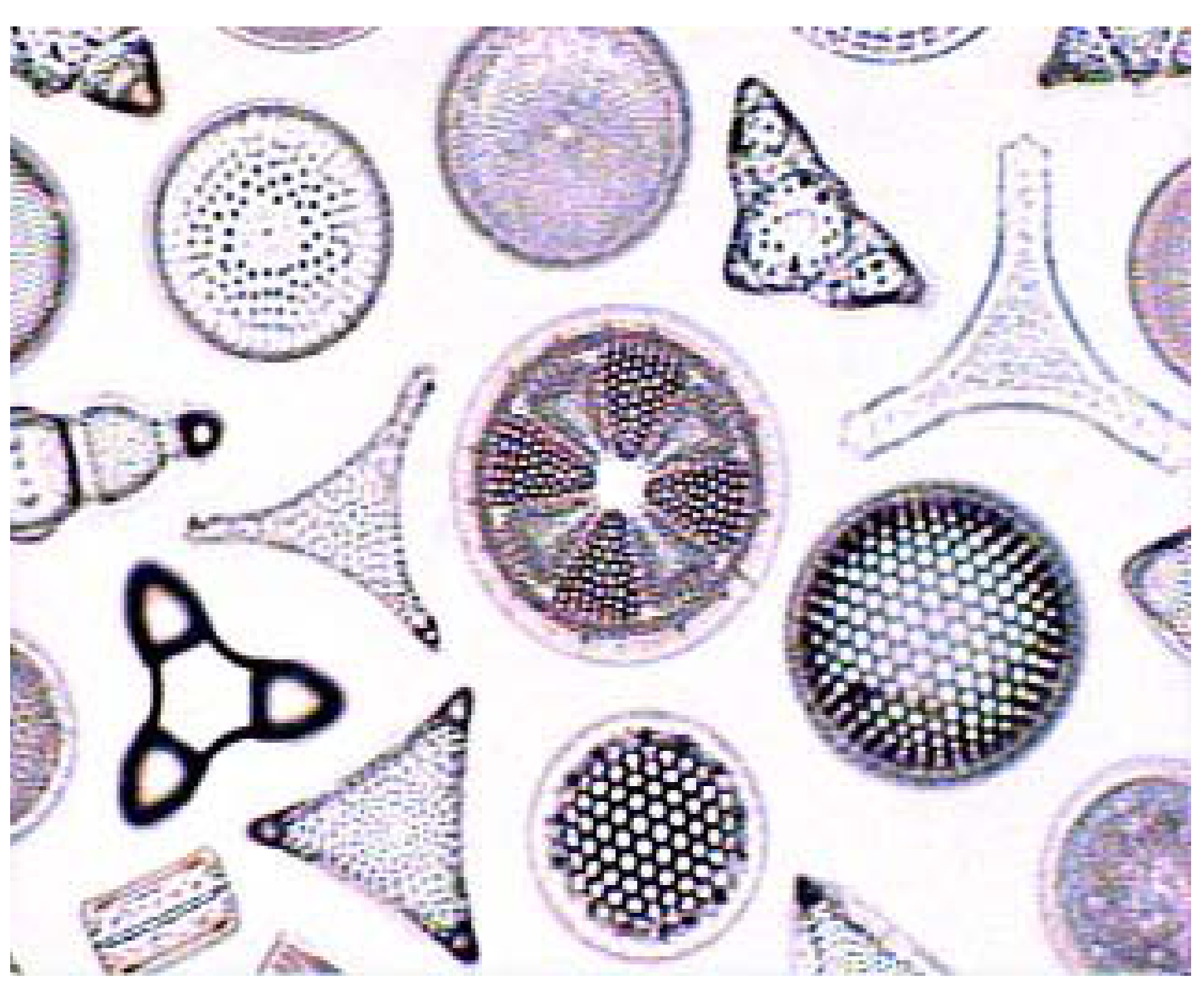
Figure: Various diatom morphologies (P C Dikshit Textbook of Forensic Medicine)
Principle: When a living person drowns, the aspirated water drives diatoms through ruptured alveolar walls into lymphatics and pulmonary veins. The beating heart then circulates them to distant organs: bone marrow, brain, liver, kidneys, skeletal muscle. In a dead body thrown into water, passive percolation may bring diatoms to the lungs, but without a beating heart they cannot reach distant organs.
Best sample: Bone marrow (cut the bone and curette the marrow from the gutter) - most reliable, especially in putrefied bodies since diatoms resist putrefaction.
Technique: 5 g of tissue + concentrated nitric acid - digests organic matter, preserves siliceous shells. Centrifuge and examine sediment under phase-contrast, dark-ground, or polarized light (shells are birefringent).
Henday's Requirements for a positive diagnosis:
- All species recovered from the organs must be present in water from the site of submersion
- Species must not be found in control (non-drowned) subjects
Limitations - False Negatives:
- Seasonal variation (diatom-poor water)
- Dry drowning
- Delayed body recovery / decomposition
- Post-mortem immersion
Limitations - False Positives (diatoms without drowning):
- Ingested shellfish or raw vegetables grown in diatom-rich soil
- Inhalation of industrial diatom-containing dust (cement, paint, insulators)
- Dusting powders
- Intestinal penetration into blood
2. Gettler Test (Chloride Test)
- Normal: Chloride ~600 mg/100 mL, equal in left and right heart chambers
| Situation | Mechanism | Left Heart Chloride | Result |
|---|---|---|---|
| Fresh water drowning | Hypotonic water absorbed from lung into blood (dilutes blood by up to 72% in 3 minutes) | Decreases up to 50% lower than right side | Left < Right |
| Salt water drowning | Hypertonic seawater draws plasma fluid into alveoli (hemoconcentration, up to 42%) | Increases 30-40% above right side | Left > Right |
- A 25% difference in chloride between sides is considered significant
- The test is of doubtful value in routine practice and is largely historical
3. Plasma Specific Gravity
- In drowning: specific gravity of plasma from the left side is less than the right side (due to hemodilution)
- In non-drowning cases: the reverse
4. Magnesium
- In saltwater drowning: magnesium content on the left side is >1.25 mg/1000 mL more than the right side
5. Serum Strontium
- Raised serum strontium in deaths due to drowning (Abdallah et al., 1985)
- Left-right strontium difference is always >75 µg/L in seawater drowning
- Helps differentiate antemortem drowning from postmortem immersion
Reliable Signs of Drowning - Summary
The following 6 findings are considered the most reliable positive signs at autopsy:
- Fine white froth at mouth and nose
- Weeds, sand, or mud firmly grasped in the hands (cadaveric spasm)
- Weeds, sand, mud, or fine froth in lungs and air passages
- Voluminous, waterlogged lungs (Emphysema aquosum)
- Water in stomach and intestines
- Diatoms found in viscera/bone marrow matching the site of submersion
When Signs Are Absent
Absence of signs does NOT rule out drowning in:
- Dry drowning / vagal inhibition (sudden cardiac arrest from cold water shock - laryngeal spasm, no water inhalation; postmortem shows asphyxia signs only)
- Helplessness from alcohol, drugs, or injury preventing struggle
- Delayed body recovery (putrefaction destroys most signs)
- Advanced decomposition - only residual evidence is water in pleural cavities and froth in bronchi; in advanced putrefaction all signs are absent
In such cases, the cause of death is reported as "Consistent with drowning" or "Undetermined."
Sources: P C Dikshit Textbook of Forensic Medicine and Toxicology, pp. 313-317; The Essentials of Forensic Medicine and Toxicology, 36th ed. (2026), pp. 363-367; DiMaio's Forensic Pathology, 3rd ed.
This is a shared conversation. Sign in to Orris to start your own chat.