

17795375732483509973238660070162.jpg
Describe this skin lesion
Reading File
Finding Sources
Finding Sources
Finding Sources
Reading File
Finding Sources
Loading Image
Knuckle Pads (Heloderma / Garrod Pads)
The image shows the dorsum of a hand with multiple well-defined, round, flesh-colored to slightly whitish, plaque-like thickenings located over the proximal interphalangeal (PIP) joints of the fingers. The skin surface overlying the lesions appears slightly hyperkeratotic. The lesions are discrete, small (consistent with the typical 10-15 mm size range), and distributed symmetrically across multiple fingers.
This morphology is highly consistent with knuckle pads (heloderma).
For comparison, the textbook reference image from Andrews' Diseases of the Skin:
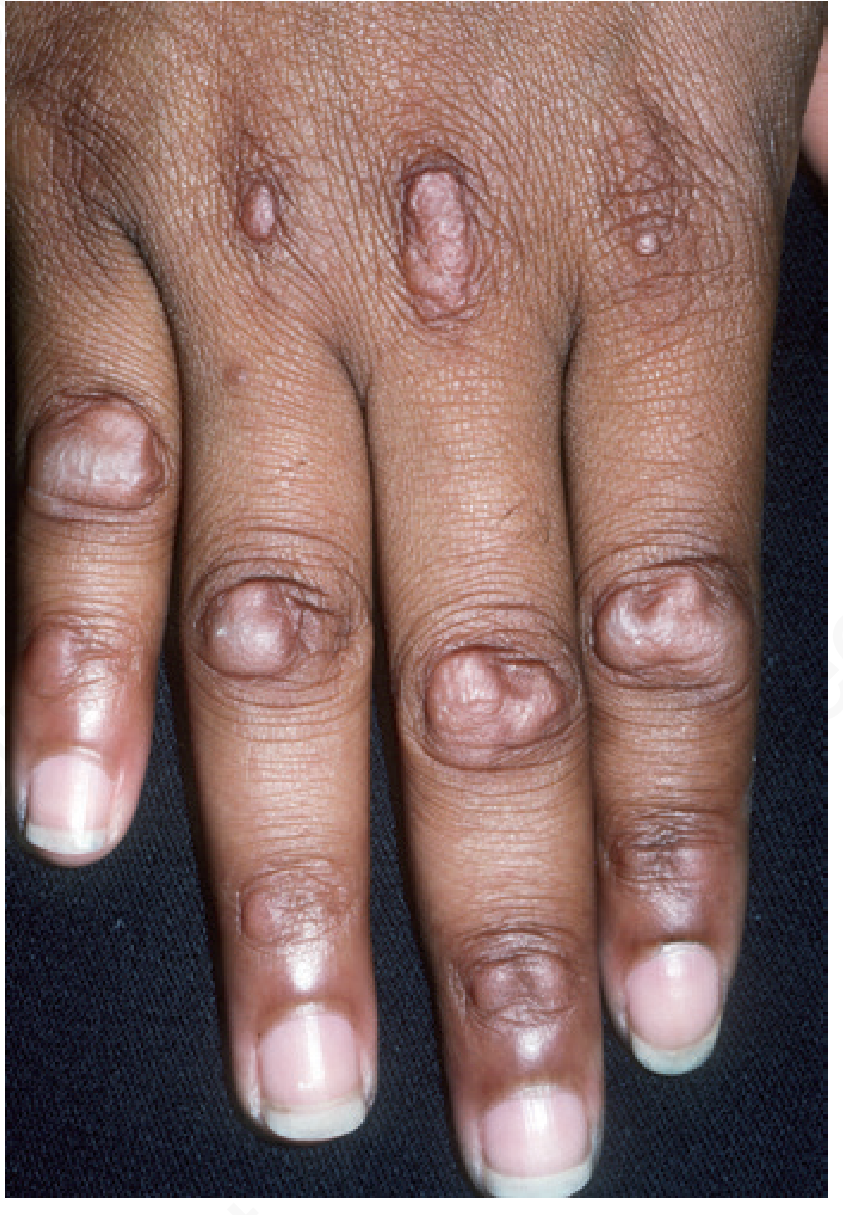
Description
| Feature | Finding |
|---|---|
| Location | Extensor aspect of PIP joints (dorsal hand) |
| Morphology | Well-defined, round, plaque-like, fibrous thickenings |
| Color | Flesh-colored to slightly pale/whitish |
| Surface | Normal to mildly hyperkeratotic epidermis |
| Size | Approximately 10-15 mm |
| Mobility | Part of skin, freely movable over deeper structures |
Key Facts
- Knuckle pads are benign fibrous thickenings (histologically fibromas) of the skin over the PIP and/or MCP joints.
- They develop at any age, grow over weeks to months, and then persist permanently.
- Associated conditions include:
- Dupuytren contracture, Peyronie disease, plantar fibromatosis (all superficial fibromatoses)
- Camptodactyly, clubbing
- Bart-Pumphrey syndrome (autosomal dominant: knuckle pads + leukonychia + hearing loss + keratoderma - GJB2 mutations)
- Epidermolytic palmoplantar keratoderma (keratin 9 mutation)
- Repetitive trauma or knuckle-cracking habit
Differential Diagnosis
| Condition | Distinguishing feature |
|---|---|
| Gottron's papules (dermatomyositis) | Violaceous/erythematous, associated with proximal muscle weakness, heliotrope rash |
| Rheumatic nodules | Deeper, non-skin lesions, associated with rheumatic disease |
| Nodular neurodermatitis | Pruritic, lichenified |
| Post-frostbite/acrocyanosis papules | Hemispheric, pitted, history of cold exposure |
| Pachydermodactyly | Swelling lateral to PIP joints (not over the joint), adolescents |
Management
- Usually no treatment required (benign, asymptomatic)
- Intralesional corticosteroids may reduce the thickening
- Intralesional 5-fluorouracil (5-FU) - similar to keloid treatment, may be beneficial
- Address any underlying repetitive trauma if identified
Source: Andrews' Diseases of the Skin: Clinical Dermatology, p. 704
Important note: This is a morphological description based on the image. A definitive diagnosis requires clinical examination and, if needed, histopathology. Please consult a dermatologist for formal evaluation and management.
This is a shared conversation. Sign in to Orris to start your own chat.