
Warts
Reading File
Warts are benign epidermal growths caused by Human Papillomavirus (HPV) infection. They are very common, especially in children and young adults, and are generally self-limiting but can be treated. Let me pull up the full textbook content.
Searching sources...
Finding Sources
Searching PubMed
warts HPV treatment
Good. Now let me read the key sections in parallel - from Fitzpatrick's (the gold standard dermatology reference), Harrison's, and the Family Medicine textbook.
Reading File
Reading File
Reading File
Now let me read more of the Fitzpatrick's section for treatment details and fetch the clinical images:
Reading File
Loading Image
Loading Image
Let me also read the Fitzpatrick's treatment section more fully and get the anogenital warts content:
Reading File
Reading File
I now have comprehensive content. Here is the full clinical overview:
Warts (Verrucae)
Warts are benign epidermal growths caused by Human Papillomavirus (HPV). Over 100 HPV types have been identified, and specific types correlate with lesion location, morphology, and oncogenic potential.
Etiology & Pathogenesis
HPV is a double-stranded DNA virus that infects keratinocytes through minor skin breaks. Different subtypes produce different clinical lesions:
| HPV Type | Clinical Lesion |
|---|---|
| HPV-1 | Deep palmoplantar warts (myrmecia) |
| HPV-2, 27, 57 | Common warts (verruca vulgaris) |
| HPV-3, 10 | Flat warts (verruca plana) |
| HPV-4 | Common/plantar warts |
| HPV-6, 11 | Anogenital warts (condylomata acuminata) |
| HPV-7 | Butcher's warts |
| HPV-16, 18 | High-risk: cervical/anogenital dysplasia and carcinoma |
Clinical Types
1. Common Warts (Verruca Vulgaris)
Sessile, dome-shaped, hyperkeratotic papules about 1 cm in diameter with small filamentous projections. Typical on the dorsal hands, fingers, knuckles, and periungual regions. Exophytic ("cauliflower-shaped") on dorsal surfaces.
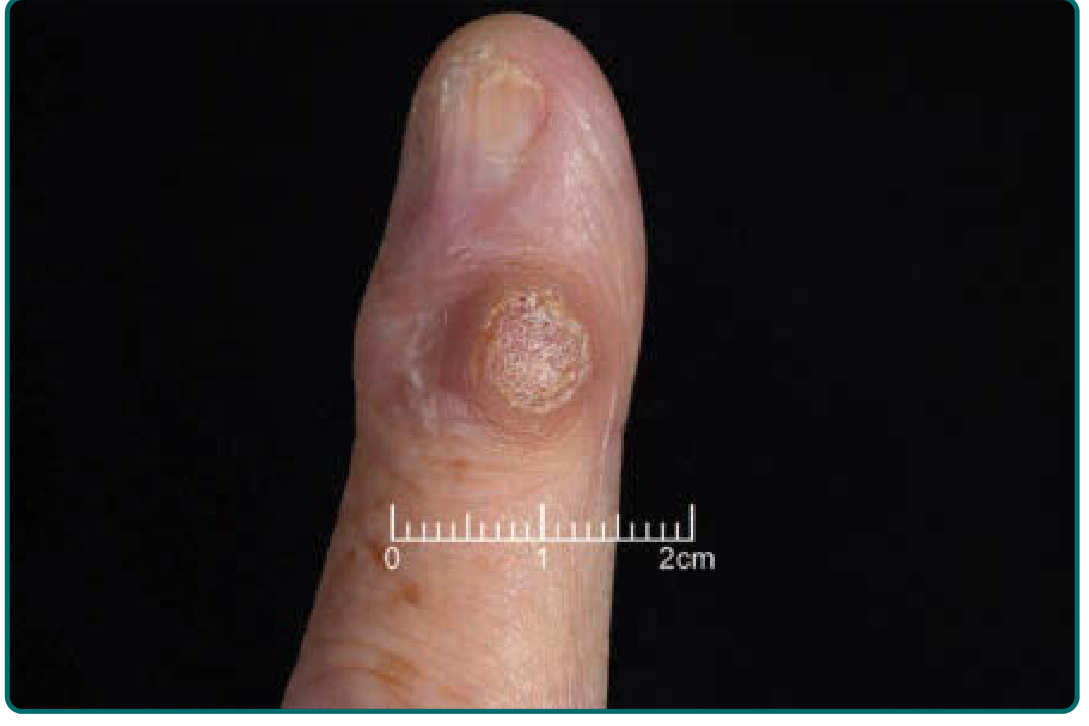
Well-defined common wart on a finger. Thrombosed capillaries appear as characteristic black dots.
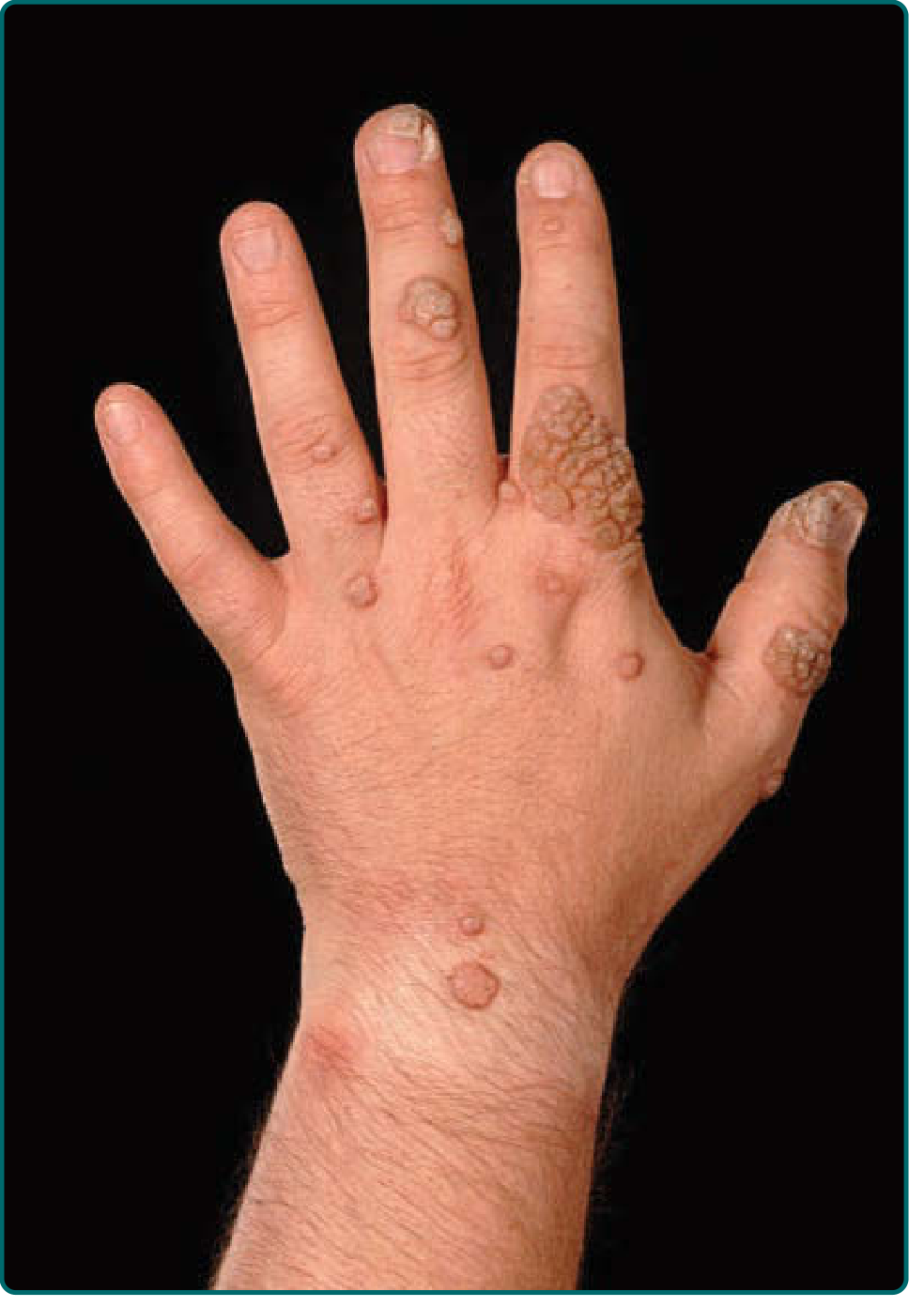
Multiple warts on the hand, with periungual warts affecting nail growth.
2. Plantar Warts (Verruca Plantaris)
Endophytic lesions on the soles, covered by thick keratin. Paring reveals a central keratinized core with punctate bleeding points (thrombosed capillaries - the so-called "seed warts"). Painful on weight-bearing surfaces. Multiple adjacent flat plantar warts coalesce into mosaic warts.
3. Flat Warts (Verruca Plana)
Small (1-4 mm), slightly elevated, flesh-colored papules with a smooth, velvety, non-verrucous surface. Common on the face, arms, and legs. Spread readily by scratching or shaving. Can propagate into the hundreds.
4. Filiform Warts
Narrow-based lesions with long, finger-like projections. Common on the face, neck, and skin folds. Seen in children around the lips and chin.
5. Anogenital Warts (Condylomata Acuminata)
Caused by HPV-6 and -11 (low risk). Begin as small papules on the vulva, vagina, cervix, penis, scrotum, perianal, and oral mucosa. Become macerated and white on mucosal surfaces; develop a cauliflower appearance when large. Considered an STI. Associated with cervical and penile carcinoma (via co-infection with HPV-16/18).
6. Oral Warts
On lips, oral cavity, and upper respiratory tract. Macerated and flat or cauliflower-shaped. Common in HIV. Laryngeal papillomatosis (recurrent respiratory papillomatosis) occurs in children via maternal infection at birth.
Histology
The histological hallmarks are:
- Acanthosis (epidermal thickening)
- Hypergranulosis
- Hyperkeratosis
- Koilocytes - keratinocytes with clear cytoplasm and a dense, twisted nucleus (pathognomonic of HPV)
Diagnosis
Warts are a clinical diagnosis in most cases. Paring the surface reveals thrombosed capillary loops (black dots) and causes pinpoint bleeding. HPV DNA detection by PCR or in situ hybridization can confirm the diagnosis but is not used in routine clinical care.
Differential diagnosis includes corns (no black dots, painful with direct pressure), molluscum contagiosum, seborrheic keratosis, and squamous cell carcinoma (for atypical or non-resolving lesions).
Clinical Course
Warts in immunocompetent individuals resolve spontaneously within 1-2 years in most cases. Extensive or recalcitrant warts in any patient should prompt assessment of immune function.
Treatment
No single therapy is universally effective. Treatment choice depends on location, extent, patient age, immune status, and patient preference.
First-Line / Office-Based
| Treatment | Details |
|---|---|
| Cryotherapy (liquid nitrogen) | Most useful for almost any location. Double freeze, repeated every 3 weeks for at least 3 months. Painful - often not tolerated around nails, soles, or in children. |
| Salicylic acid | Keratolytic plasters or solutions. Equally effective as cryotherapy for non-genital warts but requires persistent patient compliance over months. |
| Podophyllin / Podophyllotoxin | In-office or self-applied. Reduces epidermal growth. Used for anogenital warts. 50-70% clearance; moderate local reactions. |
Topical Immunomodulators
| Treatment | Details |
|---|---|
| Imiquimod | Potent inducer of local cytokine release. FDA-approved for genital warts. Self-applied. Slightly lower recurrence than podophyllotoxin. Also useful for plane warts. |
| Sinecatechins (green tea extract) | Available for genital and oral warts. |
Destructive / Surgical
- Trichloroacetic acid (TCA), silver nitrate, phenol - caustic agents
- Laser therapy (CO2 or pulsed dye laser)
- Electrocautery
- Excisional surgery - for recalcitrant or large warts
Other
- Topical retinoids - useful for reducing wart bulk
- 5-Fluorouracil (5-FU) - used especially for recalcitrant warts
- Cantharidin - blistering agent applied in office
- Intralesional bleomycin or immunotherapy - for refractory cases
- Duct tape occlusion - some evidence in children; mechanism unclear
In immunocompromised patients, wart clearance is rare. Treatment is aimed at reducing bulk, maintaining function, and avoiding pain.
Oncogenic Risk & HPV-Related Cancers
HPV-16 and -18 are the major risk factors for:
- Cervical intraepithelial neoplasia (CIN) and invasive cervical carcinoma
- Anal, vulvar, and penile squamous cell carcinoma
- Oropharyngeal squamous cell carcinoma
Risk is significantly higher in immunosuppressed patients (organ transplant recipients, HIV). Women with condylomata should have annual Pap smears.
Prevention: HPV Vaccination
The quadrivalent vaccine (Gardasil) covers HPV types 6, 11, 16, and 18. Clinical trials showed a ~90% reduction in cervical intraepithelial neoplasia, cervical cancer, and anogenital warts. Since introduction in 2007, there has been a recorded decrease in genital wart presentations and prevalence of HPV-6 and -11. Current indications cover both males and females aged 9-26 years (and up to 45 in some guidelines).
Recent evidence (2024-2025): A 2025 systematic review and meta-analysis (PMID 40670323) found zinc effective in treating HPV warts and cervical infection. A 2025 Cochrane review (PMID 41276264) confirmed the community-level benefits of HPV vaccination programmes in reducing HPV-related disease.
Sources: Fitzpatrick's Dermatology 5e, p. 3127-3132; Harrison's Principles of Internal Medicine 22e; Textbook of Family Medicine 9e, p. 945; Goldman-Cecil Medicine
This is a shared conversation. Sign in to Orris to start your own chat.