
Difference between inflammation and swelling
Inflammation and swelling are related but distinct concepts:
- Inflammation is a biological process - a complex immune/vascular response to injury, infection, or irritation. It involves chemical mediators, immune cells, and vascular changes.
- Swelling (edema) is a sign - the visible/palpable enlargement of tissue due to fluid accumulation. It is one of the five classic signs of inflammation, but can also occur without inflammation (e.g., heart failure, lymphedema).
Searching sources...
Reading File
Finding Sources
Finding Sources
Reading File
Reading File
Reading File
Now I also have the inflammation process diagram. Let me also look up edema/swelling causes that are non-inflammatory to complete the comparison.
Finding Sources
Finding Sources
I now have sufficient textbook content to give a thorough, well-cited answer. Let me also fetch the inflammation diagram.
Loading Image
Here is a thorough comparison drawn from authoritative pathology textbooks.
Inflammation vs. Swelling
The Core Distinction
| Inflammation | Swelling (Edema/Tumor) | |
|---|---|---|
| What it is | A biological process | A physical sign |
| Nature | Active immune/vascular response | Fluid accumulation in tissue |
| Always present together? | Inflammation almost always causes swelling | Swelling can occur without inflammation |
| Treated by | Anti-inflammatory drugs (NSAIDs, steroids) | Depends on cause (diuretics, compression, etc.) |
Inflammation: The Process
Inflammation is a complex protective response triggered when the body encounters microbes, dead cells, or injury. As described in Robbins & Kumar Basic Pathology, the process unfolds in five "R" steps:
- Recognition of the offending agent (by macrophages, dendritic cells, mast cells)
- Recruitment of leukocytes (neutrophils first, then monocytes/macrophages)
- Removal of the offending agent by phagocytosis
- Regulation to wind down the response
- Repair of damaged tissue
The diagram below shows this sequence:
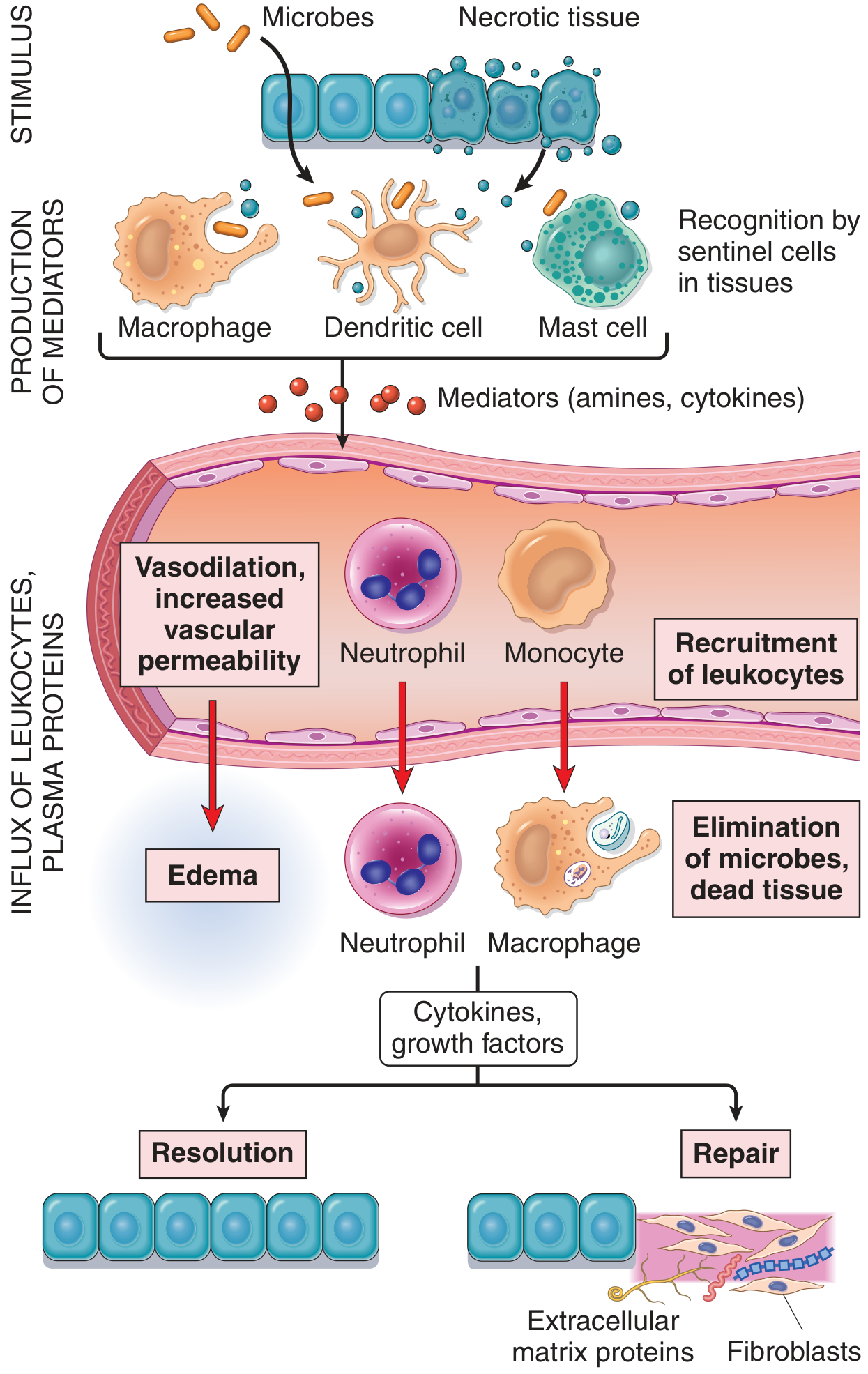
Fig. 2.1 - Robbins & Kumar Basic Pathology: Macrophages and other cells recognize microbes/damaged cells and release mediators, triggering vascular and cellular reactions. Edema forms as one consequence.
Inflammation has five classic cardinal signs (first four described by Celsus ~1st century AD; fifth added by Virchow in the 19th century):
| Latin | English | Mechanism |
|---|---|---|
| Rubor | Redness | Vasodilation → increased blood flow |
| Calor | Heat | Increased blood flow (+ metabolic activity) |
| Tumor | Swelling | Increased vascular permeability → fluid leaks out |
| Dolor | Pain | Prostaglandins, bradykinin, neuropeptides act on sensory nerves |
| Functio laesa | Loss of function | Consequence of pain and tissue injury |
Swelling (tumor) is therefore one of five signs of inflammation - Robbins, Cotran & Kumar Pathologic Basis of Disease.
Swelling (Edema): The Sign
Swelling is the visible/palpable enlargement of tissue due to excess fluid. In inflammation, this fluid is called an exudate - it is protein-rich because increased vascular permeability allows plasma proteins to leak out.
The mechanism: inflammatory mediators (especially histamine from mast cells) cause vasodilation and increased vascular permeability → plasma fluid exits into the interstitium → tissue swells - Junqueira's Basic Histology, Text and Atlas, 17e.
But swelling can occur without inflammation through entirely different mechanisms:
| Non-inflammatory cause | Mechanism |
|---|---|
| Heart failure | Increased venous hydrostatic pressure forces fluid into tissue (transudate - low protein) |
| Hypoalbuminemia (liver disease, nephrotic syndrome) | Low oncotic pressure - fluid stays outside vessels |
| Lymphedema | Blocked lymphatics fail to drain interstitial fluid |
| Venous obstruction (DVT) | Raised local venous pressure |
| Trauma (simple bruise) | Direct vessel disruption, not true inflammation |
In these cases, there is no immune activation, no neutrophil recruitment, no cytokines - just fluid imbalance.
Exudate vs. Transudate (Key Distinction for Swelling)
| Exudate (inflammatory) | Transudate (non-inflammatory) | |
|---|---|---|
| Protein content | High (>3 g/dL) | Low (<3 g/dL) |
| Specific gravity | >1.020 | <1.020 |
| Cells | Leukocytes present | Few or no cells |
| Cause | Increased vascular permeability | Hydrostatic/oncotic pressure imbalance |
Summary
- Inflammation is a systemic biological response with cellular, vascular, and chemical components. It is a process that aims to eliminate harmful stimuli and begin repair.
- Swelling is merely one physical manifestation - fluid accumulation in tissue. It is produced by inflammation but can also result from purely mechanical or hemodynamic causes with no immune involvement whatsoever.
- In clinical practice, you need to distinguish inflammatory swelling (warm, red, tender, with systemic signs like fever) from non-inflammatory swelling (typically cool, pitting, bilateral, without redness) because the treatment is completely different.
This is a shared conversation. Sign in to Orris to start your own chat.