
Write in detail about DNA recombinant technology and its applications with diagrams
Reading File
Now let me search the medical library and find relevant content on recombinant DNA technology in parallel.
Finding Sources
Finding Sources
Searching Images
recombinant DNA technology cloning vector diagram
Reading File
Finding Sources
Searching Images
plasmid vector gene cloning restriction enzyme ligation
Reading File
Reading File
Reading File
Reading File
Loading Image
Finding Sources
Finding Sources
Reading File
Reading File
Reading File
Finding Sources
Loading Image
Loading Image
Reading File
I now have comprehensive content from the textbooks and diagrams. Let me compile the full detailed answer.
Recombinant DNA Technology: A Detailed Overview
Recombinant DNA (rDNA) technology refers to the set of laboratory methods used to isolate, manipulate, join, and replicate DNA segments from different sources - creating chimeric ("hybrid") DNA molecules that can be introduced into host organisms for study or for the production of useful products. The field has transformed medicine, agriculture, forensics, and basic science since its inception in the early 1970s.
1. Definition and Core Concept
"Isolation and manipulation of DNA, including end-to-end joining of sequences from very different sources to make chimeric molecules (e.g., molecules containing both human and bacterial DNA sequences in a sequence-independent fashion)... is the essence of recombinant DNA research."
- Harper's Illustrated Biochemistry, 32nd Ed.
In essence, rDNA technology allows a scientist to take a gene from one organism (e.g., the human insulin gene) and insert it into a bacterium so that the bacterium "reads" that gene and produces the human protein.
2. Core Tools and Reagents
2.1 Restriction Endonucleases ("Molecular Scissors")
Restriction enzymes are bacterial endonucleases that recognize specific 4-8 base pair palindromic DNA sequences and cut at those sites. Named after the bacteria they were isolated from (e.g., EcoRI from Escherichia coli, BamHI from Bacillus amyloliquefaciens), they are the fundamental cutting tools of rDNA work.
- Blunt-end cutters (e.g., HpaI): Cut straight across both strands, leaving no overhang
- Sticky-end cutters (e.g., EcoRI, BamHI): Cut in a staggered manner, leaving single-stranded overhangs ("cohesive ends") that are far more useful for constructing chimeric molecules because complementary sticky ends base-pair easily before ligation
The frequency of cutting is mathematically predictable: a 4-bp recognition site cuts approximately every 256 bp (4⁴), a 6-bp site every 4,096 bp (4⁶).
Each bacterium that carries a restriction enzyme also carries a companion DNA methylase that marks its own DNA at the same recognition site, protecting the host cell from self-cleavage - always existing in pairs.
Harper's Illustrated Biochemistry, 32nd Ed.
2.2 DNA Ligase ("Molecular Glue")
DNA ligase seals the phosphodiester bonds between DNA fragments after they have annealed via their sticky ends. This enzyme is what allows a foreign DNA fragment to be permanently joined into a vector backbone to form a recombinant molecule.
2.3 Cloning Vectors
Vectors are DNA vehicles used to carry a foreign DNA insert into a host cell, where the insert will be replicated. Major types include:
| Vector Type | Insert Size | Notes |
|---|---|---|
| Plasmids | Up to ~10 kb | Circular, self-replicating; carry antibiotic resistance genes for selection |
| Bacteriophages | Up to ~20 kb | Linear DNA; uses phage lytic cycle for amplification |
| Cosmids | 35-50 kb | Hybrid of plasmid + phage cos sites; packed into phage particles |
| BACs / YACs | 100 kb - 1 Mb+ | Bacterial/yeast artificial chromosomes; used for genome projects |
Bacterial plasmids are especially useful because they exist as episomes (replicating independently from the host chromosome), their complete sequences are known, restriction sites are precisely mapped, and they can be biochemically separated from the host chromosome.
Harper's Illustrated Biochemistry, 32nd Ed.
2.4 Reverse Transcriptase
This enzyme, derived from retroviruses, synthesizes complementary DNA (cDNA) from an mRNA template. This is key for cloning expressed genes - using mRNA means the resulting cDNA contains only the coding sequence (exons), without intronic sequences that bacteria cannot process.
3. General Steps in Gene Cloning
The basic process is shown schematically in the diagram below:
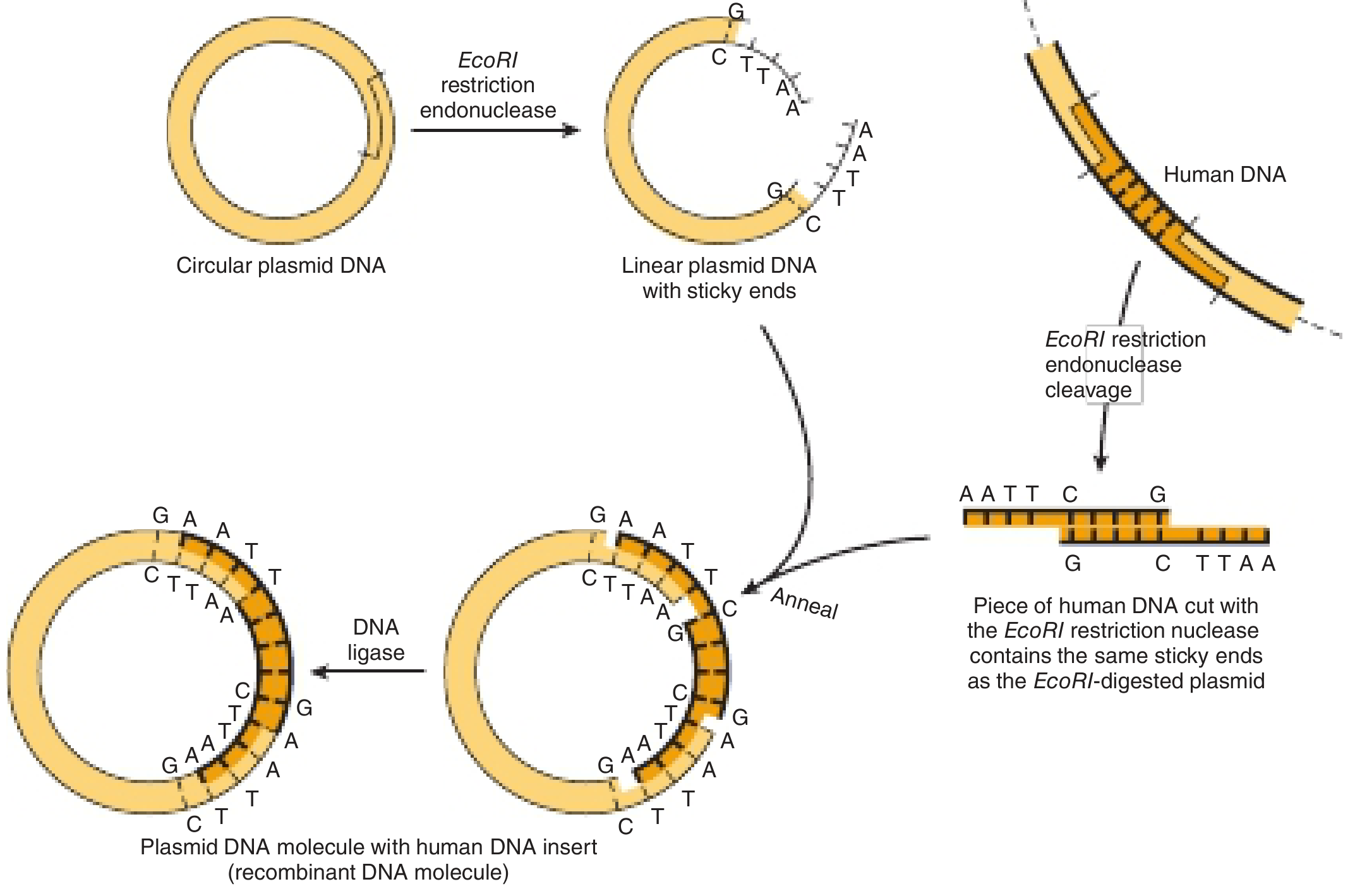
Figure: Use of restriction endonucleases to create a recombinant plasmid. The same restriction enzyme (EcoRI) is used to cut both the plasmid vector and the human DNA, generating complementary sticky ends. Annealing and ligation with DNA ligase joins the human insert into the plasmid, creating a chimeric recombinant molecule. - Harper's Illustrated Biochemistry, 32nd Ed.
Step-by-step process:
- Obtain the gene of interest - from genomic DNA (cut with restriction enzymes), by PCR amplification, or by reverse-transcribing mRNA into cDNA
- Cut the vector - use the same restriction enzyme(s) on the plasmid to create compatible sticky ends
- Ligate - mix insert and linearized vector with DNA ligase; the sticky ends anneal and are sealed
- Transform - introduce the recombinant plasmid into a competent host cell (usually E. coli) by heat shock or electroporation
- Select transformants - grow on plates containing antibiotic; only bacteria that took up the plasmid survive
- Screen clones - verify which colonies carry the correct insert by PCR, restriction mapping, or DNA sequencing
- Amplify - grow the correct clone in liquid culture; the host bacterium replicates the plasmid (and insert) every time it divides
4. Polymerase Chain Reaction (PCR)
PCR is a rapid in vitro DNA amplification technique that has largely replaced gene library approaches for amplifying known sequences. It can amplify a target sequence from a single cell's worth of DNA to billions of copies in a few hours.
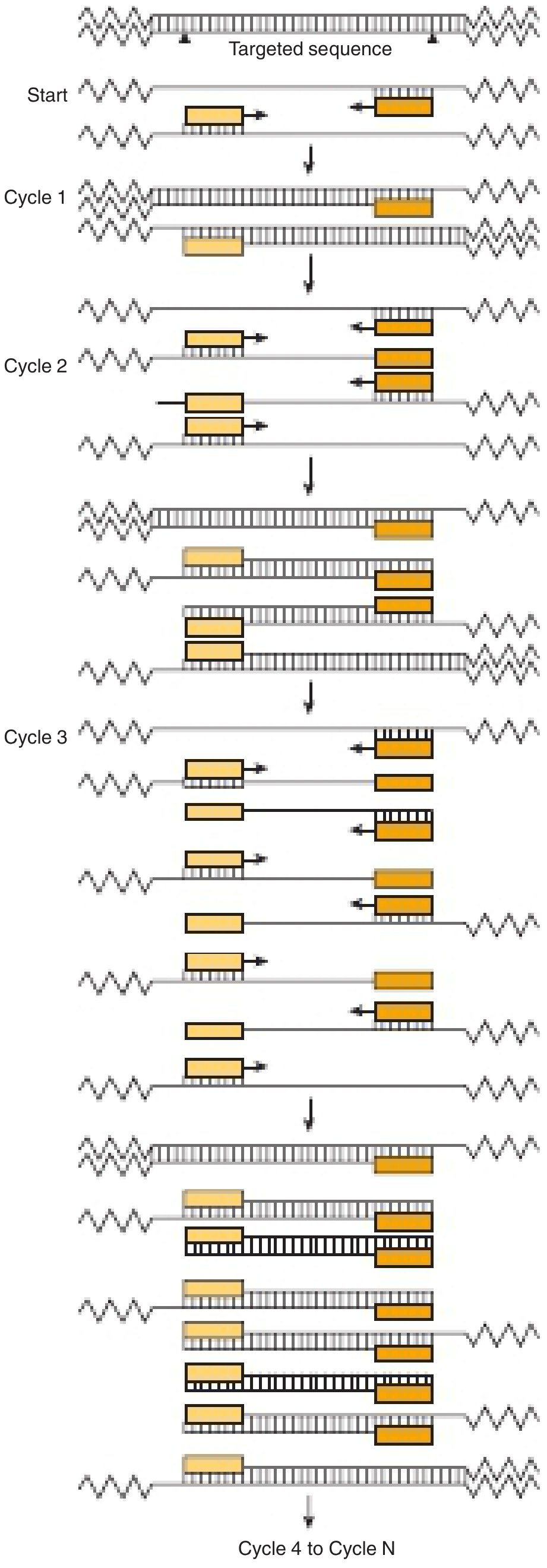
Figure: The Polymerase Chain Reaction. Each cycle consists of denaturation (>90°C), primer annealing (50-75°C), and extension by thermostable DNA polymerase. Product doubles each cycle. After 30 cycles: 2³⁰ = ~10⁹-fold amplification. - Harper's Illustrated Biochemistry, 32nd Ed.
Components required:
- Template DNA
- Two oligonucleotide primers (flanking the target, on opposite strands)
- Thermostable DNA polymerase (e.g., Taq polymerase from Thermus aquaticus)
- Four deoxyribonucleotide triphosphates (dNTPs)
- Thermal cycler (automated machine)
Three steps per cycle:
- Denaturation - heat to >90°C; double-stranded DNA separates
- Annealing - cool to ~50-75°C; primers bind their complementary sequences
- Extension - heat to ~72°C; Taq polymerase extends from each primer
20 cycles = 10⁶-fold amplification; 30 cycles = 10⁹-fold amplification.
PCR is the backbone of modern molecular diagnosis, forensics, sequencing library preparation, and countless other applications.
5. DNA Sequencing
Understanding the sequence of a cloned gene is essential for confirming its identity and function.
- Sanger (chain termination) sequencing - the first-generation method; uses dideoxynucleotide terminators to produce ladder fragments read by gel electrophoresis. Still used for single-target confirmation.
- Next-generation sequencing (NGS/HTS) - massively parallel, fluorescent label-based sequencing. Reduced the cost of sequencing the entire human genome from ~$350 million to under $1,000. Enabled the era of personalized genomics.
- Third-generation sequencing (PacBio, Oxford Nanopore) - real-time single-molecule sequencing of very long reads (up to 900 kb), now enabling complete genome assembly and direct RNA sequencing.
Harper's Illustrated Biochemistry, 32nd Ed.
6. CRISPR/Cas9 - Targeted Gene Editing
CRISPR/Cas9 is a revolutionary gene-editing tool adapted from the bacterial immune system. It allows precise, programmable cutting of genomic DNA at virtually any target site.
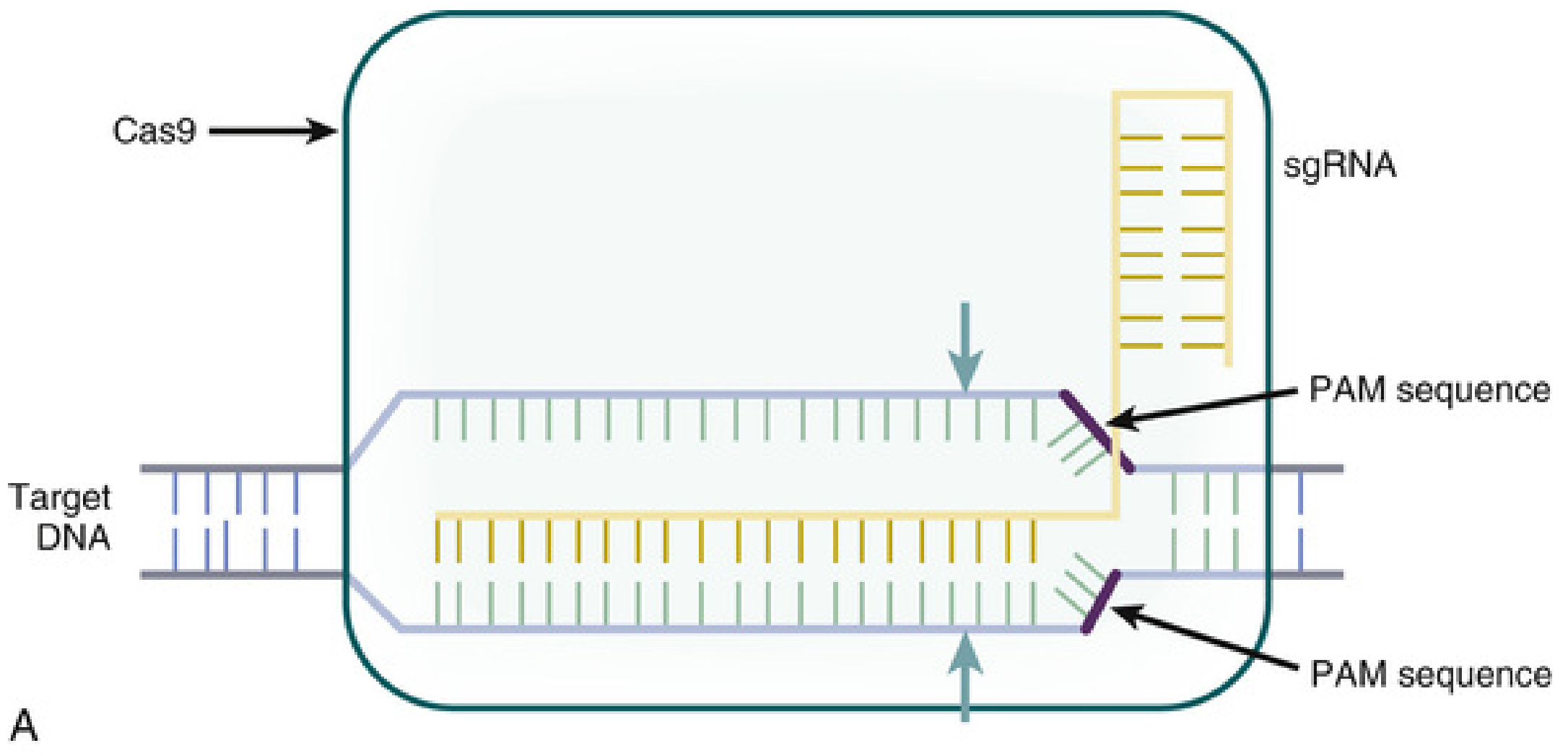
Figure: CRISPR/Cas9 system. A single guide RNA (sgRNA) contains a 20-bp sequence complementary to the target genomic DNA, plus a stem structure that binds the Cas9 nuclease. Cas9 cleaves both DNA strands adjacent to the protospacer-adjacent motif (PAM) sequence. - The Developing Human: Clinically Oriented Embryology
Mechanism:
- A single guide RNA (sgRNA) is designed with 20 bp complementary to the target genomic sequence
- The sgRNA:Cas9 complex scans the genome and binds target DNA adjacent to a PAM sequence (5'-NGG-3')
- Cas9 cleaves both DNA strands, creating a double-strand break (DSB)
- The break is repaired by:
- NHEJ (non-homologous end joining) - error-prone; introduces insertions/deletions (indels) that disrupt gene function (gene knockout)
- HDR (homology-directed repair) - precise; uses a supplied DNA template to correct or introduce mutations (gene correction)
Advantages over earlier methods (zinc finger nucleases, TALENs): modular design, easy synthesis, high specificity, low cost. It has already been used to cure sickle cell disease in human clinical trials.
The Developing Human: Clinically Oriented Embryology; Harper's Illustrated Biochemistry, 32nd Ed.
7. Applications of Recombinant DNA Technology
7.1 Therapeutic Protein Production
The most immediate medical application is the bacterial or yeast production of human proteins for therapy - providing pure, human-sequence proteins without immunological risk from animal-derived products.
| Recombinant Protein | Clinical Use |
|---|---|
| Insulin | Diabetes mellitus |
| Growth hormone (somatotropin) | GH deficiency/short stature |
| Factor VIII | Hemophilia A |
| Factor IX | Hemophilia B |
| Erythropoietin | Anemia (chronic kidney disease, chemotherapy) |
| β-Interferon | Multiple sclerosis |
| α-Galactosidase A | Fabry disease |
| Tissue plasminogen activator (tPA) | Acute ischemic stroke, MI |
Before recombinant insulin was available, diabetic patients received pig pancreas insulin, which occasionally caused sensitivity reactions. Before recombinant Factor VIII, HIV contaminated blood-derived cryoprecipitate products. Recombinant production eliminated both risks.
Emery's Elements of Medical Genetics and Genomics; Harper's Illustrated Biochemistry, 32nd Ed.
7.2 Vaccine Production
- Subunit vaccines - recombinant surface antigens (e.g., hepatitis B surface antigen [HBsAg] produced in yeast) stimulate immunity without introducing live pathogen
- Recombinant attenuated vaccines - using rDNA to remove virulence genes from live viruses, creating safer live-attenuated vaccines
- mRNA vaccines - the COVID-19 mRNA vaccines (Pfizer-BioNTech, Moderna) use in-vitro-transcribed mRNA encoding the spike protein, delivered in lipid nanoparticles. This is rDNA technology at its most modern: the spike protein cDNA was cloned, sequenced, optimized, and transcribed in vitro.
Harper's Illustrated Biochemistry, 32nd Ed.; Janeway's Immunobiology, 10th Ed.
7.3 Gene Therapy
Gene therapy is the therapeutic delivery of nucleic acid into patient cells to treat disease. It targets:
- Monogenic disorders - single-gene deficiencies where a corrected gene can restore function (e.g., ADA-SCID, hemophilia, sickle cell disease, cystic fibrosis, Gaucher disease)
- Non-genetic diseases - cancer (oncolytic viruses, CAR-T), HIV, cardiovascular disease
Delivery vectors:
Non-viral (transfection):
- Naked DNA injection
- Liposomes (cationic lipids)
- Nanoparticles
- Electroporation, gene gun
- Less immunogenic, safer, but less efficient
Viral (transduction):
- Retroviral/lentiviral vectors - integrate into the host genome; good for long-term expression in dividing cells; risk of insertional mutagenesis
- Adenoviral vectors - high-efficiency transduction; non-integrating; risk of immune activation (as in the Jesse Gelsinger case, 1999)
- Adeno-associated virus (AAV) - currently the preferred vector; non-integrating; low immunogenicity; long-term expression in post-mitotic cells (muscle, liver, neurons)
- Herpes simplex virus (HSV) - neurotropic; used for pain management gene therapy
Goldman-Cecil Medicine, International Ed.
7.4 Molecular Diagnosis
rDNA tools have transformed clinical diagnostics:
- PCR-based pathogen detection - detect HIV, Ebola, SARS-CoV-2, hepatitis B/C, tuberculosis with extreme sensitivity (down to single-copy level)
- Southern blotting - detect specific DNA sequences in genomic samples; classic tool for gene mutation detection
- DNA microarrays (gene chips) - simultaneously test thousands of gene expression levels or genetic polymorphisms
- Next-generation sequencing (NGS) - whole-genome or whole-exome sequencing for comprehensive mutation discovery in cancer and genetic disease
- Restriction fragment length polymorphism (RFLP) - historically used to detect single-point mutations (e.g., sickle cell disease: HbS destroys the MstII recognition site)
7.5 Forensic Medicine
PCR allows amplification of DNA from minute samples: a single hair follicle, a drop of dried blood, or a single spermatozoon. The resulting DNA profile (using short tandem repeat analysis, STR) can uniquely identify an individual with near-certainty. rDNA technology has:
- Exonerated wrongfully convicted individuals
- Identified perpetrators from trace evidence
- Identified remains (mass disasters, war casualties)
- Established paternity
Harper's Illustrated Biochemistry, 32nd Ed.
7.6 Transgenic Animals and Knockout/Knockin Models
Transgenic animals are created by microinjecting foreign DNA into fertilized ova. The injected DNA may integrate into germ cells, creating a heritable transgene. Applications:
- Study tissue-specific gene expression
- Model human disease (e.g., transgenic mice expressing mutant APP/PSEN1 as Alzheimer's models)
- Produce pharmaceutical proteins in milk (e.g., recombinant human antithrombin produced in goat milk)
- Study developmental biology
Knockout mice (gene targeted deletion via homologous recombination) and CRISPR-edited animals allow precise loss-of-function and gain-of-function analyses of virtually any gene.
Harper's Illustrated Biochemistry, 32nd Ed.
7.7 Agriculture and Environmental Applications
- Bt crops - plants expressing the Bacillus thuringiensis toxin gene for insect resistance (cotton, corn, soy)
- Herbicide-tolerant crops - glyphosate-resistant soybeans/corn
- Nutritionally enhanced crops - Golden Rice (expressing beta-carotene biosynthesis genes to combat vitamin A deficiency)
- Drought/temperature resistance - engineering crop plants for climate resilience
- Nitrogen fixation - attempts to engineer cereal crops that fix atmospheric nitrogen like legumes
- Bioremediation - bacteria engineered to degrade environmental pollutants
7.8 Personalized Medicine and Pharmacogenomics
NGS-based whole-exome sequencing identifies which genetic variants an individual carries that influence:
- Drug metabolism (e.g., CYP2D6 variants affecting opioid/antidepressant metabolism)
- Disease risk (e.g., BRCA1/2 mutations predicting breast cancer risk)
- Response to targeted therapies (e.g., KRAS/EGFR mutations in lung cancer determining eligibility for tyrosine kinase inhibitors)
Harper's Illustrated Biochemistry, 32nd Ed.
8. Ethical and Safety Considerations
- Biosafety - early rDNA experiments required strict containment; modern regulations (NIH guidelines) govern research
- Germline editing - CRISPR editing of human embryos raises profound ethical concerns about heritable changes. The He Jiankui case (2018) - creation of CCR5-edited babies - was widely condemned and led to calls for a global moratorium.
- GMO safety - public and regulatory debate over genetically modified food crops
- Gene therapy risks - insertional mutagenesis, immune reactions, off-target editing
- Privacy and genetic data - whole-genome sequencing raises concerns about insurance discrimination and data security
Summary Table: Key Tools
| Tool | Function | Example |
|---|---|---|
| Restriction enzymes | Cut DNA at specific sites | EcoRI, BamHI |
| DNA ligase | Join DNA fragments | T4 DNA ligase |
| Plasmids/vectors | Carry insert into host | pBR322, pUC19 |
| PCR | Amplify specific DNA sequences | Taq polymerase-based amplification |
| Reverse transcriptase | mRNA → cDNA | RT-PCR |
| DNA sequencing | Determine nucleotide order | Sanger, NGS |
| CRISPR/Cas9 | Targeted genome editing | Correction of sickle cell mutation |
| Southern blotting | Detect specific DNA sequences | Sickle cell diagnosis |
| Gene expression arrays | Profile thousands of genes simultaneously | Oncology panels |
References:
- Harper's Illustrated Biochemistry, 32nd Ed., Chapter 39 (Recombinant DNA Technology)
- Emery's Elements of Medical Genetics and Genomics - Therapeutic Applications of Recombinant DNA Technology
- Goldman-Cecil Medicine, International Ed. - Gene Therapy Delivery Methods
- The Developing Human: Clinically Oriented Embryology - CRISPR/Cas9 Gene Editing
- Janeway's Immunobiology, 10th Ed. - Recombinant Vaccines
This is a shared conversation. Sign in to Orris to start your own chat.