
Yoga and tinnitus
yoga tinnitus
yoga for tinnitus relief poses breathing exercises evidence 2024
PMID: 38157657
PMID: 37712305
https://pmc.ncbi.nlm.nih.gov/articles/PMC12895279
Yoga and Tinnitus
What Is Tinnitus?
- Subjective - heard only by the patient (most common)
- Objective - also audible to an examiner (rare)
The Stress-Tinnitus Link: Why Yoga Is Relevant
What the Evidence Says
Systematic review (Gunjawate & Ravi, 2021)
- Decreased tinnitus-related severity, stress, anxiety, and irritability
- Improved quality of life
Ashtanga Yoga (Nied ziałek et al., 2019)
4-7-8 Breathing Exercise RCT (2025, PMID in PMC12895279)
- Tinnitus severity and annoyance
- Anxiety and depression scores
- Insomnia severity The control group (information session only) showed no significant change.
Mind-Body Therapy Review in Otolaryngology (Kothari et al., 2024 - PMID 37712305)
COVID-19 Context Review (Apoorva et al., 2024 - PMID 38157657)
Textbook acknowledgment
How Yoga Helps: Proposed Mechanisms
| Mechanism | Yoga Component |
|---|---|
| Reduces sympathetic nervous system activity | Pranayama (breath control) |
| Lowers cortisol / physiological stress | Meditation, Savasana, Yoga Nidra |
| Improves sleep quality | Restorative poses, deep breathing |
| Relieves neck/shoulder muscle tension (somatic tinnitus) | Asanas (physical postures) |
| Increases cerebral circulation | Inversions, forward folds |
| Addresses anxiety and depression comorbidity | Mindfulness-based components |
Best Yoga Practices for Tinnitus
Breathing (Pranayama) - highest evidence
- Bhramari (humming bee breath): produces a vibration in the skull that may directly modulate auditory perception; well-studied
- 4-7-8 breathing: proven in an RCT to reduce tinnitus distress
- Nadi Shodhana (alternate nostril breathing): calms the nervous system
Meditation / Mind-Body
- Yoga Nidra (yogic sleep): deep relaxation state, reduces hyperarousal
- Shavasana (corpse pose): integrates the practice with full-body release
- Mindfulness meditation: shown in studies to reduce tinnitus distress comparably to relaxation therapy
Physical Poses (Asanas) - helpful for somatic/tension-related tinnitus
- Trikonasana (triangle pose): improves circulation to the head and neck
- Adho Mukha Svanasana (downward-facing dog): increases oxygenation to the head
- Gomukhasana (cow face pose): improves shoulder/neck circulation
- Bhujangasana (cobra pose): opens the chest, positive effects on upper body circulation
- Balasana (child's pose): promotes deep relaxation
Cautions
- Avoid head-down inversions if tinnitus is accompanied by vertigo (e.g., Meniere's disease) - these can provoke episodes.
- One case report (PMID 39507181) documented intracranial hypotension from dural tears following yoga - a rare but real risk of aggressive yoga positions in predisposed individuals.
- Yoga is a complementary strategy, not a replacement for audiology evaluation. Tinnitus with sudden onset, unilateral presentation, pulsatile character, or associated hearing loss warrants formal workup.
- For tinnitus with significant depression or anxiety, evidence-based treatments like Cognitive Behavioral Therapy (CBT) remain the gold standard psychological intervention.
Bottom Line
Make a comparison poster of different yoga techniques for tinnitus
A professional medical/wellness comparison poster titled "Yoga Techniques for Tinnitus Relief" comparing 6 different yoga techniques. Clean, modern design with a calming teal and white color scheme. Organized in a grid layout with 6 labeled cards/sections: 1. Bhramari Pranayama (Humming Bee Breath) - icon of sound waves, description: "Produces skull vibrations that may modulate auditory perception. Best studied technique for tinnitus. Practice 5-10 mins daily." Benefits badge: "Reduces ringing intensity" 2. 4-7-8 Breathing - icon of lungs/breath cycle, description: "Inhale 4 sec → Hold 7 sec → Exhale 8 sec. RCT-proven to reduce tinnitus severity, anxiety, and insomnia." Benefits badge: "Strongest clinical evidence" 3. Nadi Shodhana (Alternate Nostril Breathing) - icon of nostrils/breath, description: "Alternates breath through each nostril. Balances autonomic nervous system and reduces stress-related tinnitus flares." Benefits badge: "Calms nervous system" 4. Yoga Nidra (Yogic Sleep) - icon of resting figure, description: "Guided deep relaxation state. Reduces hyperarousal and breaks the stress-tinnitus feedback loop." Benefits badge: "Improves sleep quality" 5. Ashtanga Yoga (Physical Practice) - icon of person in yoga pose, description: "12-week course shown to improve tinnitus perception and quality of life. MRI evidence of increased emotional calmness." Benefits badge: "Structural brain changes" 6. Mindfulness Meditation - icon of meditation silhouette, description: "Shifts focus away from tinnitus. Reduces distress comparably to relaxation therapy. Can be combined with any other technique." Benefits badge: "Reduces distress & depression" At the bottom: a comparison table with columns: Technique | Evidence Level | Best For | Daily Time. Footer note: "Yoga is a complementary strategy. Always consult an audiologist for new or worsening tinnitus." Color coding: breathing techniques in blue, physical in green, mental/meditation in purple. Professional sans-serif fonts, clear hierarchy.
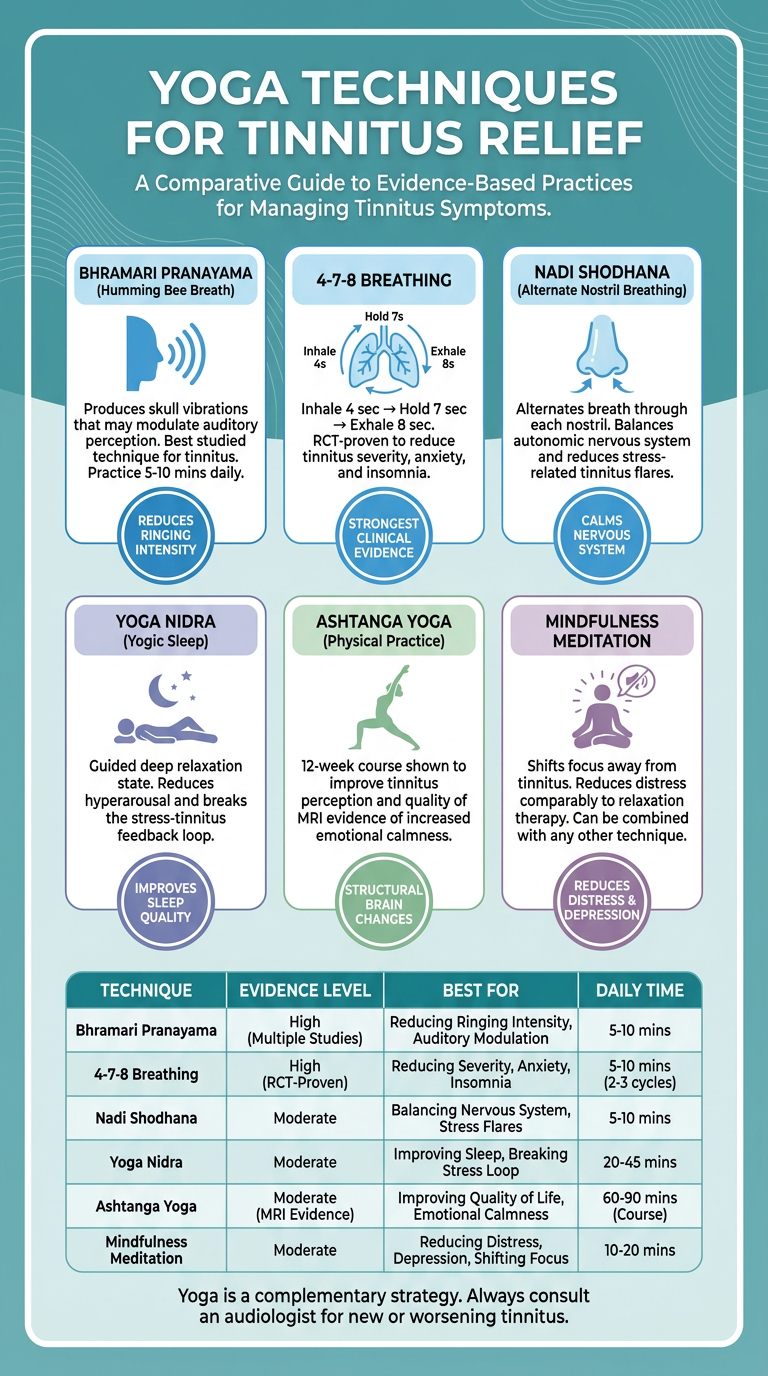
- Blue (Breathing): Bhramari Pranayama, 4-7-8 Breathing, Nadi Shodhana
- Green (Physical): Ashtanga Yoga
- Purple (Mental/Meditation): Yoga Nidra, Mindfulness Meditation
- 4-7-8 Breathing has the strongest recent clinical evidence (RCT, 2025)
- Bhramari is the most studied specifically for tinnitus due to its direct skull vibration effect
- Ashtanga Yoga has the most interesting neuroimaging evidence (gray matter changes on MRI)
- Yoga Nidra is best for those whose tinnitus disrupts sleep
- All techniques work by reducing sympathetic nervous system activity and breaking the stress-tinnitus feedback loop