
SIMPLE WAY TO UNDERSTAND MI IN ECG
Reading File
Now let me search the medical library for MI ECG content and images in parallel.
Finding Sources
Finding Sources
Searching Images
myocardial infarction ECG changes ST elevation Q wave
Finding Sources
Searching Images
ECG localization myocardial infarction territory leads coronary artery
Reading File
Loading Image
Loading Image
Reading File
Loading Image
I now have comprehensive textbook content and real ECG images. Let me compile the complete, well-illustrated answer.
MI on ECG — Simple Way to Understand
🫀 Why the ECG Changes in MI
When a coronary artery is blocked, myocardial cells go through three zones:
- Ischemia (outer zone) → T-wave changes
- Injury (middle zone) → ST changes
- Necrosis (inner zone) → Q-wave changes
Each zone produces a characteristic ECG change, and they evolve over time.
📊 The Three Key ECG Changes
| Change | What it Means | Timing |
|---|---|---|
| Hyperacute T waves (tall, peaked T) | Very early ischemia | Minutes |
| ST elevation (convex "tombstone") | Acute transmural injury | Hours |
| Pathological Q waves | Myocardial necrosis (permanent scar) | Hours–days |
| T-wave inversion | Evolving/post-infarction ischemia | Days–weeks |
| ST normalizes | Infarct stabilizing | Days |
Pathological Q wave criteria: width ≥ 0.04 s (1 small square) and depth ≥ 25% of the R-wave height.
⏱️ ECG Evolution Over Time (STEMI)
Minutes:   Hyperacute T waves (tall, broad, peaked)
Hours:     ST elevation appears — "tombstone" morphology
           Reciprocal ST depression in opposite leads
Hours–Day: Q waves develop (necrosis)
Days:      T-wave inversion
Weeks:     ST returns to baseline; Q waves may persist permanently
🗺️ STEMI Localization — Which Leads = Which Territory
This is the most clinically important part:
| Territory | Leads with ST Elevation | Culprit Artery |
|---|---|---|
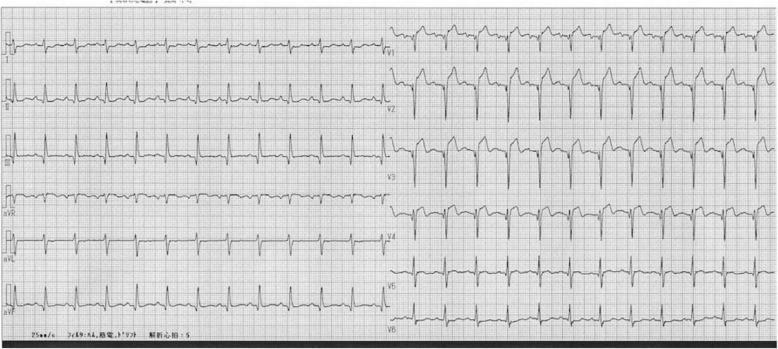
| Anterior | V1–V4 | LAD (Left Anterior Descending) |
| Anteroseptal | V1–V2 (±V3) | Proximal LAD |
| Anterolateral | V1–V6, I, aVL | Proximal LAD or LCx |
| Lateral | I, aVL | LCx or diagonal branch |
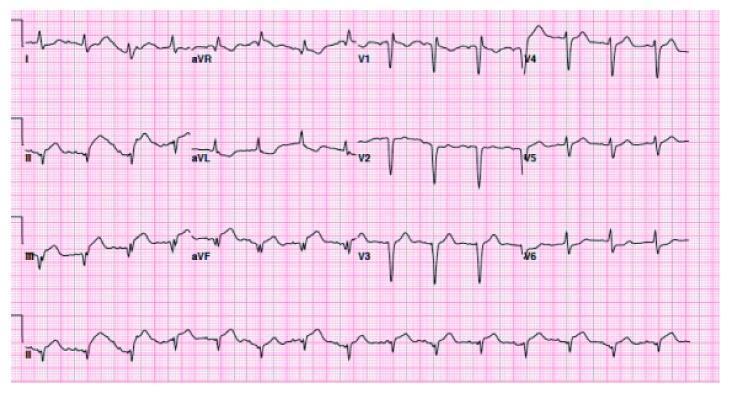
| Inferior | II, III, aVF | RCA (or LCx) |
| Inferolateral | II, III, aVF + V5–V6 | LCx |
| Posterior | Tall R in V1–V2 + ST depression V1–V3 | RCA or LCx |
| Right Ventricle | II, III, aVF + V3R–V6R (right-sided leads) | Proximal RCA |
Key tips to identify the culprit artery:
- ST elevation in III > II → Right Coronary Artery (RCA)
- ST elevation in I, aVL + ST depression V1–V3 → Left Circumflex (LCx)
- Elevation aVR > V1 → Left Anterior Descending (LAD) or left main
- ST elevation III > II + ST elevation V1 or V4R → Proximal RCA with RV involvement
(Source: Tintinalli's Emergency Medicine, Table 49-5)
🔄 Reciprocal Changes — The Mirror Image
When one wall is injured, the opposite leads show ST depression (mirror image). This confirms the ST elevation is real infarction, not artifact:
- Inferior STEMI (II, III, aVF) → Reciprocal depression in I, aVL
- Anterior STEMI (V1–V4) → Reciprocal depression in inferior leads
- Posterior MI → No ST elevation in standard leads; shows tall R + ST depression in V1–V3
📋 STEMI Diagnostic Criteria (Standard)
-
≥ 2 contiguous leads with:
- V2–V3: ≥ 2.5 mm in men <40 yrs; ≥ 2 mm in men ≥40 yrs; ≥ 1.5 mm in women
- All other leads: ≥ 1 mm
-
New LBBB + chest pain = treat as STEMI equivalent
🖼️ Real ECG Examples
Anterior STEMI (LAD occlusion) — Tombstone morphology V2–V4
Inferior STEMI (RCA occlusion) — Classic pattern
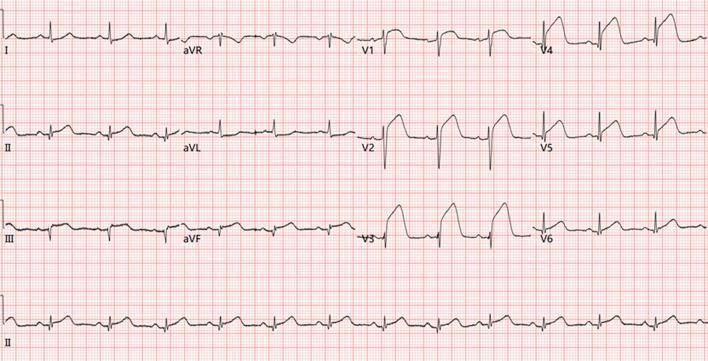
Extensive STEMI — Multi-territory involvement
🧠 Quick Memory Aid: "STEMI in a NUTSHELL"
S — ST elevation (convex, upward)
T — Tombstone shape = bad sign
E — Elevation in ≥2 contiguous leads
M — Mirror image (reciprocal depression)
I — Identify territory → coronary artery

Then later...
Q — Q waves form (necrosis)
I — Inversion of T waves (evolving)
⚠️ STEMI Mimics (Don't Miss These)
| Condition | Clue to Distinguish |
|---|---|
| Early repolarization | Notched J point, concave ST, young athlete |
| Pericarditis | Diffuse ST elevation all leads, PR depression, saddle-shaped |
| LBBB (old) | Apply Sgarbossa criteria |
| LVH | ST elevation in V1–V2 with large QRS voltages |
| Brugada | Downsloping ST in V1–V2, right bundle pattern |
| Hyperkalemia | Peaked T waves, no chest pain, wide QRS |
Summary Flow
Chest pain + ECG
       ↓
ST elevation in ≥2 contiguous leads?
       ↓ YES
Identify territory (table above)
       ↓
Look for reciprocal depression (confirms it)
       ↓
Activate cath lab → PCI within 90 min (door-to-balloon)
(Sources: Tintinalli's Emergency Medicine — STEMI chapter; Goldman-Cecil Medicine)
This is a shared conversation. Sign in to Orris to start your own chat.