
Drugs for Heart failure
Reading File
Now let me search the medical library and PubMed in parallel for comprehensive coverage.
Finding Sources
Searching PubMed
"heart failure" AND pharmacotherapy
Finding Sources
Finding Sources
Good, I have key sources. Now let me read the detailed pharmacology sections from Goldman-Cecil and Braunwald's in parallel.
Reading File
Finding Sources
Reading File
Finding Sources
Reading File
Reading File
I now have rich information. Let me fetch the ARNI mechanism diagram image and read the remaining sections on MRAs, ivabradine, and digoxin.
Reading File
Loading Image
I now have comprehensive information from authoritative sources. Let me compile the full answer.
Drugs for Heart Failure
Heart failure (HF) pharmacotherapy is organized around two main goals: relieving symptoms (congestion, breathlessness) and modifying disease (reducing mortality and hospitalization). For HF with reduced ejection fraction (HFrEF, LVEF ≤40%), four drug classes now form the cornerstone of therapy - the "Fantastic Four."
1. Diuretics (Symptom Relief)
Loop diuretics (furosemide, bumetanide, torsemide) are the primary agents for congestion relief. They produce rapid, intense diuresis by blocking the Na-K-2Cl transporter in the thick ascending limb of Henle.
- Thiazides (hydrochlorothiazide, metolazone) can be added in severe/resistant HF - they act synergistically with loop diuretics by blocking sodium reabsorption at a different nephron segment
- In advanced (stage D) HF, resistance to loop diuretics can develop due to gut edema impairing absorption, and IV bolus or continuous infusion may be required
- The loop + thiazide combination requires close monitoring of electrolytes (risk of hyponatremia, hypokalemia) and renal function
Diuretics alone are NOT sufficient for HF treatment - they relieve symptoms but do not slow structural progression or reduce mortality. - Goldman-Cecil Medicine, p. 482
2. ARNI - Sacubitril/Valsartan (First-Line, Preferred)
Sacubitril/valsartan (brand: Entresto) is the preferred first-line agent over ACE inhibitors/ARBs for HFrEF.
Mechanism: Dual action -
- Valsartan blocks the AT1 receptor, preventing harmful angiotensin II effects (vasoconstriction, aldosterone secretion, fibrosis, ventricular hypertrophy)
- Sacubitril is converted to LBQ657, which inhibits neprilysin - the enzyme that breaks down ANP, BNP, and CNP - thereby boosting natriuretic peptide effects (vasodilation, natriuresis, reduced sympathetic tone)
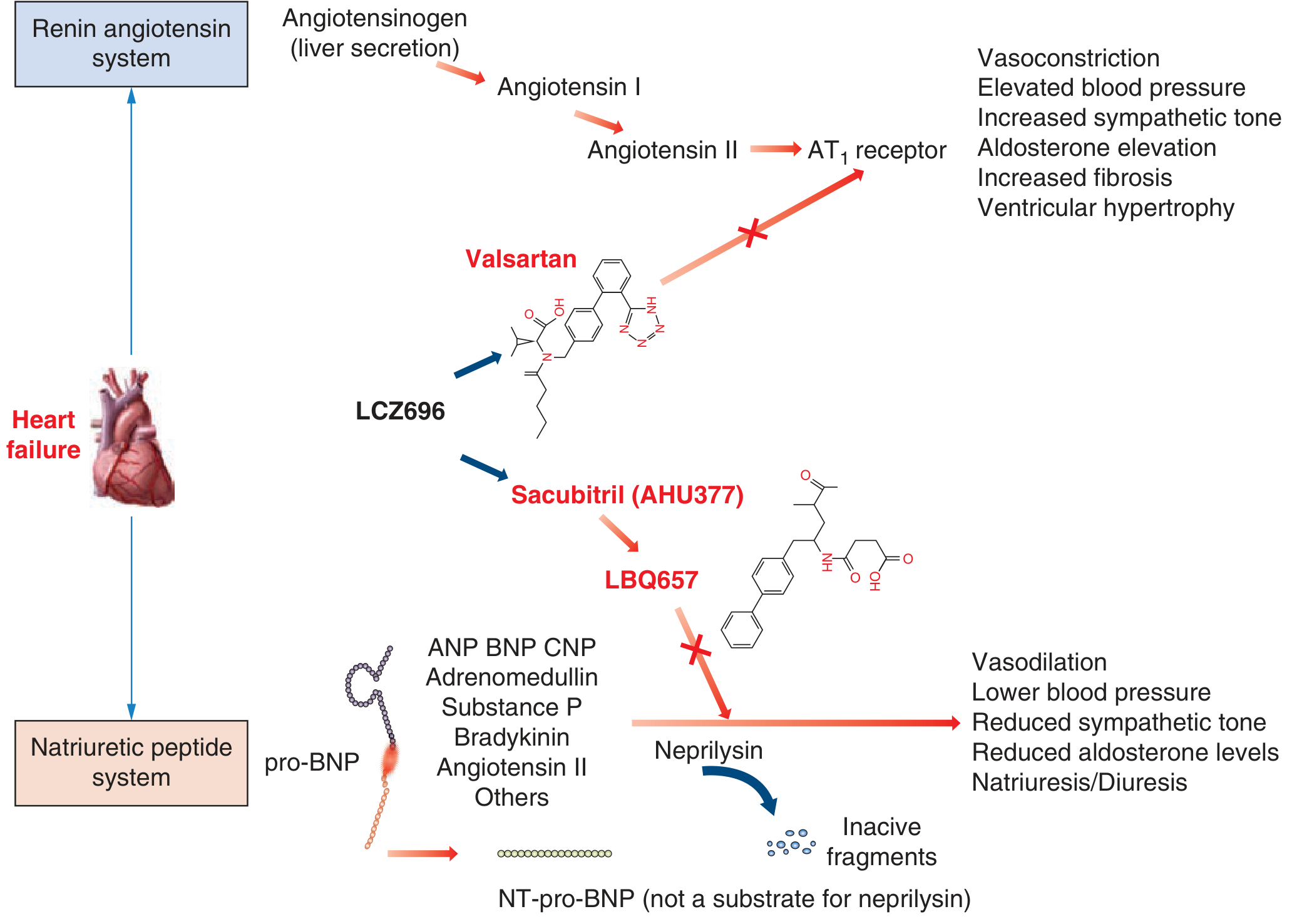
The PARADIGM-HF trial (n=8,442) showed sacubitril/valsartan reduced the composite of cardiovascular death or HF hospitalization by 20% vs. enalapril, with a 22% reduction in sudden death risk. - Fuster & Hurst's The Heart, 15th ed.
Important note: ARNI + ACE inhibitor is contraindicated (risk of angioedema from combined bradykinin accumulation). A 36-hour washout from ACE inhibitor is required before switching to sacubitril/valsartan.
3. ACE Inhibitors / ARBs (Use when ARNI not tolerated)
ACE Inhibitors (enalapril, lisinopril, ramipril, captopril):
- Block conversion of Ang I → Ang II, and prevent bradykinin breakdown
- Reduce LV size, improve EF, decrease symptoms, hospital admissions, and mortality
- Indicated for ALL patients with LV systolic dysfunction regardless of symptoms or etiology
- Key side effects: dry cough (~5%), hyperkalemia, hypotension, angioedema (rare but serious)
ARBs (losartan, candesartan, valsartan):
- Selectively block AT1 receptor
- Used when ACE inhibitor causes cough or angioedema
- Clinical benefits similar to ACE inhibitors when used at equivalent doses
- Combination ACE inhibitor + ARB is contraindicated (increased adverse effects, no added efficacy)
Starting doses are low and gradually uptitrated toward trial-proven target doses. - Goldman-Cecil Medicine, p. 482-483
4. Beta-Blockers
Three beta-blockers have proven mortality benefit in HFrEF: carvedilol, metoprolol succinate (CR/XL), and bisoprolol.
- Block the harmful effects of chronic sympathetic activation in HF (tachycardia, arrhythmia, myocyte toxicity, maladaptive remodeling)
- Reduce mortality, sudden death, and hospitalizations
- Must be started at very low doses and uptitrated slowly (typically every 2 weeks)
- Initiation is contraindicated in acutely decompensated/wet HF - start only once the patient is stable and euvolemic
- If heart rate falls below 50 bpm or symptoms worsen, halve the dose or seek specialist advice
5. Mineralocorticoid Receptor Antagonists (MRAs)
Spironolactone and eplerenone block aldosterone receptors, countering aldosterone-driven sodium retention, potassium loss, and cardiac fibrosis.
- Increase survival, reduce hospitalizations, and improve NYHA class in symptomatic HF (NYHA II-IV)
- Eplerenone is particularly indicated post-MI with LV dysfunction
- Doses: Spironolactone 25-50 mg/day; Eplerenone 25-50 mg/day
- Key monitoring: Serum K+ and creatinine at 1, 4, 8, 12 weeks then every 6 months
- Contraindications/cautions: K+ >5.0 mmol/L, creatinine >2.5 mg/dL
- Spironolactone causes gynecomastia (switch to eplerenone if this occurs)
6. SGLT2 Inhibitors - The Newest "Pillar"
Dapagliflozin and empagliflozin are now first-line therapy for HFrEF regardless of diabetes status.
Mechanism: Inhibit SGLT2 in the renal proximal tubule → increased urinary glucose and sodium excretion + osmotic diuresis. Additional effects include increased hematocrit, slowed GFR decline, and modest blood pressure reduction. The exact mechanism of HF benefit is not fully established.
Clinical benefits: When added to ARNI/ACE inhibitor/ARB + beta-blocker + MRA:
- Decrease LV size, improve EF
- Reduce symptoms and HF hospitalizations
- Prolong survival in both diabetic and non-diabetic patients
- Also mitigate MRA-induced hyperkalemia
Dosing: Single fixed dose, no uptitration needed
- Dapagliflozin 10 mg once daily
- Empagliflozin 10 mg once daily
Contraindications: Type 1 diabetes, history of diabetic ketoacidosis, eGFR <20 mL/min/1.73 m²
Side effects to watch: Genital fungal infections (5-10%), rare ketoacidosis. Hold 3 days before elective surgery. - Goldman-Cecil Medicine, p. 483-484
Summary: The "Fantastic Four" for HFrEF (LVEF ≤40%)
| Drug Class | Example | Key Benefit |
|---|---|---|
| ARNI (preferred) or ACE-I/ARB | Sacubitril/valsartan, enalapril | Reduce mortality + HF hospitalizations |
| Beta-Blocker | Carvedilol, bisoprolol, metoprolol | Reduce mortality + sudden death |
| MRA | Spironolactone, eplerenone | Reduce mortality + hospitalizations |
| SGLT2 Inhibitor | Dapagliflozin, empagliflozin | Reduce mortality + HF hospitalizations + renal protection |
Second-Line / Additional Agents
Ivabradine
- Inhibits the I(f) (funny) channel in the SA node to slow heart rate
- Indicated when heart rate remains >70 bpm in sinus rhythm despite maximum tolerated beta-blocker dose
- Has no negative inotropic effect - pure rate reduction
Digoxin
- A cardiac glycoside that inhibits Na/K-ATPase → increased intracellular Ca²⁺ → positive inotropy
- Also has vagotonic effects (slows AV conduction - useful in HF with AF)
- Can be added to diuretic + ACE inhibitor if HF remains symptomatic despite standard treatment in sinus rhythm
- Narrow therapeutic index; monitor levels, electrolytes (hypokalemia increases toxicity risk)
- Drug interactions: verapamil, quinidine increase digoxin levels
Hydralazine + Nitrates
- Combination of hydralazine (arterial vasodilator) and isosorbide dinitrate (venodilator)
- Reduces preload and afterload
- Particularly beneficial in Black patients with HFrEF (A-HeFT trial)
- Used when ACE inhibitors/ARBs/ARNIs are not tolerated
HF with Preserved EF (HFpEF, LVEF ≥50%)
HFpEF is much harder to treat. Most drugs proven in HFrEF (ACE-I, ARBs, beta-blockers, MRAs) have not shown mortality benefit in HFpEF clinical trials. Diuretics remain the mainstay for symptom relief. SGLT2 inhibitors (empagliflozin, dapagliflozin) are the most promising recent agents showing modest benefit in HFpEF as well. Treatment of underlying causes (hypertension, AF, coronary disease) is essential.
Recent Evidence (2024-2026)
A recent meta-analysis in JAMA (2026) confirmed SGLT2 inhibitors reduce kidney outcomes across a wide range of eGFR and albuminuria levels, reinforcing their broad use in HF with concomitant CKD. A 2025 systematic review in JACC Heart Failure also evaluated GLP-1 receptor agonists (semaglutide, liraglutide) in HFpEF/HFmrEF, showing symptom and functional improvements - an emerging area to watch.
Sources: Goldman-Cecil Medicine International Edition (2-Volume Set); Fuster & Hurst's The Heart, 15th Edition; Braunwald's Heart Disease, 2-Volume Set; Katzung's Basic and Clinical Pharmacology, 16th Edition
This is a shared conversation. Sign in to Orris to start your own chat.