
Explain Epithelium it's classification and it's type
Reading File
Now let me search the medical library for epithelium content.
Finding Sources
Finding Sources
Reading File
Finding Sources
Reading File
Reading File
Reading File
Finding Sources
Finding Sources
Loading Image
Reading File
Finding Sources
Reading File
Finding Sources
Now let me grab images of the specific epithelium types and glandular classification.
Finding Sources
Finding Sources
Reading File
Reading File
I now have comprehensive information from multiple authoritative textbooks. Let me compose the full answer.
Epithelium: Definition, Classification, and Types
What is Epithelium?
Epithelium is one of the four fundamental tissue types of the body. It is characterized by:
- Close cell apposition - epithelial cells are always contiguous, joined by specialized cell-to-cell junctions with minimal intercellular space
- Presence at a free surface - facing the exterior of the body, a body cavity, or the lumen of a tube/organ
- Rest on a basement membrane (basal lamina) - anchoring the epithelium to the underlying connective tissue
- Avascularity - receives nutrients by diffusion from connective tissue capillaries
Epithelium covers body surfaces, lines body cavities and tubes, and forms glands. It functions as a selective barrier between the external environment and the underlying connective tissue.
"Epithelial cells, whether arranged in a single layer or in multiple layers, are always contiguous with one another... joined by specialized cell-to-cell junctions that create a selective barrier between the external environment and the underlying connective tissue."
- Histology: A Text and Atlas, 8th ed.
Classification of Epithelium
The traditional classification is descriptive and based on two main factors:
Factor 1 - Number of Cell Layers
| Term | Meaning |
|---|---|
| Simple | One cell layer thick; all cells rest on the basement membrane |
| Stratified | Two or more cell layers; only the basal layer rests on the basement membrane |
Factor 2 - Shape of Surface Cells
| Term | Shape |
|---|---|
| Squamous | Width greater than height (flat, scale-like) |
| Cuboidal | Width, depth, and height approximately equal |
| Columnar | Height appreciably exceeds width |
In stratified epithelia, only the shape of the surface (topmost) layer is used for classification.
A third factor - specialization of the apical surface - may also be added (e.g., "simple columnar ciliated," "stratified squamous keratinized").
Types of Epithelium
Below is the full classification with locations and functions:
1. Simple Squamous Epithelium
- Structure: Single layer of flat cells with disc-shaped nuclei
- Locations:
- Vascular system → called endothelium
- Body cavities (pleural, peritoneal, pericardial) → called mesothelium
- Bowman's capsule of the kidney
- Alveoli of the lung
- Function: Exchange, barrier, lubrication
2. Simple Cuboidal Epithelium
- Structure: Single layer of cube-shaped cells with round, central nuclei
- Locations: Small ducts of exocrine glands, kidney tubules, thyroid follicles, surface of the ovary (germinal epithelium)
- Function: Absorption, secretion, conduit
3. Simple Columnar Epithelium
- Structure: Single layer of tall cells, nuclei near the base; may bear microvilli or cilia
- Locations: Small intestine and colon, stomach lining, gallbladder
- Function: Absorption and secretion
- Variants: Simple columnar ciliated (e.g., uterine tubes), simple columnar with goblet cells (intestines)
4. Pseudostratified (Columnar) Epithelium
- Structure: Appears stratified but is actually simple - all cells contact the basement membrane, but not all reach the surface; nuclei appear at different levels
- Locations: Trachea and bronchial tree (often ciliated), ductus deferens, epididymis efferent ductules
- Function: Secretion, conduit, mucociliary transport
- Note: Identification typically relies on knowing the normal anatomical location, as it can be difficult to confirm all cells contact the basement membrane on histology
5. Stratified Squamous Epithelium
The most common stratified epithelium. Has two subtypes:
a. Keratinized
- Surface cells are dead, anucleate, filled with keratin
- Location: Epidermis (skin)
- Function: Barrier against water loss and abrasion
b. Nonkeratinized
- Surface cells retain nuclei and most metabolic functions
- Locations: Oral cavity, esophagus, vagina (moist internal surfaces)
- Function: Protection with flexibility; barrier in moist surfaces
6. Stratified Cuboidal Epithelium
- Structure: Two or more layers; surface cells cuboidal
- Locations: Sweat gland ducts, large ducts of exocrine glands, anorectal junction
- Function: Barrier and conduit
7. Stratified Columnar Epithelium
- Structure: Relatively rare; surface cells columnar
- Locations: Largest ducts of exocrine glands, anorectal junction, conjunctiva of eyelids
- Function: Barrier, conduit, mucus secretion
8. Transitional Epithelium (Urothelium)
- Structure: Unique stratified epithelium; surface cells are large, dome-shaped "umbrella cells" - can flatten as the bladder fills
- Locations: Renal calyces, ureters, urinary bladder, proximal urethra
- Function: Distensible barrier; protects underlying tissue from hypertonic urine
"Unique morphological features of the cells allow distension of transitional epithelium as the urinary bladder fills."
- Junqueira's Basic Histology, 17th ed.
Summary Table
| Type | Layers | Location | Function |
|---|---|---|---|
| Simple squamous | 1 | Endothelium, mesothelium, alveoli | Exchange, barrier |
| Simple cuboidal | 1 | Kidney tubules, thyroid, gland ducts | Absorption, secretion |
| Simple columnar | 1 | Intestine, stomach, gallbladder | Absorption, secretion |
| Pseudostratified | 1 (appears multi) | Trachea, ductus deferens | Secretion, transport |
| Stratified squamous keratinized | Multiple | Epidermis | Water-loss barrier |
| Stratified squamous nonkeratinized | Multiple | Oral cavity, esophagus, vagina | Protection |
| Stratified cuboidal | Multiple | Sweat gland ducts | Conduit |
| Stratified columnar | Multiple | Large exocrine ducts | Conduit |
| Transitional (urothelium) | Multiple, distensible | Bladder, ureters | Distensible barrier |
Histology Images
Here are actual H&E-stained histology sections from the textbook:
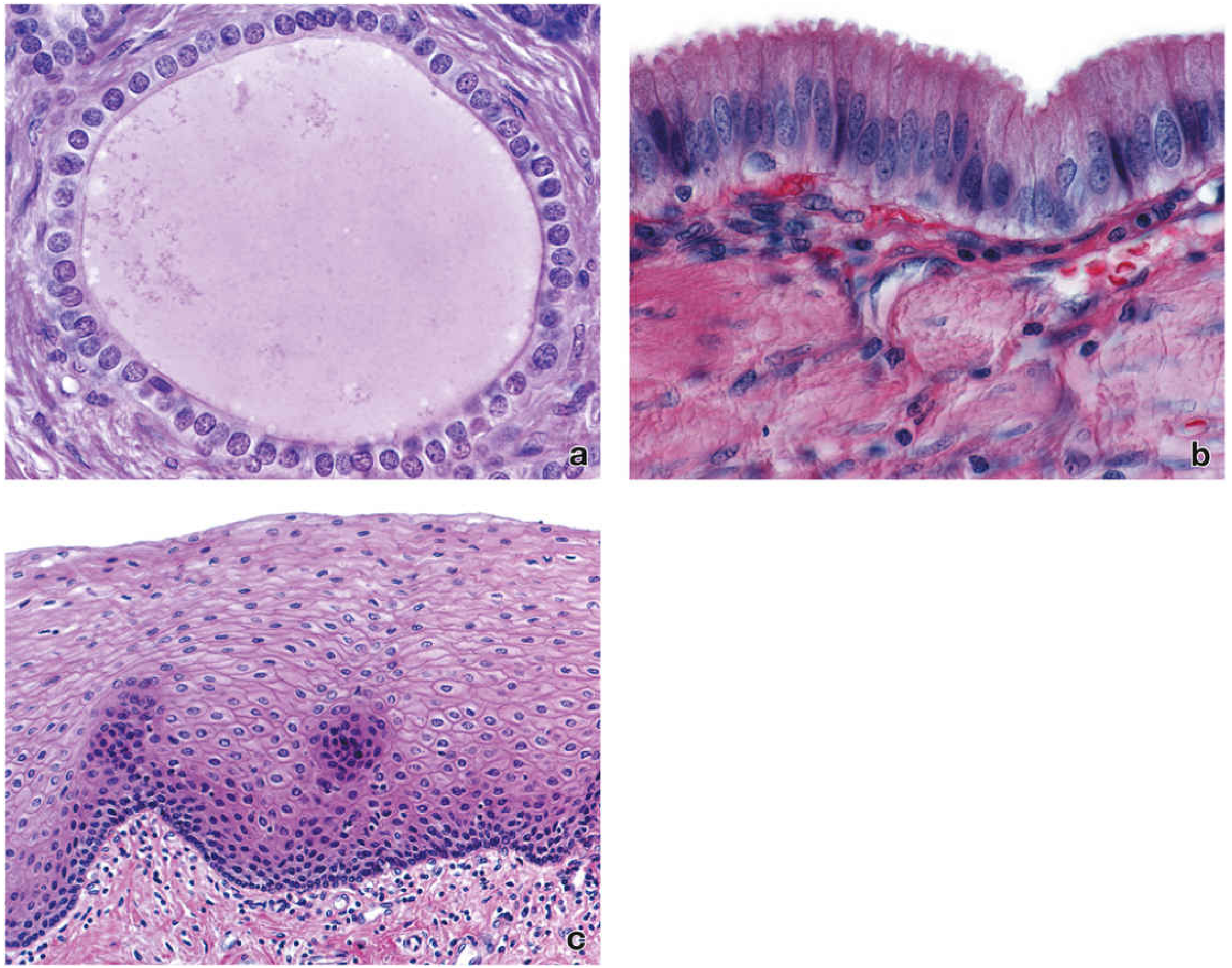
Top-left (a): Simple cuboidal epithelium lining a pancreatic duct (×540)
Top-right (b): Simple columnar epithelium lining the gallbladder (×540)
Bottom (c): Stratified squamous epithelium of the esophagus - note the multiple cell layers and flat surface cells (×240)
Special Named Epithelia
| Name | Type | Location |
|---|---|---|
| Endothelium | Simple squamous | Blood and lymphatic vessel lining |
| Endocardium | Simple squamous | Heart chambers (ventricles/atria) |
| Mesothelium | Simple squamous | Pleura, pericardium, peritoneum |
Glandular Epithelium
Epithelium also forms glands - structures specialized for secretion.
By Destination of Secretion
| Type | Route | Examples |
|---|---|---|
| Exocrine | Secretes via a duct onto a surface | Salivary glands, pancreas (acinar), sweat glands |
| Endocrine | Secretes hormones directly into bloodstream | Thyroid, adrenal, pituitary |
Exocrine Secretion Mechanisms
| Mechanism | Process | Examples |
|---|---|---|
| Merocrine | Secretory vesicles fuse with apical membrane → exocytosis (most common) | Pancreatic acinar cells, most glands |
| Apocrine | Apical cytoplasm pinches off with secretory product | Mammary gland (lipid release into milk) |
| Holocrine | Entire cell disintegrates to release secretion | Sebaceous glands, meibomian glands |
Exocrine Gland Structural Classification
By duct complexity:
- Simple gland - unbranched duct
- Compound gland - branched duct system
By secretory unit shape:
- Tubular - tube-shaped (e.g., colon crypts)
- Acinar/Alveolar - grape-shaped (e.g., pancreas)
- Tubuloalveolar - mixed (e.g., submandibular gland)
By secretory product:
- Serous - watery, protein-rich secretion
- Mucous - thick, mucin-rich secretion
- Mixed - both serous and mucous
Functions of Epithelium
Depending on the cell types present, epithelium can serve:
- Secretion - stomach, gastric glands
- Absorption - intestinal epithelium, kidney tubules
- Transportation - ciliated epithelium moves particles (bronchial tree)
- Mechanical protection - stratified squamous (skin), transitional (bladder)
- Receptor function - taste buds, olfactory epithelium, retina
Sources: Histology: A Text and Atlas with Correlated Cell and Molecular Biology, 8th ed.; Junqueira's Basic Histology, 17th ed.; Color Atlas of Human Anatomy, Vol. 2
Search for microscopy images of epithelial types
Finding Sources
Finding Sources
Finding Sources
Finding Sources
Finding Sources
Let me search the histology plate sections directly where the microscopy images will be concentrated.
Reading File
Finding Sources
Found the main plate. Let me read it along with other plate sections to collect all microscopy images.
Reading File
Finding Sources
Reading File
Excellent! I now have all the image URLs. Let me fetch them all in parallel.
Loading Image
Loading Image
Loading Image
Loading Image
Loading Image
Loading Image
Good - all 6 plate images retrieved. Now let me also get the transitional epithelium, keratinized skin, and Junqueira's images.
Finding Sources
Reading File
Loading Image
Loading Image
Loading Image
Loading Image
All images retrieved. Here is the full gallery of microscopy images from Histology: A Text and Atlas (Pawlina) and Junqueira's Basic Histology, organized by epithelial type:
Epithelium - Microscopy Image Gallery
All images are H&E-stained light micrographs from authoritative histology textbooks.
1. Simple Squamous, Cuboidal, and Columnar - Three Types in One Section
Simple epithelia - Exocrine pancreas, monkey, H&E ×450
Three types are visible together:
- The circular acinus (top-left): pyramidal secretory cells taller than wide = simple columnar
- The small longitudinal duct (arrows): flattened cells with flat nuclei = simple squamous
- The larger cross-sectioned duct (asterisk): round nuclei, square-profile cells = simple cuboidal
2. Simple Cuboidal Epithelium
Simple cuboidal - Kidney tubules, human, H&E ×450
Cross-sectioned kidney tubules lined by a single layer of cells whose width approximates height (arrows mark lateral boundaries). Note the round, centrally placed nuclei - the hallmark of cuboidal cells.
3. Simple Columnar Epithelium
Simple columnar - Colon, human, H&E ×350
A single layer of tall cells with basally placed, elongated nuclei lines the colon lumen. Light-staining "goblet" shapes (arrows) are mucus-secreting goblet cells interspersed among absorptive cells. Intestinal glands (GL) extend down into the connective tissue (CT).
4. Pseudostratified Columnar Epithelium (Trachea)
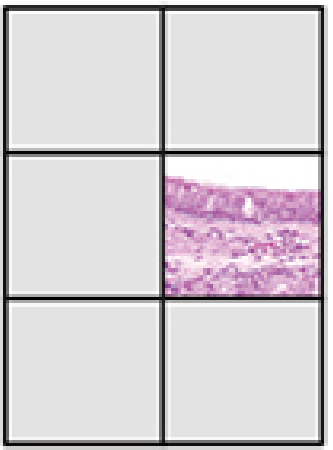
Pseudostratified columnar - Trachea, monkey, H&E ×450
Note the two levels of nuclei: tall columnar cells (CC) with elongated nuclei and cilia (C) on the apical surface, plus a layer of short basal cells (BC) between them. The thick acellular basement membrane is clearly visible beneath the epithelium. Despite appearances, all cells contact the basement membrane - making this a simple (not stratified) epithelium. A tracheal gland acinus (circle) with visible lumen sits below.
5. Pseudostratified Columnar Epithelium (Epididymis)
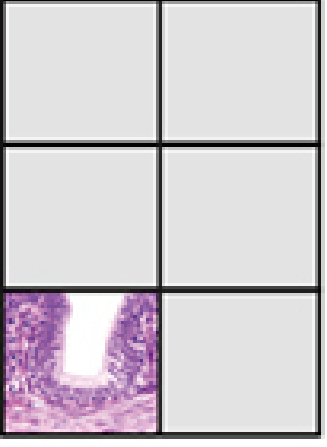
Pseudostratified columnar - Epididymis, human, H&E ×450
Another example of pseudostratified columnar epithelium. Two rows of nuclei are clearly seen - basal cells (BC) and tall columnar cells (CC). The apical surface shows stereocilia (long microvilli) rather than motile cilia. Note how the epithelium appears thicker on the right due to a tangential plane of section - always examine the thinnest region to assess true organization.
6. Stratified Squamous Epithelium (Nonkeratinized)

Stratified squamous nonkeratinized - Vagina, human, H&E ×225
Multiple cell layers visible. The basal layer (BC) is compact with small cells and densely packed nuclei. As cells migrate toward the surface they flatten progressively into disc-like squames. The clear (empty) cytoplasm above the basal layer is due to glycogen loss during slide preparation. Surface cells retain their nuclei - the defining feature of nonkeratinized epithelium. Underlying connective tissue (CT) contains fibroblasts.
7. Stratified Squamous Epithelium (Keratinized) - Skin
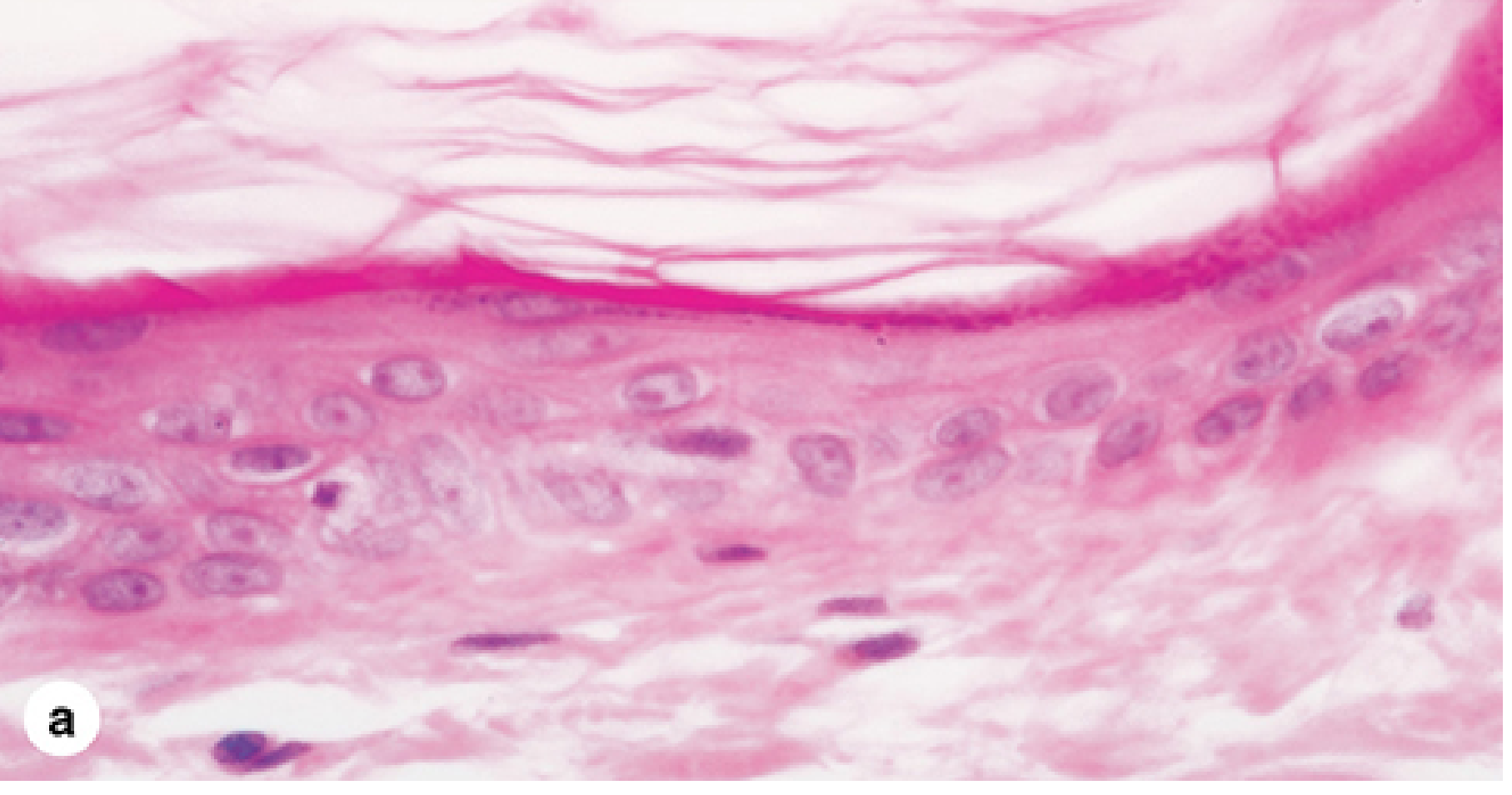
Stratified squamous keratinized - Epidermis (skin), H&E ×400
The surface shows flat, anucleate keratin-packed squames (pale pink layers at top) - the defining feature distinguishing keratinized from nonkeratinized epithelium. Beneath these are nucleated cells in progressively more rounded layers. The deepest (basal) layer has small cuboidal cells with large nucleus-to-cytoplasm ratio, resting on the basement membrane.
8. Stratified Epithelia Comparison Panel
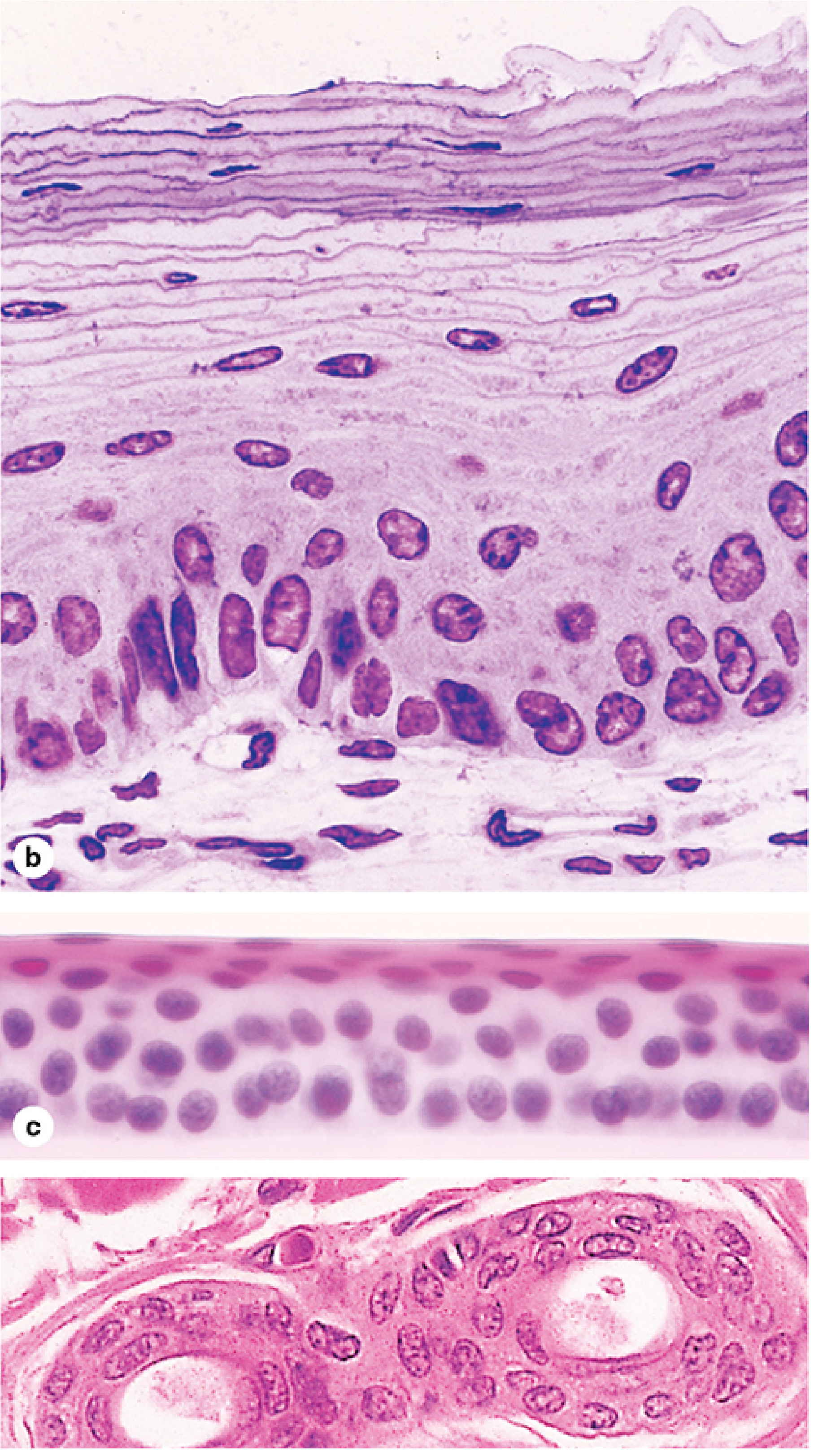
Junqueira's comparison panel, all ×400:
- (b) Top - Stratified squamous nonkeratinized (esophagus): elongated flat surface cells with visible nuclei; nucleated cells throughout all layers
- (b) Bottom - Also showing multiple layers; note the keratin accumulation pattern and cell flattening progressing toward the surface
- (c) - Simple cuboidal lining of a thyroid follicle (single layer, round nuclei, height = width)
- (d) - Stratified cuboidal in a sweat gland duct: the characteristic double layer of cuboidal cells
9. Stratified Cuboidal Epithelium (Sweat Gland Duct)

Stratified cuboidal - Sweat gland duct, H&E ×400
The classic location for stratified cuboidal epithelium. Two concentric layers of cuboidal cells form the duct wall. Note the distinct double layer visible in the coiled duct cross-sections (left side), a reliable identification feature of this relatively rare epithelial type.
10. Transitional Epithelium (Urothelium)
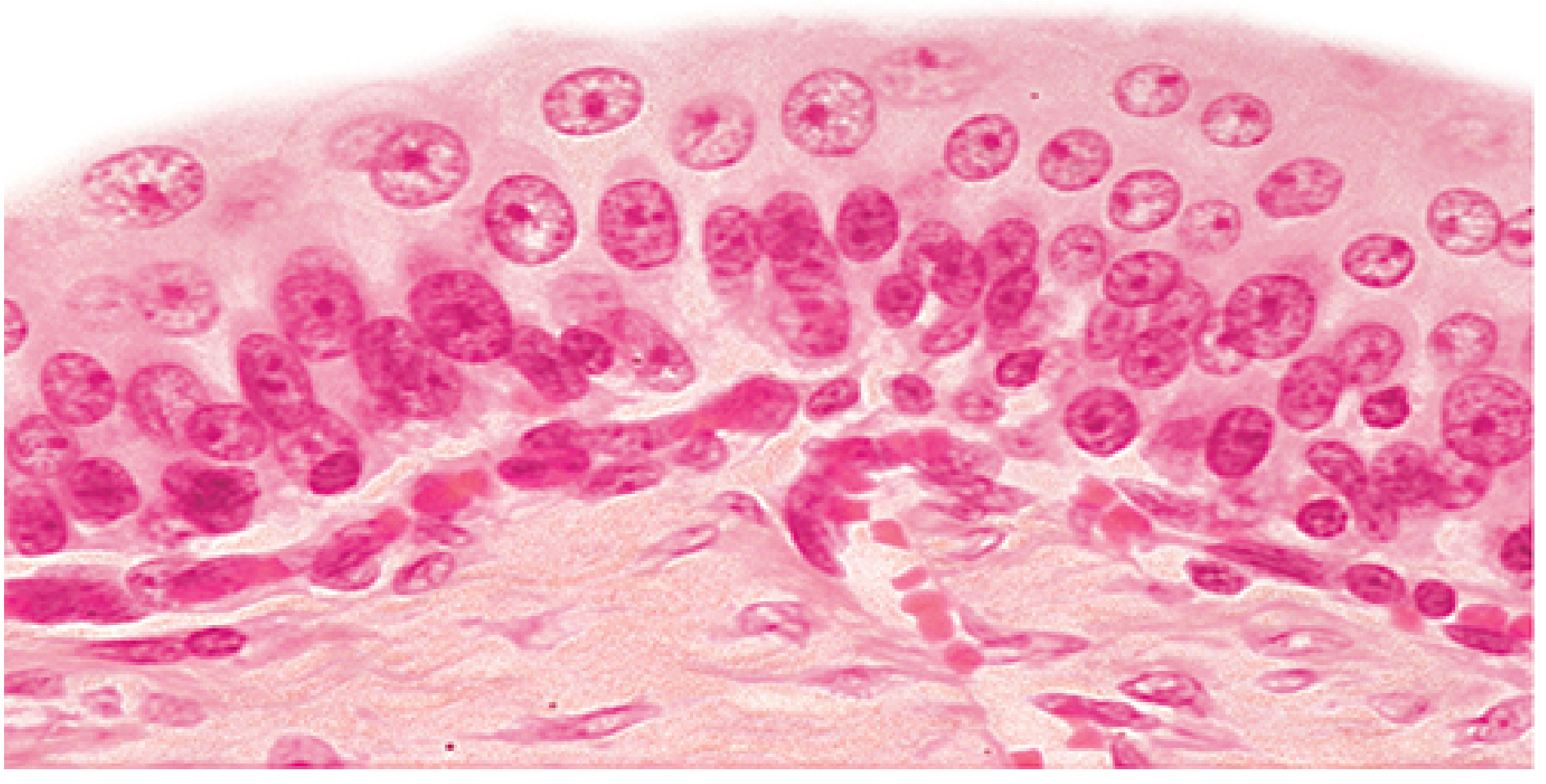
Transitional epithelium (urothelium) - Urinary bladder, H&E ×400
Multiple cell layers are present. The surface layer shows large, rounded "umbrella cells" - dome-shaped cells with large round nuclei and specialized plasma membranes that allow distension. Intermediate and basal layers appear smaller and more cuboidal. The epithelium becomes thinner and cells appear more squamous when the bladder is distended.
Quick Visual Reference Guide
| Epithelium Type | Key Microscopy Feature |
|---|---|
| Simple squamous | Single layer; flat cells; disc-shaped nuclei |
| Simple cuboidal | Single layer; square cells; round central nuclei |
| Simple columnar | Single layer; tall cells; basal oval nuclei; may have goblet cells |
| Pseudostratified | Nuclei at multiple levels; all on basement membrane; thick BM |
| Stratified squamous keratinized | Multiple layers; anucleate surface squames |
| Stratified squamous nonkeratinized | Multiple layers; surface cells retain nuclei |
| Stratified cuboidal | Classic double layer in duct walls |
| Transitional (urothelium) | Dome-shaped umbrella surface cells; changes with distension |
Source: Histology: A Text and Atlas (Pawlina/Ross), 8th ed. (Plate 5.2); Junqueira's Basic Histology, 17th ed. (Figures 4-14 to 4-16)
Search for microscopy images of epithelial types
The images are already in our previous response — I retrieved all the microscopy plates directly from the medical textbook library. Here's a quick recap of what was found:
| # | Image | Epithelium Type | Source / Tissue |
|---|---|---|---|
| 1 | | Simple squamous + cuboidal + columnar (3-in-1) | Exocrine pancreas, monkey H&E ×450 |
| 2 | | Simple cuboidal | Kidney tubules, human H&E ×450 |
| 3 | | Simple columnar (+ goblet cells) | Colon, human H&E ×350 |
| 4 | | Pseudostratified columnar ciliated | Trachea, monkey H&E ×450 |
| 5 | | Pseudostratified columnar (stereocilia) | Epididymis, human H&E ×450 |
| 6 | | Stratified squamous nonkeratinized | Vagina, human H&E ×225 |
| 7 | | Stratified squamous keratinized | Skin epidermis H&E ×400 |
| 8 | | Comparison panel (keratinized, nonkeratinized, cuboidal, stratified cuboidal) | Junqueira's ×400 |
| 9 | | Stratified cuboidal | Sweat gland duct H&E ×400 |
| 10 | | Transitional epithelium (urothelium) | Urinary bladder H&E ×400 |
All images are real H&E-stained light micrographs from Histology: A Text and Atlas (Pawlina/Ross, 8th ed.) and Junqueira's Basic Histology (17th ed.), pulled directly from the textbook library. Scroll up in our conversation to see each image displayed in full with its detailed caption.
This is a shared conversation. Sign in to Orris to start your own chat.