
Explainin detail the role of quantum biology in autoimmunity with proper diagram
quantum biology autoimmunity
quantum biology role in autoimmunity mechanisms 2024 2025
https://pmc.ncbi.nlm.nih.gov/articles/PMC12816978/
quantum biology immune system diagram autoimmunity
https://sciencex.com/news/2026-05-ancient-quantum-machine-im…
A detailed scientific diagram titled "Quantum Biology in Autoimmunity" showing six interconnected mechanisms: 1) Quantum Tunneling in Enzymes - showing proton/electron tunneling through energy barriers in myeloperoxidase and nitric oxide synthase producing ROS and reactive nitrogen species that trigger inflammation; 2) TCR-pMHC Quantum Recognition - showing T cell receptor binding to peptide-MHC complex with quantum mechanical electron transfer and conformational induced-fit changes driving degeneracy and self-reactivity; 3) Radical Pair Mechanism - showing spin-correlated electron pairs influenced by magnetic fields affecting ROS production and redox balance in immune cells; 4) OAS Innate Immune Sensor - showing oligoadenylate synthetase protein with magnesium metal center activated by quantum processes detecting viral dsRNA or damaged tissue and triggering interferon pathway; 5) Mitochondrial Quantum Proton Pumping - showing quantum tunneling in electron transport chain complexes producing ATP and ROS, with redox imbalance disrupting immune homeostasis; 6) Quantum Coherence Disruption - showing loss of quantum coherence in redox signaling leading to chronic inflammation and autoimmunity (lupus, rheumatoid arthritis, MS). Use arrows connecting all six modules to show how quantum disruption leads to autoimmunity. Color scheme: blue for quantum processes, red for pathological outcomes, green for normal immune function. Include molecular structures, energy barrier diagrams, and clinical disease labels.
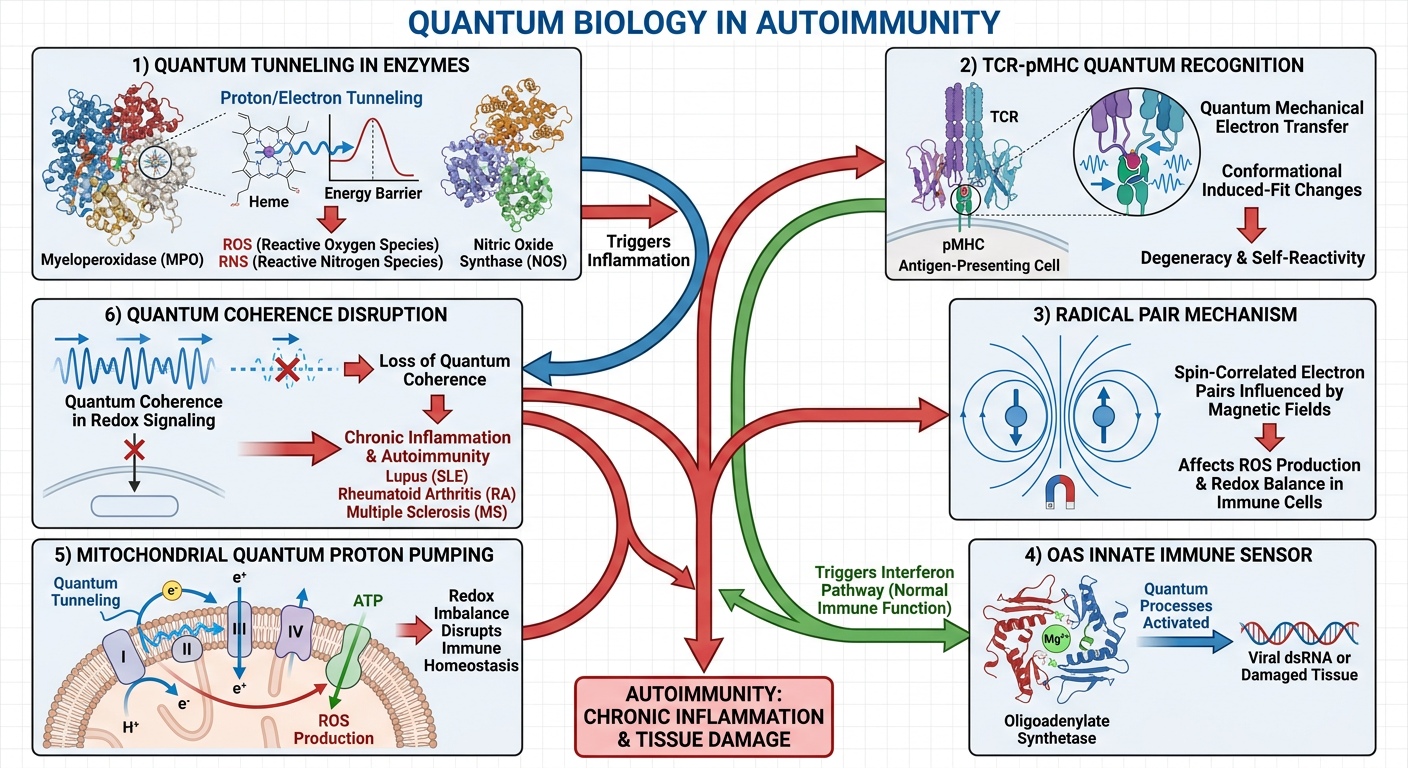
Quantum Biology in Autoimmunity
1. Foundational Concepts: Why Quantum Biology Matters in Immunity
- Wave-particle duality of protons and electrons becomes functionally significant
- Quantum tunneling allows particles to cross energy barriers classically forbidden
- Spin states of electron pairs dictate the chemical fate of radical intermediates
- Quantum coherence transiently preserves superposition in reaction dynamics
2. Quantum Tunneling in Immune Enzymes and ROS Production
Mechanism
| Enzyme | Quantum Process | Immune Output |
|---|---|---|
| Myeloperoxidase (MPO) | Proton & electron tunneling through energy barriers | HOCl, O₂⁻ (oxidative burst) |
| Nitric oxide synthase (NOS) | Electron tunneling + spin transitions | •NO, reactive nitrogen species |
| NADPH oxidase | Quantum electron transfer through flavins | Superoxide (O₂⁻) in neutrophils |
Link to Autoimmunity
- In SLE: excess ROS oxidize nucleic acids → neo-antigens → anti-dsDNA antibodies
- In RA: synovial MPO activity creates localized hypochlorous acid storms damaging cartilage
- In MS: NOS-derived peroxynitrite causes nitrosylation of myelin proteins, generating new autoantigens
3. The Radical Pair Mechanism (RPM)
How it Works
- A biochemical reaction generates two radicals simultaneously — an electron pair in a spin-entangled state (singlet or triplet)
- The two spin states have different chemical reactivities and different lifetimes
- External magnetic fields — including Earth's geomagnetic field and endogenous bio-electromagnetic fields — can interconvert singlet ↔ triplet states
- This alters the ratio of products formed
Immune Implications
- Spin-correlated radical pairs in neutrophils and macrophages influence whether ROS are channeled toward NLRP3 inflammasome activation (triplet state products) or resolved homeostically (singlet state products)
- Disruption of spin dynamics by oxidative stress or altered tissue electromagnetic environments tips the balance toward persistent inflammation
- Quantum computing simulations can reconstruct spin Hamiltonians of these radical pair systems to model their behavior with atomic precision — something classical computation cannot achieve
4. Quantum Mechanics of T Cell Receptor (TCR) Recognition
Classical View
Quantum Extension: TCR Degeneracy
- Electron density distributions across the binding interface are delocalized quantum mechanically, not fixed to individual atoms
- The "induced fit" conformational change in the CDR3 loop involves quantum mechanical shifts in electron cloud geometry
- Quantum tunneling of protons at hydrogen-bonding networks in the binding interface contributes to binding specificity and avidity
- TCR degeneracy arises because the electronic wavefunction of the receptor spans a broader conformational landscape than classical docking predicts
Autoimmune Consequences
- Molecular mimicry exploits TCR degeneracy: a pathogen-derived peptide (e.g., EBV EBNA-1, Streptococcal M-protein) shares sufficient quantum-electronic similarity with a self-peptide to activate autoreactive T cells
- Altered peptide ligands (APLs) that differ by a single amino acid can shift from agonist → antagonist due to quantum-level changes in electron density at the binding interface
- Quantum models can predict which novel peptides — in emerging infections or environmental antigens — are electronically similar enough to self-antigens to trigger autoimmunity
5. OAS Proteins: An Ancient Quantum Machine at the Root of Innate Immunity
2026 Discovery (Hannover Medical School)
- OAS proteins function as molecular "smoke detectors": they sense viral dsRNA or damaged self-tissue
- Their function is governed by a magnesium-containing metal center
- Quantum mechanical processes within this metal center control the conformational switch that activates the immune response
- This mechanism is estimated to be >3.5 billion years old — predating complex life, making quantum immunology an ancient biological strategy
Autoimmune Relevance
- Pathological OAS activation occurs in interferonopathies (Aicardi-Goutières syndrome, SLE) where endogenous RNA/DNA triggers chronic interferon signaling
- Drugs that inhibit OAS quantum activation could suppress autoimmune IFN storms
- Drugs that enhance OAS quantum activation could boost antiviral and antitumor immunity
- The quantum nature of OAS sensitivity may explain why sub-threshold endogenous nucleic acids sometimes breach immune tolerance
6. Quantum Proton Pumping in the Mitochondrial Respiratory Chain
Mechanism
- Complex I (NADH dehydrogenase): Uses quantum tunneling for electron transfer across ~98Å — physically impossible by classical thermal diffusion at this distance
- Complex III/IV: Proton pumping involves quantum tunneling through hydrogen bonds in cytochrome c oxidase
- ATP synthase rotation is driven by a proton gradient maintained by these quantum transfers
Immune Connection
- Mitochondrial ROS from quantum-level electron leakage at Complex I/III are the primary source of the redox signal in T cell activation
- In autoimmune disease states (SLE, RA, Sjögren's), mitochondrial dysfunction increases quantum electron leak → excess superoxide → oxidative modification of mtDNA → cGAS/STING activation → type I IFN
- Quantum proton tunneling rates are temperature- and pH-sensitive, linking metabolic states (fever, acidosis in inflamed joints) to altered immune signaling thresholds
7. Electromagnetic Fields (EMFs) and Quantum Immune Modulation
- Radical pair spin states in immune cells — shifting ROS production balance
- Ion channel quantum conductance — altering Ca²⁺ flux required for NF-κB and NFAT activation (key transcription factors in T cell activation)
- Cytoskeletal quantum coherence in tubulin networks — influencing signal transduction geometry
8. Quantum Coherence, Decoherence, and the "Quantum Order" of Immunity
Immune regulation represents a dynamic quantum order maintained through coherent spin and redox interactions. Disruption of this order — decoherence — underlies chronic inflammation and autoimmunity.
| State | Quantum Description | Clinical Correlate |
|---|---|---|
| Healthy immune homeostasis | Coherent spin-redox interactions; radical pairs resolved correctly | Balanced Th1/Th2/Treg axis |
| Subclinical immune activation | Partial decoherence; excess triplet radical pairs | Elevated ANA, subclinical inflammation |
| Overt autoimmunity | Full decoherence; sustained ROS storms, TCR degeneracy exploited | SLE, RA, MS, T1DM |
| Therapeutic target | Restore coherence and redox symmetry | Antioxidants, spin trap agents, EMF therapy |
9. Autoimmune Diseases Through the Quantum Biology Lens
| Disease | Classical Mechanism | Quantum Biology Insight |
|---|---|---|
| SLE | Anti-dsDNA antibodies, complement activation | Quantum tunneling in NOS → peroxynitrite → oxidized nucleosomes as neoantigens; RPM disruption driving persistent IFN-α |
| Rheumatoid Arthritis | Anti-CCP, synovial inflammation | MPO quantum electron transfer → HOCl → citrullination of joint proteins; quantum cytokine-receptor binding simulations (TNF-α, IL-6) |
| Multiple Sclerosis | Demyelination by autoreactive T cells | TCR quantum degeneracy → EBV mimicry of MBP; mitochondrial ROS → nitrosylated myelin antigens |
| Type 1 Diabetes | Beta-cell destruction by CD8+ T cells | Quantum proton tunneling in islet enzymes alters peptide presentation; OAS activation by viral dsRNA triggers innate IFN cascade |
| Interferonopathies | Chronic type I IFN signaling | OAS metal-center quantum activation by endogenous nucleic acids |
10. Therapeutic Implications
- Quantum-informed drug design: Simulate cytokine–receptor binding energetics (TNF:TNFR, IL-6:IL-6R) at the electronic level to design biologics with superior binding affinity and selectivity
- Spin trap agents: Compounds like PBN (phenyl-N-tert-butylnitrone) that stabilize radical pair spin states — repurposing them as targeted anti-inflammatory agents
- OAS modulators: Inhibit quantum-activated OAS in SLE interferonopathy; activate OAS in viral-triggered autoimmune flares
- Mitochondria-targeted quantum antioxidants: MitoQ and SkQ1 are quantum-structured antioxidants that deliver electron-scavenging moieties directly to Complex I/III, quenching the source of immune-activating ROS
- EMF-based immunotherapy: Precisely calibrated low-frequency fields to shift radical pair spin equilibria toward pro-resolving states
Key Diagram Reference
- Blue: Quantum-level processes (tunneling, spin, coherence, OAS metal center)
- Red: Pathological autoimmune outcomes (SLE, RA, MS)
- Green: Normal/homeostatic immune function
- Arrows show how disruption of quantum order at the molecular level propagates to clinical autoimmunity
Sources
- PMC12816978 — A quantum–mechanical framework for redox biology, disease... (2025)
- MDPI Quantum Rep. 4(2):11 — Quantum Biology Research Meets Pathophysiology and Therapeutic Mechanisms (2022)
- Fedorov et al., ACS Omega (2026) — OAS innate immune quantum mechanism, Hannover Medical School
- Janeway's Immunobiology 10e — TCR–pMHC structure and recognition mechanics