
Turner syndrome
Reading File
Now let me search the medical library and PubMed in parallel for Turner syndrome.
Finding Sources
Searching PubMed
"Turner syndrome"[MeSH Terms] AND management
Now let me read the most comprehensive sources - Robbins Pathology (both sections) and the Embryology book in parallel.
Reading File
Reading File
Reading File
Let me get the remaining clinical features from Robbins (both books) and fetch the illustration image.
Reading File
Reading File
Loading Image
I now have comprehensive information from the medical library. Let me compile the full answer.
Turner Syndrome
Turner syndrome is a chromosomal disorder caused by complete or partial monosomy of the X chromosome, resulting in primary hypogonadism and a constellation of somatic abnormalities in phenotypic females. It is the most common sex chromosome abnormality in females, affecting approximately 1 in 2,000-3,000 live-born females.
Genetics and Karyotypes
Three categories of karyotypic abnormalities are seen:
| Type | Karyotype | Frequency |
|---|---|---|
| Classic monosomy X | 45,X | ~57% |
| Structural abnormality of X | 46,X,i(X)(q10); 46,X,r(X); 46,X,del(Xq or Xp) | ~14% |
| Mosaicism | 45,X/46,XX; 45,X/46,XY; 45,X/47,XXX; 45,X/46,X,i(X)(q10) | ~29% |
Key points:
- The missing or defective X is most often paternal in origin (in ~75-80% of cases, the retained X is maternal), indicating the error usually occurs in paternal gametogenesis.
- 45,X is the most common cytogenetic abnormality in spontaneous abortions, accounting for ~18% of chromosomally abnormal abortions. Only ~1% of 45,X embryos survive to birth.
- Y chromosome material is present in 5-10% of mosaic Turner patients (e.g., 45,X/46,XY). These individuals carry a significantly higher risk of gonadoblastoma and require gonadectomy.
- Mosaic patients have milder phenotypes; some with 45,X/46,XX mosaicism may present only with primary amenorrhea and can rarely even conceive.
Clinical Features
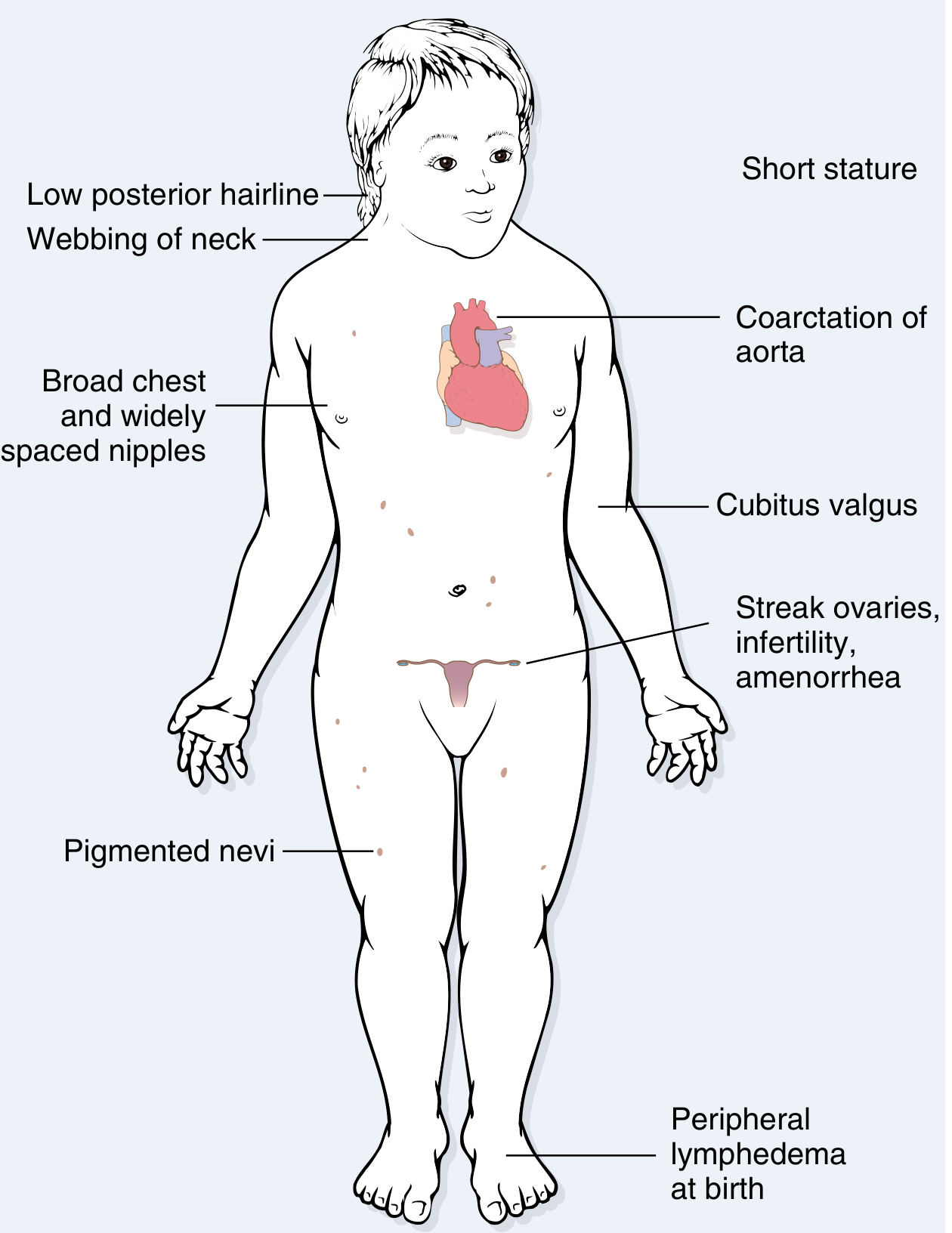
From Robbins, Cotran & Kumar Pathologic Basis of Disease
Neonatal/Infantile
- Lymphedema of the dorsum of hands and feet (due to lymphatic obstruction)
- Cystic hygroma (markedly distended lymphatics at the nape of the neck) - resolves into neck webbing
Somatic Features
- Short stature - below the 3rd percentile; the hallmark feature
- Webbing of the neck (pterygium colli)
- Low posterior hairline
- Shield chest with widely spaced nipples
- Cubitus valgus (increased carrying angle of the arms)
- Pigmented nevi
- High-arched palate
Cardiovascular (25-50% of patients)
- Predominantly left-sided defects: coarctation of the aorta and bicuspid aortic valve are most frequent
- Aortic root dilation in ~30%; 100-fold increased risk of aortic dissection
- Cardiovascular abnormalities are the leading cause of death in childhood
- Notably, ~5% of young females initially diagnosed with coarctation of the aorta have Turner syndrome
Renal
- Horseshoe kidney and other structural anomalies
Gonadal/Reproductive
- Failure to develop secondary sex characteristics at puberty
- Infantile genitalia, minimal breast development, sparse pubic hair
- Primary amenorrhea (most patients)
- Streak ovaries - fibrous strands devoid of follicles, the result of accelerated oocyte loss (complete by age 2 years)
- Infertility in the vast majority
Endocrine/Metabolic
- Autoimmune hypothyroidism - occurs in up to 50% of patients (especially those with isochromosome Xq)
- Glucose intolerance, insulin resistance, obesity, NAFLD - subset of patients can develop full metabolic syndrome
- Note: growth hormone therapy (used for short stature) worsens insulin resistance
Neurological/Cognitive
- Intellect is generally normal
- Subtle deficits in visual-spatial information processing are described
Pathogenesis
The molecular basis is not fully understood, but key insights include:
-
Streak ovaries: Both X chromosomes are needed for normal oocyte maintenance. In Turner syndrome, fetal ovaries develop normally until ~18 weeks gestation, after which the absence of a second X drives accelerated oocyte loss, complete by age 2 years. This has been described as "menopause before menarche."
-
SHOX gene haploinsufficiency: The short stature homeobox gene (SHOX) at Xp22.33 lies in the pseudoautosomal region and escapes X-inactivation - meaning both normal males and females have two active copies. Loss of one copy in Turner syndrome causes short stature. SHOX deletions also occur in 2-5% of otherwise normal children with short stature. (In contrast, the extra copy in Klinefelter syndrome contributes to tall stature.)
-
Other X-linked loci: Cardiac malformations and endocrine abnormalities cannot be explained by SHOX alone; additional genes on the short arm contribute to somatic features, while genes on the long arm affect fertility and menstruation.
Diagnosis
- Karyotyping is the definitive test. Conventional cytogenetics detects mosaicism in ~30% of cases; more sensitive molecular techniques (FISH, SNP arrays) raise this to ~75%.
- Clinical clue in adults: short stature + primary amenorrhea = strong suspicion for Turner syndrome.
- Prenatal diagnosis: can be identified on ultrasound (cystic hygroma, fetal hydrops) and confirmed by amniocentesis/CVS.
Management Highlights
- Growth hormone therapy to improve final adult height (started in childhood)
- Estrogen replacement therapy at puberty to induce secondary sex characteristics and protect bone density
- Cardiac surveillance - regular echocardiography and MRI for aortic root dilation/coarctation
- Thyroid function monitoring (TSH annually)
- Fertility: assisted reproduction (oocyte donation + IVF) is possible for those desiring pregnancy, though pregnancy carries cardiovascular risks (particularly aortic dissection)
- Gonadectomy in patients with Y chromosome material to prevent gonadoblastoma
Recent Evidence (2024-2026)
Three recent systematic reviews highlight active research areas:
- A 2025 meta-analysis (PMID 41243107) examined the global prevalence of autoimmune diseases in Turner syndrome, reinforcing the well-known autoimmune predisposition.
- A 2025 systematic review (PMID 39743222) explored karyotype-phenotype correlations in non-mosaic X chromosome structural rearrangements.
- A 2025 meta-analysis (PMID 40557696) assessed the impact of karyotype on congenital heart disease risk in Turner syndrome, confirming karyotype significantly influences cardiovascular phenotype.
Sources: Robbins & Kumar Basic Pathology; Robbins, Cotran & Kumar Pathologic Basis of Disease; The Developing Human - Clinically Oriented Embryology
This is a shared conversation. Sign in to Orris to start your own chat.