
Impact of qum in e health,integrated medicine and multidisciplinary care
I'll research the impact of Quality Use of Medicines (QUM) in e-health, integrated medicine, and multidisciplinary care. Let me first read the medical library skill, then conduct parallel searches.
Searching sources...
Reading File
Now let me run parallel searches across the medical library, PubMed, and web simultaneously.
Finding Sources
Finding Sources
Searching PubMed
"quality use of medicines" AND "e-health" OR "electronic health"
Searching the Web
QUM quality use of medicines e-health integrated medicine multidisciplinary care impact
Good results found. Let me now do deeper parallel searches on each sub-topic and extract the most relevant content.
Reading Web Page
https://www.intechopen.com/chapters/40020
Finding Sources
Searching PubMed
"quality use of medicines" AND multidisciplinary
Excellent - I now have rich, comprehensive data from all sources. Let me compile the full, detailed answer.
Impact of QUM in E-Health, Integrated Medicine, and Multidisciplinary Care
1. What is Quality Use of Medicines (QUM)?
QUM is a policy and clinical practice framework that places the individual at the centre of care. Originating from Australia's National Medicines Policy (NMP), it has since been adopted and adapted in many countries including Canada and Saudi Arabia.
QUM essentially refers to:
- Selecting wisely - choosing medicines appropriate to the individual, based on clinical need, evidence, and cost-effectiveness; considering non-pharmacological options first where suitable
- Using safely and effectively - correct dosing, monitoring for adverse effects, minimising harm
- Improving ability to manage - supporting patient self-management and adherence
QUM encompasses conventional pharmaceuticals, complementary/alternative medicines (CAM), and non-prescription products, making it directly relevant to integrative medicine settings.
2. QUM and E-Health
Definition of E-Health
E-Health refers to the cost-effective and secure use of information and communication technologies (ICT) to support health and health-related fields, as defined by the WHO EMRO e-Health framework.
How QUM Drives E-Health Outcomes
| E-Health Tool | QUM Impact |
|---|---|
| Electronic Health Records (EHR) | Centralises medication histories, reduces duplication and discrepancies |
| Computerised Physician Order Entry (CPOE) | Reduces prescribing errors, enforces formulary compliance |
| Clinical Decision Support Systems (CDSS) | Prompts evidence-based prescribing at point of care |
| Medication apps / mHealth | Supports patient adherence and self-management |
| Telepharmacy | Extends pharmacist reach in rural/remote areas |
| eHealth platforms for monitoring | Enables pharmacovigilance at population scale |
Key demonstrated impacts (from the Saudi Arabia QUM narrative review, PMC 2025):
- EHR + CPOE implementations generally improved medication safety and efficiency, though results were mixed across settings
- Antibiotic stewardship programs (technology-supported) effectively reduced antimicrobial use and costs
- Medication reconciliation programs reduced discrepancies by up to 20% in some studies
E-health strengthens QUM by:
- Reducing paperwork and duplication, thus lowering healthcare costs
- Reducing medical errors and enabling better clinical decision-making
- Bridging communication gaps between patients and providers
- Improving all dimensions of patient care: safety, effectiveness, efficiency, equity
- Supporting distance learning and continuing education for prescribers
Challenges
- Ethical issues: privacy, consent, data security
- Health literacy barriers limiting patient use of digital tools
- Interoperability gaps between systems
- Not all e-health apps have been proven safe - a scoping review (Stevens et al., 2019, J Med Internet Res) found adverse effects when apps replace rather than complement human care contacts
3. QUM and Integrated Medicine (Integrative Medicine)
What is Integrative Medicine?
Integrative medicine (IM) blends conventional medical treatments with evidence-based complementary/alternative medicines (CAM) to provide holistic, patient-centred care based on evidence and patient choice.
QUM as a Framework for Integrative Medicine
QUM is directly applicable as a governance and safety framework for integrative medicine, because CAM use is widespread but often undisclosed to conventional prescribers. The IntechOpen chapter on QUM and Integrative Medicine (Dunning) sets out how:
QUM applied to integrative medicine involves:
- Active partnerships with patients - effective communication, collaboration, using evidence-based policies and guidelines to deliver consistent care
- Engaging the patient in care goals and decisions, providing objective ethical information about medicine options in culturally appropriate formats
- Pharmacovigilance - encompassing the entire medicine pathway, appropriate prescribing and monitoring of both conventional and CAM medicines
- Monitoring outcomes - including the patient's medicine self-management capability, adherence, and adverse event reporting
- Documenting CAM use - this is critically important as undisclosed CAM use leads to drug-herb interactions and patient harm
- Sustainable practices - QUM is broad enough to encompass sustainable agricultural and carbon-reduction considerations relevant to CAM sourcing
Why QUM is needed in integrative settings:
- The WHO estimates 80% of the developing world's population uses plants as medicines - yet most are not disclosed to physicians
- Short CAM training courses may not adequately prepare practitioners to deliver safe, evidence-informed care
- QUM provides a standardised, scalable research framework to evaluate IM and CAM interventions
4. QUM and Multidisciplinary Care
The Multidisciplinary Team (MDT) in QUM
Multidisciplinary care means professionals from different disciplines working together to address a patient's physical, psychological, and social needs. In the context of QUM, the MDT typically includes:
- Pharmacists (medicines management specialists)
- Physicians and specialists (prescribers)
- Nurses (administration and monitoring)
- Allied health professionals (physiotherapists, dietitians, social workers)
- CAM practitioners (in integrative settings)
- Patients and carers (active partners in QUM)
Evidence for Multidisciplinary QUM Interventions
From the Saudi Arabia QUM review:
- Pharmacist involvement in medication reconciliation, standardised processes, multidisciplinary teams, and follow-up after transitions of care were among the most impactful interventions for reducing medication discrepancies
- Hospital pharmacist interventions showed acceptance rates of up to 92% and improved medication safety
- The combination of multiple interventions as part of a comprehensive program yielded the best results
- A combined educational-clinical pharmacist intervention showed the broadest impact on reducing inappropriate prescribing (Najjar et al., 2018)
Austin Health QUM Team (real-world example): The QUM pharmacist team manages the hospital formulary, collaborates with MDTs to safely introduce new medications, sources high-cost or rare medicines, evaluates safety/efficacy/cost-effectiveness of new medicines, and updates hospital guidelines - all within a multidisciplinary framework.
Deprescribing as a QUM-MDT activity: Recent 2026 clinical practice guidelines emphasise MDT-led deprescribing in older people as a QUM priority, addressing polypharmacy - one of the most common quality and safety problems in geriatric care.
Key MDT Roles in QUM
| Role | QUM Contribution |
|---|---|
| Pharmacist | Medication review, reconciliation, CPOE oversight, patient education |
| Physician | Evidence-based prescribing, appropriate therapeutic selection |
| Nurse | Safe administration, adherence monitoring, adverse event reporting |
| Allied health | Promoting non-pharmacological alternatives (QUM principle 1) |
| Patient/carer | Self-management, reporting symptoms and CAM use |
5. Interconnections: QUM, E-Health, IM and MDT Together
The three domains are mutually reinforcing:
QUM Framework
      |
      |----> E-Health Tools (EHR, CPOE, apps)
      |         - Automate QUM safeguards at scale
      |         - Pharmacovigilance & monitoring
      |
      |----> Integrative Medicine
      |         - Governance of CAM within QUM policy
      |         - Prevents drug-herb interactions
      |         - Documents CAM use in e-records
      |
      |----> Multidisciplinary Teams
                - Shared decision-making
                - Medication reconciliation
                - Transitions of care safety
When all three are aligned, outcomes improve across safety, cost, equity, and patient experience. The evidence consistently shows that no single intervention is as effective as a comprehensive, multi-pronged QUM program that uses e-health tools, respects integrative medicine principles, and deploys multidisciplinary teams.
Key Sources
- QUM & Integrative Medicine - IntechOpen (Dunning)
- Effectiveness of QUM Programs in Saudi Arabia - PMC 2025
- WHO e-Health definition
- Park's Textbook of Preventive and Social Medicine - essential medicines and quality of care
- PMID 41943558 - Deprescribing in Older People: Clinical Practice Guideline (2026)
- PMID 38053566 - Medicines Stewardship, Aust Prescr (2023)
- PMID 41058377 - Collaborative Pharmacist Prescribing Models in Australian Hospitals (2026)
Impact of qum on integrated medicine
QUM (Quality Use of Medicines) shapes integrative medicine by providing a safety and governance framework for combining conventional and complementary/alternative medicines (CAM). It ensures evidence-based selection, monitoring, and patient-centred decision-making across all medicine types.
Searching sources...
Finding Sources
Finding Sources
Searching PubMed
"quality use of medicines" AND "integrative medicine" OR "complementary medicine"
Searching the Web
QUM quality use of medicines impact on integrative medicine complementary alternative CAM framework
Now let me pull specific textbook content and do a deeper extract of the IntechOpen chapter, which is the most directly relevant source.
Reading Web Page
https://www.intechopen.com/chapters/40020
Reading File
Reading File
I now have rich material from multiple authoritative sources. Here is the comprehensive answer.
Impact of QUM on Integrated Medicine
1. Understanding the Two Frameworks
Quality Use of Medicines (QUM)
QUM is a clinical and policy framework originating from Australia's National Medicines Policy (NMP) that places the individual at the centre of care. It has three core pillars:
- Wise selection - choosing medicines appropriate to the individual; considering non-pharmacological options first; using evidence-based criteria
- Safe and effective use - correct dosing, monitoring, minimising harm and interactions
- Improving the capacity to manage - supporting patient self-management, adherence, and informed decision-making
Importantly, QUM explicitly covers conventional pharmaceuticals, CAM, and non-prescription medicines - making it directly applicable to integrative settings.
Integrative Medicine (IM)
Integrative medicine combines conventional medical treatment with evidence-based complementary and alternative medicine (CAM) into a unified, patient-centred approach. As defined by the US National Center for Complementary and Integrative Health (NCCIH), it "includes conventional medical therapies as well as nonpharmaceutical and nonsurgical therapies...for which some evidence base now exists" - typically lifestyle interventions, mind-body practices, and natural products. (Goldman-Cecil Medicine, 22nd Ed.)
Integrative medicine is characterised by:
- Treating the whole person - body, mind, and spirit
- A strong therapeutic alliance between practitioner and patient
- Use of both traditional/alternative and conventional treatments
- Patient-centred decision-making based on best available evidence (Textbook of Family Medicine, 9th Ed.)
2. How QUM Impacts Integrative Medicine: Key Domains
2.1 Providing a Governance and Safety Framework for CAM
The single most important impact of QUM on integrative medicine is that it provides a structured governance framework where none previously existed for CAM. As articulated by Dunning (2004) and expanded in the IntechOpen chapter on QUM and Integrative Care:
"QUM is a useful framework for managing CAM and IM at all levels and exemplifies person-centred care, using non-medicine options where possible and pharmacovigilance."
Without QUM, CAM use in integrative settings carries significant risk:
- Drug-herb interactions (e.g., St John's Wort reducing efficacy of antiretrovirals, warfarin, oral contraceptives)
- Undisclosed CAM use by patients leading to unanticipated adverse events
- Poorly trained CAM practitioners delivering unsafe care from short courses
- Lack of standardised monitoring or adverse event reporting
QUM addresses each of these gaps systematically.
2.2 Disclosure and Documentation of CAM Use
One of the most clinically impactful contributions of QUM to integrative medicine is normalising CAM disclosure. The IntechOpen QUM-IM chapter identifies this explicitly:
"One of the most common reasons people do not disclose CAM use is because health professionals do not ask about it."
The PMC evidence-based CAM review (2024) confirms the same pattern globally:
"Patients seldom ever consult their doctors about CAM or even share information about their usage of CAM since they strongly believe that their clinicians have the power to forbid CAM use."
QUM operationalises disclosure through:
- Non-judgmental questioning at every clinical encounter
- Active documentation of CAM use in the medical record
- Creating a therapeutic environment where patients feel safe disclosing without fear of judgment
- Training clinicians to use appropriate body language and effective questioning techniques
2.3 Evidence-Based Evaluation of CAM Therapies
QUM brings an evidence-based medicine (EBM) lens to integrative medicine - an area historically resistant to rigorous evaluation. The NIH classifies CAM into five domains (see figure below):
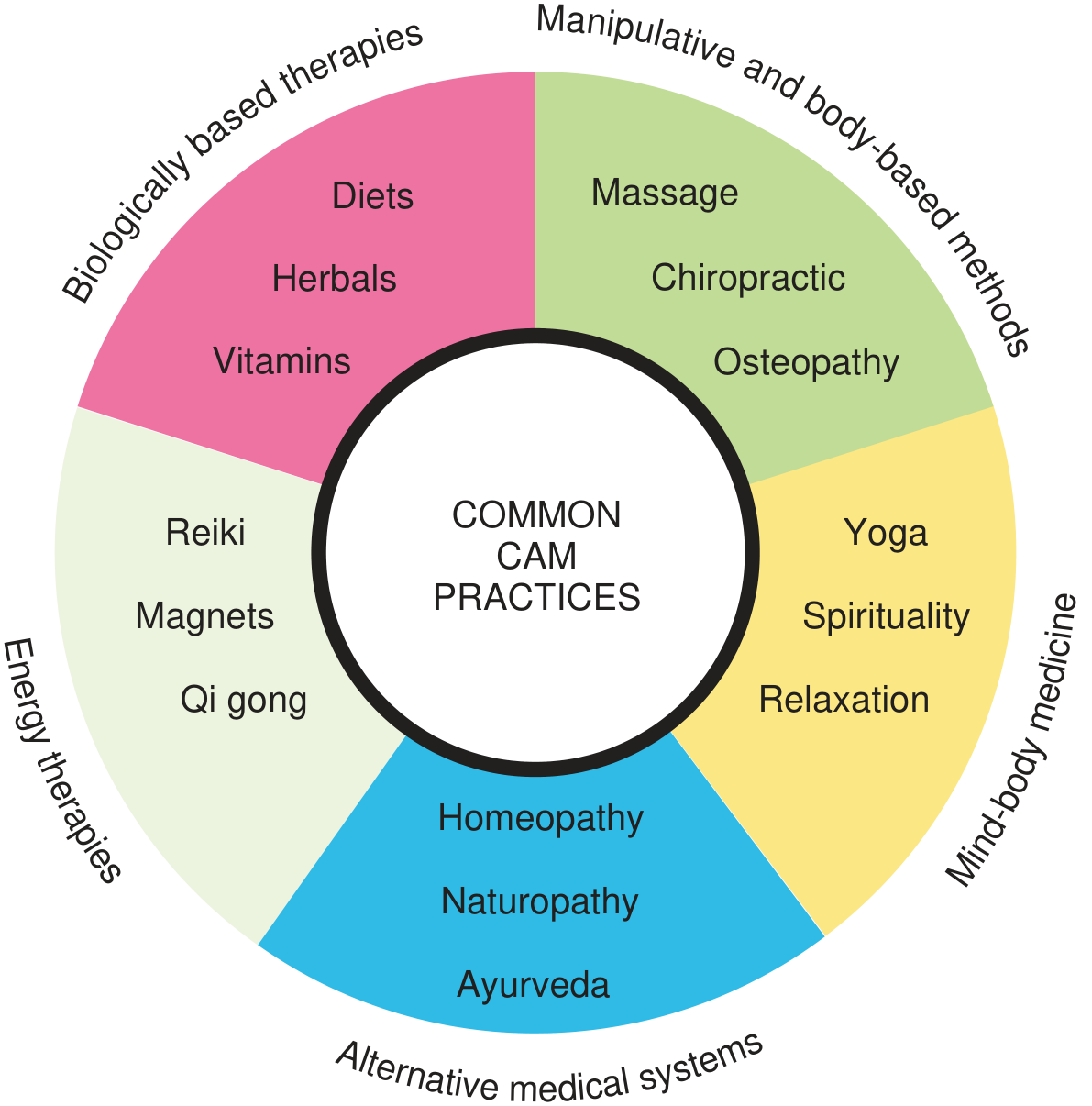
QUM's contribution to evidence evaluation in integrative medicine:
| QUM Principle | Impact on CAM/IM Evidence |
|---|---|
| Select wisely | Requires evidence of safety AND effectiveness before recommending CAM |
| Pharmacovigilance | Tracks adverse events from CAM, generating real-world evidence |
| Research framework | QUM can serve as a structured framework to evaluate IM/CAM interventions (Dunning) |
| Monitoring outcomes | Tracks whether integrative treatments achieve intended clinical goals |
Therapies that pass the QUM evidence threshold progressively cross over from "CAM" into conventional medicine - the boundary between the two is not fixed. As the Textbook of Family Medicine notes: "the list of what is considered CAM changes continually as therapies proved to be safe and effective become adopted into conventional health care."
2.4 Patient-Centred Care and Shared Decision-Making
QUM and integrative medicine share the same philosophical foundation: the patient is an active partner, not a passive recipient of care. QUM in integrative medicine involves:
- Engaging the individual in setting care goals and making decisions
- Providing objective, ethical information about both conventional and CAM options in a language and format the patient understands and that is culturally appropriate
- Respecting patient autonomy and values - most CAM users choose it because it aligns with their values and worldview
- Being non-judgmental about patient choices while ensuring they are informed of risks
The 2024 PMC review confirms: "A patient-centred strategy equips patients with the knowledge to make better decisions" - a goal shared by both QUM and IM.
2.5 Pharmacovigilance Across the Entire Medicine Pathway
In integrative medicine, pharmacovigilance is more complex than in conventional settings because:
- Natural products may contain variable concentrations of active compounds
- Quality control of herbal medicines differs widely across countries
- Drug-herb interactions are frequently underreported
- CAM adverse events rarely reach formal reporting systems
QUM expands pharmacovigilance to include:
- Monitoring the entire medicine pathway - from sourcing and manufacturing to dispensing and patient use
- Adverse event reporting for CAM, not just conventional medicines
- Sustainable sourcing considerations (e.g., endangered plant species used in some CAM traditions)
- Application of CITES protections to safeguard biodiversity in CAM medicine sourcing
2.6 Education and Professional Responsibility
QUM elevates professional standards in integrative medicine by:
- Requiring health professionals to ask about and document CAM use at every clinical encounter
- Promoting CAM curriculum integration into medical and nursing education (as recommended by the PMC evidence-based CAM review)
- Distinguishing between adequately trained CAM practitioners (who meet national training standards) and those who completed short, inadequately supervised courses
- Holding both conventional and CAM practitioners to the same ethical standards of care
The WHO recommends integrating complementary medicine practitioners into the formal healthcare system when necessary, to increase safety and efficacy - a recommendation only achievable through QUM-like governance.
2.7 QUM-Specific Framework for CAM Modalities
QUM has already been adapted for specific CAM applications. Dunning (2004) developed a QUM framework specifically for essential oils / aromatherapy in nursing practice. This framework is adaptable to CAM generally, and represents how QUM can be operationalised at the modality level - not just as a broad policy.
National health systems in Egypt, Jordan, Kuwait, Saudi Arabia, and the UAE have integrated herbal CAM alongside Western treatment. QUM-type governance frameworks are being adopted to manage this integration safely.
3. Summary: QUM as the Bridge Between CAM and Conventional Medicine
Without QUM                        With QUM
-----------                        --------
CAM used without disclosure   -->  Systematic disclosure + documentation
No evidence standards for CAM -->  Evidence-based selection criteria
Drug-herb interactions missed  -->  Pharmacovigilance across all medicines
Patient as passive recipient   -->  Patient as active partner
CAM and conventional at odds   -->  Coordinated, unified integrative care
No accountability for CAM      -->  Professional responsibility framework
QUM does not privilege conventional medicine over CAM, nor vice versa. It applies the same rigorous, patient-centred, evidence-based standard to every therapy - which is precisely what makes integrative medicine clinically safe and trustworthy.
Key Sources
- Integrating Complementary and Conventional Care Using QUM as a Framework - Dunning, IntechOpen
- Evidence-Based CAM in Current Medical Practice - PMC 2024
- Goldman-Cecil Medicine, International Edition - Complementary and Integrative Medicine chapter
- Textbook of Family Medicine, 9th Ed. - What is CAM? Chapter 12
- Kaplan & Sadock's Comprehensive Textbook of Psychiatry - Complementary and Integrative Geriatric Psychiatry
Give briefly
Impact of QUM on Integrated Medicine (Brief)
QUM (Quality Use of Medicines) is a framework that selects medicines wisely, uses them safely, and supports patient self-management. Its impact on integrative medicine (IM) - which blends conventional and complementary/alternative medicine (CAM) - covers five key areas:
1. Safety Governance for CAM
QUM provides the only structured safety framework for CAM use in integrative settings - covering evidence evaluation, dosing, monitoring, and adverse event reporting for both conventional and natural medicines.
2. CAM Disclosure & Documentation
QUM mandates that clinicians ask about CAM use at every encounter in a non-judgmental way and document it in the medical record - preventing dangerous drug-herb interactions that go undetected when patients self-medicate silently.
3. Evidence-Based Selection
QUM applies the same evidence standard to CAM as to conventional medicines. Only therapies with demonstrated safety and effectiveness are recommended - pushing integrative medicine toward rigorous, research-backed practice.
4. Pharmacovigilance
QUM extends monitoring across the entire medicine pathway, including herbal and natural products - tracking adverse effects, quality control, and sourcing concerns (e.g., endangered plant species in CAM).
5. Patient-Centred Shared Decisions
Both QUM and IM share the same core value: the patient is an active partner. QUM ensures patients receive objective, culturally appropriate information about all options - conventional and complementary - to make truly informed choices.
Bottom line: QUM acts as the bridge that makes integrative medicine clinically safe, accountable, and evidence-driven rather than an unregulated mix of therapies.
Is cam and Im are same
No, CAM and IM are not the same, though they are closely related. Here is the distinction:
CAM vs Integrative Medicine (IM)
| Feature | CAM | Integrative Medicine (IM) |
|---|---|---|
| Full form | Complementary & Alternative Medicine | Integrative Medicine |
| Definition | Non-mainstream health practices used alongside OR instead of conventional medicine | A coordinated approach that combines conventional medicine WITH evidence-based CAM |
| Relationship to conventional medicine | May be used separately from conventional care | Always used together with conventional care |
| Evidence requirement | Variable - ranges from well-studied to unproven | Emphasises only evidence-based CAM within a conventional framework |
| Scope | The raw collection of non-mainstream therapies (herbs, acupuncture, yoga, homeopathy, etc.) | A philosophy and practice model that selectively incorporates CAM |
| Who delivers it | Often CAM practitioners independently | Conventional clinicians who also use selected CAM tools |
Simple Way to Remember
- Alternative medicine = used instead of conventional medicine
- Complementary medicine = used alongside conventional medicine
- CAM = umbrella term for both of the above
- Integrative Medicine = a deliberate, evidence-guided fusion of conventional + best-of-CAM into one unified care plan
Analogy
Think of CAM as a collection of ingredients, and Integrative Medicine as the recipe - IM selects only the safe, proven CAM ingredients and combines them with conventional medicine in a structured, patient-centred way.
So IM uses CAM, but CAM is not automatically integrative medicine.
This is a shared conversation. Sign in to Orris to start your own chat.