
from Guyton and Hall Textbook of Medical Physiology (4th South Asia Edition) write a proper 10 mark long answer on referred pain; enumerate different types of pain
Reading File
Finding Sources
Finding Sources
Reading File
Reading File
Referred Pain and Types of Pain
(Guyton and Hall, Textbook of Medical Physiology, 4th South Asia Edition — Ch. 49: "Somatic Sensations II: Pain, Headache, and Thermal Sensations")
Introduction
Pain is a protective sensation that warns the body of actual or impending tissue damage and initiates reflex and behavioural responses to remove the damaging stimulus. Pain receptors (nociceptors) are free nerve endings, widely distributed in the skin and in certain deep tissues such as the periosteum, arterial walls, joint surfaces, falx, and tentorium, but only sparsely present in most other deep tissues. They are excited by mechanical, thermal, and chemical stimuli.
Enumeration of the Different Types of Pain
A. Based on rate of onset and quality of sensation
- Fast pain (sharp pain, pricking pain, acute pain, electric pain)
- Felt within about 0.1 second of the stimulus.
- Conducted by small, myelinated A-delta fibers (neospinothalamic tract).
- Not felt in most deep tissues, only in skin.
- Slow pain (slow burning pain, aching pain, throbbing pain, nauseous pain, chronic pain)
- Begins after 1 second or more and increases slowly over seconds to minutes.
- Conducted by small, unmyelinated type C fibers (paleospinothalamic tract).
- Occurs in both skin and deep tissues/organs; associated with actual tissue destruction.
B. Based on the site/origin of the sensation
- Superficial (cutaneous) pain - arises from skin, sharply localised, may be fast or slow.
- Deep somatic pain - arises from muscles, tendons, joints, and bone; usually dull and aching.
- True visceral pain - arises from the internal organs themselves; poorly localised, dull, aching, transmitted almost exclusively by type C fibers.
- Parietal pain - occurs when a diseased viscus also irritates the adjoining parietal peritoneum, pleura, or pericardium; sharp and precisely localised (dual innervation - visceral C fibers plus somatic A-delta fibers from the body wall).
- Referred pain - visceral (or deep somatic) pain felt at a site distant from its actual origin, usually on the body surface.
Referred Pain
Definition
Referred pain is the phenomenon in which a person feels pain in a part of the body that is fairly remote from the tissue actually causing the pain. Pain arising in a visceral organ is very often "referred" to an area on the body surface. Recognition of the typical patterns of referred pain is clinically important because, in many visceral diseases, referred pain on the surface may be the only clinical sign of disease.
Mechanism of Referred Pain
Branches of visceral pain afferent fibers, on entering the spinal cord, converge and synapse on the same second-order neurons in the dorsal horn that also receive pain signals from the corresponding dermatome of skin. When the visceral pain fibers are strongly stimulated, the signals travel through some of these shared second-order neurons up the spinothalamic pathway to the brain. Because these neurons are normally activated by input from the skin, the cerebral cortex "learns" to interpret the signal as arising from the skin, and the person perceives the pain as though it originates from the corresponding cutaneous (dermatomal) area rather than from the diseased organ itself. This is called the convergence-projection theory.
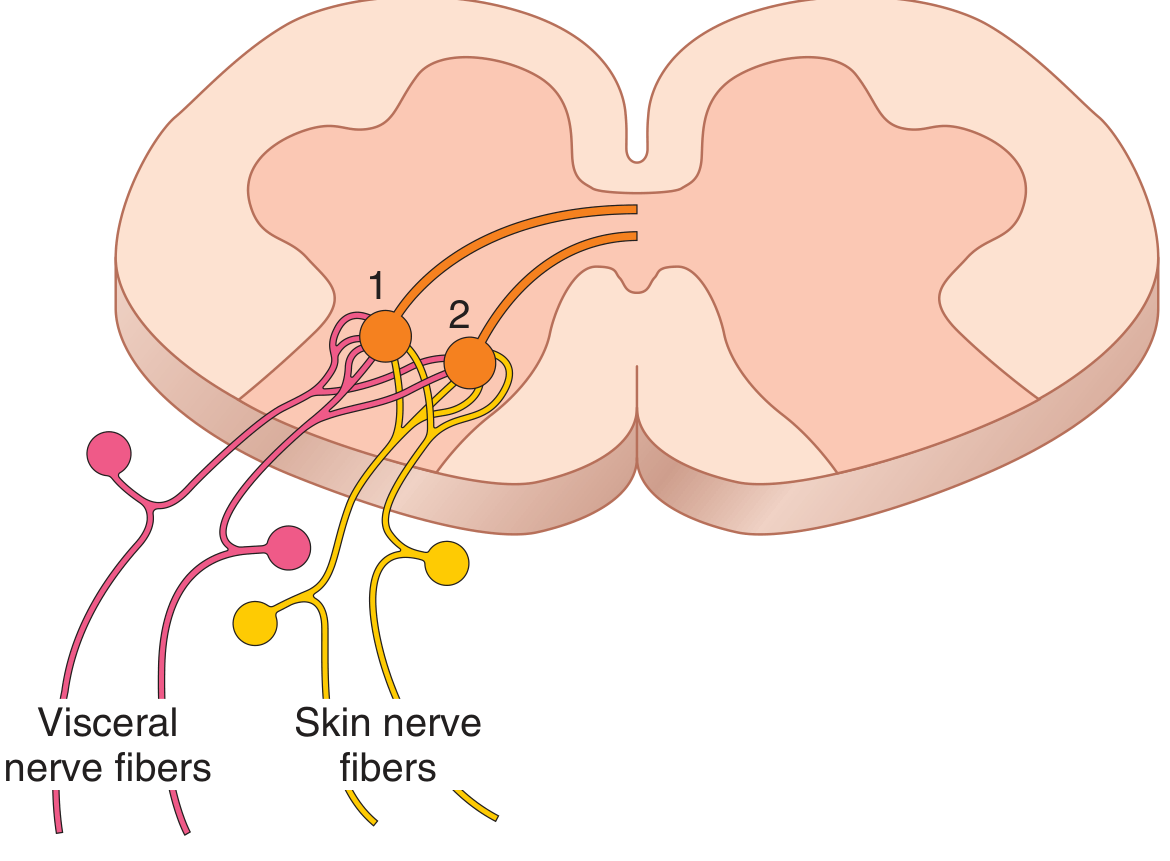
Figure 49.5, Guyton and Hall - Mechanism of referred pain and referred hyperalgesia; neurons 1 and 2 receive pain signals from both the skin and the viscera.
Basis of the Pattern of Reference
The skin area to which pain is referred corresponds to the embryological (dermatomal) segment of origin of the affected organ, not its adult anatomical position - because the sensory nerve fibers of the organ and the corresponding skin dermatome enter the spinal cord at the same segmental level established during embryonic development.
Clinical Examples of Referred Pain
| Diseased Organ | Site of Referred Pain | Segmental/Nerve Basis |
|---|---|---|
| Heart (angina/myocardial ischemia) | Left shoulder, left arm (medial side), neck, jaw | T1-T5 sympathetic afferents |
| Diaphragm (central irritation, e.g., subphrenic abscess) | Tip of the shoulder | Phrenic nerve (C3-C5) |
| Gallbladder / biliary colic | Right shoulder and inferior angle of right scapula | Shared segmental afferents |
| Appendix (early appendicitis) | Periumbilical region (T10 dermatome) before localising to right iliac fossa | Visceral afferents of midgut origin |
| Ureter/kidney (renal colic) | Groin, testis/labium | T11-L1 |
| Stomach/duodenum (peptic ulcer) | Epigastrium | T6-T9 |
Clinical Significance
Because most viscera lack sensory receptors for touch, temperature, or other modalities and signal almost exclusively through pain, referred pain is frequently the earliest and sometimes the only symptom that leads a clinician to suspect visceral disease. Recognising these patterns (e.g., left arm pain suggesting cardiac ischemia, or shoulder-tip pain suggesting diaphragmatic irritation) is fundamental to clinical diagnosis. Referred pain is often accompanied by referred hyperalgesia (increased tenderness) in the corresponding cutaneous area, and by reflex muscle spasm (guarding) in the overlying abdominal wall, which further aids localisation of the diseased viscus.
Relation to Visceral and Parietal Pain
True visceral pain itself is diffuse, dull, and poorly localised because visceral nociceptive fibers are sparse and widely dispersed, and because visceral disease commonly stimulates many nerve endings simultaneously (e.g., in ischemia, chemical irritation, smooth muscle spasm, over-distention of a hollow viscus, or stretching of the visceral connective tissue). Highly localised damage to a viscus (e.g., a surgical incision through the gut) causes little pain, whereas diffuse stimulation (e.g., ischemia from occluded blood supply) causes severe pain. When the disease process extends to involve the adjacent parietal peritoneum or pleura, a second, sharp, well-localised parietal pain is felt directly over the site of the lesion, transmitted through somatic afferents of the body wall - explaining, for example, the classic shift in appendicitis from vague periumbilical (visceral, referred) pain to sharp, localised right iliac fossa (parietal) pain as the inflamed appendix irritates the overlying peritoneum.
Summary
Pain is broadly classified as fast (A-delta, sharp) or slow (C fiber, aching) pain, and by site of origin into cutaneous, deep somatic, visceral, parietal, and referred pain. Referred pain results from convergence of visceral and cutaneous afferents onto shared second-order spinal neurons, causing visceral pain to be perceived in the corresponding embryological dermatome on the body surface. Its recognition is of major diagnostic value in clinical medicine, since it often provides the only external clue to internal disease.
This is a shared conversation. Sign in to Orris to start your own chat.