
The tracing of the artery supply of heart
Reading File
Finding Sources
Finding Sources
Searching Images
labeled diagram right and left coronary artery branches and territories of heart
Searching PubMed
coronary artery anatomy
Searching the Web
coronary arteries anatomy branches right left coronary artery dominance Merck Manual
Reading File
Reading File
Reading Web Page
https://www.ncbi.nlm.nih.gov/books/NBK534790
Reading File
Arterial supply of the heart: tracing
The heart is supplied by two coronary arteries, which arise from the beginning of the ascending aorta, just above the aortic valve, from the right and left aortic sinuses. They run on the surface of the heart in the coronary (atrioventricular) sulcus and give branches toward the apex. Gray's Anatomy for Students, p. 239.
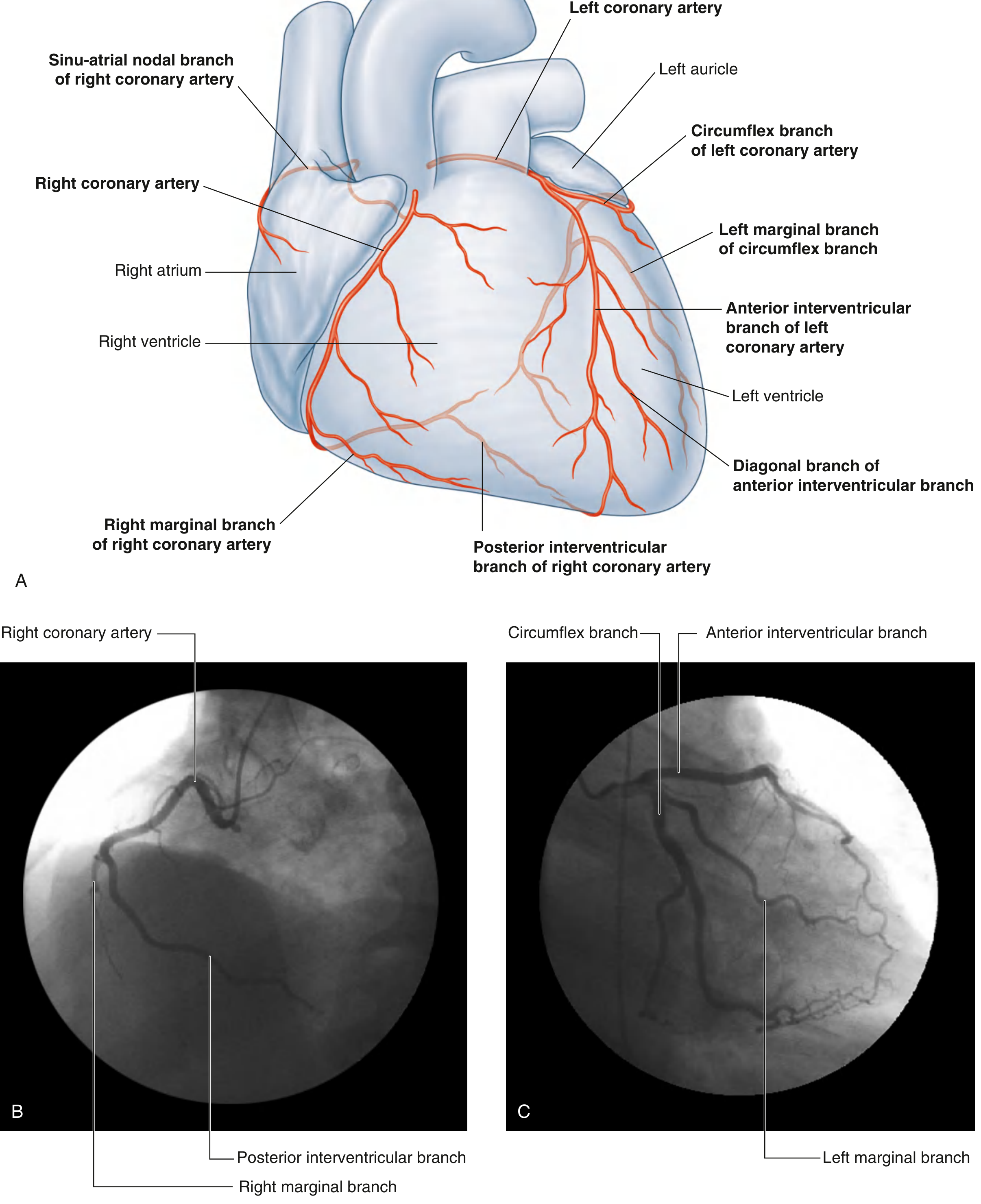
1. Right coronary artery (RCA)
Origin: Right aortic sinus
Course: Passes between the pulmonary trunk and right auricle, then descends in the right atrioventricular groove. It reaches the inferior border of the heart, turns posteriorly, and usually reaches the posterior interventricular sulcus.
Course: Passes between the pulmonary trunk and right auricle, then descends in the right atrioventricular groove. It reaches the inferior border of the heart, turns posteriorly, and usually reaches the posterior interventricular sulcus.
Branches and supply
Right aortic sinus
       ↓
Right coronary artery
       ├─ Conus branch → outflow tract of right ventricle
       ├─ SA nodal branch → SA node, usually
       ├─ Right atrial branches → right atrium
       ├─ Right marginal (acute marginal) artery → right ventricle
       ├─ AV nodal branch → AV node, usually
       └─ Posterior interventricular artery / PDA
             → inferior walls of ventricles
             → posterior one-third of interventricular septum
Main territory supplied by RCA
- Right atrium
- Most of right ventricle
- Part of left ventricle, especially the inferior/posterior surface
- Posterior one-third of interventricular septum
- SA node in most people
- AV node in most people
2. Left coronary artery (LCA)
Origin: Left aortic sinus
Course: It has a short trunk, called the left main coronary artery, which passes between the pulmonary trunk and left auricle. It usually divides into:
Course: It has a short trunk, called the left main coronary artery, which passes between the pulmonary trunk and left auricle. It usually divides into:
- Anterior interventricular artery, also called left anterior descending artery (LAD)
- Circumflex artery (LCx)
Left aortic sinus
       ↓
Left main coronary artery
       ├─ LAD / anterior interventricular artery
       │     ├─ Septal perforators → anterior two-thirds of IV septum
       │     └─ Diagonal branches → anterior and lateral LV wall
       │
       └─ Circumflex artery
             ├─ Left atrial branches → left atrium
             └─ Obtuse marginal branches → lateral wall of LV
LAD course and supply
- Runs in the anterior interventricular groove toward the apex.
- Gives septal perforating branches and diagonal branches.
- Supplies:
- Anterior wall of left ventricle
- Part of right ventricle near the anterior interventricular groove
- Anterior two-thirds of interventricular septum
- AV bundle and bundle branches
- Often the apex
Circumflex artery course and supply
- Runs leftward in the left atrioventricular groove.
- Gives obtuse marginal branches.
- Supplies:
- Left atrium
- Lateral and posterior parts of the left ventricle
The LAD supplies the anterior septum and anterior wall; the PDA supplies the inferior septum and inferior ventricular wall; obtuse marginal branches supply the lateral LV wall. Textbook of Clinical Echocardiography, p. 235.
Coronary dominance
Dominance is defined by the artery that gives rise to the posterior descending artery (PDA):
| Type | PDA arises from | Approximate frequency |
|---|---|---|
| Right-dominant | RCA | 70-80% |
| Left-dominant | Circumflex branch of LCA | 10-20% |
| Co-dominant | Contributions from both RCA and LCx | remainder |
In the usual right-dominant circulation, the RCA supplies the posterior interventricular region and a substantial part of the posterior left ventricle. In left dominance, an enlarged circumflex artery provides this supply. Gray's Anatomy for Students, pp. 239-241. This is also summarized in StatPearls' coronary anatomy review.
Quick examination summary
RCA → right heart + inferior/posterior heart + posterior 1/3 IV septum
LAD → anterior LV + anterior 2/3 IV septum + apex
LCx → left atrium + lateral/posterior LV
PDA → determines coronary dominance
Clinical point: Occlusion of the LAD can damage a large area of left ventricular myocardium and the interventricular septum. RCA occlusion may cause inferior wall ischemia and can affect the SA or AV node.
This is a shared conversation. Sign in to Orris to start your own chat.