
I am going to community health diagnosis ( karnali providence jumla as a mbbs 2nd year student ) and my professor ask me to give presentation on malnutrition ( Nepal scenaria ) and she asked me to give presentation on malnutrition ( focus on community level ) I need to teach community person. Provide me all in here not presentation form , and give me images and tables also.. and give me the reference also
Which language should the community-teaching material use? · Which group will be your main audience in Jumla? · What do you need first?
-
Meaning of malnutrition
- Undernutrition, micronutrient deficiencies, and overweight
- Simple community-friendly explanation
-
Why malnutrition happens in Jumla/Karnali
- Food insecurity and seasonal shortages
- Poverty, difficult transport, remote geography
- Low dietary diversity
- Maternal undernutrition, early marriage and pregnancy
- Poor infant and young child feeding
- Diarrhoea, worms, respiratory infections, poor sanitation
- Gender-related food distribution and workload
-
Who is most at risk
- Children under 5 years, especially 6-23 months
- Pregnant and breastfeeding women
- Adolescent girls
- Low-birth-weight infants
- Poor and food-insecure households
-
Types and visible signs
- Stunting: child is too short for age
- Wasting: child is too thin for height
- Underweight: low weight for age
- Bilateral pitting oedema: swelling of both feet
- Anaemia and other micronutrient problems
- Danger signs requiring referral
-
How communities identify and screen children
- MUAC tape
- Checking both feet for pitting oedema
- Growth monitoring and regular weighing
- When to visit the health post urgently
-
Prevention from pregnancy to age 2 years
- The first 1,000 days
- Maternal diet, antenatal care, iron-folic acid and deworming as advised by health workers
- Early initiation and exclusive breastfeeding for the first 6 months
- Complementary feeding from 6 months while continuing breastfeeding until 2 years or beyond
- Safe water, sanitation, vaccination and prompt treatment of illness
-
Locally practical food messages for Jumla
- Use available foods: cereals, pulses/beans, eggs, milk or curd where available, green leafy vegetables, potatoes, seasonal fruits, oil/ghee in small amounts, and animal-source foods when possible
- Improve child meals by adding a pulse, vegetable, egg/milk/meat when available, and a little oil/ghee for energy
- Feed young children more often than adults
-
Treatment and referral
- What families should do at home for mild nutrition problems
- What must be managed through the health post, outpatient therapeutic programme, or nutrition rehabilitation services
- Why families should not wait if a child is severely thin, has swollen feet, is not feeding, is very sleepy, or has repeated vomiting/diarrhoea
-
Community action
- Mothers' groups, Female Community Health Volunteers, health posts, schools, local agriculture groups, kitchen gardens, hygiene promotion, and household decision-making.
Brief community overview
A child needs frequent, diverse, safe food; continued breastfeeding; clean water and hygiene; vaccination and early treatment when ill.
- Nepal and Karnali/Jumla situation
- Causes and risk factors
- Types, signs, MUAC screening and referral
- Prevention and infant/young-child feeding
- Locally available foods and practical meal examples
- Community-level intervention plan
- Full combined field-teaching note
Full combined field-teaching note. And I need to give presentation in front of professor first as pre so help me
Nepal Demographic Health Survey 2022 child nutrition stunting wasting underweight Karnali Province Jumla malnutrition official PDF
Nepal National Nutrition Strategy Multi-Sector Nutrition Plan infant young child feeding community management acute malnutrition official
child malnutrition community interventions
https://dhsprogram.com/pubs/pdf/PR142/PR142.pdf
mid upper arm circumference MUAC tape child malnutrition screening edema
WHO infant young child feeding complementary foods 6 months breastfeeding infographic
PMID: 40272950
site:dhsprogram.com Nepal DHS 2022 Karnali Province stunted wasted underweight children table PDF
Malnutrition in Nepal: Community-Level Field-Teaching Note
Audience: Community members, mothers/caregivers, pregnant women, adolescent girls, FCHVs, teachers, and local leaders
Level: MBBS second-year community health diagnosis
1. Learning objectives
- Explain malnutrition in simple words.
- Identify children and mothers at high risk.
- Recognize common signs of undernutrition and danger signs.
- Describe correct breastfeeding and complementary feeding.
- Use locally available foods to improve family diets.
- Know when and where to refer a child to the health post.
- Participate in household and community actions to prevent malnutrition.
Part A. Professor-facing content
2. Definition of malnutrition
- Stunting: a child is too short for his or her age due to long-term poor nutrition and repeated infection.
- Wasting: a child is too thin for his or her height due to recent weight loss or failure to gain weight.
- Underweight: low weight for age. It can result from stunting, wasting, or both.
- Micronutrient deficiencies: lack of iron, iodine, vitamin A, zinc, and other vitamins/minerals.
- Severe acute malnutrition (SAM): a life-threatening form of acute undernutrition.
3. Malnutrition situation in Nepal and Karnali
Key national and provincial facts
| Indicator, children under 5 years | Nepal, NDHS 2022 | Karnali Province, NDHS 2022 | Interpretation |
|---|---|---|---|
| Stunting | 25% | 36% | Long-term growth failure is especially serious in Karnali |
| Wasting | 8% | Provincial estimate should be checked in the Karnali report before presenting exact value | Acute malnutrition |
| Underweight | 19% | Provincial estimate should be checked in the Karnali report before presenting exact value | Mixed chronic and acute undernutrition |
| Severe stunting | 6% | Not stated here | Highest-risk chronic growth failure |
| Exclusive breastfeeding, 0-5 months | 56% | National indicator | Needs improvement |
| Early initiation of breastfeeding | 55% | National indicator | Breastfeeding within 1 hour after birth |
| Minimum dietary diversity, 6-23 months | 78% in NDHS key-indicator definition | Interpret carefully with indicator definition | Variety of food groups |
| Minimum acceptable diet, 6-23 months | 43% reported by UNICEF Nepal | Diet quality plus minimum meal frequency remain inadequate |
4. Why malnutrition occurs: UNICEF conceptual framework
| Level | Causes | Example relevant to Jumla/Karnali |
|---|---|---|
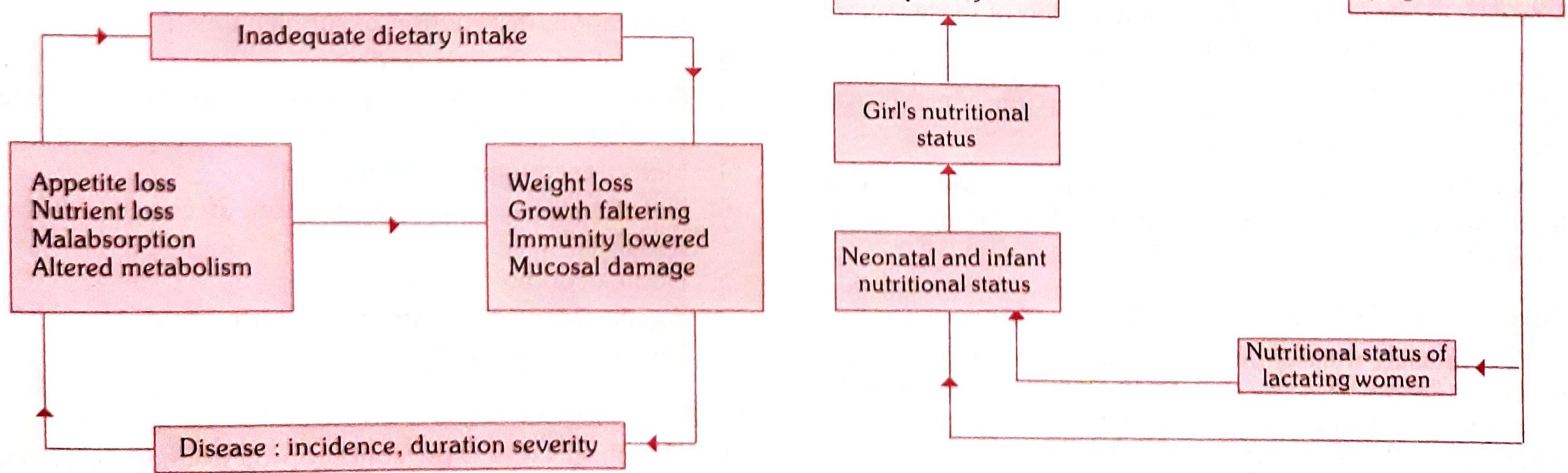
| Immediate causes | Inadequate dietary intake and disease/infection | Child eats little during diarrhoea, cough, fever, or worm infestation |
| Underlying causes | Household food insecurity, inadequate care/feeding, unhealthy environment, limited health services | Seasonal food shortage, low dietary diversity, delayed care-seeking, unsafe water, remote health facility |
| Basic causes | Poverty, geography, social inequality, low maternal education, weak infrastructure, gender norms | Difficult transport, workload of women, limited cash income, early marriage/pregnancy |
Malnutrition-infection cycle
Local risk factors to ask about during community diagnosis
- Household food shortage, especially before harvest or during winter
- Diet mainly based on cereal/potato with little pulse, egg, milk, meat, fruit, or vegetables
- Child not breastfed exclusively before 6 months
- Complementary foods started too late, too early, too thin, too little, or too infrequently
- Child receives food last or less than adults
- Mother is undernourished or anaemic
- Early marriage, early pregnancy, short birth interval
- Repeated diarrhoea, pneumonia, fever, worms, skin infections
- Unsafe drinking water, open defecation, poor handwashing
- Incomplete immunisation or missed vitamin A programme contacts
- Poor access to ANC, growth monitoring, health posts, and referral transport
- Heavy physical work by pregnant or breastfeeding mothers
- Alcohol/tobacco use in the household affecting food expenditure and care
5. Who is most vulnerable?
- Pregnant women
- Lactating mothers
- Adolescent girls
- Low-birth-weight or preterm babies
- Children aged 6-23 months
- Children under 5 with repeated diarrhoea, pneumonia, fever, or worms
- Children from poor, food-insecure, remote, or socially excluded households
- Children whose mothers are thin, anaemic, or have little education
6. Types of undernutrition
| Type | Technical indicator | Simple explanation for community | Main meaning |
|---|---|---|---|
| Stunting | Height-for-age < -2 SD | “Age अनुसार बच्चाको उचाइ कम हुनु” | Long-term poor nutrition and repeated infection |
| Wasting | Weight-for-height < -2 SD | “उचाइ अनुसार बच्चा धेरै दुब्लो हुनु” | Recent weight loss or acute undernutrition |
| Underweight | Weight-for-age < -2 SD | “उमेर अनुसार तौल कम हुनु” | Can be due to stunting, wasting, or both |
| SAM | Weight-for-height < -3 SD, MUAC <115 mm, or bilateral pitting oedema | “धेरै दुब्लो वा दुवै खुट्टा सुन्निएको बच्चा” | Medical/nutritional emergency |
7. Recognition and community screening
A. Look for visible warning signs
- Child becoming very thin, weak, or less active
- Ribs, shoulder bones, or buttocks very prominent
- Loss of fat from upper arms, thighs, and buttocks
- Poor appetite or refusal to breastfeed/feed
- Weight not increasing over months
- Hair becoming thin, sparse, or changing colour
- Repeated diarrhoea, cough, fever, or mouth sores
- Delayed walking, play, learning, or development
- Swelling of both feet
B. Test for bilateral pitting oedema
- Press gently with both thumbs on the tops of both feet for about 3 seconds.
- Remove thumbs.
- If a pit remains on both feet, suspect nutritional oedema.
- Refer urgently to the health facility.
C. MUAC screening
| MUAC result | Classification | Community action |
|---|---|---|
| <11.5 cm / <115 mm | Severe acute malnutrition | Urgent referral to health post/facility the same day |
| 11.5 to <12.5 cm | Moderate acute malnutrition | Refer for assessment, feeding counselling, follow-up and programme enrolment according to local protocol |
| ≥12.5 cm | Usually not acute malnutrition by MUAC | Continue growth monitoring and prevention counselling |
| Any bilateral pitting oedema | Severe acute malnutrition | Urgent referral regardless of MUAC |
Immediate referral danger signs
- Bilateral swelling of feet
- MUAC less than 11.5 cm
- Very thin appearance with visible wasting
- Not able to drink, breastfeed, or eat
- Persistent vomiting
- Convulsion, unconsciousness, unusual sleepiness
- Fever, severe diarrhoea, chest indrawing, or difficult breathing
- Dehydration
- Any child whose caregiver feels the child is becoming rapidly weaker
Part B. Community teaching content
8. Key messages in simple Nepali
Opening message
कुपोषण भनेको खाना कम खानु मात्र होइन। बच्चा वा आमाले आवश्यक मात्रामा विभिन्न प्रकारका पोषिलो खाना नपाउनु, बारम्बार बिरामी हुनु, सफा पानी र सरसफाइको कमी हुनु पनि कुपोषणका कारण हुन्।
Healthy child = नियमित स्तनपान/पोषिलो खाना + सफा पानी + सरसफाइ + खोप + बिरामी हुँदा छिटो उपचार।
Five messages everyone should remember
- गर्भवती र सुत्केरी आमाले अरूभन्दा बढी र विविध खाना खानुपर्छ।
- जन्मेको एक घण्टाभित्र स्तनपान सुरु गरौं।
- ६ महिनासम्म आमाको दूध मात्र दिऔं। पानी, मह, घुट्टी, जडिबुटी वा अन्य खाना नदिऔं।
- ६ महिनापछि आमाको दूधसँगै बाक्लो, नरम, विविध र बारम्बार खाना दिऔं।
- बच्चा धेरै दुब्लो भएमा, दुवै खुट्टा सुन्निएमा, वा खान नसकेमा तुरुन्त स्वास्थ्य संस्था जाऔं।
9. Nutrition during pregnancy and breastfeeding
Community message
“आमा स्वस्थ भए बच्चा स्वस्थ हुन्छ।”
| What families should do | Practical examples |
|---|---|
| Eat one extra nutritious meal/snack daily during pregnancy and breastfeeding | Dal-bhat with vegetables; roti/dhido with dal; egg; milk/curd; roasted beans; seasonal fruit |
| Eat diverse foods daily where possible | Staple food + pulse/bean + green/yellow vegetable + animal-source food or milk/egg + fruit |
| Attend ANC and take supplements as prescribed | Iron-folic acid, calcium or other supplements according to Nepal health-worker advice |
| Use iodized salt | Check that the package has the iodized salt logo; store dry and covered |
| Rest and reduce heavy workload | Family should share water collection, firewood, farm and household work |
| Avoid tobacco and alcohol | Protect mother, fetus, and household food budget |
| Seek care for anaemia or illness | Tiredness, dizziness, pallor, breathlessness, fever or bleeding need assessment |
10. Infant and young child feeding
A. From birth to 6 months
| Practice | Correct message |
|---|---|
| Start breastfeeding | Within one hour after birth |
| First milk, colostrum | Give it. It is the baby’s first vaccine and should not be discarded |
| Exclusive breastfeeding | Only breast milk for the first 6 completed months |
| Do not give | Water, honey, ghutti, animal milk, formula, rice water, herbal liquids, or other foods unless medically advised |
| Feeding frequency | Breastfeed whenever the baby wants, day and night |
| If breastfeeding difficulty | Ask FCHV/health worker for positioning and attachment support |
B. From 6 months onward
“६ महिनापछि बच्चालाई आमाको दूध मात्र होइन, बाक्लो, नरम, पोषिलो र बारम्बार खाना चाहिन्छ।”
Age-appropriate feeding
| Child age | Food consistency | Minimum meal frequency if breastfed | Suggested amount and practice |
|---|---|---|---|
| 6-8 months | Thick porridge, mashed foods, soft foods | 2-3 meals/day plus 1-2 nutritious snacks if wanted | Start with 2-3 tablespoons, increase gradually |
| 9-11 months | Mashed/chopped family foods, finger foods | 3-4 meals/day plus 1-2 snacks | Half small bowl per meal, according to appetite |
| 12-23 months | Family food, chopped as needed | 3-4 meals/day plus 1-2 snacks | Three-quarter to one small bowl per meal |
| 24 months and above | Family food | 3 meals plus healthy snacks | Continue responsive feeding and dietary diversity |
Principles of good complementary feeding
- Thick: Thin watery porridge fills the stomach but gives little energy.
- Frequent: Young children have small stomachs and need small meals many times daily.
- Diverse: Give foods from several food groups.
- Responsive: Sit with the child, encourage patiently, do not force or punish.
- Safe: Wash hands, use clean utensils, cover food, and give freshly prepared food where possible.
- Continue feeding during illness: Offer breast milk and small frequent meals. Give an extra meal daily for about 2 weeks after recovery.
11. Locally practical foods for Jumla
| Food group | Examples that may be locally available or accessible | Why it matters |
|---|---|---|
| Staple/energy foods | Dhido, rice, roti, maize, millet, barley, buckwheat, potatoes | Energy for growth and activity |
| Pulses/plant protein | Lentil, beans, soybeans, chickpeas, peas | Protein, iron, zinc |
| Animal-source foods | Egg, milk, curd, cheese, meat, fish when available | High-quality protein, iron, zinc, vitamin B12 |
| Green/yellow vegetables | Saag, spinach, leafy vegetables, pumpkin, carrot, seasonal vegetables | Vitamins, folate, fibre |
| Fruits | Apple, seasonal fruits, orange/citrus where available | Vitamins, especially vitamin C |
| Added fat | Oil, ghee, groundnut/sesame paste where appropriate | Adds energy to child food |
| Iodized salt | Packed iodized salt | Prevents iodine-deficiency disorders |
Affordable meal examples for 6-23 months
| Meal | How to enrich it |
|---|---|
| Thick lito/porridge | Add mashed lentil/bean flour, milk if available, egg, a little oil/ghee, mashed seasonal fruit |
| Mashed dal-bhat-tarkari | Make soft and thick; add oil/ghee and mashed egg/meat when available |
| Mashed potato with dal and vegetables | Add lentil, chopped greens, and a little oil |
| Khichadi | Rice/millet + lentil + vegetables + oil/ghee; mash for younger child |
| Egg with soft staple food | Boiled or scrambled egg mixed into soft rice/dhido/roti pieces |
| Roasted/mashed beans or chickpeas | Give in safe, age-appropriate texture; avoid choking hazards |
Important practical message
12. Dietary diversity: simple “family food plate” method
- Staple food: rice, dhido, roti, potato, maize, millet
- Body-building food: dal, beans, egg, milk, curd, meat, fish
- Protective food: green/yellow vegetables and fruit
- Energy addition: small amount of oil/ghee
13. Hygiene, infection prevention, and nutrition
| Household action | Why it prevents malnutrition |
|---|---|
| Wash hands with soap and water before preparing food, feeding a child, eating, and after cleaning stool | Reduces diarrhoeal disease |
| Use safe drinking water | Reduces diarrhoea and intestinal infection |
| Use a toilet and dispose of child stool safely | Prevents faecal contamination and worms |
| Keep utensils and feeding bowl clean | Prevents contamination |
| Complete routine immunisation | Prevents serious infections |
| Take child for growth monitoring and vitamin A services as scheduled | Detects problems early and supports child health |
| Treat diarrhoea promptly with ORS and zinc only as advised by health worker | Prevents dehydration and continued weight loss |
| Continue breast milk and feeding during illness | Helps recovery and prevents worsening malnutrition |
14. Micronutrient deficiencies
| Nutrient | Deficiency problem | Community prevention message |
|---|---|---|
| Iron | Anaemia, tiredness, poor concentration, adverse pregnancy outcomes | Eat pulses, green leafy vegetables, egg/meat where possible; use ANC iron-folic acid as prescribed |
| Iodine | Goitre, impaired brain development in child | Use iodized salt |
| Vitamin A | Poor vision/night blindness, reduced immunity | Participate in child vitamin A programme; give green/yellow vegetables, egg, milk where available |
| Zinc | Poor growth, reduced immunity, prolonged diarrhoea | Diverse diet; use zinc for diarrhoea only on health-worker advice |
| Folate | Maternal anaemia; neural tube defects in fetus | ANC registration and folic acid/iron-folic acid according to protocol |
Part C. Community-level action plan
15. What different community members can do
| Person/group | Actions |
|---|---|
| Mother/caregiver | Exclusive breastfeeding, timely complementary feeding, responsive feeding, growth monitoring, seek care early |
| Father and family | Buy/support nutritious food, share household work, support ANC and health-post visits, do not restrict mother’s diet |
| Grandparents | Support colostrum feeding, avoid harmful feeding beliefs, encourage diverse family foods |
| FCHV | Identify pregnant women and vulnerable children, counsel households, check referral completion, mobilize mothers’ groups |
| Health post | Growth monitoring, MUAC screening, SAM/MAM assessment and referral/treatment per national protocol, IYCF counselling, ANC and micronutrient services |
| School/teachers | Nutrition education, handwashing, adolescent-girl health and anaemia awareness, school garden where feasible |
| Ward/local government | Improve water/sanitation, food security, kitchen gardens, transport/referral, social protection and nutrition planning |
| Agriculture groups | Promote household production of vegetables, pulses, small livestock, poultry, fruit, and storage practices |
16. Suggested community diagnosis checklist for your Jumla field visit
Household-level questions
| Area | Questions to ask |
|---|---|
| Family composition | Number of under-5 children, pregnant women, adolescent girls, elderly people |
| Food security | Is there food shortage? In which months? Does the family borrow food or skip meals? |
| Dietary diversity | What did the child/mother eat yesterday? How many food groups? |
| Infant feeding | Was breastfeeding begun within 1 hour? Is an infant under 6 months getting anything other than breast milk? When were complementary foods started? |
| Feeding frequency | How many times yesterday did the child aged 6-23 months eat? |
| Illness | Any diarrhoea, cough/difficult breathing, fever, worm problem in past 2 weeks? |
| WASH | Water source, water treatment, toilet, handwashing facility, disposal of child stool |
| Services | ANC visits, iron-folic acid use, child immunisation, vitamin A, growth monitoring, distance to health post |
| Social factors | Who decides food purchase? Does pregnant mother have rest? Does the child eat before or after adults? |
| Anthropometry | Weight, height/length, MUAC for 6-59 months, bilateral pitting oedema check |
Community-level observations
- Distance, walking time, and transport barriers to health post
- Food market availability and seasonal price changes
- Common local crops, livestock, milk/egg availability
- Water source and sanitation status
- Mothers’ group/FCHV activity
- Seasonal migration and its effect on caregiving and income
- Existing school feeding, child grant, agriculture, or nutrition programmes
17. A practical 30-minute community teaching session
Materials
- MUAC tape
- Growth chart or child health card
- Picture cards/food samples
- One small bowl, spoon, and locally available foods
- Flipchart/poster
- Clean water and soap demonstration if possible
Session flow
| Time | Activity | Main message |
|---|---|---|
| 0-3 min | Introduce yourself and ask: “What does a healthy child look like?” | Start from community knowledge |
| 3-7 min | Explain malnutrition in simple language | Not only lack of food, but also illness and poor care |
| 7-12 min | Discuss signs and danger signs | Thin child, both feet swelling, poor feeding = referral |
| 12-18 min | Demonstrate breastfeeding/complementary feeding messages | Exclusive breastfeeding 0-6 months; thick diverse food after 6 months |
| 18-22 min | Show local food combinations | Staple + dal/bean/egg/milk + vegetables + oil/ghee |
| 22-25 min | Demonstrate MUAC and foot oedema check | Children 6-59 months; refer red MUAC/oedema |
| 25-28 min | Hygiene and illness messages | Handwashing, safe water, vaccination, continue feeding during illness |
| 28-30 min | Ask five recall questions and make referral plan | Check understanding and link to FCHV/health post |
18. Short speaking script for community members
नमस्कार। आज हामी बच्चा, गर्भवती आमा र सुत्केरी आमाको पोषणको बारेमा कुरा गर्नेछौं। कुपोषण भनेको खाना नपाउनु मात्र होइन। बच्चाले पर्याप्त र विभिन्न प्रकारको खाना नपाउनु, बारम्बार झाडापखाला वा निमोनिया हुनु, सफा पानी र सरसफाइको कमी हुनु पनि कुपोषणका कारण हुन्।बच्चा जन्मेपछि एक घण्टाभित्र स्तनपान सुरु गर्नुपर्छ। पहिलो पहेंलो दूध नफाल्नुहोस्, यही बच्चाको पहिलो खोपजस्तै हो। छ महिनासम्म आमाको दूध मात्र दिनुपर्छ। पानी, मह, घुट्टी र अन्य खाना आवश्यक हुँदैन।छ महिनापछि आमाको दूधसँगै बाक्लो, नरम र पोषिलो खाना सुरु गर्नुपर्छ। पातलो जाउलो मात्रले बच्चा बढ्दैन। लिटो वा खिचडीमा दाल, सागसब्जी, अण्डा, दूध, वा थोरै तेल/घिउ थप्न सकिन्छ। बच्चालाई दिनमा धेरै पटक सानो-सानो मात्रा खुवाउनुपर्छ।बच्चा धेरै दुब्लो देखिएमा, खान नसकेमा, वा दुवै खुट्टा सुन्निएमा तुरुन्त स्वास्थ्य चौकी जानुपर्छ। गर्भवती र सुत्केरी आमालाई परिवारले बढी आराम, बढी विविध खाना र स्वास्थ्य जाँचको सहयोग गर्नुपर्छ।हाम्रो सन्देश: आमाको दूध, बाक्लो पोषिलो खाना, सफा पानी, सरसफाइ र समयमै उपचारले कुपोषण रोक्छ।
Part D. How to present before your professor
19. Suggested 12-slide presentation structure
- Title: Malnutrition in Nepal: Community-Level Approach for Jumla, Karnali
- Learning objectives
- Definition and types of malnutrition
- Nepal and Karnali situation: NDHS 2022 data
- Why focus on Karnali/Jumla? Geography, food insecurity, service access, seasonality
- Causes: UNICEF framework
- Stunting, wasting, underweight and SAM
- Community screening: MUAC, oedema, danger signs
- First 1,000 days and maternal nutrition
- IYCF: breastfeeding and complementary feeding
- Local food-based solutions and WASH
- Community action plan, referral pathway, conclusion
Strong opening for professor presentation
“Malnutrition in Jumla should not be approached only as a food shortage problem. It is a combined outcome of food insecurity, maternal nutrition, infant feeding, infection, sanitation, poverty, seasonal access, and health-service barriers. Therefore, community diagnosis must identify both children at immediate risk and the household/community determinants that produce malnutrition.”
Strong concluding statement
“For Jumla, the practical priority is to protect the first 1,000 days, identify wasting early with MUAC and oedema screening, improve breastfeeding and complementary feeding with locally feasible foods, prevent infection through WASH and immunisation, and ensure rapid referral of severe cases.”
20. Likely viva questions and concise answers
| Question | Suggested answer |
|---|---|
| Why is stunting high in Karnali? | It reflects chronic deprivation: poor dietary diversity, recurrent infections, maternal undernutrition, poverty, difficult geography, seasonal food insecurity, and barriers to health/WASH services. |
| Differentiate wasting and stunting. | Wasting is low weight-for-height and usually reflects recent or acute malnutrition. Stunting is low height-for-age and reflects chronic growth failure. |
| Why is the first 1,000 days important? | It is the period from conception to age 2 years, when brain growth and linear growth are rapid; nutrition deficits can cause lasting effects. |
| What is MUAC used for? | Rapid community screening for acute malnutrition in children aged 6-59 months. MUAC below 11.5 cm indicates SAM. |
| What are criteria for SAM? | Weight-for-height below -3 SD, MUAC below 115 mm, or bilateral pitting oedema. |
| What should a family do if both feet are swollen? | Seek urgent assessment at the health post/facility, because bilateral pitting oedema can indicate severe acute malnutrition. |
| What is exclusive breastfeeding? | Giving only breast milk for the first 6 completed months, without water or other foods/liquids, except prescribed medicines/ORS/vitamins when needed. |
| What are the community interventions? | IYCF counselling, maternal nutrition and ANC, MUAC/growth monitoring, prompt referral, immunisation, vitamin A services, WASH, kitchen gardens, women’s groups, FCHV mobilisation, social protection and local government coordination. |
References
-
Ministry of Health and Population, New ERA, and ICF. Nepal Demographic and Health Survey 2022. Kathmandu, Nepal; 2023. The full NDHS report reports national under-5 stunting of 25%, wasting of 8%, underweight of 19%, and Karnali stunting of 36%.
-
UNICEF Nepal. The Nepal nutrition overview describes national nutrition trends, infant feeding gaps, and Nepal’s Multi-Sector Nutrition Plan III, 2023-2030.
-
National Planning Commission, Government of Nepal. The Nepal Nutrition and Food Security Portal describes Nepal’s multisectoral nutrition approach involving health, agriculture, education, WASH, and social protection.
-
Park K. Park’s Textbook of Preventive and Social Medicine. Sections on nutritional assessment, types of undernutrition, and severe acute malnutrition, p. 736.
-
Robbins SL, Cotran RS, Kumar V. Robbins, Cotran & Kumar Pathologic Basis of Disease. Nutritional Diseases and Severe Acute Malnutrition section.
-
Lassi ZS, et al. Community-based child food interventions/supplements for prevention of wasting: systematic review and meta-analysis. Nutrition Reviews. 2025. PMID: 40272950. This recent review supports benefit from certain community food/supplement interventions, but local programmes should follow Nepal health-system guidance rather than using supplements indiscriminately.
what is malnutrition from k park only defination
Park's Textbook of Preventive and Social Medicine definition malnutrition
malnutrition
“Malnutrition is a pathological state resulting from a relative or absolute deficiency or excess of one or more essential nutrients.”
Source: Park’s Textbook of Preventive and Social Medicine, Nutrition chapter.