
Properties of Nerve fibers
Reading File
Now let me search the medical library for nerve fiber properties.
Finding Sources
Finding Sources
Finding Sources
Reading File
Reading File
Reading File
Reading File
Loading Image
Reading File
I now have comprehensive data from Guyton, Ganong, and Morgan & Mikhail. Let me compile the full answer.
Properties of Nerve Fibers
Nerve fibers vary widely in diameter, myelination, conduction velocity, and function. Two classification systems are used in parallel: a letter-based general classification (A, B, C) used mainly for motor and mixed fibers, and a numerical classification (I, II, III, IV) used by sensory physiologists.
1. General Classification (Letter System)
Nerve fibers range from 0.5 to 20 micrometers in diameter, with conduction velocities from 0.5 to 120 m/sec. Larger diameter = faster conduction.
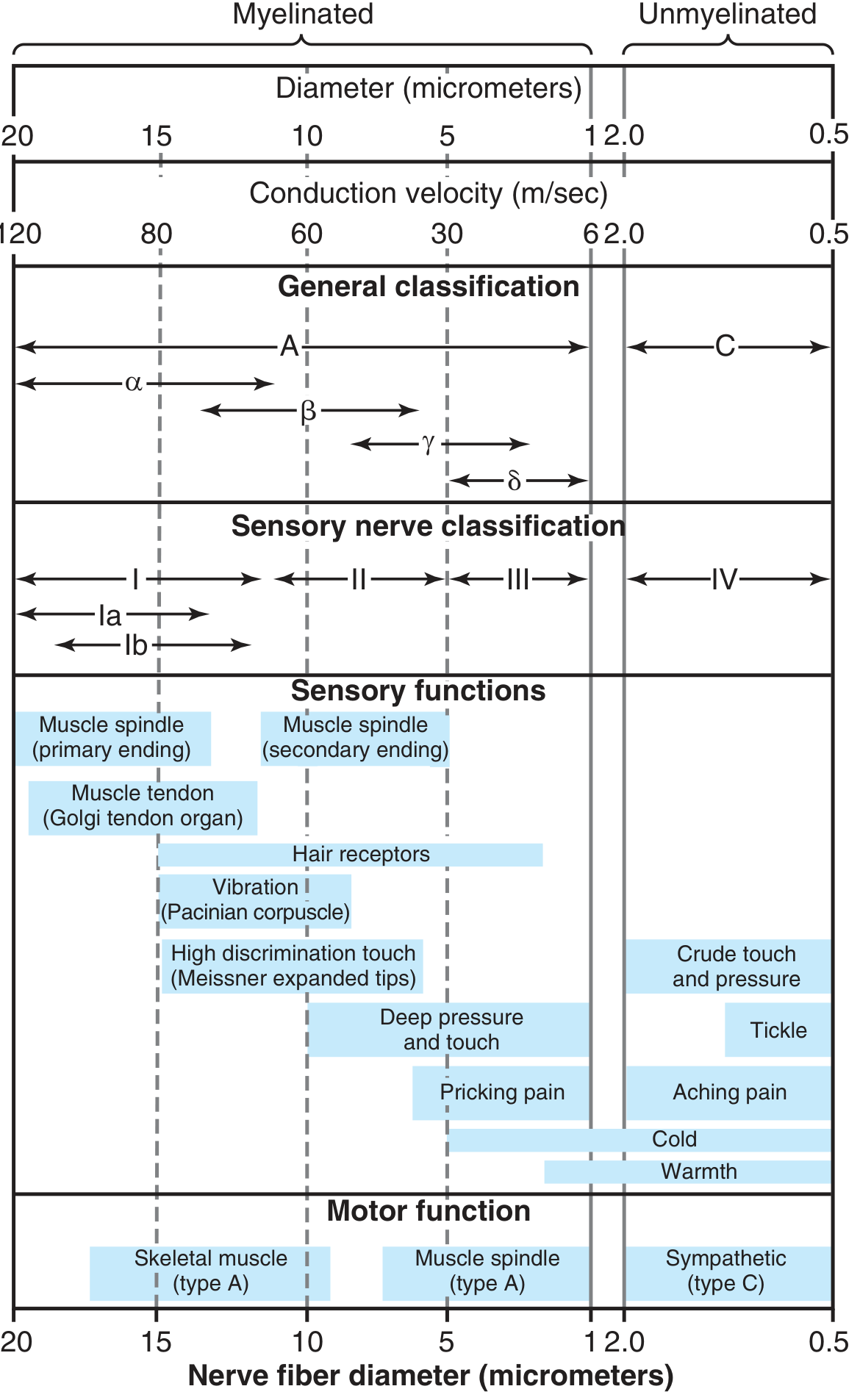
Figure: Physiological classifications and functions of nerve fibers (Guyton & Hall)
Type A Fibers (Myelinated)
| Subtype | Diameter (μm) | Velocity (m/s) | Function |
|---|---|---|---|
| Aα | 12-20 | 70-120 | Proprioception (muscle spindle primary endings, Golgi tendon organs); somatic motor |
| Aβ | 5-12 | 30-70 | Touch, pressure, vibration (Pacinian corpuscle), high-discrimination touch |
| Aγ | 3-6 | 15-30 | Motor to intrafusal muscle spindle fibers |
| Aδ | 2-5 | 12-30 | Sharp/pricking pain, temperature (cold), some touch |
- Spike duration: Aβ ~0.4-0.5 ms; Absolute refractory period ~0.4-1 ms
Type B Fibers (Myelinated)
| Property | Value |
|---|---|
| Diameter | <3 μm |
| Velocity | 3-15 m/s |
| Function | Preganglionic autonomic fibers |
| Spike duration | 1.2 ms |
| Absolute refractory period | 1.2 ms |
Type C Fibers (Unmyelinated)
These constitute more than half of sensory fibers in most peripheral nerves, and include all postganglionic autonomic fibers.
| Subtype | Diameter (μm) | Velocity (m/s) | Function |
|---|---|---|---|
| C (dorsal root) | 0.4-1.2 | 0.5-2 | Slow/aching pain, temperature (warmth), crude touch, tickle, itch |
| C (sympathetic) | 0.3-1.3 | 0.7-2.3 | Postganglionic sympathetic |
- Spike duration: ~2 ms; Absolute refractory period: ~2 ms
- The smallest C fibers take ~2 seconds to transmit from the big toe to the spinal cord.
2. Numerical Classification of Sensory Fibers
Sensory physiologists use a separate numerical system based on axonal diameter and conduction velocity. The correspondence to the letter system is:
| Number | Origin | Letter Equivalent |
|---|---|---|
| Ia | Muscle spindle, annulospiral (primary) ending | Aα |
| Ib | Golgi tendon organ | Aα |
| II | Muscle spindle, flower-spray (secondary) ending; touch, pressure | Aβ |
| III | Pain and cold receptors; some touch receptors | Aδ |
| IV | Pain, temperature, other receptors | C |
3. Differential Susceptibility to Blocking Agents
Fiber types differ in their sensitivity to hypoxia, pressure, and local anesthetics - a fact with direct clinical relevance:
| Agent | Most Susceptible | Intermediate | Least Susceptible |
|---|---|---|---|
| Hypoxia | B | A | C |
| Pressure | A | B | C |
| Local anesthetics | C (unmyelinated) | B | A |
Key clinical points from Ganong's Review of Medical Physiology:
- Local anesthetics depress C fibers first, then B, then A fibers (smallest to largest)
- Pressure blocks large-diameter A fibers first (explains why a limb "falling asleep" loses touch before pain)
- In a peripheral nerve block: onset of inhibition follows - autonomic → sensory → motor
4. Myelination and Conduction Velocity
- Myelinated fibers conduct via saltatory conduction (impulse jumps between nodes of Ranvier) - faster and more energy-efficient
- Unmyelinated fibers conduct via continuous propagation - slower
- The myelin sheath is formed by Schwann cells in the peripheral nervous system and oligodendrocytes in the CNS
- A Schwann cell myelinates only a single axon segment; one oligodendrocyte can myelinate up to ~50 axons
5. Signal Intensity Transmission
Nerve fibers convey signal strength (e.g., intensity of pain) by two mechanisms:
- Spatial summation: recruiting more parallel fibers as stimulus intensity increases
- Temporal summation: increasing the frequency of action potentials along a single fiber (frequency modulation)
Sources:
- Guyton and Hall Textbook of Medical Physiology, pp. 587-588
- Ganong's Review of Medical Physiology, 26th ed., pp. 103-104 (Tables 4-1, 4-2, 4-3)
- Morgan & Mikhail's Clinical Anesthesiology, 7e, p. 484 (Table 16-1)
This is a shared conversation. Sign in to Orris to start your own chat.