
Management of hyperglycaemia
I'll start by reading the medical library skill, then search for comprehensive information on hyperglycaemia management in parallel.
Reading File
Now I'll run parallel searches across the library and PubMed simultaneously.
Finding Sources
Finding Sources
Searching PubMed
"hyperglycemia"[MeSH Terms] AND "management"[MeSH Terms]
Finding Sources
Finding Sources
Searching PubMed
"type 2 diabetes"[MeSH Terms] AND "hypoglycemic agents"[MeSH Terms]
Let me read the textbook content found and search more specifically.
Reading File
Finding Sources
Excellent. Now let me read the most relevant sections in parallel.
Reading File
Reading File
Reading File
Let me get more content on pharmacological options and also read the perioperative hyperglycaemia and DKA/HHS sections.
Reading File
Reading File
Finding Sources
Let me read more on the specific drug classes and DKA/HHS management.
Reading File
Reading File
I now have comprehensive data to write a thorough answer. Let me also fetch a relevant image showing the treatment algorithm.
Searching Images
type 2 diabetes management algorithm pharmacological treatment stepwise
I now have enough material to write a comprehensive, well-structured answer.
Management of Hyperglycaemia
Hyperglycaemia management spans lifestyle modification, pharmacological therapy (oral and injectable agents), target setting, monitoring, and acute crisis management. The approach varies by context - chronic type 2 DM, type 1 DM, and acute hyperglycaemic emergencies each require distinct strategies.
1. Treatment Goals
- The ADA recommends targeting HbA1c < 7.0% in most patients. This level has been clearly shown to reduce microvascular complications (retinopathy, nephropathy, neuropathy). - Symptom to Diagnosis, 4th Ed.
- Intensive control (HbA1c < 6.5%) does not consistently reduce macrovascular events and may be harmful in older patients with established cardiovascular disease.
- Goals must be individualised - frail elderly patients, those with cognitive impairment, and those on insulin/complex regimens prioritise avoidance of hypoglycaemia over tight control.
- In patients with HbA1c > 9%, start with dual therapy. If HbA1c > 10%, consider combination injectable therapy from the outset.
HbA1c - Mean Plasma Glucose Correlation
| HbA1c (%) | Mean Plasma Glucose (mg/dL) |
|---|---|
| 6 | 126 |
| 7 | 154 |
| 8 | 183 |
| 9 | 212 |
| 10 | 240 |
| 11 | 269 |
| 12 | 298 |
2. Monitoring
- HbA1c: every 3 months when targets are not met or therapy is changing; every 6 months in stable patients at goal. Note that 50% of the HbA1c value reflects glycaemia in the month before measurement, 25% from days 30-60, and 25% from days 60-90.
- Home blood glucose monitoring (SMBG): Patients on multiple daily insulin doses should test fasting, pre-lunch, pre-dinner, and pre-bed. Those on basal-only insulin should test fasting each morning.
- Continuous glucose monitoring (CGM): Increasingly integrated with insulin pumps (sensor-augmented pump; hybrid closed-loop systems). - Washington Manual of Medical Therapeutics
3. Lifestyle Modification
The foundation of all treatment for type 2 DM:
- Weight loss: goal of at least 10% of body weight
- Diet modification: reduced caloric and carbohydrate intake; Mediterranean-type or low-glycaemic diets
- Exercise: at least 150 minutes/week of moderate-intensity activity - improves insulin sensitivity in skeletal muscle and reduces hepatic glucose output
- Best instituted with a certified diabetes educator or dietician
4. Pharmacological Treatment
Step 1 - Monotherapy
Metformin is the recommended first-line agent if tolerated.
| Feature | Detail |
|---|---|
| Mechanism | Reduces hepatic glucose production (activates AMPK) |
| HbA1c reduction | 1-2% |
| Weight | Neutral to slight loss |
| Hypoglycaemia risk | Low |
| Key side effects | GI (nausea, diarrhoea), lactic acidosis (rare), vitamin B12 deficiency |
| Contraindication | eGFR < 30 mL/min; withhold in acute illness, surgery, iodinated contrast |
| Outcome data | Reduced microvascular and macrovascular events + total mortality in obese T2DM (UKPDS 1998) |
Step 2 - Dual Therapy (add to metformin if HbA1c target not met after ~3 months)
Choice depends on patient-specific factors - cardiovascular disease, heart failure, renal function, weight, hypoglycaemia risk, and cost:
| Agent Class | Examples | HbA1c reduction | Weight | Hypoglycaemia | Key Notes |
|---|---|---|---|---|---|
| Sulfonylureas | Glipizide, glimepiride | 1-1.5% | Gain (2-5 kg) | Moderate | Reduce microvascular outcomes; avoid glyburide (severe hypoglycaemia); may lose efficacy as beta-cell function declines |
| Thiazolidinediones (TZDs) | Pioglitazone | ~1-1.5% | Gain | Low | Increases peripheral insulin sensitivity; avoid in heart failure or oedema; risk of fractures |
| DPP-4 inhibitors | Sitagliptin, linagliptin, vildagliptin | ~0.75% | Neutral | Low | Potentiate endogenous GLP-1; no GI effects; cardiovascularly safe but no CV benefit |
| SGLT-2 inhibitors | Empagliflozin, dapagliflozin, canagliflozin | ~0.5-1% | Loss (~3 kg) | Low | Block renal glucose reabsorption; risk of genitourinary infections; empagliflozin reduces CV events and mortality in established CVD; reduces heart failure hospitalisation and renal progression; avoid if eGFR < 30 |
| GLP-1 receptor agonists | Liraglutide, semaglutide, dulaglutide, exenatide | ~1% | Loss (~4 kg) | Low | Increase insulin/reduce glucagon/slow gastric emptying; subcutaneous (or oral for semaglutide); liraglutide reduces CV events and mortality in established CVD; contraindicated in history of pancreatitis or medullary thyroid carcinoma/MEN2 |
| Basal insulin | Glargine, degludec | 1-2.5% | Gain | High | Highest efficacy; use when oral agents fail or HbA1c > 10% |
Based on cardiovascular outcome trials (CVOTs): GLP-1 receptor agonists should be considered first-line in patients with established CVD or stroke; SGLT2 inhibitors should be first-line in patients with heart failure or diabetic kidney disease. - Washington Manual of Medical Therapeutics
Step 3 - Triple Therapy
If target not achieved after ~3 months on dual therapy, add a third agent. Example combinations include:
- Metformin + Sulfonylurea + TZD / DPP-4i / SGLT-2i / GLP-1 RA / Insulin
- Metformin + SGLT-2i + Sulfonylurea / TZD / DPP-4i / GLP-1 RA / Insulin
- Metformin + GLP-1 RA + Sulfonylurea / TZD / SGLT-2i / Insulin
Step 4 - Insulin Therapy
Indications for insulin in T2DM:
- Failure of oral/injectable agents to achieve glycaemic control
- Metabolic decompensation (DKA, HHS)
- Newly diagnosed with severe hyperglycaemia (HbA1c > 10%)
- Chronic kidney disease precluding other agents
- Pregnancy
Types of insulin:
| Type | Example | Onset | Peak | Duration |
|---|---|---|---|---|
| Rapid-acting | Lispro, Aspart, Glulisine | 5-15 min | 30-90 min | 3-5 h |
| Short-acting | Regular | 30-60 min | 2-3 h | 5-8 h |
| Intermediate | NPH | 1-2 h | 4-8 h | 12-16 h |
| Long-acting | Glargine, Detemir | 1-2 h | Peakless | 20-24 h |
| Ultra long-acting | Degludec | ~1 h | Flat | >42 h |
- A typical regimen provides 50% basal + 50% bolus (prandial) insulin.
- Insulin pump (CSII) with CGM integration (hybrid closed-loop) is increasingly used, especially in T1DM.
- Absorption is fastest from the abdomen, then arm > buttocks > thigh.
5. Special Populations
| Population | Modification |
|---|---|
| Elderly / frail | Relax HbA1c target (< 8-8.5%); avoid hypoglycaemia; avoid complex regimens |
| CKD eGFR 30-60 | Reduce SGLT-2i dose; caution with metformin; avoid sulfonylureas prone to accumulation |
| CKD eGFR < 30 | Stop metformin; avoid SGLT-2i; prefer insulin or some GLP-1 RAs with dose adjustment |
| Heart failure | Prefer SGLT-2i; avoid TZDs |
| Established CVD | Prefer GLP-1 RA or SGLT-2i as add-on after metformin |
| Pregnancy | Insulin is preferred; metformin sometimes used; most oral agents contraindicated |
6. Acute Hyperglycaemic Crises
Diabetic Ketoacidosis (DKA)
- Occurs in T1DM (and sometimes T2DM with precipitating illness)
- Management: IV fluid resuscitation (0.9% NaCl), insulin infusion (0.1 units/kg/h), potassium replacement (hyperkalaemia may mask total body K+ depletion; severe hypokalaemia can develop after insulin is started), correction of acidosis, identify and treat precipitant.
Hyperosmolar Hyperglycaemic State (HHS)
- Occurs in T2DM; typically blood glucose > 600 mg/dL, severe dehydration, no significant acidosis
- Management similar to DKA but with focus on gradual fluid replacement and lower-dose insulin (once fluids started); sodium correction must be done cautiously.
7. Perioperative Hyperglycaemia
- Perioperative hyperglycaemia is associated with increased morbidity and mortality.
- Target blood glucose of 140-180 mg/dL in most hospitalised/perioperative patients.
- Metformin should be withheld in patients with acute illness, surgery, or iodinated contrast imaging.
- Insulin infusion protocols are used for tight intraoperative control when indicated. - Barash's Clinical Anesthesia, 9th Ed.; Miller's Anesthesia, 10th Ed.
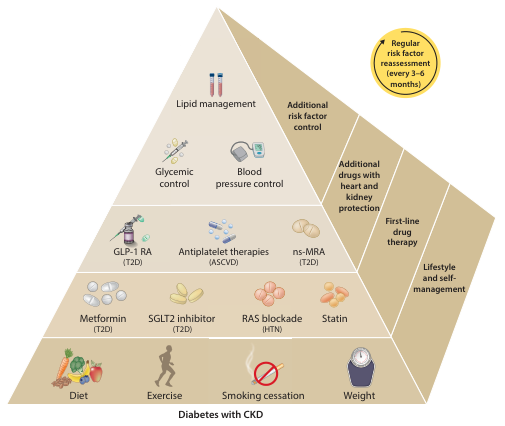
Pyramid-based stepwise treatment algorithm from lifestyle interventions to advanced pharmacological therapies, with risk factor reassessment every 3-6 months.
Key Evidence Updates (2025-2026)
A 2025 network meta-analysis (PMID 39985051) evaluated the effects of different hypoglycaemic drugs on beta-cell function in T2DM, providing comparative data on preservation of insulin secretory capacity across drug classes. This reinforces the clinical rationale for early use of agents that preserve beta-cell function rather than relying solely on HbA1c lowering. A recent systematic review (PMID 41572243) also addressed oral carbohydrate treatment for iatrogenic hypoglycaemia in T2DM, relevant to managing treatment-induced hypoglycaemia.
Sources: Symptom to Diagnosis: An Evidence-Based Guide, 4th Ed. | Lippincott Illustrated Reviews: Pharmacology | Washington Manual of Medical Therapeutics | Barash's Clinical Anesthesia, 9th Ed. | Miller's Anesthesia, 10th Ed. | Fischer's Mastery of Surgery, 8th Ed. | Comprehensive Clinical Nephrology, 7th Ed.
This is a shared conversation. Sign in to Orris to start your own chat.