
Thyroglossal cyst examination
Reading File
Now let me search the medical library and web in parallel for thyroglossal cyst examination findings.
Finding Sources
Searching the Web
thyroglossal cyst clinical examination findings signs
Now let me read the most detailed surgical and ENT textbook sections in parallel:
Reading File
Reading File
Reading File
Let me also fetch the clinical image and search for more detailed examination content (including Bailey & Love or similar surgical examination texts):
Loading Image
Finding Sources
Excellent - S Das and Bailey & Love are in the library. Let me read the detailed examination sections from both:
Reading File
Reading File
Now let me read the S Das detailed local examination section and also fetch the clinical image:
Reading File
Reading File
Now let me fetch the key clinical images and read the Scott-Brown's detailed section:
Reading File
Loading Image
Loading Image
I now have comprehensive information from multiple authoritative sources. Let me compile the full answer.
Thyroglossal Cyst - Clinical Examination
A thyroglossal duct cyst (TDC) is the most common congenital cystic neck mass and the second most common benign neck mass overall after lymphadenopathy. It arises from a persistent remnant of the thyroglossal duct, which normally regresses by the 8th-10th week of gestation as the thyroid descends from the foramen caecum at the base of the tongue to its pretracheal position.
Anatomy Relevant to Examination
The duct passes through (or around) the body of the hyoid bone, giving the cyst its characteristic movement. Most cysts (65%) sit just below the hyoid bone, 15% are at hyoid level, and 20% are above it. Lingual TDCs are rare (1-2%).
Inspection
Position:
- Midline or very close to midline (75% truly midline; rest within 2 cm of midline)
- Most often at or just below the hyoid bone
- When adjacent to the thyroid cartilage, may lie slightly to one side
Appearance:
- Smooth, rounded swelling in the anterior midline of the neck
- Skin over it is usually normal and non-adherent unless infected
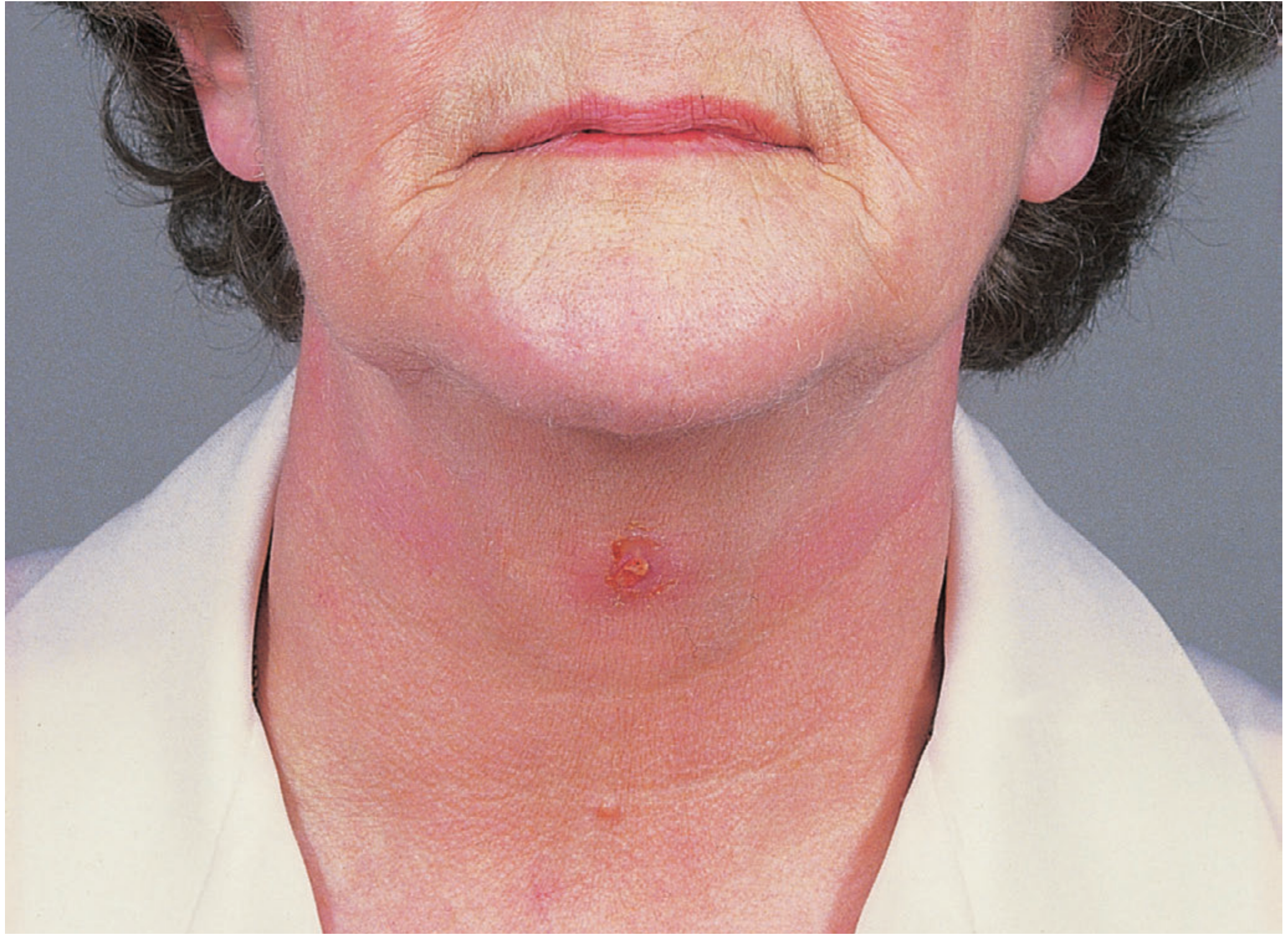
- If previously infected/ruptured: a discharging sinus or fistula may be visible at the midline below the hyoid, with the opening indrawn and overlaid by a crescentic fold of skin
Key inspection maneuvers:
- Swallowing - ask the patient to swallow (offer a glass of water); the cyst moves upward with deglutition, like a thyroid swelling - S Das, A Manual on Clinical Surgery
- Tongue protrusion (pathognomonic) - ask the patient to protrude the tongue; the cyst moves upward since the thyroglossal duct extends from the foramen caecum of the tongue down to the thyroid isthmus. This is the pathognomonic sign of a thyroglossal cyst - S Das, A Manual on Clinical Surgery
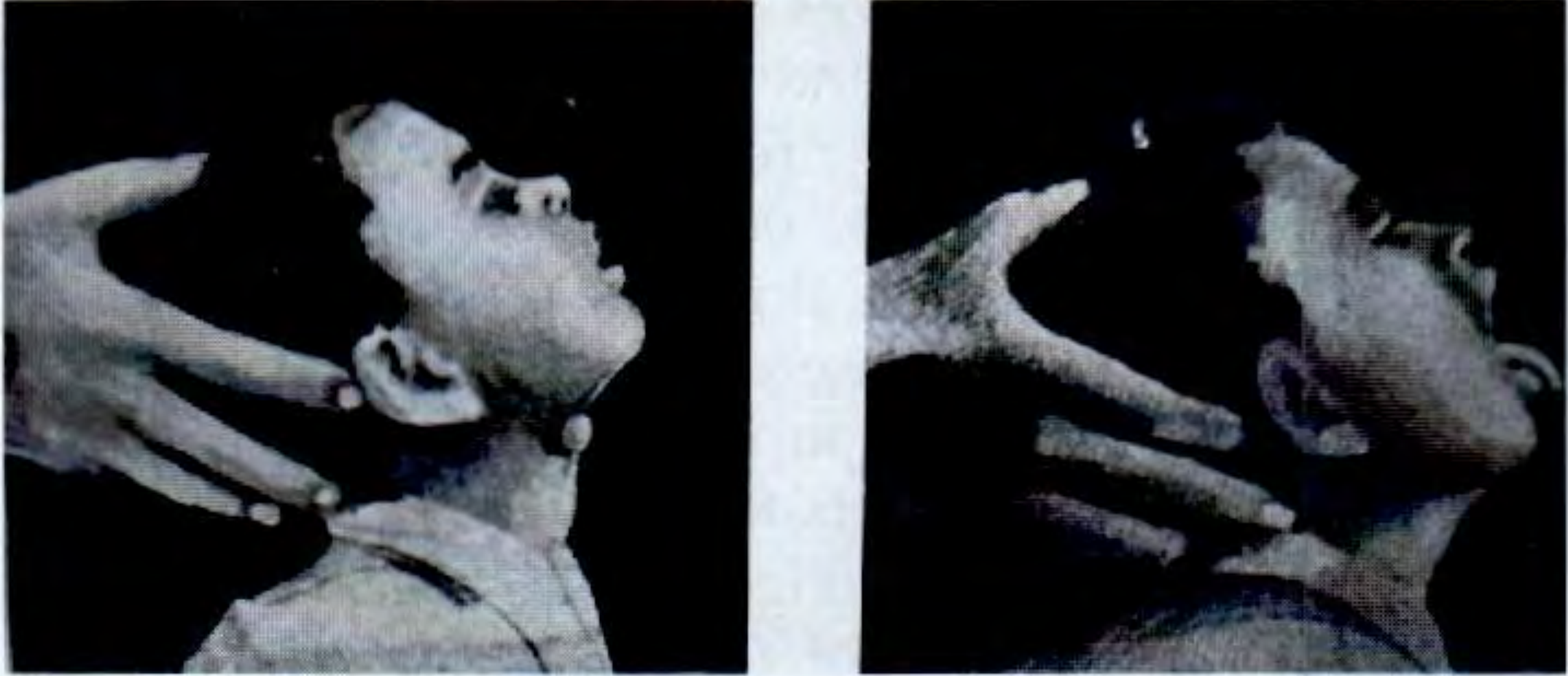
Important caveat: Bailey & Love notes that upward movement with swallowing and tongue protrusion can also occur with other midline cysts (e.g., dermoid cysts) since it merely indicates attachment to the hyoid bone. However, movement with tongue protrusion specifically is the distinguishing feature of thyroglossal cysts. - Bailey and Love's Short Practice of Surgery, 28th Ed.
Palpation
| Feature | Finding |
|---|---|
| Site | Midline, at or below hyoid bone |
| Size | Typically 2-4 cm |
| Shape | Smooth, rounded |
| Surface | Smooth |
| Consistency | Soft, cystic, fluctuant (may feel firm/tense if infected or proteinaceous) |
| Edge | Well-defined |
| Tenderness | Non-tender (tender if infected) |
| Mobility | Mobile side to side, but tethered superiorly to hyoid; moves cranio-caudally with swallowing and tongue protrusion |
| Transillumination | May transilluminate (cystic) |
| Skin attachment | Skin is free unless previously infected |
| Underlying structures | Cannot get below it; attached to hyoid |
Confirm movement on palpation:
- Place two fingers on the cyst, ask patient to protrude the tongue - feel it move upward under your fingers.
- Ask patient to swallow - feel cranial movement.
If infected: the cyst is warm, tender, red, fluctuant, and the overlying skin may be adherent. A discharging sinus or fistula (thyroglossal fistula) may be present below the hyoid, pointing medially.
Percussion
Not particularly informative for a neck cyst, but dullness is expected.
Auscultation
No bruit (helps distinguish from vascular lesions or goitre).
Summary of Key Distinguishing Signs
| Sign | Thyroglossal Cyst | Thyroid Swelling | Dermoid Cyst |
|---|---|---|---|
| Moves with swallowing | ✓ | ✓ | May do (if attached to hyoid) |
| Moves with tongue protrusion | ✓ Pathognomonic | ✗ | May do (if attached to hyoid) |
| Position | Midline, subhyoid | Anterior neck, bilateral | Midline, suprathyoid usually |
| Consistency | Cystic | Variable | Doughy/cystic |
| Transillumination | + | ± | + |
Associated Examination Findings
- Oropharynx: Inspect the base of tongue for a lingual thyroid (rare; if present, there may be no palpable thyroid in the normal neck position).
- Normal thyroid: Always palpate/confirm the presence of a normal thyroid gland in the lower neck; if no normal thyroid is felt, the cyst may represent the only thyroid tissue (ectopic/lingual thyroid). - Scott-Brown's Otorhinolaryngology, Head & Neck Surgery
- Lymph nodes: Check for cervical lymphadenopathy (if malignancy is suspected - TDC has ~1% risk of papillary thyroid carcinoma). A hard, irregular consistency or rapid enlargement should raise suspicion.
Investigations to Mention After Examination
- Ultrasound - confirms cystic mass, midline, and presence of normal thyroid inferiorly (anechoic with posterior wall enhancement on USS).
- FNAC - aspirate shows colloid-like fluid, mucus, and cholesterol crystals.
- TFTs (TSH, T4) - check thyroid status.
- Tc-99m/I-123 isotope scan - if cyst is above the hyoid or lingual thyroid is suspected.
- CT/MRI - for large cysts, suspected malignancy, or mediastinal extension.
Sources
- S Das - A Manual on Clinical Surgery, 13th Ed.
- Bailey and Love's Short Practice of Surgery, 28th Ed.
- Sabiston Textbook of Surgery, 21st Ed.
- Scott-Brown's Otorhinolaryngology Head & Neck Surgery
- Schwartz's Principles of Surgery, 11th Ed.
This is a shared conversation. Sign in to Orris to start your own chat.