
Penile block twchnique
Reading File
Finding Sources
Finding Sources
Searching the Web
penile nerve block technique dorsal penile nerve block circumcision
Reading File
Reading File
Reading File
Reading File
Reading File
Searching Images
dorsal penile nerve block anatomy technique diagram
Penile Block Technique
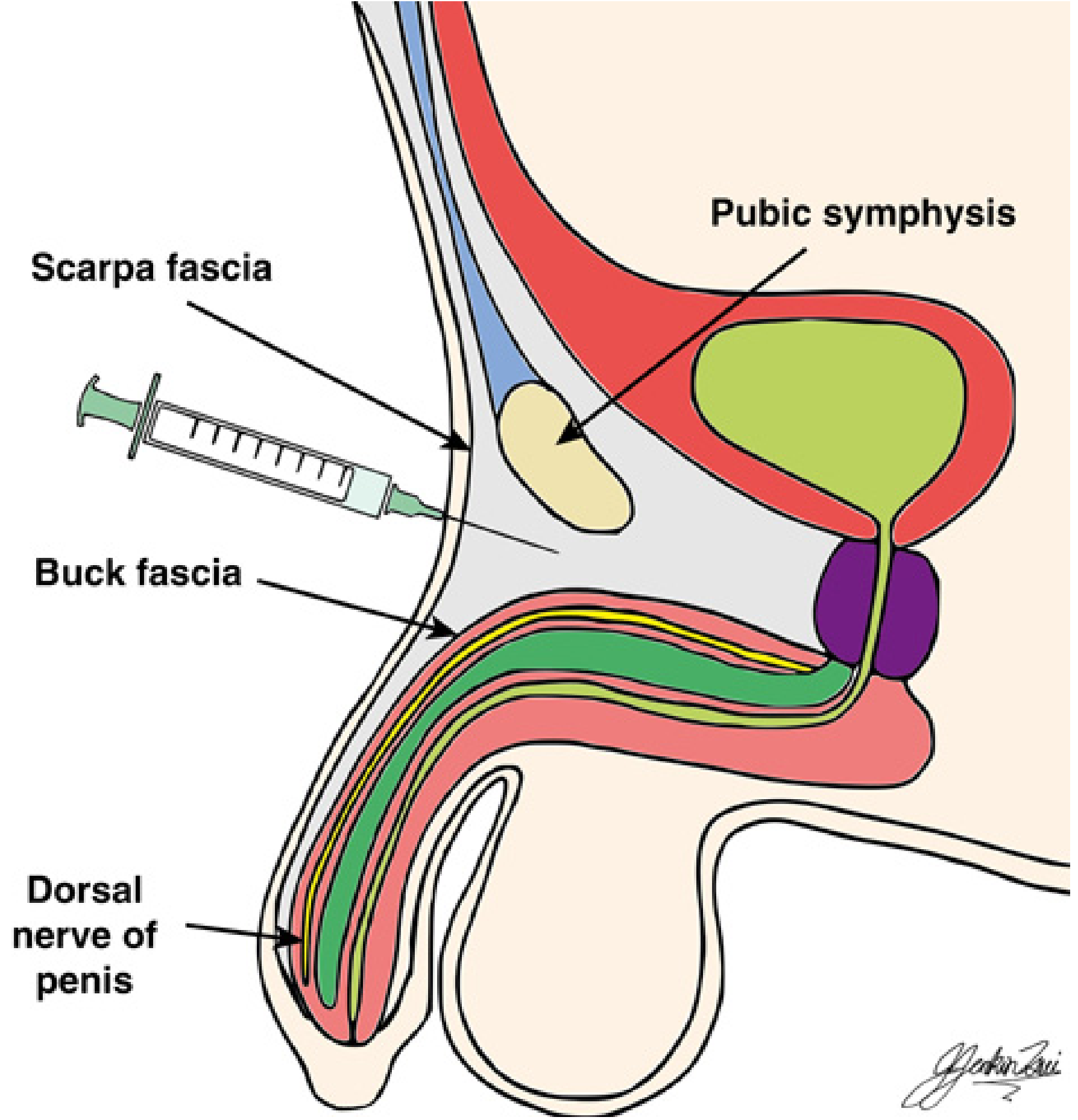
The penile block provides regional anesthesia for procedures on the penile shaft, glans, and foreskin (circumcision, dorsal slit, paraphimosis reduction, phimosis release, urethral surgery, penile laceration repair). It relies on blocking the dorsal nerves of the penis, the terminal sensory branches of the pudendal nerve (S2-S4), which run bilaterally along the dorsal aspect of the penis beneath Buck's fascia before dividing to encircle and supply the shaft and glans (Barash, Cullen, and Stoelting's Clinical Anesthesia, 9e, p. 2470; Miller's Anesthesia, 10e, p. 3639).
There are two standard approaches, often combined for complete coverage.
1. Ring Block (Circumferential Subcutaneous Block)
This is the simplest and most commonly used technique, especially for circumcision.
- Prepare the genitalia and pubic area with antiseptic and apply a fenestrated drape; patient supine.
- Using a 27-gauge, 1-inch needle and 1% lidocaine without epinephrine, raise a skin wheal (0.5-1 mL) at the dorsal junction of the penis and pubis, just over the superficial dorsal vein.
- Without withdrawing the needle, angle it to each side of the dorsal vein and inject more anesthetic.
- Advance the needle subcutaneously, circumferentially, staying just superficial to (not through) the deep fascia (Buck's fascia), injecting about 4-5 mL on each side until a complete ring surrounds the penile base. The loose penile skin allows the ventral surface to be reached from both sides without repuncturing there.
- After a few minutes, inject an additional ~1 mL into the frenulum with a fine (30-gauge) needle for full ventral coverage.
- Wait several minutes and test anesthetic depth (e.g., gently grasping the foreskin edge with a hemostat) before proceeding.
(Pfenninger and Fowler's Procedures for Primary Care, 3rd ed., pp. 830-831; Roberts and Hedges' Clinical Procedures in Emergency Medicine, Box 55.2)
In adults, 20-25 mL total of 0.75% lidocaine or 0.25% bupivacaine is typically sufficient; in infants, only 0.5-1 mL per side is used (Barash, Cullen, and Stoelting's Clinical Anesthesia, 9e, p. 2470).
2. Dorsal Penile Nerve Block (Subpubic/Base-of-Penis Block)
This targets the nerves more proximally, near the pubic bone, and is often preferred for longer or deeper procedures.
- Patient supine; prepare skin.
- Identify two injection sites at the inferior edge of the pubic bone, roughly the 10 and 2 o'clock positions relative to the penile base.
- Insert a 25- to 27-gauge needle (about 1.5 inches) perpendicular/ventrally until it contacts the pubic bone.
- "Walk" the needle caudad off the inferior pubic ramus and through Buck's fascia (a fascial "click" can often be felt as the needle passes through Scarpa's fascia into the subpubic space).
- Aspirate to rule out vascular puncture, then inject ~5 mL of local anesthetic at each site (0.1 mL/kg per side, max 5 mL, in children). A 50:50 mixture of 0.5% bupivacaine and 1-2% lidocaine (without epinephrine) gives rapid onset with a duration suited to circumcision.
- Gentle traction on the penis helps tension the fascia and improves the sense of the fascial click; ultrasound guidance can confirm correct needle placement across Scarpa's fascia and has been shown to improve block efficacy and reduce early postoperative pain compared with the blind fascial-click technique, though it adds procedure time.
(Pfenninger and Fowler's Procedures for Primary Care, 3rd ed., p. 5170; Miller's Anesthesia, 10e, pp. 3639-3641)
Key Safety Points
- Never use epinephrine - the penis is supplied by end arteries, and vasoconstriction risks ischemia and necrosis of the glans/shaft.
- Avoid a median (midline) puncture, which risks lacerating the dorsal artery or injecting directly into the corpus cavernosum (equivalent to intravascular injection).
- Contraindications include local skin infection at the puncture site.
- Reported morbidity is very low when a plain (epinephrine-free) local anesthetic is used correctly; complications are more often described with infiltration deep to Buck's fascia at the dorsal aspect rather than the safer subpubic/Scarpa's fascia plane.
- In children, dorsal penile block or ring block provides better analgesia than topical EMLA cream or sucrose, and caudal block is associated with a higher fistula rate than penile block in some series (19.2% vs 0%) (Textbook of Family Medicine, 9e; Campbell-Walsh-Wein Urology, 3-vol set).
Recent evidence check
I ran a quick check for recent systematic reviews/meta-analyses on penile nerve block; results were mainly technique-comparison studies (e.g., ultrasound-guided reverse approach vs landmark dorsal penile nerve block) rather than large meta-analyses overturning the above practice, consistent with the textbook guidance above. If you want, I can pull the specific 2024 comparative study on ultrasound-guided technique for more detail.
This is a shared conversation. Sign in to Orris to start your own chat.