
Short note on immunity 6 marks question
I'll read the medical library skill first, then search for immunity content.
Reading File
Now let me search for immunity content in the medical library.
Finding Sources
Finding Sources
Good sources found. Let me read the most relevant sections from Robbins Pathology and Cellular & Molecular Immunology simultaneously.
Reading File
Reading File
Excellent content retrieved. Let me also get a bit more on adaptive immunity components (humoral and cell-mediated) and fetch the key diagram.
Reading File
Loading Image
I now have comprehensive, authoritative content to write a well-structured 6-mark short note on immunity. Here it is:
Immunity - Short Note (6 Marks)
Definition
Immunity is the ability of the body to resist and defend against infectious microorganisms and their products. It is mediated by two broad, interconnected systems: innate immunity and adaptive immunity, which act sequentially to protect the host.
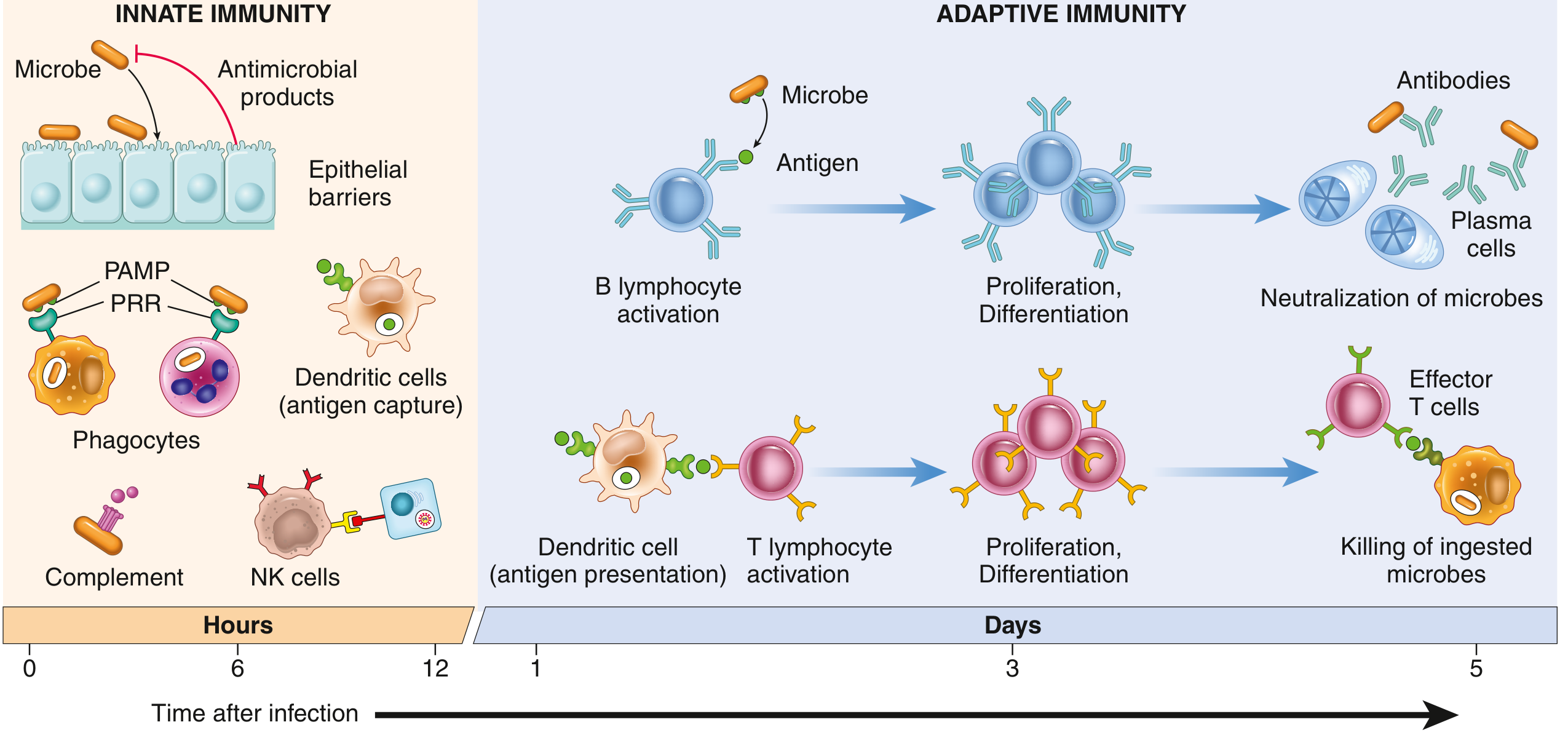
1. Innate Immunity (Natural/Native Immunity)
Innate immunity is the first line of defense - it is always present (pre-formed) and acts within hours of infection without requiring prior exposure to the pathogen.
Components:
- Physical/epithelial barriers - skin and mucosal surfaces, with antimicrobial molecules
- Phagocytic cells - neutrophils and macrophages that engulf and destroy pathogens
- Dendritic cells - capture antigens and bridge innate to adaptive immunity
- Natural Killer (NK) cells - kill virus-infected and tumor cells
- Complement system - plasma proteins that lyse microbes and opsonize them
- Pattern Recognition Receptors (PRRs) - e.g., Toll-like receptors (TLRs) that detect PAMPs (pathogen-associated molecular patterns) and DAMPs (damage-associated molecular patterns)
Characteristics: No memory, broad specificity, encoded by germline genes, limited diversity.
2. Adaptive Immunity (Acquired/Specific Immunity)
Adaptive immunity develops in response to infection and takes 3-7 days to become fully active. It is antigen-specific and has immunological memory.
Two arms:
a) Humoral Immunity (B cell-mediated)
- B lymphocytes recognize antigens and differentiate into plasma cells
- Plasma cells secrete antibodies (immunoglobulins)
- Antibodies neutralize toxins, opsonize bacteria, and activate complement
- Provides protection against extracellular pathogens
b) Cell-Mediated Immunity (T cell-mediated)
- CD4+ helper T cells recognize antigens presented on MHC Class II molecules (on APCs/macrophages); they activate B cells and macrophages via cytokines
- CD8+ cytotoxic T cells recognize antigens on MHC Class I molecules (on all nucleated cells); they directly kill infected or tumor cells
- Important against intracellular pathogens (viruses, mycobacteria)
Characteristics: Antigen-specific, high diversity (somatic recombination), immunological memory, self-tolerance.
Key Comparison Table
| Feature | Innate | Adaptive |
|---|---|---|
| Specificity | Broad (PAMPs) | Antigen-specific |
| Onset | Hours (immediate) | Days (3-7 days) |
| Memory | None | Yes |
| Diversity | Low (germline genes) | Very high (somatic recombination) |
| Cells | Phagocytes, NK, DCs | T & B lymphocytes |
| Secreted proteins | Complement, cytokines | Antibodies |
Interaction Between Innate and Adaptive Immunity
The two systems are not independent. Innate immune responses provide "danger signals" (via cytokines and costimulators) that activate adaptive immune responses. Conversely, adaptive responses enhance innate mechanisms - for example, antibodies opsonize microbes for phagocytosis. This interplay ensures rapid and effective host defense.
Immunological Memory
A hallmark of adaptive immunity. After initial exposure (primary response), memory B and T cells persist. On re-exposure, a faster, stronger secondary response occurs - the basis of vaccination.
Sources: Robbins & Kumar Basic Pathology, p. 156-159; Cellular and Molecular Immunology (Abbas et al.), p. 30-31
This is a shared conversation. Sign in to Orris to start your own chat.