
Biochemistry about glyconeogenesis
I'll start by reading the medical library skill, then search for gluconeogenesis content in parallel.
Reading File
Now let me search the library and web in parallel for gluconeogenesis content.
Finding Sources
Searching the Web
gluconeogenesis biochemistry pathway enzymes regulation
Excellent results. Now let me read the key biochemistry textbook sections in parallel.
Reading File
Reading File
Finding Sources
Excellent content. Let me now read the deeper sections on unique enzymes, regulation, and substrates from both books in parallel.
Reading File
Reading File
Very rich content. Let me grab the regulation section and the Guyton & Hall physiology content in parallel, plus the key diagrams.
Reading File
Reading File
Loading Image
I now have comprehensive content from multiple authoritative textbooks. Let me compile a thorough, well-structured answer.
Gluconeogenesis - Biochemistry
(Note: You wrote "glyconeogenesis" - this is the standard pathway known as gluconeogenesis. Covered below in full.)
Overview
Gluconeogenesis is the metabolic pathway by which glucose is synthesized de novo from non-carbohydrate precursors. It is not simply a reversal of glycolysis - it is a distinct pathway that shares 7 reversible glycolytic reactions but uses 4 unique reactions to bypass the 3 irreversible steps of glycolysis.
Primary site: Liver (accounts for ~90% of gluconeogenesis after an overnight fast)
Secondary site: Kidney cortex (~10% normally; rises to ~40% during prolonged fasting >48 hours)
Minor sites: Small intestine
"Deficiencies of gluconeogenic enzymes cause hypoglycemia." - Biochemistry, 8th ed. Lippincott Illustrated Reviews, p. 353
Why It Matters
Several tissues cannot synthesize glucose but depend on it as a primary or sole fuel:
- Brain
- Erythrocytes (RBCs) - lack mitochondria
- Kidney medulla
- Lens and cornea of the eye
- Testes
- Exercising skeletal muscle
After an overnight fast, liver glycogen is depleted within <24 hours, after which gluconeogenesis becomes essential for survival.
Substrates (Gluconeogenic Precursors)
The three major precursors are:
1. Lactate
- Produced by anaerobic glycolysis in exercising muscle and RBCs
- Taken up by the liver and oxidized to pyruvate by lactate dehydrogenase
- Enters gluconeogenesis via the Cori Cycle: muscle glycolysis → lactate → bloodstream → liver gluconeogenesis → glucose → back to muscle
2. Glycerol
- Released from hydrolysis of triacylglycerols (TAGs) in adipose tissue during fasting
- Phosphorylated by glycerol kinase → glycerol-3-phosphate
- Oxidized by glycerol-3-phosphate dehydrogenase → DHAP (dihydroxyacetone phosphate), a direct glycolytic/gluconeogenic intermediate
3. Glucogenic Amino Acids
- The major source of glucose during prolonged fasting (from protein breakdown in muscle)
- All amino acids except leucine and lysine are glucogenic
- Deaminated to α-keto acids (e.g., pyruvate, oxaloacetate, α-ketoglutarate) → enter the TCA cycle → feed into gluconeogenesis
- Alanine is a major carrier: muscle pyruvate + glutamate → alanine (via transamination) → liver → reconverted to pyruvate (glucose-alanine cycle)
Important: Acetyl CoA and compounds yielding only acetyl CoA (leucine, lysine, ketone bodies) cannot produce net glucose synthesis, because pyruvate dehydrogenase is irreversible.
The Pathway: 4 Unique Reactions Bypassing Glycolysis
The diagram below (from Basic Medical Biochemistry, 6e) shows the full pathway:
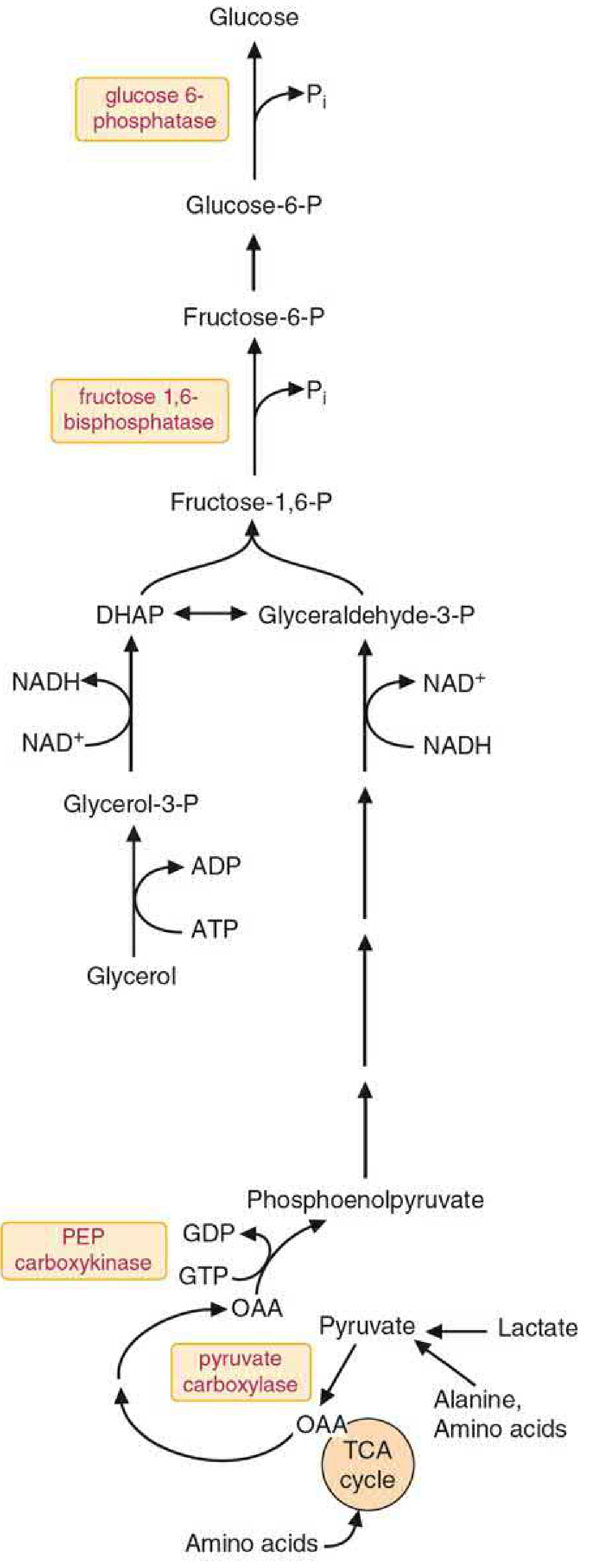
Bypass 1: Pyruvate → Phosphoenolpyruvate (PEP)
This bypasses the irreversible pyruvate kinase reaction (PEP → pyruvate in glycolysis).
It requires two enzymes acting sequentially:
Step 1a - Pyruvate Carboxylase (PC):
- Location: Mitochondrial matrix
- Reaction: Pyruvate + CO₂ + ATP → Oxaloacetate (OAA) + ADP + Pᵢ
- Cofactor: Biotin (covalently bound to ε-amino group of lysine)
- Activated allosterically by acetyl CoA (signals excess fat oxidation → need for gluconeogenesis)
- OAA also serves an anaplerotic function (replenishes TCA cycle intermediates)
Step 1b - PEPCK (Phosphoenolpyruvate Carboxykinase):
- Reaction: OAA + GTP → PEP + CO₂ + GDP
- Location: Both cytosolic and mitochondrial isozymes exist
- OAA must be transported to cytosol (as malate or aspartate) since the inner mitochondrial membrane is impermeable to OAA. This transport also shuttles NADH reducing equivalents from mitochondria to cytosol for later steps.
Bypass 2: Fructose-1,6-bisphosphate → Fructose-6-phosphate
This bypasses the irreversible phosphofructokinase-1 (PFK-1) reaction.
Enzyme: Fructose-1,6-bisphosphatase (FBPase-1)
- Location: Cytosol (liver and kidney)
- Reaction: Fructose-1,6-bisphosphate + H₂O → Fructose-6-phosphate + Pᵢ
- Inhibited allosterically by: AMP, fructose-2,6-bisphosphate
- Activated allosterically by: citrate
Bypass 3: Glucose-6-phosphate → Glucose
This bypasses the irreversible hexokinase/glucokinase reaction.
Enzyme: Glucose-6-phosphatase
- Location: ER membrane of liver and kidney (NOT present in muscle or brain - these tissues cannot release free glucose)
- Reaction: Glucose-6-phosphate + H₂O → Glucose + Pᵢ
- The free glucose is then released into the bloodstream
Energy Cost of Gluconeogenesis
Synthesizing 1 molecule of glucose from 2 pyruvates costs:
| Cofactor | Amount |
|---|---|
| ATP | 4 |
| GTP | 2 |
| NADH | 2 |
| Total ATP equivalents | 6 |
This is energetically expensive - hence gluconeogenesis only runs when energy (from fat oxidation) is available.
"The ATP and NADH coenzymes required for gluconeogenesis are primarily provided by fatty acid oxidation." - Biochemistry, 8th ed. Lippincott, p. 366
Regulation
Gluconeogenesis and glycolysis are reciprocally regulated to prevent futile cycling.
Allosteric Regulation
| Effector | Effect on Gluconeogenesis |
|---|---|
| Acetyl CoA | Activates pyruvate carboxylase (PC) ↑ |
| AMP | Inhibits FBPase-1 (gluconeogenesis ↓); activates PFK-1 (glycolysis ↑) |
| Fructose-2,6-bisphosphate | Inhibits FBPase-1 ↓; activates PFK-1 ↑ |
| ATP | Inhibits PFK-1 → shifts toward gluconeogenesis |
| Citrate | Activates FBPase-1 ↑ |
Key logic: When energy is LOW (high AMP), gluconeogenesis is suppressed and glycolysis is activated. When energy is HIGH (high ATP, acetyl CoA from fat oxidation), gluconeogenesis is favored.
Hormonal Regulation
Glucagon (fasting state):
- Lowers hepatic fructose-2,6-bisphosphate → activates FBPase-1 and inhibits PFK-1
- Via cAMP/PKA: phosphorylates and inactivates pyruvate kinase → diverts PEP toward glucose synthesis
- Increases transcription of PEPCK gene via CREB transcription factor
Insulin (fed state):
- Decreases PEPCK gene expression
- Raises fructose-2,6-bisphosphate → promotes glycolysis, inhibits gluconeogenesis
Cortisol (stress/fasting):
-
Mobilizes amino acids from muscle protein → provides gluconeogenic substrates
-
Increases expression of gluconeogenic enzyme genes (including PEPCK)
-
This is stimulated by ACTH from the adenohypophysis when glucose is scarce
-
Guyton and Hall Textbook of Medical Physiology, p. 840
The Cori Cycle
A key inter-organ metabolic loop:
Muscle:  Glucose → Lactate (anaerobic glycolysis)
              ↓ (via blood)
Liver:   Lactate → Pyruvate → Glucose (gluconeogenesis)
              ↓ (via blood)
Back to Muscle
This cycle transfers the metabolic burden of lactate disposal from muscle to liver, at the cost of 6 ATP (net) per glucose cycle.
Disorders of Gluconeogenesis
Enzyme deficiencies cause hypoglycemia, especially during fasting:
| Deficiency | Consequence |
|---|---|
| Fructose-1,6-bisphosphatase | Fasting hypoglycemia, lactic acidosis |
| PEPCK | Hepatomegaly, hypoglycemia (diagnosed by enzyme activity in fibroblasts or liver biopsy) |
| Pyruvate carboxylase | Hypoglycemia, lactic acidosis, hyperammonemia |
| Glucose-6-phosphatase (Von Gierke disease) | Severe fasting hypoglycemia, hepatomegaly |
- Henry's Clinical Diagnosis and Management by Laboratory Methods, p. 1240
Quick Summary Table
| Feature | Detail |
|---|---|
| Main site | Liver (90%) |
| Activated by | Glucagon, cortisol, fasting, acetyl CoA |
| Inhibited by | Insulin, AMP, fructose-2,6-bisphosphate |
| Key substrates | Lactate, glycerol, glucogenic amino acids |
| Unique enzymes | PC, PEPCK, FBPase-1, Glucose-6-phosphatase |
| Energy cost | 6 ATP equivalents per glucose |
| Cannot use | Leucine, lysine, acetyl CoA (ketogenic only) |
Sources:
- Biochemistry, 8th ed. Lippincott Illustrated Reviews, Ch. 10, pp. 353-366
- Basic Medical Biochemistry - A Clinical Approach, 6e, Ch. 28, pp. 1007-1020
- Guyton and Hall Textbook of Medical Physiology, Ch. (Carbohydrate Metabolism), p. 840
- Henry's Clinical Diagnosis and Management by Laboratory Methods, p. 1240
This is a shared conversation. Sign in to Orris to start your own chat.