
Send some pictures for presentation
~/
python -c "from pypdf import PdfReader; p='/tmp/workspace/attachments/5aed2681-3bb1-41bc-901b-77d6e9e04cec/response.pdf'; r=PdfReader(p); print('PAGES',len(r.pages)); [print('\\n---PAGE',i+1,'---\\n', (x.extract_text() or '')[:5000]) for i,x in enumerate(r.pages)]"
thyroglossal duct cyst anatomical diagram hyoid bone tract foramen cecum Sistrunk procedure
Sistrunk procedure surgical illustration central hyoid bone excision thyroglossal duct cyst
thyroglossal duct cyst Sistrunk procedure anatomy diagram hyoid bone image
"thyroglossal duct cyst" AND surgery


I have offline presentation, what are the questions may ask by professor
python -c "from pypdf import PdfReader; p='/tmp/workspace/attachments/5aed2681-3bb1-41bc-901b-77d6e9e04cec/Teal and Ivory Modern Thyroid Health Presentation.pdf'; r=PdfReader(p); print('PAGES',len(r.pages)); [print('\\n---PAGE',i+1,'---\\n', (x.extract_text() or '')[:7000]) for i,x in enumerate(r.pages)]"
"thyroglossal duct cyst" AND surgery
thyroglossal duct cyst Sistrunk procedure diagnosis management guideline
Most likely questions
-
What is your diagnosis?
Thyroglossal duct cyst (TGDC), a congenital midline neck cyst caused by persistence of the thyroglossal duct. -
Why is TGDC your diagnosis in this child?
It is a painless, slowly growing, midline neck mass in a 6-year-old that moves with both swallowing and tongue protrusion. Movement with tongue protrusion is the characteristic clue. -
Why does the mass move on tongue protrusion?
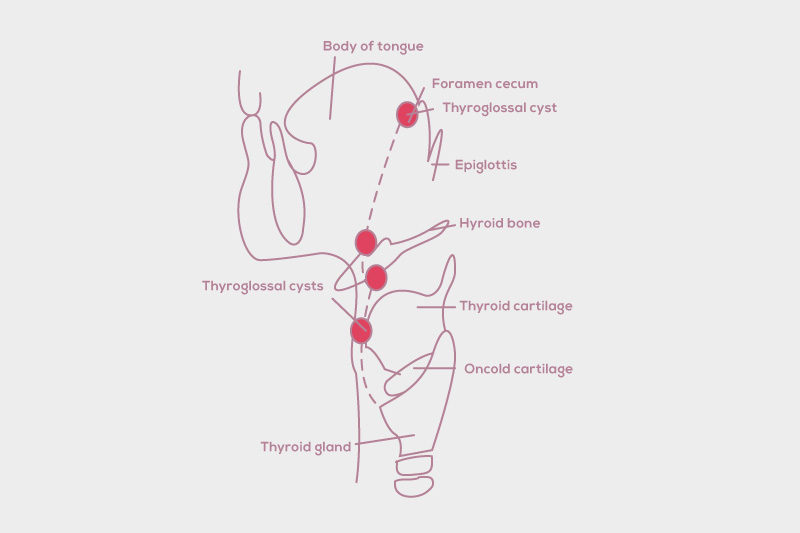
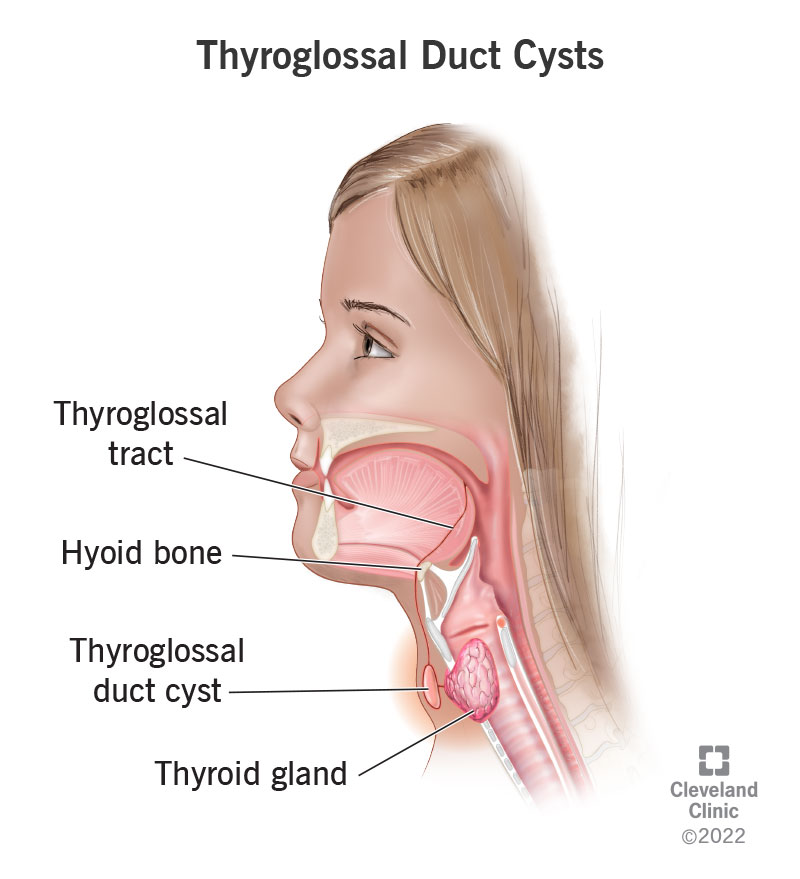
A persistent tract remains connected superiorly to the foramen cecum at the tongue base. When the tongue protrudes, genioglossus contraction pulls this tract and the cyst upward. -
Why does it move with swallowing?
During swallowing, the hyoid bone and laryngeal framework elevate. Since the cyst is closely related to the hyoid and pretracheal fascial structures, it moves upward too. -
What is the embryological origin of TGDC?
The thyroid primordium starts at the foramen cecum in the fourth week of gestation and descends to the pretracheal neck through the thyroglossal duct. Failure of duct involution leaves epithelial remnants that can form a cyst. -
What is the foramen cecum?
It is the embryological origin of the thyroid at the base of the tongue, at the apex of the sulcus terminalis. -
Where is the usual site of a TGDC?
Usually in the midline near or just below the hyoid bone, commonly between the hyoid bone and thyroid cartilage. -
What are the differential diagnoses of a midline neck mass in a child?
- Dermoid or epidermoid cyst
- Ectopic thyroid tissue
- Thyroid nodule or goiter
- Reactive lymph node
- Laryngocele, although it is less likely in this case
- Cystic hygroma, usually lateral and transilluminant
-
How do you differentiate a dermoid cyst from TGDC?
A dermoid cyst is often submental, does not typically move with tongue protrusion, and may feel doughy. TGDC is more closely related to the hyoid and characteristically rises with tongue protrusion. -
How do you differentiate ectopic thyroid from TGDC?
Ectopic thyroid may be the only functioning thyroid tissue. Ultrasound should confirm a normal thyroid in its usual pretracheal location. If it is absent, thyroid scintigraphy may be needed. -
What is the first-line investigation?
Neck ultrasonography. It confirms whether the lesion is cystic and checks for a normally located thyroid gland. -
Why must you confirm a normal thyroid gland before surgery?
Because the neck mass may be ectopic thyroid tissue, sometimes the patient’s only functioning thyroid. Removing it could cause permanent hypothyroidism. -
Are thyroid function tests always required?
They are not always necessary in a typical case with a normal thyroid on ultrasound and no symptoms of thyroid dysfunction. They are useful if ectopic thyroid or thyroid dysfunction is suspected. -
When is a thyroid scan indicated?
When ultrasound cannot identify a normal thyroid gland, or when ectopic thyroid tissue is suspected. -
Is FNAC routinely required?
No. It is not routine in a typical pediatric TGDC. Consider it if the diagnosis is uncertain or if there are suspicious features such as a solid component, calcifications, fixation, rapid growth, or lymphadenopathy. -
What is the definitive treatment?
The Sistrunk procedure. -
What does the Sistrunk procedure involve?
En bloc removal of:
- The cyst
- The persistent thyroglossal tract
- The central part of the hyoid bone
- A core of suprahyoid tissue toward the tongue base and foramen cecum
-
Why is the central part of the hyoid bone removed?
The thyroglossal tract is intimately related to the hyoid bone and may pass anterior, posterior, or through it. Removing the central hyoid reduces the risk of residual tract and recurrence. -
Why is simple cyst excision not preferred?
It leaves behind tract remnants and therefore has a much higher recurrence risk than a Sistrunk procedure. -
What structures are encountered during surgery?
- Skin and subcutaneous tissue
- Platysma
- Anterior jugular veins
- Deep cervical fascia
- Strap muscles, particularly sternohyoid and sternothyroid
- Hyoid bone
- Thyrohyoid membrane
- Suprahyoid tract toward the tongue base
-
Which important nerves can be injured?
The hypoglossal nerve can be at risk during excessive lateral or superior dissection near the hyoid. The internal branch of the superior laryngeal nerve may be relevant during deep dissection around the thyrohyoid membrane. -
What are the complications of surgery?
- Recurrence
- Wound infection
- Hematoma or seroma
- Scar
- Rare nerve injury
- Rare airway or pharyngeal entry
- Hypothyroidism only if ectopic or sole thyroid tissue was removed
-
What are complications of an untreated TGDC?
Recurrent infection, abscess, rupture with sinus or fistula formation, cosmetic enlargement, and very rarely carcinoma. -
Can TGDC become malignant?
Yes, but it is rare. Papillary thyroid carcinoma is the most common malignancy arising in a TGDC. Suspicious clues include rapid enlargement, a hard or fixed mass, cervical lymph nodes, or solid/calcified elements on imaging. -
Why should surgery not be done during acute infection?
Inflammation obscures tissue planes and increases wound complications and recurrence. Treat the infection first with appropriate antibiotics, then perform elective surgery after inflammation settles. -
Does this child need special preoperative preparation?
Yes. The child has bronchial asthma, so asthma control and anesthetic assessment are important before general anesthesia. -
What would make you suspect an infected TGDC?
Pain, tenderness, erythema, warmth, fever, sudden enlargement, purulent discharge, or a draining sinus. -
Why is there no cervical lymphadenopathy in this case?
This supports an uncomplicated benign congenital lesion. Lymphadenopathy would raise concern for infection or, rarely, malignancy. -
What does histopathology show in TGDC?
A cyst may be lined by squamous, respiratory-type, or cuboidal epithelium. Thyroid follicles can be present in the cyst wall, often with chronic inflammatory changes. -
What is the prognosis after a Sistrunk procedure?
Usually excellent. Follow-up is needed to detect recurrence, infection, scar concerns, and uncommon pathology findings.
Professor may challenge these points in your slides
1. “Ultrasound is the gold standard”
It confirms a cystic lesion and verifies the presence of a normal thyroid gland. A 2025 systematic review also found ultrasound to be the most commonly used preoperative investigation (recent review).
2. “TFTs are routinely needed”
3. “TGDC is firm”
4. “Hypothyroidism is a usual postoperative complication”
5. “The duct always passes anterior to the hyoid”
One strong final-summary answer
“This patient most likely has a thyroglossal duct cyst because he has a painless, slowly enlarging midline neck mass that moves with swallowing and tongue protrusion. Ultrasound should confirm a cystic lesion and demonstrate a normally located thyroid gland. Definitive treatment is the Sistrunk procedure, which removes the cyst, the central hyoid bone, and the tract toward the foramen cecum to reduce recurrence.”