
Physiology of olfaction. Ms ent University exam pattern for 20 marks.
Reading File
Finding Sources
Finding Sources
Finding Sources
Finding Sources
Reading File
Reading File
Reading File
Reading File
Loading Image
Reading File
Reading File
Loading Image
Loading Image
Loading Image
I now have all the material needed for a comprehensive 20-mark MS ENT exam answer. Here is the full structured answer:
Physiology of Olfaction
MS ENT University Exam - 20 Marks
1. Introduction (2 marks)
Olfaction (smell) is one of the two chemical senses, the other being gustation (taste). Odorant molecules dissolved in nasal mucus bind to chemoreceptors in the olfactory epithelium, triggering a cascade that ultimately generates action potentials transmitted to the cerebral cortex. The flavor of food is a combination of taste and smell - this is why food tastes different during nasal congestion.
Clinical relevance: Olfactory dysfunction is often one of the earliest symptoms of Alzheimer disease. Anosmia (absence of smell), hyposmia (decreased smell), and dysosmia (distorted smell) result from varied causes - viral infections, head trauma, cribriform plate fractures, anterior fossa tumors, and toxic chemical exposure.
2. Olfactory Epithelium (4 marks)
The olfactory epithelium is a yellowish-pigmented specialized mucosa covering approximately 10 cm² in the roof of each nasal cavity near the septum. It is the site in the body where the nervous system is closest to the external environment.
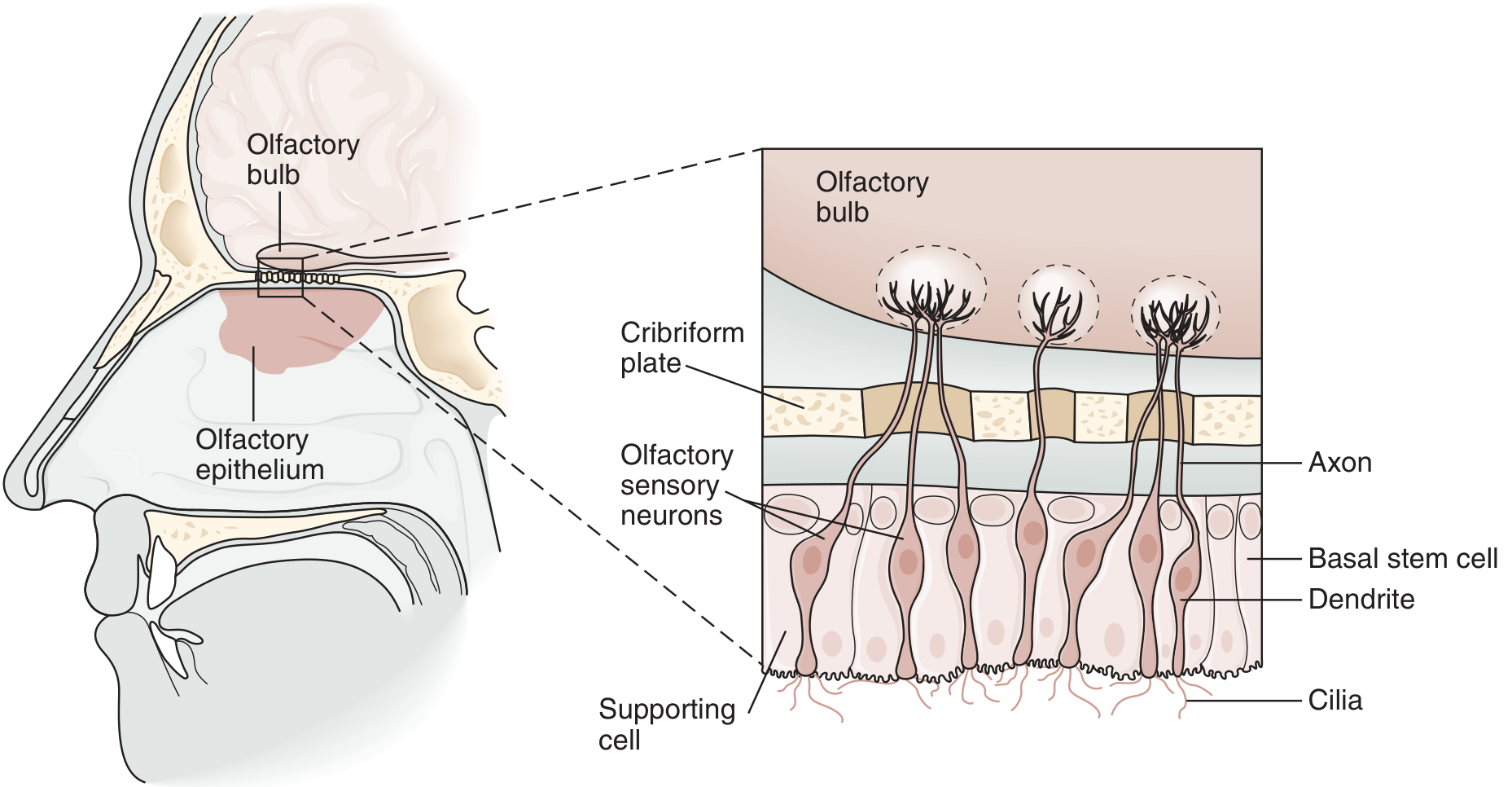
Fig. Structure of the olfactory epithelium (Ganong's Review of Medical Physiology)
Three Cell Types:
| Cell Type | Structure | Function |
|---|---|---|
| Olfactory Receptor (Sensory) Cells | Bipolar neurons with a short dendrite ending in a knob bearing 6-12 cilia | Odorant binding, detection, and transduction; also the primary afferent neuron |
| Supporting (Sustentacular) Cells | Columnar epithelial cells with apical microvilli and secretory granules | Secrete mucus providing optimal ionic/molecular environment for odor detection; odorant-binding proteins facilitate diffusion of odorants to receptors |
| Basal Stem Cells | Located at the base of the epithelium; undifferentiated | Mitotic stem cells - continuously replace olfactory receptor neurons (which survive only 1-2 months); this is the basis of neurogenesis in adults |
Key anatomical point: Odorants reach the epithelium via turbinate-induced turbulent airflow that directs air toward the roof of the nasal cavity. Olfactory receptor cell axons are unmyelinated - the smallest and slowest fibers in the nervous system.
3. Olfactory Receptors (3 marks)
- Humans possess approximately ~400 functional odorant receptor genes (out of ~1000 total olfactory genes in the genome, accounting for 3% of the human genome)
- All odorant receptors are G protein-coupled receptors (GPCRs) with diverse amino acid sequences
- Each olfactory receptor cell expresses only ONE type of odorant receptor gene
- One receptor can respond to multiple odorants (not dedicated to a single odorant)
- Each odorant can bind to multiple receptor types with varying affinities
This combinatorial arrangement allows discrimination of perhaps more than 1 million distinct odors.
4. Signal Transduction (4 marks)
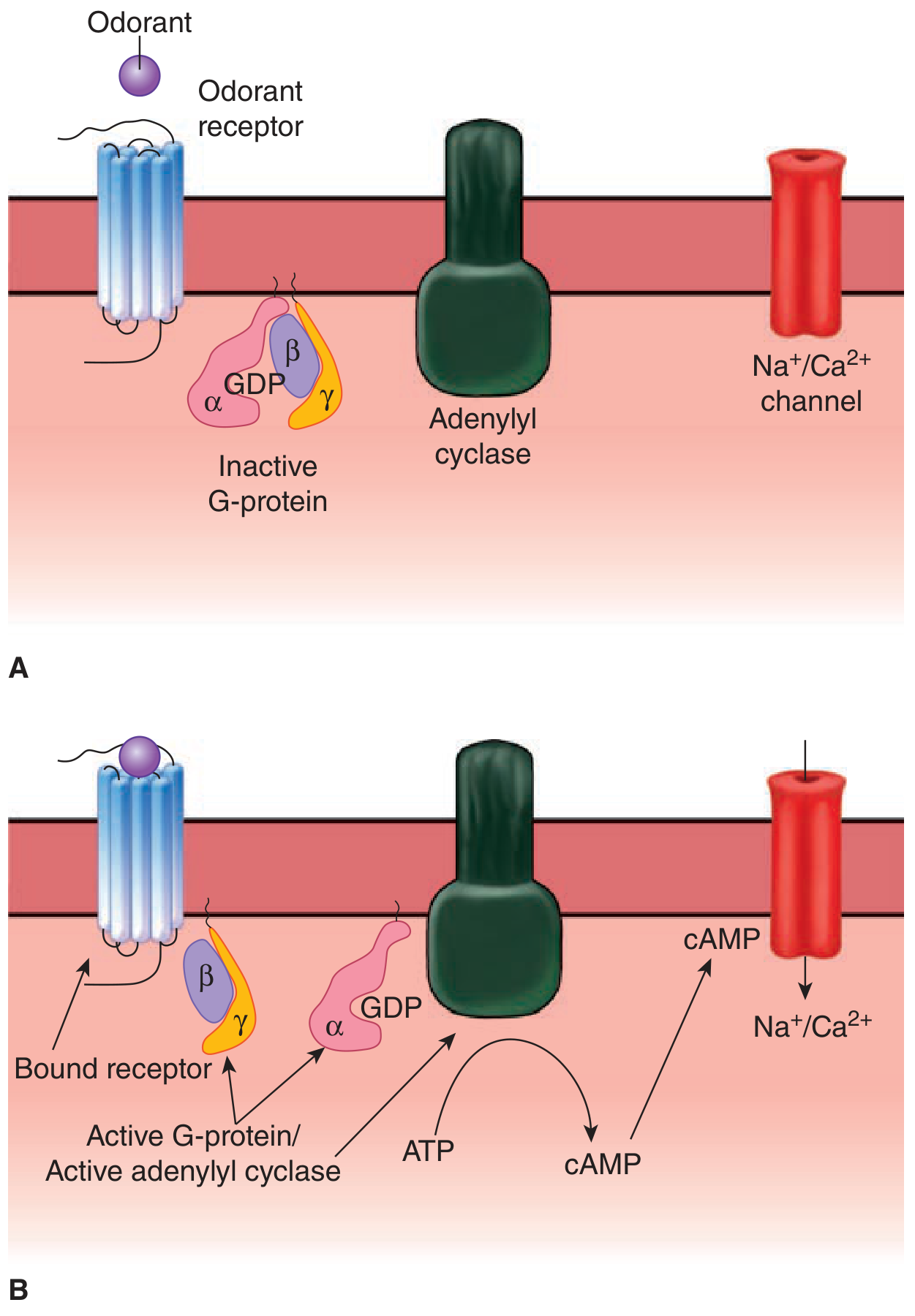
Fig. Signal transduction in an odorant receptor - G-protein-coupled mechanism (Ganong's)
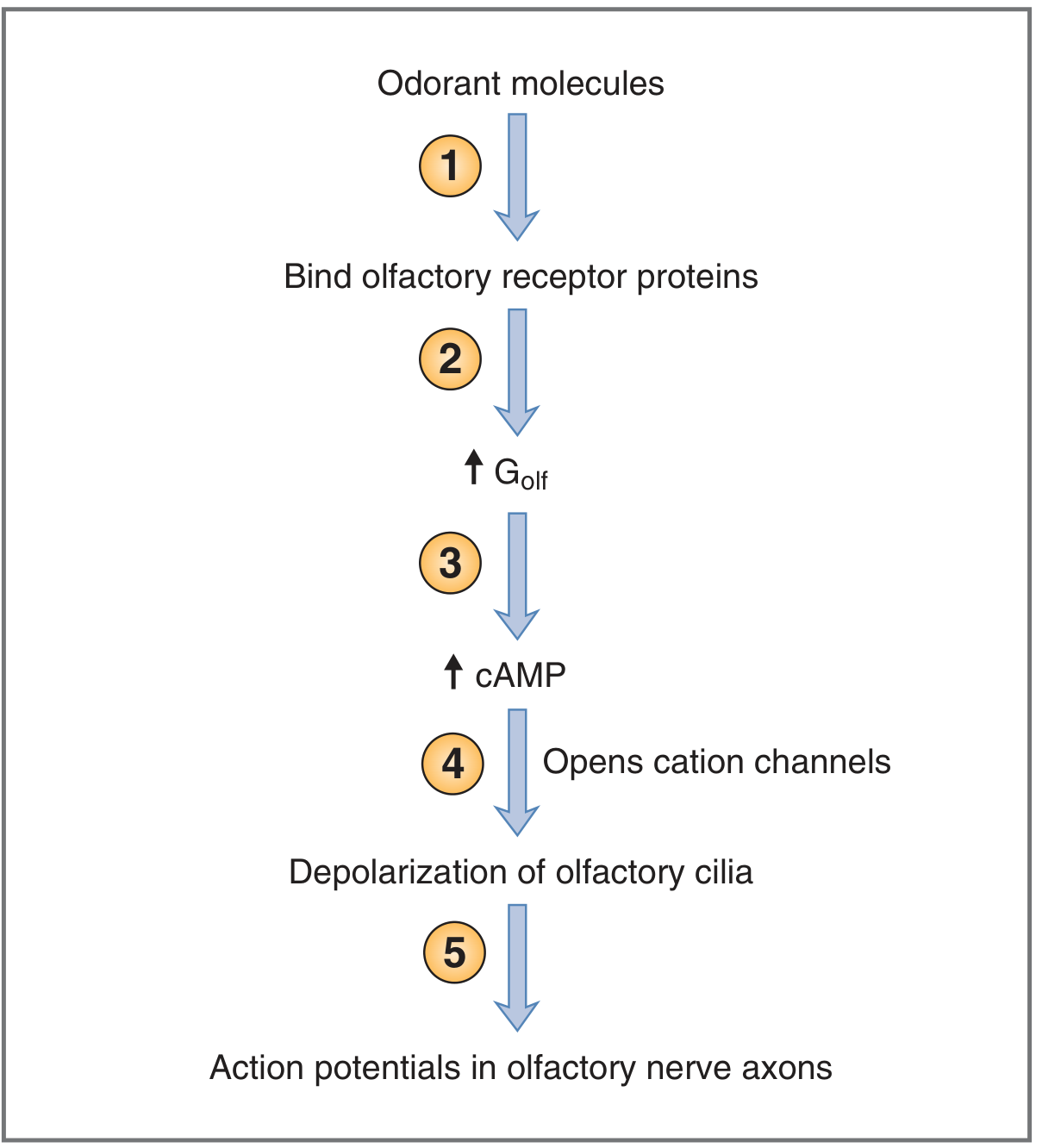
Fig. Steps in olfactory transduction (Costanzo Physiology)
Steps (numbered for exam clarity):
- Odorant dissolves in nasal mucus and binds to specific olfactory receptor proteins on cilia of olfactory receptor cells
- G protein (G-olf) activation: Odorant-receptor binding causes the heterotrimeric G-protein subunits (α, β, γ) to dissociate; the α-subunit (G-olf) is released
- Adenylyl cyclase activation: G-olf α-subunit activates adenylyl cyclase → catalyzes ATP → cAMP → intracellular cAMP increases
- Cation channel opening: cAMP acts as second messenger to open cyclic nucleotide-gated (CNG) cation channels permeable to Na⁺, K⁺, and Ca²⁺
- Amplification via Cl⁻ channels: Influx of Ca²⁺ opens Ca²⁺-activated Cl⁻ channels → Cl⁻ flows outward (because olfactory neurons have unusually high intracellular Cl⁻) → further depolarization (this amplifies the signal)
- Receptor potential: Net inward cation current produces a graded depolarizing receptor potential
- Action potential generation: If receptor potential exceeds threshold, action potentials fire in the olfactory nerve (Cranial Nerve I) axon and propagate toward the olfactory bulb
5. Encoding of Olfactory Stimuli (2 marks)
Olfactory discrimination uses an across-fiber pattern code:
- Each odorant produces a unique spatial pattern of activity across a population of receptors
- This pattern is projected onto specific glomeruli in the olfactory bulb, forming an "odor map"
- The CNS decodes these odor maps to identify specific smells
- Receptors are not dedicated to single odorants but show differential selectivity - receptor A may respond strongly to "apple" while receptor B responds weakly
6. Olfactory Pathway (4 marks)
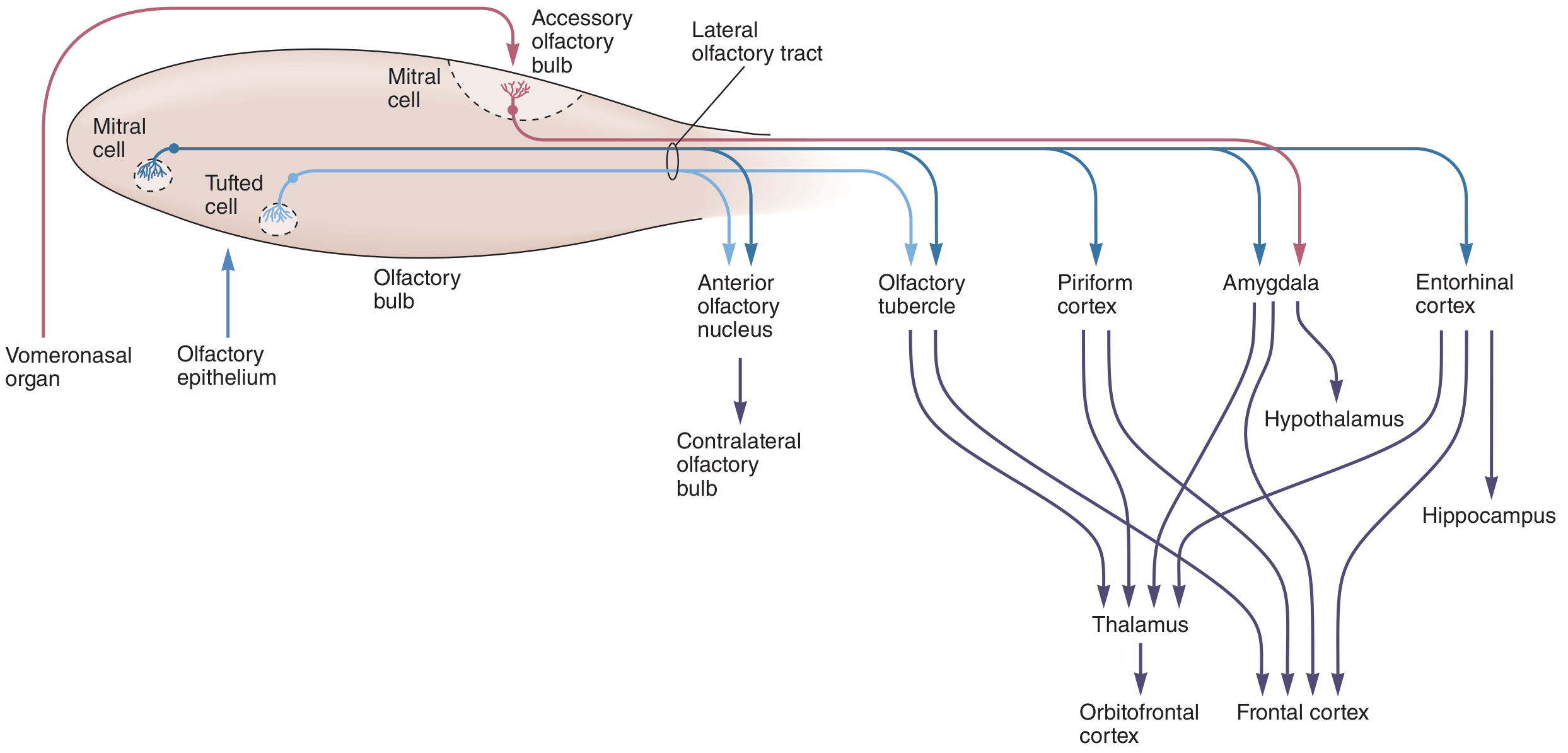
Fig. Complete olfactory pathway (Ganong's Review of Medical Physiology)
Relay Stations (Order):
1st Order Neurons (Olfactory receptor cells in olfactory epithelium):
- Axons pass through the cribriform plate of the ethmoid bone
- Synapse in the olfactory bulb
Olfactory Bulb (processing center):
- Axons from ~1000 olfactory receptors converge onto 1 mitral cell via clusters called glomeruli
- Contains mitral cells (2nd order neurons) and tufted cells - both relay neurons
- Also contains periglomerular cells (inhibitory, connect glomeruli via GABA) and granule cells (inhibitory, make dendrodendritic synapses with mitral cells via GABA/glutamate) - both provide lateral inhibition that sharpens olfactory discrimination
Lateral Olfactory Tract - axons of mitral and tufted cells project posteriorly to five regions of the olfactory (piriform) cortex:
| Region | Higher Projections | Function |
|---|---|---|
| Anterior olfactory nucleus | Anterior commissure → contralateral olfactory bulb | Bilateral coordination |
| Olfactory tubercle | Thalamus → orbitofrontal cortex | Conscious odor discrimination |
| Piriform cortex (primary olfactory cortex) | Thalamus → orbitofrontal cortex | Odor identification |
| Amygdala | Hypothalamus | Emotional/autonomic responses to smells (fear, feeding) |
| Entorhinal cortex | Hippocampus | Memory associated with smell |
Key distinction from other senses: Olfaction is the only sensory system that does NOT relay through the thalamus before reaching the cortex (direct access to limbic system). This explains the powerful link between smell and emotion/memory.
Conscious odor discrimination depends on the pathway to the neocortex (orbitofrontal cortex). Emotive aspects of olfaction derive from limbic projections (amygdala → hypothalamus).
7. Olfactory Adaptation and Thresholds (1 mark)
- Adaptation (fatigue): Prolonged exposure to an odorant leads to decreased sensitivity - this occurs peripherally at the receptor level and centrally
- Odor detection threshold: The lowest concentration detectable; e.g., hydrogen sulfide is detectable at 0.0005 ppm
- Weber's fraction for smell is poor: A change of ~30% in concentration is required before intensity difference can be detected (compare: vision only needs 1% change in intensity)
- Women have more acute olfaction than men; olfactory sensitivity peaks at ovulation
- Substances with strong odors tend to have high water and lipid solubility
8. Clinical Correlations (important for ENT) (included in above marks)
| Disorder | Cause | Mechanism |
|---|---|---|
| Anosmia | Cribriform plate fracture | Severs olfactory axons passing through cribriform plate |
| Hyposmia | Nasal polyps, congestion, decongestant overuse | Prevents odorants reaching olfactory epithelium |
| Congenital anosmia | Kallmann syndrome (associated with GnRH deficiency and hypogonadism) | Failure of olfactory neuron migration |
| Early Alzheimer disease | Neurodegeneration | Olfactory cortex involved early; smell loss often precedes other symptoms |
| Dysosmia | Head trauma, viral infection | Distorted or phantom smell perception |
Summary Diagram Flow (Quick Recall)
Odorant in air
    ↓ (dissolved in nasal mucus)
Olfactory cilia receptors (GPCR → G-olf → adenylyl cyclase → ↑cAMP → cation channels open → depolarization)
    ↓ Action potential in CN I
Cribriform plate (unmyelinated axons)
    ↓
Olfactory bulb (glomeruli: 1000 receptors : 1 mitral cell; lateral inhibition by granule/periglomerular cells)
    ↓ Lateral olfactory tract
Five olfactory cortex areas:
    • Piriform cortex → thalamus → orbitofrontal cortex (conscious smell)
    • Amygdala → hypothalamus (emotion/autonomic)
    • Entorhinal cortex → hippocampus (smell-memory)
References:
- Costanzo Physiology, 7th Edition - Chapter 3 (Special Senses)
- Ganong's Review of Medical Physiology, 26th Edition - Chapter 9 (Smell & Taste)
- Principles of Neural Science, Kandel et al. - Chapter on Olfaction
This is a shared conversation. Sign in to Orris to start your own chat.