
Explain me cephalosporins from basic to clinics drug of choice
Reading File
Now let me search the medical library for comprehensive cephalosporin content in parallel:
Finding Sources
Finding Sources
Finding Sources
Finding Sources
The best source is Katzung's Basic and Clinical Pharmacology (Ch. 43) and Lippincott Pharmacology. Let me read these key sections in parallel:
Reading File
Reading File
I can see the Katzung file has the cephalosporin content. Let me read the dedicated cephalosporin section:
Reading File
Finding Sources
Now let me read the core cephalosporin section from Katzung and from Goodman & Gilman in parallel:
Reading File
Reading File
Excellent - I have rich content. Let me read the clinical uses section from Katzung for 1st-4th gen and the Lippincott section:
Reading File
Reading File
Now let me get the 3rd and 4th generation sections plus clinical uses table from Katzung and the Lippincott table:
Reading File
I now have comprehensive content from Katzung and Goodman & Gilman. Let me compile the complete, detailed answer.
Cephalosporins: From Basic Science to Clinical Drug of Choice
1. HISTORICAL OVERVIEW
Cephalosporins were first isolated in 1945 from the fungus Cephalosporium acremonium by Brotzu, who noticed the seawater near a Sardinian sewage outlet had antibacterial activity. The core compound, 7-aminocephalosporanic acid (7-ACA), forms the scaffold on which all modern cephalosporins are built. They are now the most widely prescribed class of antibiotics globally.
2. BASIC CHEMISTRY
All cephalosporins share a bicyclic nucleus: a beta-lactam ring (4-membered) fused to a dihydrothiazine ring (6-membered) - this is called the 7-aminocephalosporanic acid (7-ACA) nucleus. This differs from penicillins, which have a 5-membered thiazolidine ring (forming 6-aminopenicillanic acid, 6-APA).
Two key modification sites determine activity:
- R1 side chain at position 7 (C-7) - determines antibacterial spectrum and beta-lactamase stability
- R2 side chain at position 3 (C-3) - influences pharmacokinetics and metabolic stability
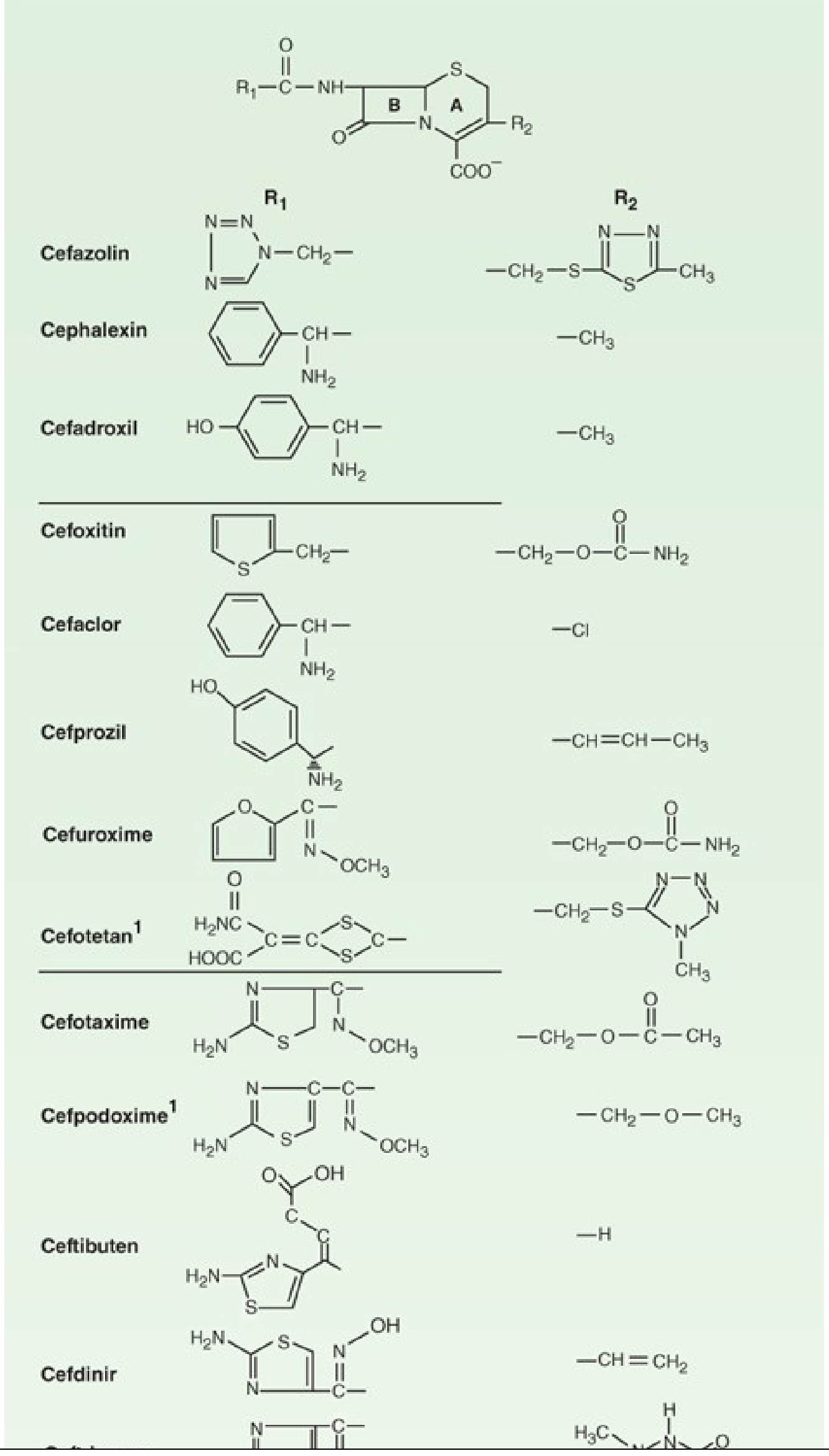
(Katzung, Figure 43-6: R1 and R2 substituents on the 7-ACA nucleus)
3. MECHANISM OF ACTION
Cephalosporins are bactericidal and work by inhibiting bacterial cell wall synthesis:
- Binding to Penicillin-Binding Proteins (PBPs) - transpeptidases and carboxypeptidases on the bacterial inner membrane
- Inhibition of cross-linking of peptidoglycan chains (transpeptidation step) - the final step in cell wall synthesis
- Cell wall weakening leads to osmotic lysis and bacterial death
- Activation of autolysins contributes to bacterial killing
They are time-dependent antibiotics - efficacy correlates with the %T > MIC (percentage of dosing interval that free drug concentration exceeds the MIC), not peak concentration.
4. MECHANISMS OF RESISTANCE
| Mechanism | Detail |
|---|---|
| Beta-lactamase production | Most common - enzymes hydrolyze the beta-lactam ring (e.g., ESBLs, AmpC, KPCs, MBLs) |
| Altered PBPs | MRSA expresses PBP2a (encoded by mecA gene) with very low affinity for most cephalosporins |
| Reduced outer membrane permeability | Loss of porins (OmpF, OmpC) in gram-negatives limits entry |
| Efflux pumps | Active pumping out of the drug (e.g., MexAB-OprM in P. aeruginosa) |
| AmpC induction | In Enterobacter, Citrobacter, Serratia - inducible chromosomal AmpC derepression occurs with 2nd/3rd gen exposure |
Important: "ESCAPPM" or "SPICE" organisms (Serratia, Pseudomonas, indole-positive Proteus, Citrobacter, Enterobacter) harbor inducible AmpC beta-lactamases. Even if in vitro susceptibility is shown to 2nd/3rd-gen cephalosporins, clinical failure can occur - these should be avoided or used with caution in serious infections.
5. GENERATIONS OF CEPHALOSPORINS
The generational classification reflects an expanding gram-negative spectrum with each generation while gram-positive coverage (except for 5th gen) relatively decreases.
Key Rule:
With each generation, gram-negative coverage expands, gram-positive activity relatively decreases, and beta-lactamase stability increases.
FIRST GENERATION
Agents: Cefazolin (IV/IM), Cephalexin (oral), Cefadroxil (oral)
Spectrum:
- Excellent gram-positive: Streptococci, MSSA (methicillin-sensitive S. aureus)
- Limited gram-negative: E. coli, K. pneumoniae, P. mirabilis (the "3 E-K-P" organisms)
- No activity: MRSA, enterococci, Pseudomonas, Bacteroides fragilis
Pharmacokinetics:
- Cephalexin oral: peak serum ~15-20 mcg/mL after 500 mg; given 250-500 mg four times daily
- Cefazolin IV: peak ~185 mcg/mL after 1g infusion; dosed 0.5-2 g IV every 8 hours
- Renal excretion (dose adjust in renal failure); cefazolin does NOT penetrate the CNS
Drug of Choice / Clinical Uses:
| Indication | Drug |
|---|---|
| Surgical prophylaxis | Cefazolin (DOC for most clean/clean-contaminated surgeries) |
| Skin/soft tissue infections (MSSA, strep) | Cephalexin (oral), Cefazolin (IV) |
| MSSA bacteremia/sepsis | Cefazolin (preferred over antistaphylococcal PCN due to tolerability) |
| UTI (susceptible E. coli/Klebsiella) | Cephalexin oral |
| Mild penicillin allergy (non-immediate) | Cefazolin can be substituted |
SECOND GENERATION
Agents: Cefuroxime (oral/IV), Cefoxitin (IV), Cefotetan (IV), Cefaclor (oral), Cefprozil (oral)
Spectrum: Extended gram-negative vs. 1st gen, retained gram-positive activity
- Cefuroxime: adds H. influenzae, Moraxella catarrhalis, Neisseria coverage; useful for community-acquired pneumonia
- Cefoxitin/Cefotetan (cephamycins): extended anaerobic activity including B. fragilis; used in mixed aerobic-anaerobic infections
- Still no activity against Pseudomonas, enterococci, MRSA
Pharmacokinetics:
- Cefuroxime IV: serum levels 75-125 mcg/mL after 1g; oral dose 250-500 mg twice daily
- Cefoxitin: short half-life, given every 6-8 hours
Drug of Choice / Clinical Uses:
| Indication | Drug |
|---|---|
| Surgical prophylaxis (colorectal/gynecologic) | Cefoxitin or Cefotetan (anaerobic coverage needed) |
| Community-acquired pneumonia (mild, outpatient) | Cefuroxime axetil |
| Sinusitis, otitis media, bronchitis (H. influenzae) | Cefuroxime axetil |
| Pelvic inflammatory disease (with doxycycline) | Cefoxitin IV |
| Intra-abdominal infections (mild-moderate) | Cefoxitin/Cefotetan |
| Lyme disease (early disseminated) | Cefuroxime axetil |
THIRD GENERATION
Agents:
- Parenteral: Ceftriaxone, Cefotaxime, Ceftazidime, Cefoperazone
- Oral: Cefixime, Cefdinir, Cefpodoxime, Ceftibuten
Spectrum:
- Markedly enhanced gram-negative coverage (most Enterobacterales)
- Ceftriaxone/Cefotaxime: excellent streptococcal activity (best among 3rd gen)
- Ceftazidime: unique activity against Pseudomonas aeruginosa (but weaker gram-positive)
- All: penetrate CSF adequately for meningitis
- Activity reduced vs. ESBL-producing organisms
Pharmacokinetics:
- Ceftriaxone: half-life 7-8 hours - once-daily dosing possible; excreted via biliary tract (no dose adjustment for renal failure)
- Cefotaxime: half-life ~1 hour; metabolized to desacetylcefotaxime; given every 4-8 hours
- Cefixime oral: half-life 3-4 hours; 400 mg once daily
Drug of Choice / Clinical Uses:
| Indication | Drug |
|---|---|
| Bacterial meningitis (empiric, >1 month) | Ceftriaxone or Cefotaxime + Vancomycin (for resistant pneumococcus) |
| Gonorrhea (uncomplicated urogenital) | Ceftriaxone 500 mg IM single dose (now 500 mg due to rising resistance) |
| Community-acquired pneumonia (moderate-severe, hospitalized) | Ceftriaxone + macrolide or fluoroquinolone |
| Typhoid fever | Ceftriaxone IV (DOC in severe disease) |
| Lyme neuroborreliosis | Ceftriaxone IV |
| Pyelonephritis/severe UTI | Ceftriaxone or Cefotaxime |
| Meningococcemia/disseminated gonococcal infection | Ceftriaxone |
| Pseudomonal infections | Ceftazidime IV |
| H. influenzae meningitis | Ceftriaxone or Cefotaxime |
| Outpatient UTI / otitis media (oral) | Cefdinir, Cefpodoxime, Cefixime |
| Empiric sepsis (community-acquired) | Ceftriaxone |
Caution: Do not use 3rd-gen cephalosporins for Enterobacter, Citrobacter, Serratia serious infections - AmpC derepression causes treatment failure even when the isolate appears susceptible in vitro. - Katzung, p. 1251
Neonates: Avoid ceftriaxone - biliary displacement of bilirubin can cause kernicterus. Use cefotaxime instead. - Goodman & Gilman, p. 967
FOURTH GENERATION
Agent: Cefepime (IV/IM only)
Spectrum: Combines best of 1st and 3rd gen:
- Good gram-positive: MSSA, S. pneumoniae (including PCN-non-susceptible strains)
- Broad gram-negative: Pseudomonas aeruginosa + Enterobacterales
- More resistant to chromosomal AmpC beta-lactamases than 3rd gen
- Penetrates CSF well
Pharmacokinetics: Half-life ~2 hours; renally cleared; dose adjust in renal failure
Drug of Choice / Clinical Uses:
| Indication | Drug |
|---|---|
| Febrile neutropenia (empiric) | Cefepime (monotherapy in non-high-risk) |
| Hospital-acquired pneumonia / VAP (Pseudomonas risk) | Cefepime |
| Enterobacter serious infections | Cefepime (preferred over 3rd-gen due to AmpC stability) |
| Nosocomial sepsis (non-MRSA) | Cefepime |
| Meningitis due to gram-negative enteric rods | Cefepime |
Cefepime is the only fourth-generation cephalosporin currently available in the USA. - Katzung, p. 1251
FIFTH GENERATION (ANTI-MRSA CEPHALOSPORINS)
Agents: Ceftaroline (IV, USA-approved), Ceftobiprole (IV, not USA-approved)
Mechanism of the added feature: Modified R1 side chain allows binding to PBP2a (the low-affinity PBP encoded by mecA that confers MRSA resistance) - this is unique among cephalosporins
Spectrum:
- MRSA (>95% of isolates inhibited) - the distinguishing feature
- Penicillin-resistant S. pneumoniae
- Gram-negative coverage similar to cefotaxime (NOT Pseudomonas)
- No activity against VRE or Acinetobacter
Drug of Choice / Clinical Uses:
| Indication | Drug |
|---|---|
| MRSA skin/soft tissue infections | Ceftaroline (alternative to vancomycin) |
| Community-acquired pneumonia (MRSA possible) | Ceftaroline |
| MRSA bacteremia (salvage) | Ceftaroline |
SIDEROPHORE CEPHALOSPORINS (Novel)
Agent: Cefiderocol
Mechanism: Uses the bacterial iron-uptake system ("Trojan horse" - siderophore-conjugated) to bypass outer membrane barriers; extremely broad gram-negative spectrum including carbapenem-resistant organisms (CROs)
Indication: Carbapenem-resistant gram-negative infections (last-resort agent)
6. SPECTRUM SUMMARY TABLE
| Generation | Key Gram (+) | Key Gram (-) | Notable Gaps | Prototype Drug |
|---|---|---|---|---|
| 1st | MSSA, Strep | E. coli, Klebsiella, P. mirabilis | Pseudomonas, MRSA, Bacteroides | Cefazolin |
| 2nd | MSSA, Strep | Above + H. influenzae, Moraxella | Pseudomonas, MRSA | Cefuroxime |
| 2nd (cephamycins) | Moderate | Enterobacterales | Pseudomonas, MRSA | Cefoxitin |
| 3rd | Strep (reduced staph) | Broad Enterobacterales | MRSA, Enterococcus | Ceftriaxone |
| 3rd (anti-pseudomonal) | Weaker | Enterobacterales + Pseudomonas | MRSA | Ceftazidime |
| 4th | MSSA, Strep (including PCN-R) | Broad + Pseudomonas + AmpC-stable | MRSA | Cefepime |
| 5th | MRSA, MSSA, Strep | Enterobacterales (not Pseudomonas) | Pseudomonas, VRE | Ceftaroline |
7. ADVERSE EFFECTS
| Adverse Effect | Details |
|---|---|
| Hypersensitivity | Most common concern; maculopapular rash, urticaria; anaphylaxis rare. Cross-reactivity with penicillins is ~1-2% (much less than the previously quoted 10%) - primarily determined by shared R1 side chains, not the beta-lactam core |
| GI disturbance | Diarrhea, especially cefoperazone (biliary excretion); C. difficile colitis risk |
| Coombs test positivity | Common with high doses; hemolysis rare |
| Biliary pseudolithiasis | Ceftriaxone - precipitates in bile due to high biliary excretion and calcium binding |
| Kernicterus risk | Ceftriaxone displaces bilirubin from albumin - contraindicated in neonates |
| Disulfiram-like reaction | Cephalosporins with methylthiotetrazole (MTT) ring: Cefotetan, Cefoperazone - avoid alcohol |
| Hypoprothrombinemia | MTT side chain drugs (cefazolin, cefotetan, cefoperazone) can prolong PT |
| Nephrotoxicity | Rare alone; potentiated by aminoglycosides or loop diuretics |
| Seizures | High-dose Cefepime, especially in renal impairment - neurotoxicity |
8. CROSS-REACTIVITY WITH PENICILLINS
The old teaching of 10% cross-reactivity is outdated. Modern data shows:
- Cross-reactivity is ~1-2% and is driven by shared R1 side chains between specific penicillins and cephalosporins, not the beta-lactam ring itself
- Patients with mild/distant penicillin reactions: low risk - cephalosporins generally safe
- Patients with severe immediate hypersensitivity (anaphylaxis) to penicillin: skin test first or use cautious graded challenge before giving a cephalosporin - Goodman & Gilman, p. 964
- Cephalosporins may be used in patients with PCN-induced maculopapular rashes but avoided in those with anaphylactic history - Katzung
9. QUICK CLINICAL CHEAT SHEET - DRUGS OF CHOICE
| Clinical Scenario | Cephalosporin of Choice |
|---|---|
| Surgical prophylaxis (most surgeries) | Cefazolin 1st gen |
| MSSA bacteremia | Cefazolin |
| Bacterial meningitis (empiric, community) | Ceftriaxone + Vancomycin |
| Gonorrhea (uncomplicated) | Ceftriaxone 500 mg IM |
| Community-acquired pneumonia (hospitalized) | Ceftriaxone + macrolide |
| Typhoid fever (severe) | Ceftriaxone |
| Lyme neuroborreliosis | Ceftriaxone |
| Febrile neutropenia | Cefepime |
| Pseudomonal infection | Ceftazidime or Cefepime |
| Nosocomial HAP/VAP (Pseudomonas risk) | Cefepime or Ceftazidime |
| MRSA skin/soft tissue infection | Ceftaroline |
| Pelvic inflammatory disease / intra-abdominal (anaerobic) | Cefoxitin (2nd gen cephamycin) |
| Colorectal surgery prophylaxis | Cefoxitin or Cefotetan |
| Pediatric meningitis | Cefotaxime (avoid ceftriaxone in neonates) |
| Carbapenem-resistant gram-negative | Cefiderocol |
10. RENAL DOSING NOTE
Nearly all cephalosporins require dose adjustment in renal failure except ceftriaxone (biliary excretion). Cefazolin, cefepime, and ceftazidime in particular accumulate in renal failure; cefepime accumulation is associated with neurotoxicity and seizures.
Sources: Katzung's Basic and Clinical Pharmacology, 16th Ed., Ch. 43, pp. 1247-1258; Goodman & Gilman's Pharmacological Basis of Therapeutics, pp. 901-975; Lippincott Illustrated Reviews Pharmacology, pp. 964-969
This is a shared conversation. Sign in to Orris to start your own chat.