

Flowchart
Medical flowchart titled "Recirculation of Urea" showing the following steps in a vertical flowchart with arrows connecting each box: Box 1: "50% of urea filtered in glomeruli is reabsorbed in Proximal Convoluted Tubule (PCT)" Arrow down Box 2: "Almost equal amount of urea is secreted in Loop of Henle" Arrow down Box 3: "Fluid in Distal Convoluted Tubule (DCT) has as much urea as amount originally filtered" Arrow down Box 4: "Collecting duct is impermeable to urea" Arrow down Box 5: "Water reabsorption from DCT and collecting duct in presence of ADH → Urea concentration increases in collecting duct" Arrow down Box 6: "Concentration gradient → Urea diffuses from inner medullary part of collecting duct into medullary interstitium" Arrow down Box 7: "Continuous diffusion → Urea concentration increases in inner medulla → Hyperosmolarity of interstitium in inner medulla" Arrow down (with a feedback loop arrow going back up to Box 1 labeled "Recirculation continues") Box 8: "By concentration gradient → Urea re-enters Loop of Henle → Cycle repeats" Also include a separate small box on the side: "Reabsorption of Na⁺ from collecting duct medullary part → adds to osmolarity of inner medulla" Use blue and white color scheme with clear labels, clean medical textbook style
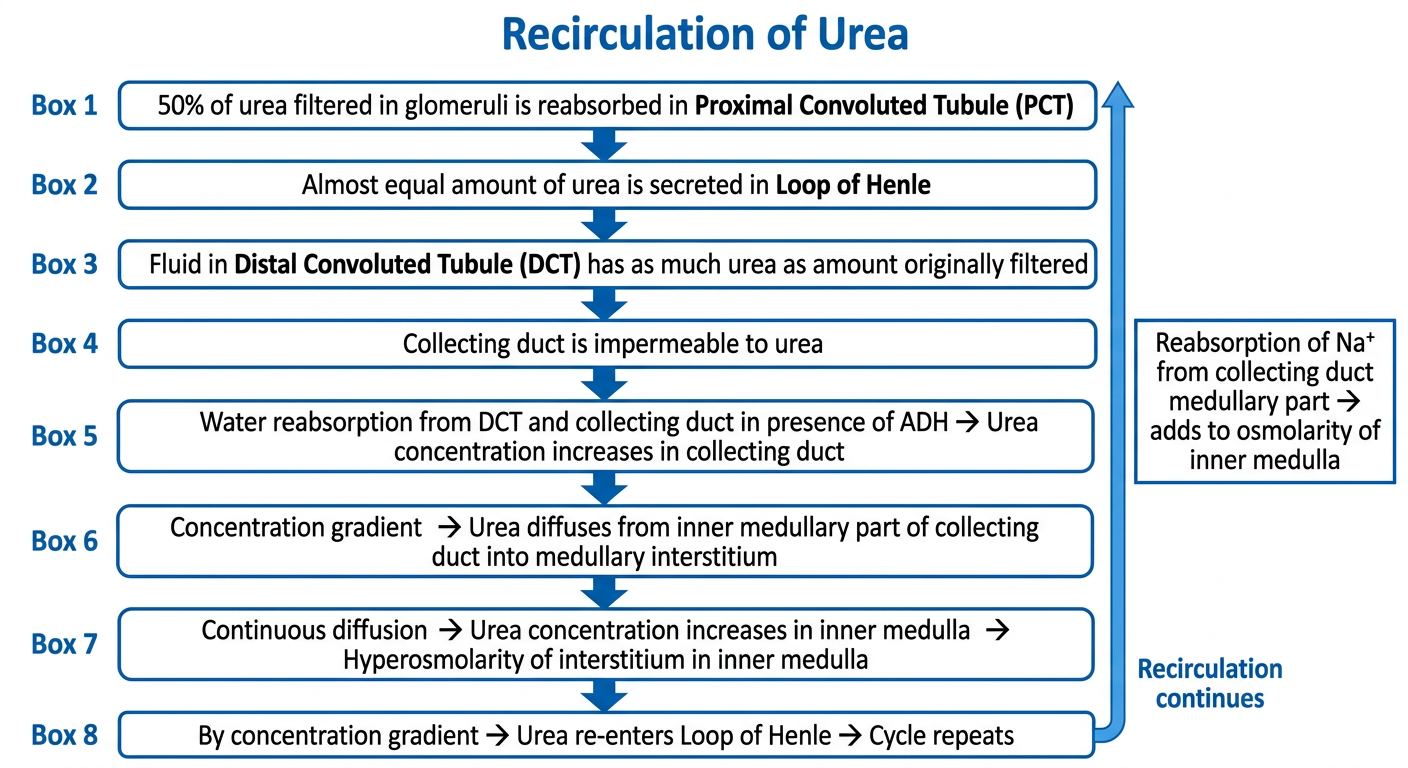
- 50% of filtered urea is reabsorbed in the PCT
- An equal amount is secreted back into the Loop of Henle
- So the fluid reaching the DCT has as much urea as was originally filtered
- The collecting duct is impermeable to urea, so urea stays inside
- ADH causes water reabsorption from DCT and collecting duct → urea concentration rises in the collecting duct
- The concentration gradient drives urea diffusion from the inner medullary collecting duct → medullary interstitium
- This raises urea in the inner medulla → hyperosmolarity of inner medullary interstitium
- By the concentration gradient, urea re-enters the Loop of Henle → the cycle repeats
This recirculation of urea is a key mechanism for urinary concentration, explained further in Guyton & Hall Medical Physiology under "Urea Contributes to Hyperosmotic Renal Medullary Interstitium."