
Jai Shree Ram
Jai Shree Ram! 🙏
How can I help you today? Feel free to ask me anything - whether it's medical questions, research, documents, calculations, or any other topic you need assistance with.
What is main cause of fistula in young person
In young persons, Crohn's disease is the most common cause of fistula (especially perianal/enteric fistulas). Other common causes include anorectal abscess, tuberculosis, and trauma.
Searching sources...
Reading File
Finding Sources
Finding Sources
Searching PubMed
perianal fistula young adults etiology
Finding Sources
Finding Sources
Reading File
Reading File
Here is a thorough answer based on authoritative surgical and gastroenterology textbooks:
Main Causes of Fistula in a Young Person
1. Cryptoglandular Infection (Most Common Overall)
The most common cause of anorectal fistula in any age group, including young adults, is infection of the anal glands - known as the cryptoglandular theory.
- The anal glands open into the crypts of Morgagni at the dentate line and penetrate into the intersphincteric space
- Fecal material blocks the gland ducts, leading to abscess formation, which then tracks outward to form a fistula
- Anal sepsis most frequently affects people in the 3rd and 4th decades of life (i.e., young adults!)
- Common bacteria involved: E. coli, Enterococcus spp., Bacteroides fragilis
So in a young person presenting with a perianal fistula, anorectal abscess from cryptoglandular disease is the #1 cause - Yamada's Textbook of Gastroenterology, p. 1489.
2. Crohn's Disease (Most Important Specific Cause in Young People)
Crohn's disease is the most important disease-specific cause of fistula in young persons because:
- Crohn's typically presents in the 2nd-3rd decade of life
- Up to 30% of patients with Crohn's disease will develop perianal abscess or fistula
- Crohn's fistulas are often complex, multiple, and recurrent (the classic "watering-can perineum" with multiple external openings)
- They do NOT follow the typical cryptoglandular pattern
- A young person with recurrent or complex fistulas should always be evaluated for Crohn's disease
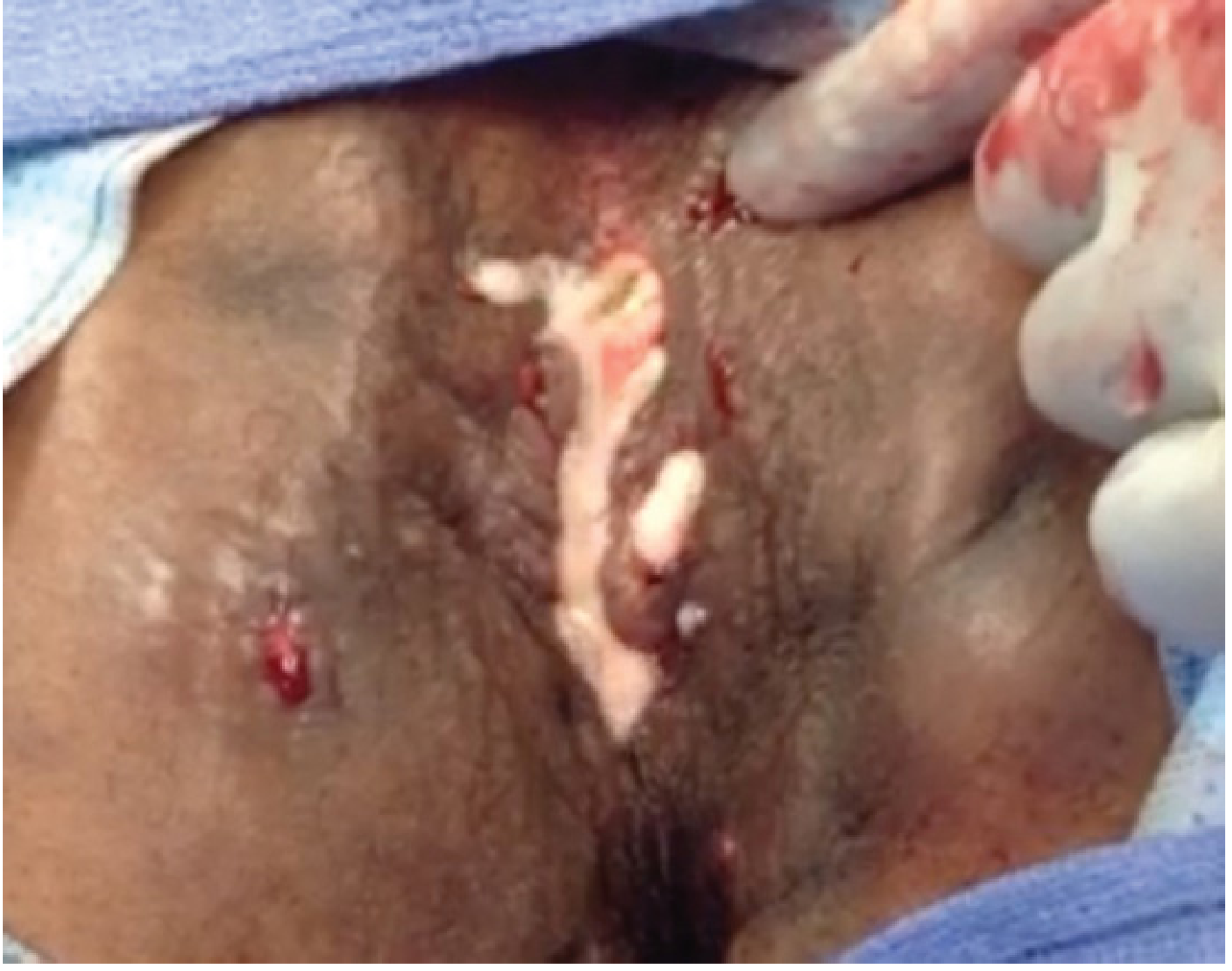
Perianal fistulas in Crohn's disease - multiple openings with hydrogen peroxide injection (Mulholland & Greenfield's Surgery, p. 2521)
3. Other Causes to Consider in Young Patients
| Cause | Notes |
|---|---|
| Tuberculosis (TB) | Important in endemic regions (e.g., India); fistulas are often indurated, painless |
| Sexually transmitted infections | Lymphogranuloma venereum (LGV), actinomycosis |
| Trauma / Foreign body | Can cause perianal sepsis and fistula |
| Hidradenitis suppurativa | Chronic skin condition, causes complex tracts |
| Pilonidal disease | Midline sacrococcygeal fistula in young adults |
| Malignancy | Less common but must be excluded |
Key Summary
In a young person (20s-30s), the two most important causes are:
- Cryptoglandular anorectal abscess - the most frequent cause overall
- Crohn's disease - the most important underlying systemic disease, especially if the fistula is complex, recurrent, or associated with diarrhea/abdominal symptoms
In India and other TB-endemic regions, tuberculosis should also be actively considered when fistulas are atypical (painless, indurated, multiple, not healing after surgery).
This is a shared conversation. Sign in to Orris to start your own chat.