
Can you teach me the brainstem in detail and easy to understand
Reading File
Now let me search the library for brainstem content in parallel:
Finding Sources
Finding Sources
Finding Sources
Reading File
Reading File
Finding Sources
Finding Sources
Finding Sources
Excellent - found the key sources. Let me now read the most relevant sections from Neuroanatomy through Clinical Cases and Gray's Anatomy:
Reading File
Reading File
Reading File
Reading File
Reading File
Reading File
Now let me fetch some key brainstem diagrams:
Loading Image
Loading Image
Loading Image
Excellent images! Let me now fetch one more important internal anatomy image:
Loading Image
Loading Image
I now have comprehensive content to write a detailed, easy-to-understand guide on the brainstem. Let me compile everything:
The Brainstem: A Complete Guide
What Is the Brainstem?
The brainstem is a stalk-like structure in the posterior cranial fossa that connects the forebrain above to the spinal cord below, with the cerebellum attached behind it. Think of it as the brain's "command center for survival" - it controls breathing, heart rate, blood pressure, consciousness, and relays virtually all signals between the brain and the rest of the body.
It has three main jobs:
- Conduit - everything traveling between brain and spinal cord passes through it
- Cranial nerve headquarters - houses the nuclei for cranial nerves III through XII
- Vital reflex center - regulates breathing, cardiovascular function, and consciousness
The Three Parts (Top to Bottom)
The brainstem is divided into three regions from rostral (top/toward brain) to caudal (bottom/toward spinal cord):
| Region | Position | Length | Key Cranial Nerves |
|---|---|---|---|
| Midbrain (Mesencephalon) | Most rostral | ~2 cm | CN III, IV |
| Pons | Middle | ~2.5 cm | CN V, VI, VII, VIII |
| Medulla Oblongata | Most caudal | ~3 cm | CN IX, X, XI, XII |
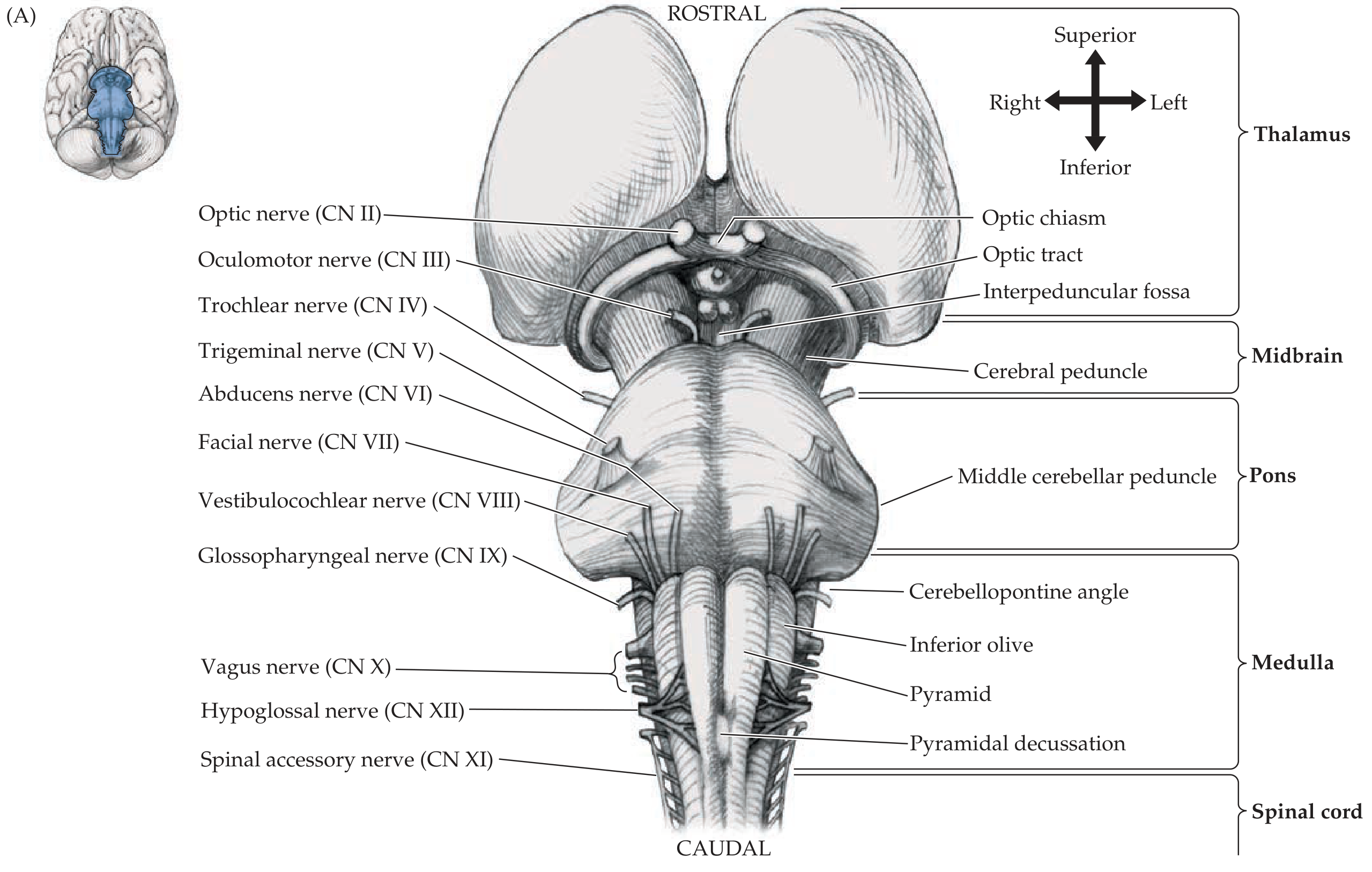
Here is how the brainstem looks from the front, with cranial nerves labeled:
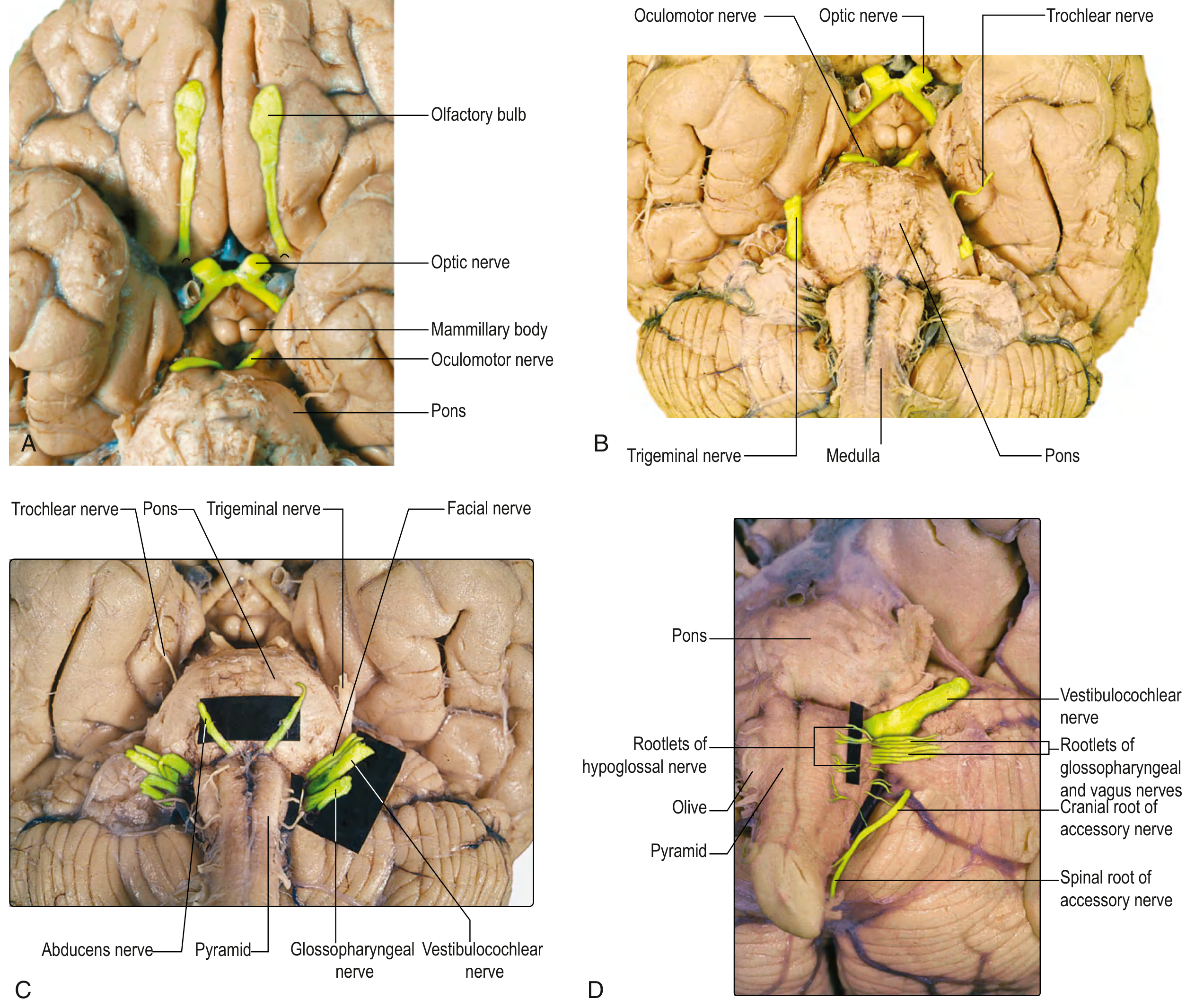
And here is a cadaveric photograph showing real anatomy:
Internal Organization: Three Layers
Any cross-section of the brainstem can be divided into three "layers" from back to front:
- Tectum ("roof" in Latin) - only present in the midbrain; contains the superior and inferior colliculi
- Tegmentum ("covering") - the middle layer present throughout; contains most nuclei, reticular formation, and ascending/descending tracts
- Basis - the most ventral (front) portion; where the corticospinal and corticobulbar tracts travel
A memory tip: T-T-B from back to front = Tectum, Tegmentum, Basis.
1. The Midbrain
Exterior landmarks
- Interpeduncular fossa - a deep midline groove on the anterior surface
- Crus cerebri (cerebral peduncles) - two large pillars of motor fibers flanking the fossa, descending from the cortex
- Superior and inferior colliculi - four bumps on the posterior surface ("tectum"), called the corpora quadrigemina
- CN III emerges from the interpeduncular fossa
- CN IV emerges just below the inferior colliculi - it is the only cranial nerve to exit from the dorsal (back) side of the brainstem
Key internal structures
| Structure | Location | Function |
|---|---|---|
| Oculomotor nucleus (CN III) | Rostral tegmentum | Controls most eye movements + eyelid elevation |
| Edinger-Westphal nucleus | Dorsal to CN III nucleus | Parasympathetic: pupil constriction, lens accommodation |
| Trochlear nucleus (CN IV) | Caudal tegmentum | Controls the superior oblique muscle (eye rolls down and in) |
| Red nucleus | Central tegmentum | Motor coordination, relay for cerebellar output |
| Substantia nigra | Between tegmentum and basis | Dopamine production; critical for movement control |
| Periaqueductal gray (PAG) | Around cerebral aqueduct | Pain modulation, defensive responses |
| Cerebral aqueduct | Midline | Connects 3rd and 4th ventricles; CSF flows through here |
| Superior colliculus | Tectum (rostral) | Visual reflexes (orienting gaze to sudden visual stimuli) |
| Inferior colliculus | Tectum (caudal) | Auditory relay (hearing pathway) |
Easy memory: At the superior colliculus level, you see the oculomotor nucleus (CN III) and red nucleus. At the inferior colliculus level, you see the trochlear nucleus (CN IV).
2. The Pons
The pons is the bulging middle part of the brainstem (pons = "bridge" in Latin). It looks like a rounded bridge when viewed from the front, partly because it serves as a relay station between the cerebral cortex and the cerebellum.
Exterior landmarks
- Basilar sulcus - a midline groove on the anterior surface where the basilar artery runs
- Middle cerebellar peduncle - the large connection carrying signals from pons to cerebellum
- CN V (trigeminal) - exits from the lateral pons, the largest cranial nerve
- CN VI, VII, VIII - exit at the pontomedullary junction (between pons and medulla)
Key internal structures
Here is a cross-section through the pons showing its internal organization:
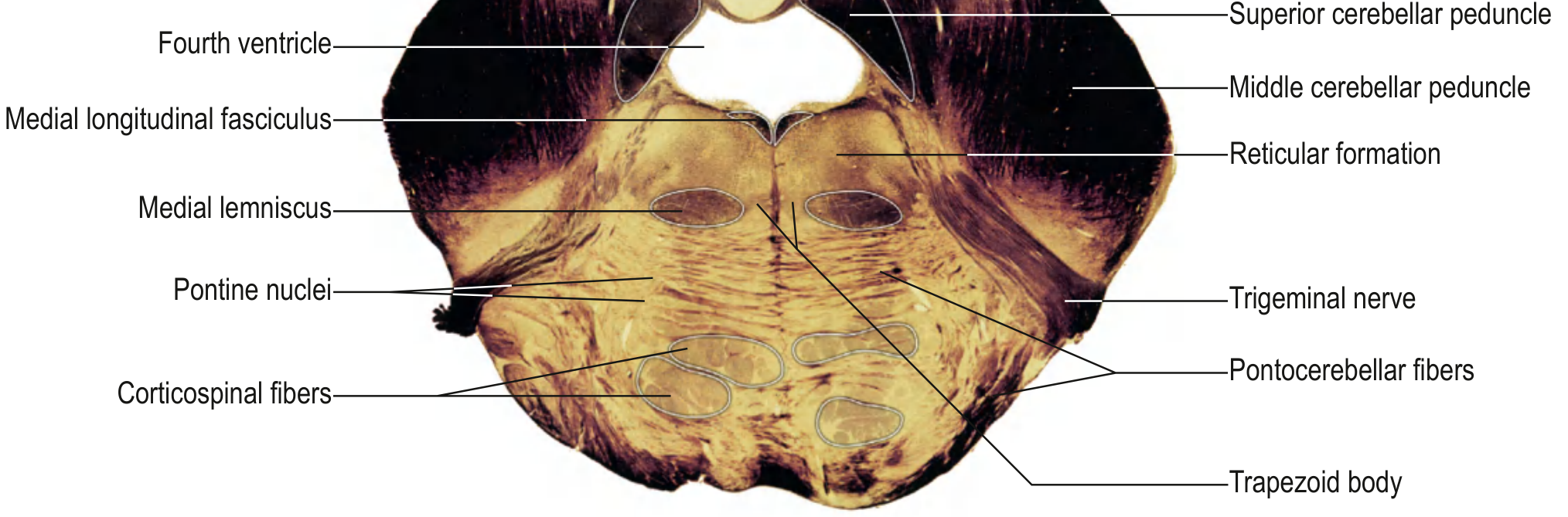
| Structure | Function |
|---|---|
| Pontine nuclei | Relay cortical motor signals to cerebellum via middle cerebellar peduncle |
| Corticospinal fibers | Motor signals descending from cortex to spinal cord (broken into bundles by pontine nuclei) |
| Medial lemniscus | Touch/vibration/proprioception traveling up to thalamus |
| Medial longitudinal fasciculus (MLF) | Coordinates conjugate eye movements; connects CN III, IV, VI nuclei |
| Reticular formation | Sleep/wake, respiration, cardiovascular control |
| Raphe nuclei | Serotonin production |
| Locus coeruleus | Norepinephrine production; attention and arousal |
| Trapezoid body | Hearing pathway decussation |
Cranial nerve nuclei in the pons:
- CN V (Trigeminal) - chief sensory nucleus (fine touch, face), motor nucleus (chewing muscles), mesencephalic nucleus (proprioception), and spinal nucleus (pain/temperature, extends into medulla)
- CN VI (Abducens) - moves the eye laterally
- CN VII (Facial) - motor: facial expression; parasympathetic: lacrimation, salivation; sensory: taste from anterior 2/3 tongue
- CN VIII (Vestibulocochlear) - hearing (cochlear nuclei at pontomedullary junction) and balance (vestibular nuclei span pons and rostral medulla)
3. The Medulla Oblongata
The medulla is the lowest and most caudal part of the brainstem - it continues directly into the spinal cord at the foramen magnum. It contains the most vital reflex centers in the body.
Exterior landmarks
- Anterior median fissure - midline groove, continuous with spinal cord
- Pyramids - two prominent ridges lateral to the fissure containing corticospinal fibers (the "motor highway")
- Pyramidal decussation - where ~85% of corticospinal fibers cross to the opposite side at the caudal medulla - this is why the left brain controls the right body!
- Olives (inferior olivary nuclei) - oval bulges lateral to pyramids; important for coordination
- Inferior cerebellar peduncles - connection between medulla and cerebellum
Key internal structures
| Structure | Function |
|---|---|
| Nucleus tractus solitarius (NTS) | Receives visceral sensory input (taste, gut, heart, lungs); controls eating, autonomic reflexes |
| Nucleus ambiguus | Motor nucleus for CN IX, X, XI; controls swallowing, phonation |
| Dorsal motor nucleus of CN X | Parasympathetic output to thoracic and abdominal organs |
| Hypoglossal nucleus (CN XII) | Controls tongue movement |
| Inferior olivary nucleus | Cerebellar motor learning and coordination |
| Gracile nucleus | Receives touch/vibration from lower body (dorsal columns) |
| Cuneate nucleus | Receives touch/vibration from upper body (dorsal columns) |
| Spinal trigeminal nucleus | Pain and temperature from the face (continuation of CN V) |
| Reticular formation | Breathing rhythm generation, cardiovascular regulation |
Cranial nerve nuclei in the medulla:
- CN IX (Glossopharyngeal) - taste from posterior tongue, carotid body/sinus sensation, parotid gland
- CN X (Vagus) - the great "wandering" nerve; parasympathetic to heart, lungs, gut; gag reflex; voice
- CN XI (Spinal Accessory) - primarily from upper cervical cord; controls sternocleidomastoid and trapezius
- CN XII (Hypoglossal) - tongue movements
The Reticular Formation: The Hidden Network
Running through the entire length of the brainstem (in the tegmentum) is the reticular formation - a diffuse network of neurons that is not a single nucleus but a complex web with enormous influence:
- Arousal and consciousness - the ascending reticular activating system (ARAS) projects to the thalamus and cortex to maintain wakefulness. Damage = coma.
- Sleep regulation - specific nuclei regulate REM and non-REM sleep cycles
- Respiratory rhythmogenesis - the pre-Botzinger complex in the medulla generates breathing rhythm
- Cardiovascular control - adjusts heart rate and blood pressure
- Pain modulation - descending pathways suppress pain signals
- Motor tone - modulates muscle tone and posture
The Cranial Nerves: Quick Reference
A helpful mnemonic for cranial nerves from the brainstem: "Oh, Oh, Oh, To Touch And Feel Very Good Velvet - AH!" (CN I-XII)
| CN | Name | Brainstem Level | Key Function |
|---|---|---|---|
| III | Oculomotor | Midbrain | Eye movement (most), eyelid, pupil constriction |
| IV | Trochlear | Midbrain (dorsal exit) | Superior oblique (eye down + in) |
| V | Trigeminal | Pons | Face sensation, jaw movement |
| VI | Abducens | Pontomedullary junction | Lateral eye movement |
| VII | Facial | Pontomedullary junction | Facial expression, taste, tears, saliva |
| VIII | Vestibulocochlear | Pontomedullary junction | Hearing + balance |
| IX | Glossopharyngeal | Medulla | Taste, swallowing, carotid sinus |
| X | Vagus | Medulla | Parasympathetic to viscera, gag reflex |
| XI | Accessory | Medulla + cervical cord | Neck/shoulder muscles |
| XII | Hypoglossal | Medulla | Tongue movement |
Key Tracts Passing Through the Brainstem
Ascending (going UP to brain):
- Medial lemniscus - fine touch, vibration, proprioception from body
- Spinothalamic tract - pain and temperature from body; runs lateral to medial lemniscus in brainstem
- Lateral lemniscus - auditory pathway
Descending (going DOWN from brain):
- Corticospinal tract - voluntary motor commands to spinal cord (decussates in medulla)
- Corticobulbar tract - motor commands to cranial nerve motor nuclei
The Medial Longitudinal Fasciculus (MLF)
This is a key white matter tract running vertically in the dorsal tegmentum of all three brainstem levels. It connects the nuclei of CN III, IV, and VI to coordinate conjugate eye movements (both eyes moving together). Damage to the MLF causes internuclear ophthalmoplegia - the eye on the side of the lesion cannot adduct during horizontal gaze, while the other eye shows nystagmus.
Why Brainstem Lesions Are So Serious
The brainstem is packed with structures in a very small space. A small lesion can cause multiple simultaneous deficits. The classic pattern is:
"Crossed" findings = brainstem lesion
- Ipsilateral cranial nerve deficit (same side as lesion) - because cranial nerve nuclei are in the brainstem itself
- Contralateral limb/body findings (opposite side) - because the long tracts (corticospinal, spinothalamic) have already crossed or will cross
For example, in lateral medullary syndrome (Wallenberg syndrome) from posterior inferior cerebellar artery (PICA) occlusion:
- Ipsilateral face: loss of pain/temperature (spinal trigeminal nucleus)
- Contralateral body: loss of pain/temperature (spinothalamic tract)
- Dysphagia, hoarseness (nucleus ambiguus)
- Horner syndrome ipsilateral (descending sympathetic fibers)
- Vertigo, nystagmus (vestibular nuclei)
- Ataxia (inferior cerebellar peduncle)
Blood Supply
| Brainstem Part | Arteries |
|---|---|
| Midbrain | Posterior cerebral artery (PCA), superior cerebellar artery (SCA) |
| Pons | Basilar artery (paramedian and circumferential branches) |
| Medulla | Vertebral artery, anterior spinal artery, PICA (posterior inferior cerebellar artery) |
The entire posterior brainstem is supplied by the vertebrobasilar system. Basilar artery occlusion is catastrophic, causing "locked-in syndrome" (complete paralysis below the eyes) or death.
Summary: A Simple Mental Map
ROSTRAL (toward brain)
    ┌─────────────────────────────────┐
    │  MIDBRAIN  (~2 cm)              │
    │  - Superior/inferior colliculi  │
    │  - CN III, IV nuclei            │
    │  - Red nucleus, Substantia nigra│
    │  - Cerebral aqueduct            │
    ├─────────────────────────────────┤
    │  PONS  (~2.5 cm)                │
    │  - CN V, VI, VII, VIII nuclei   │
    │  - Pontine nuclei (→ cerebellum)│
    │  - Locus coeruleus, Raphe nuclei│
    │  - 4th ventricle roof           │
    ├─────────────────────────────────┤
    │  MEDULLA  (~3 cm)               │
    │  - CN IX, X, XI, XII nuclei     │
    │  - Pyramidal decussation        │
    │  - NTS, Nucleus ambiguus        │
    │  - Inferior olivary nucleus     │
    │  - VITAL CENTERS (breathing,    │
    │    heart rate, vomiting)        │
    └─────────────────────────────────┘
CAUDAL (toward spinal cord)
Sources:
- Neuroanatomy through Clinical Cases, 3rd Edition (Blumenfeld) - Chapters 12, 13, 14
- Gray's Anatomy for Students - Part IV: Brainstem
- Kaplan & Sadock's Comprehensive Textbook of Psychiatry - Section 1.2
This is a shared conversation. Sign in to Orris to start your own chat.