
/generatehandwrittenimages Discuss homeostasis under the following headings- concept, regulatory mechanisms and disorders. - for md physiology 10 marks theory question. You can make many images and not just one for completing the answer
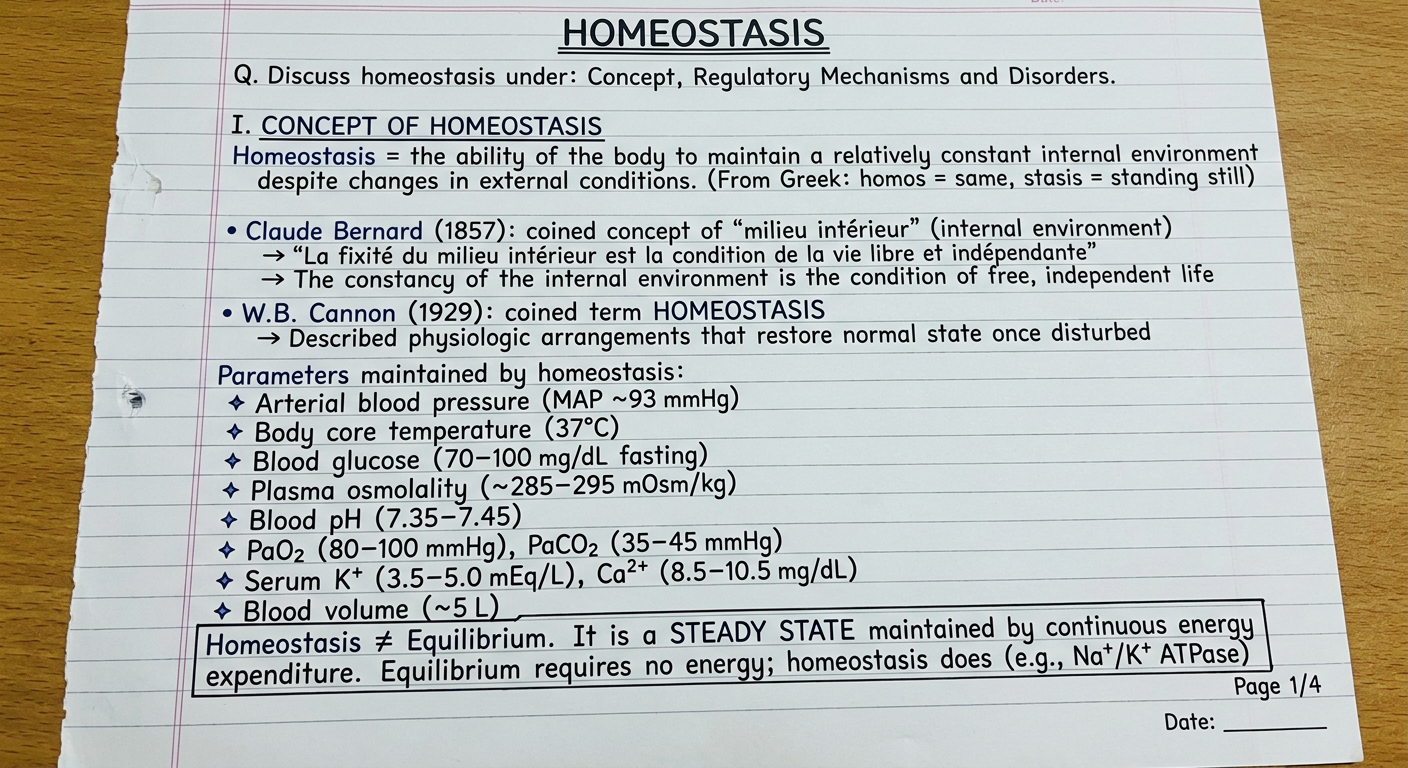
Handwritten medical exam answer on ruled notebook paper with blue ink pen, neat student handwriting style, for MD Physiology 10-mark question. Page 1 of 4. Title at top center: "HOMEOSTASIS" (underlined, larger heading) Below: "Q. Discuss homeostasis under: Concept, Regulatory Mechanisms and Disorders." Subheading: "I. CONCEPT OF HOMEOSTASIS" (underlined) Definition section: "Homeostasis = the ability of the body to maintain a relatively constant internal environment despite changes in external conditions." "(From Greek: homos = same, stasis = standing still)" Historical background: "• Claude Bernard (1857): coined concept of 'milieu intérieur' (internal environment)" " → 'La fixité du milieu intérieur est la condition de la vie libre et indépendante'" " → The constancy of the internal environment is the condition of free, independent life" "• W.B. Cannon (1929): coined term HOMEOSTASIS" " → Described physiologic arrangements that restore normal state once disturbed" What is regulated (bullet list): "Parameters maintained by homeostasis:" " ✦ Arterial blood pressure (MAP ~93 mmHg)" " ✦ Body core temperature (37°C)" " ✦ Blood glucose (70–100 mg/dL fasting)" " ✦ Plasma osmolality (~285–295 mOsm/kg)" " ✦ Blood pH (7.35–7.45)" " ✦ PaO₂ (80–100 mmHg), PaCO₂ (35–45 mmHg)" " ✦ Serum K⁺ (3.5–5.0 mEq/L), Ca²⁺ (8.5–10.5 mg/dL)" " ✦ Blood volume (~5 L)" Key concept box (hand-drawn box): "Homeostasis ≠ Equilibrium" "It is a STEADY STATE maintained by continuous energy expenditure" "Equilibrium requires no energy; homeostasis does (e.g., Na⁺/K⁺ ATPase)" At bottom right: "Page 1/4" and date line for student to fill in
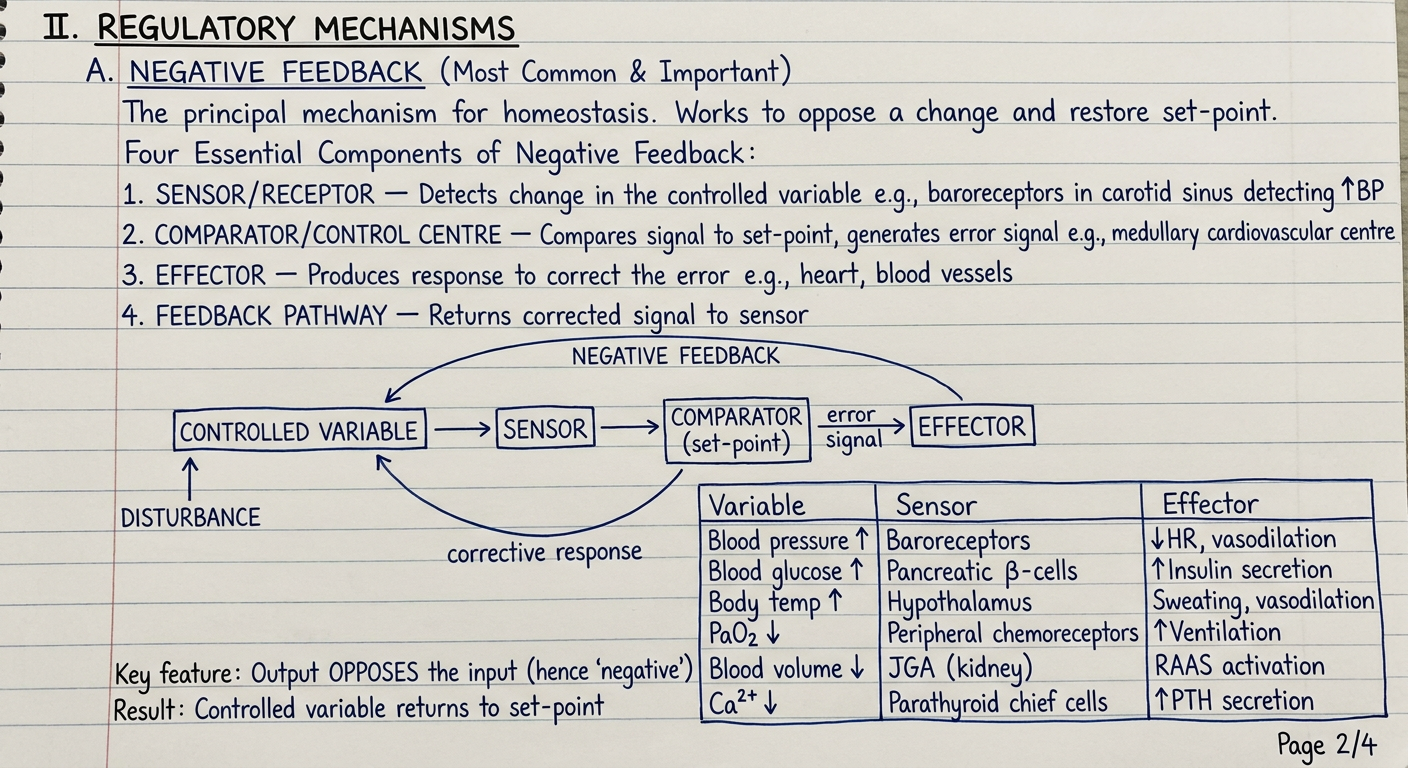
Handwritten medical exam answer on ruled notebook paper, blue ink pen, neat student handwriting, MD Physiology exam. Page 2 of 4. Title: "II. REGULATORY MECHANISMS" (underlined, bold heading) Subheading: "A. NEGATIVE FEEDBACK (Most Common & Important)" (underlined) Text: "The principal mechanism for homeostasis. Works to oppose a change and restore set-point." "Four Essential Components of Negative Feedback:" " 1. SENSOR/RECEPTOR — Detects change in the controlled variable" " e.g., baroreceptors in carotid sinus detecting ↑BP" " 2. COMPARATOR/CONTROL CENTRE — Compares signal to set-point, generates error signal" " e.g., medullary cardiovascular centre" " 3. EFFECTOR — Produces response to correct the error" " e.g., heart, blood vessels" " 4. FEEDBACK PATHWAY — Returns corrected signal to sensor" Below this: A hand-drawn circular diagram showing the feedback loop: [CONTROLLED VARIABLE] → (arrow up = DISTURBANCE) → [SENSOR] → [COMPARATOR (set-point)] → error signal → [EFFECTOR] → corrective response → back to [CONTROLLED VARIABLE] With a curved arrow labeled "NEGATIVE FEEDBACK" looping back "Key feature: Output OPPOSES the input (hence 'negative')" "Result: Controlled variable returns to set-point" Examples table (hand-drawn two-column table): "Variable | Sensor | Effector" "Blood pressure ↑ | Baroreceptors | ↓HR, vasodilation" "Blood glucose ↑ | Pancreatic β-cells | ↑Insulin secretion" "Body temp ↑ | Hypothalamus | Sweating, vasodilation" "PaO₂ ↓ | Peripheral chemoreceptors | ↑Ventilation" "Blood volume ↓ | JGA (kidney) | RAAS activation" "Ca²⁺ ↓ | Parathyroid chief cells | ↑PTH secretion" At bottom right: "Page 2/4"
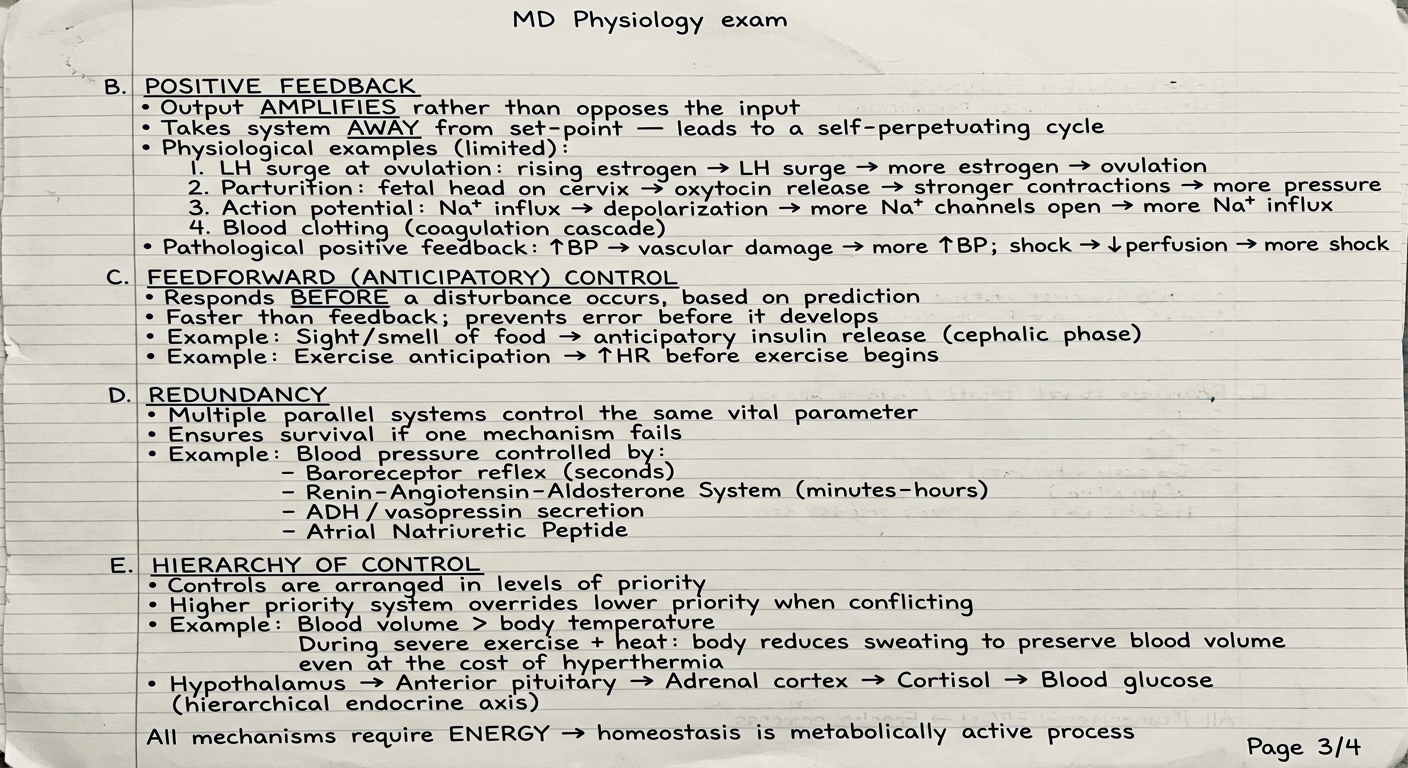
Handwritten medical exam answer on ruled notebook paper, blue ink pen, neat student handwriting, MD Physiology exam. Page 3 of 4. Heading: "B. POSITIVE FEEDBACK" (underlined) "• Output AMPLIFIES rather than opposes the input" "• Takes system AWAY from set-point — leads to a self-perpetuating cycle" "• Physiological examples (limited):" " 1. LH surge at ovulation: rising estrogen → LH surge → more estrogen → ovulation" " 2. Parturition: fetal head on cervix → oxytocin release → stronger contractions → more pressure" " 3. Action potential: Na⁺ influx → depolarization → more Na⁺ channels open → more Na⁺ influx" " 4. Blood clotting (coagulation cascade)" "• Pathological positive feedback: ↑BP → vascular damage → more ↑BP; shock → ↓perfusion → more shock" Heading: "C. FEEDFORWARD (ANTICIPATORY) CONTROL" (underlined) "• Responds BEFORE a disturbance occurs, based on prediction" "• Faster than feedback; prevents error before it develops" "• Example: Sight/smell of food → anticipatory insulin release (cephalic phase)" "• Example: Exercise anticipation → ↑HR before exercise begins" Heading: "D. REDUNDANCY" (underlined) "• Multiple parallel systems control the same vital parameter" "• Ensures survival if one mechanism fails" "• Example: Blood pressure controlled by:" " - Baroreceptor reflex (seconds)" " - Renin-Angiotensin-Aldosterone System (minutes-hours)" " - ADH / vasopressin secretion" " - Atrial Natriuretic Peptide" Heading: "E. HIERARCHY OF CONTROL" (underlined) "• Controls are arranged in levels of priority" "• Higher priority system overrides lower priority when conflicting" "• Example: Blood volume > body temperature" " During severe exercise + heat: body reduces sweating to preserve blood volume" " even at the cost of hyperthermia" "• Hypothalamus → Anterior pituitary → Adrenal cortex → Cortisol → Blood glucose" " (hierarchical endocrine axis)" Small note at bottom: "All mechanisms require ENERGY → homeostasis is metabolically active process" "Page 3/4"
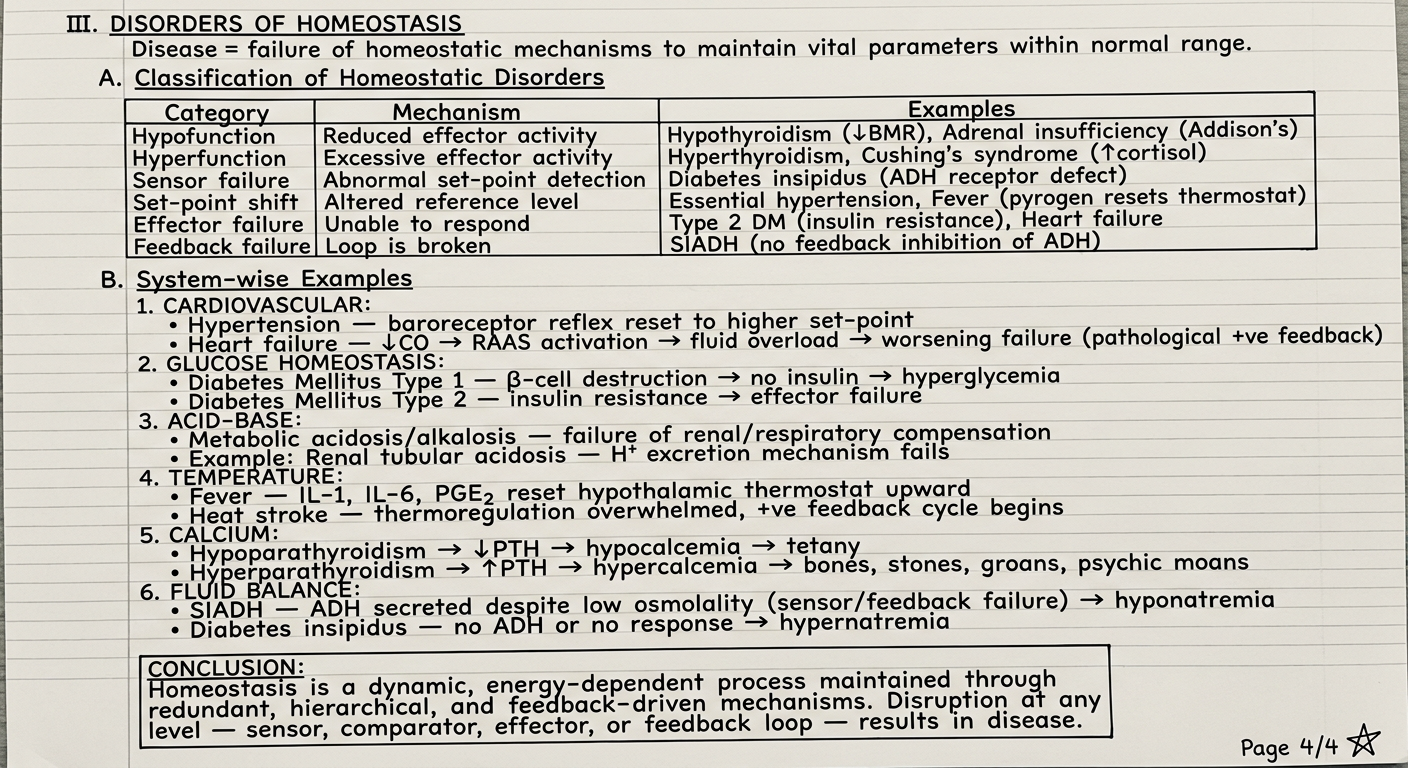
Handwritten medical exam answer on ruled notebook paper, blue ink pen, neat student handwriting, MD Physiology exam. Page 4 of 4. Heading: "III. DISORDERS OF HOMEOSTASIS" (underlined, bold) Introductory line: "Disease = failure of homeostatic mechanisms to maintain vital parameters within normal range." Subheading: "A. Classification of Homeostatic Disorders" (underlined) Hand-drawn table with 3 columns: "Category | Mechanism | Examples" "Hypofunction | Reduced effector activity | Hypothyroidism (↓BMR), Adrenal insufficiency (Addison's)" "Hyperfunction | Excessive effector activity | Hyperthyroidism, Cushing's syndrome (↑cortisol)" "Sensor failure | Abnormal set-point detection | Diabetes insipidus (ADH receptor defect)" "Set-point shift | Altered reference level | Essential hypertension, Fever (pyrogen resets thermostat)" "Effector failure | Unable to respond | Type 2 DM (insulin resistance), Heart failure" "Feedback failure | Loop is broken | SIADH (no feedback inhibition of ADH)" Subheading: "B. System-wise Examples" (underlined) "1. CARDIOVASCULAR:" " • Hypertension — baroreceptor reflex reset to higher set-point" " • Heart failure — ↓CO → RAAS activation → fluid overload → worsening failure (pathological +ve feedback)" "2. GLUCOSE HOMEOSTASIS:" " • Diabetes Mellitus Type 1 — β-cell destruction → no insulin → hyperglycemia" " • Diabetes Mellitus Type 2 — insulin resistance → effector failure" "3. ACID-BASE:" " • Metabolic acidosis/alkalosis — failure of renal/respiratory compensation" " • Example: Renal tubular acidosis — H⁺ excretion mechanism fails" "4. TEMPERATURE:" " • Fever — IL-1, IL-6, PGE₂ reset hypothalamic thermostat upward" " • Heat stroke — thermoregulation overwhelmed, +ve feedback cycle begins" "5. CALCIUM:" " • Hypoparathyroidism → ↓PTH → hypocalcemia → tetany" " • Hyperparathyroidism → ↑PTH → hypercalcemia → bones, stones, groans, psychic moans" "6. FLUID BALANCE:" " • SIADH — ADH secreted despite low osmolality (sensor/feedback failure) → hyponatremia" " • Diabetes insipidus — no ADH or no response → hypernatremia" Conclusion box (hand-drawn rectangle): "CONCLUSION:" "Homeostasis is a dynamic, energy-dependent process maintained through" "redundant, hierarchical, and feedback-driven mechanisms. Disruption at any" "level — sensor, comparator, effector, or feedback loop — results in disease." Bottom right: "Page 4/4" with small star doodle
📝 Homeostasis — MD Physiology (10 Marks)
What's covered (marks breakdown for 10-mark answer):
| Section | Content | Marks |
|---|---|---|
| Concept | Definition, milieu intérieur, Claude Bernard, W.B. Cannon, parameters regulated, homeostasis vs equilibrium | ~3 |
| Regulatory Mechanisms | Negative feedback (4 components + diagram + examples), positive feedback (physiol + pathol), feedforward, redundancy, hierarchy | ~4 |
| Disorders | Classification table, system-wise: CVS, DM, acid-base, temperature, Ca²⁺, fluid balance | ~3 |
- The term "homeostasis" was coined by W.B. Cannon (1929) - "milieu intérieur" was Claude Bernard (1857)
- Negative feedback has exactly 4 components: sensor, comparator, effector, feedback pathway
- Homeostasis is a steady state, not equilibrium - it requires energy (contrast is a common MCQ trap)
- Examples of physiological positive feedback: LH surge, parturition, action potential upstroke, coagulation