
@Create image routes of administration of drugs
A detailed medical educational diagram showing all major routes of drug administration in the human body. Include: Oral (by mouth/tablet/capsule), Sublingual (under tongue), Buccal (cheek), Intravenous IV (into vein), Intramuscular IM (into muscle), Subcutaneous SC (under skin), Intradermal (into skin layers), Inhalation (lungs/inhaler), Transdermal (skin patch), Rectal (suppository), Topical (skin surface), Nasal (intranasal spray), Ophthalmic (eye drops), Otic (ear drops), Intrathecal (spinal canal), Epidural (epidural space). Show a central human body silhouette with labeled arrows pointing to each route location. Use a clean, professional medical illustration style with color-coded categories: enteral routes in green, parenteral routes in blue, topical/transdermal in orange, inhalation in purple. Include small icons or illustrations for each route. Title: "Routes of Drug Administration". White background, medical textbook quality.
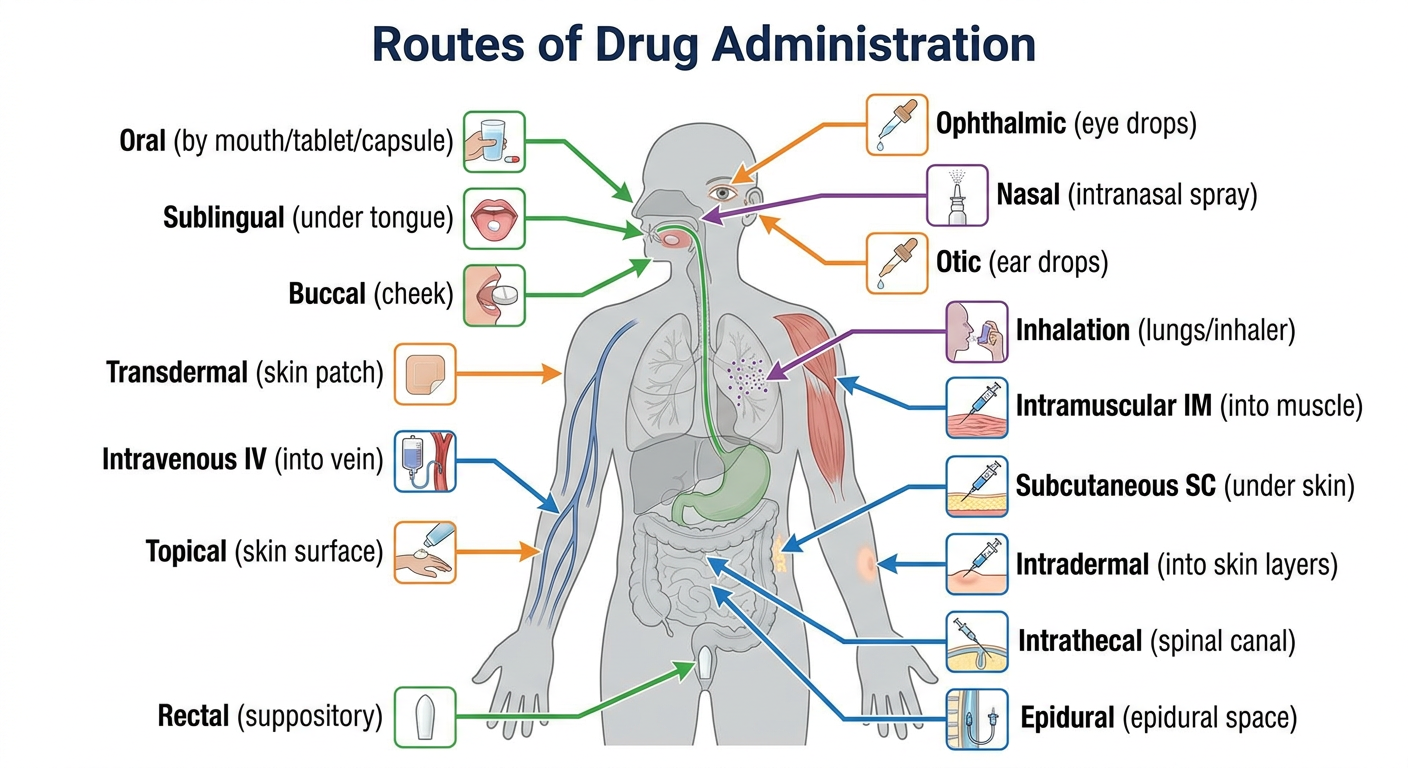
- Oral - tablets, capsules, syrups swallowed
- Sublingual - dissolved under the tongue (e.g., nitroglycerin)
- Buccal - absorbed through cheek mucosa
- Rectal - suppositories or enemas
- Intravenous (IV) - directly into a vein; fastest onset
- Intramuscular (IM) - into muscle (e.g., vaccines)
- Subcutaneous (SC) - under the skin (e.g., insulin)
- Intradermal (ID) - into the skin layers (e.g., TB test)
- Intrathecal - into the spinal canal (e.g., spinal anesthesia)
- Epidural - into the epidural space
Chart
A clean, professional medical reference chart/table showing routes of drug administration. The chart has columns: Route | Example Drugs | Onset | Bioavailability | Advantages | Disadvantages. Rows include: Oral, Sublingual, Buccal, Rectal, Intravenous (IV), Intramuscular (IM), Subcutaneous (SC), Intradermal, Inhalation, Transdermal, Topical, Intranasal, Ophthalmic, Intrathecal, Epidural. Each row is color-coded by category: green for enteral, blue for parenteral injections, purple for inhalation, orange for transdermal/topical. Bold header row in dark navy blue with white text. Alternating light row colors for readability. Title at top: "Routes of Drug Administration – Clinical Reference Chart". Clean sans-serif font, medical textbook/poster style, white background.
400, message: Got more than 4194304 bytes when reading: b'data: {"candidates": [{"content": {"role": "model","parts": [{"inlineData": {"mimeType": "image/png"...'.
We encountered an error while processing your request. Please try again or reach out to us for help.