
Hip bone
Reading File
Finding Sources
Searching Images
hip bone anatomy os coxae ilium ischium pubis
Finding Sources
Finding Sources
Reading File
Finding Sources
Reading File
Loading Image
Loading Image
Loading Image
The Hip Bone (Os Coxae)
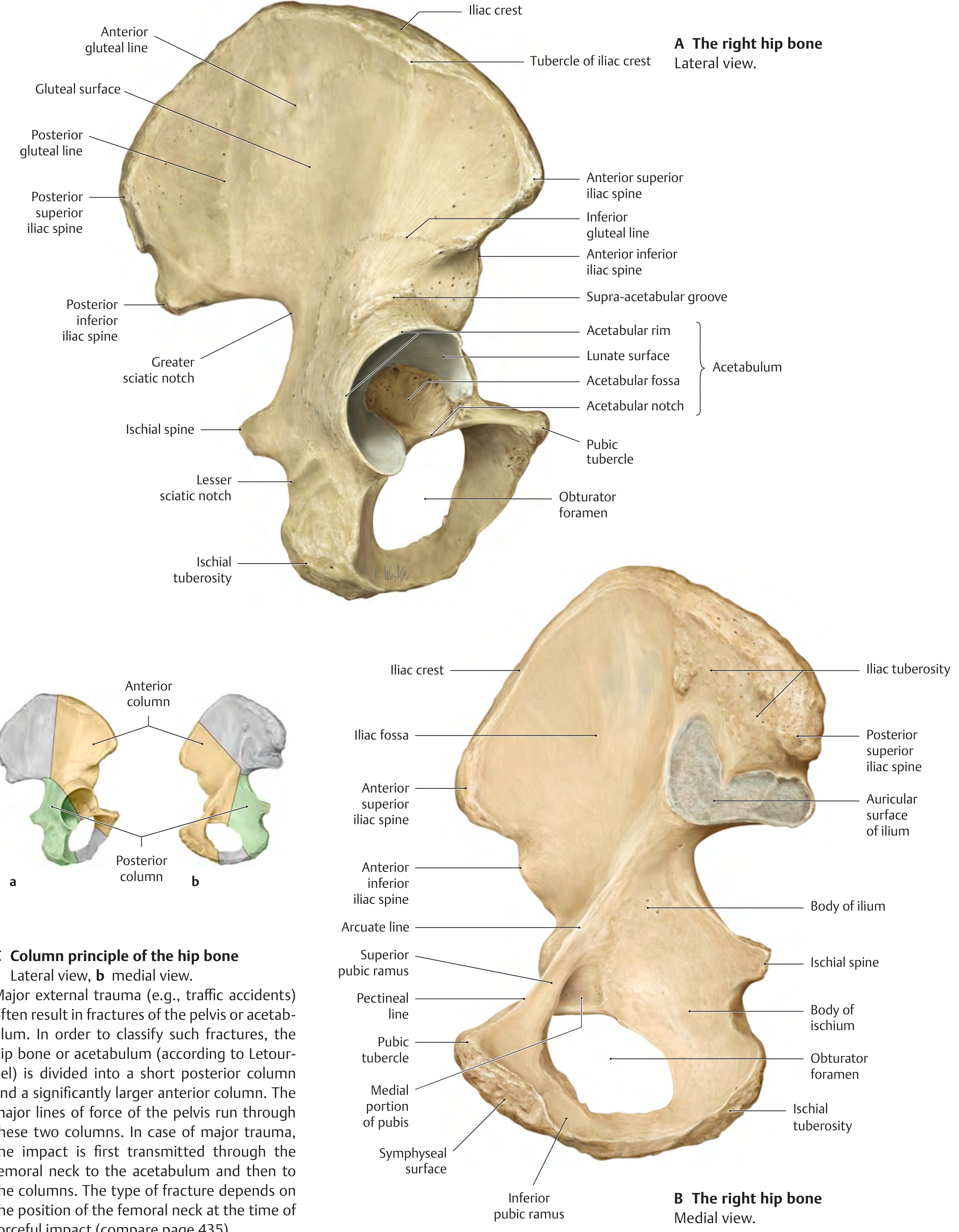
The hip bone (os coxae / innominate bone) is a large, irregularly shaped flat bone that forms the lateral wall of the pelvis. Each hip bone is composed of three parts that fuse during development: the ilium, ischium, and pubis. They converge at the acetabulum, the cup-shaped socket of the hip joint.
Lateral View
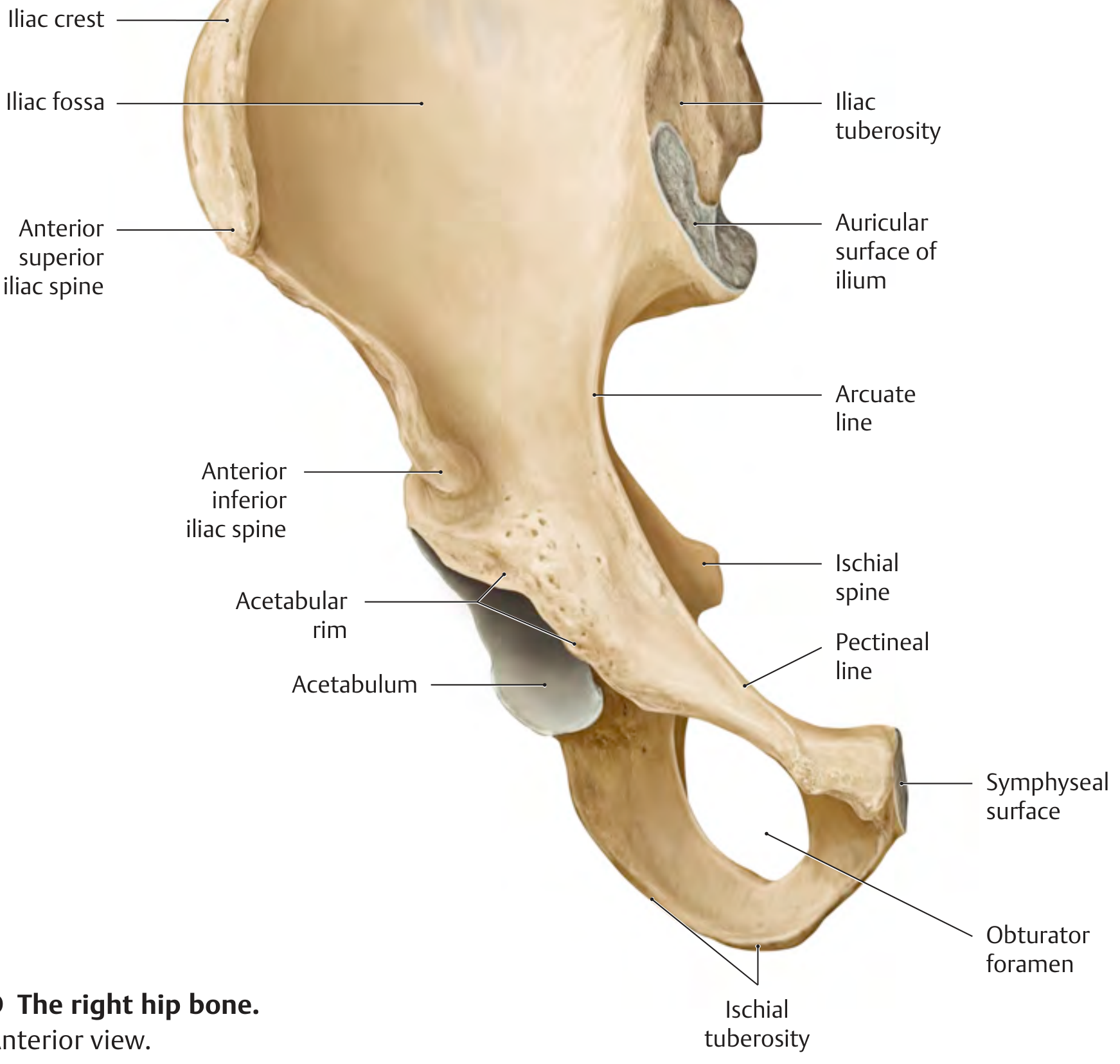
Anterior View
The Three Parts
1. Ilium
The largest, fan-shaped upper portion. Key landmarks:
- Iliac crest — the palpable superior rim, running from the anterior superior iliac spine (ASIS) to the posterior superior iliac spine (PSIS)
- Iliac fossa — concave medial surface, origin of iliacus muscle
- Gluteal surface (lateral) — divided by the anterior, posterior, and inferior gluteal lines for gluteal muscle attachments
- Auricular surface — ear-shaped area on the medial surface that articulates with the sacrum at the sacroiliac joint
- Arcuate line — marks the pelvic brim on the medial surface
2. Ischium
The posteroinferior part. Key landmarks:
- Body of ischium — fuses with ilium and pubis at the acetabulum
- Ischial spine — separates the greater sciatic notch (above) from the lesser sciatic notch (below); attachment site for the sacrospinous ligament
- Ischial tuberosity — the bony projection we sit on; attachment for hamstring muscles and the sacrotuberous ligament
- Ischial ramus — inferior projection that joins the inferior pubic ramus
3. Pubis
The anteromedial part. Key landmarks:
- Superior pubic ramus — bears the pecten pubis (pectineal line), forming part of the pelvic brim
- Pubic tubercle — attachment of the inguinal ligament
- Symphyseal surface — articulates with the contralateral pubis at the fibrocartilaginous pubic symphysis
- Inferior pubic ramus — joins the ischial ramus to form the ischiopubic ramus, enclosing the obturator foramen
The Acetabulum
The three bones meet in the acetabulum, which faces laterally and slightly inferiorly. Their contributions are:
- Ilium — 2/5
- Ischium — 2/5
- Pubis — 1/5
The acetabulum has a smooth lunate surface (articular cartilage) surrounding a central non-articular acetabular fossa, and is bounded by the acetabular rim. The inferior gap is the acetabular notch.
Triradiate Cartilage (Development)
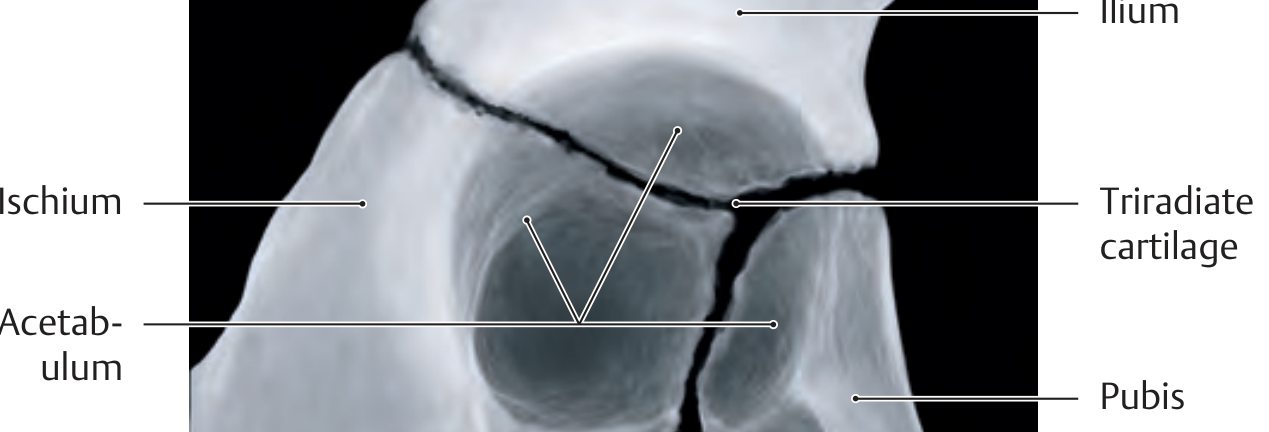
The three bones are separated at birth by a Y-shaped growth plate — the triradiate cartilage. Definitive fusion (synostosis) occurs between 14 and 16 years of life.
The Pelvic Ring
The paired hip bones articulate with each other at the pubic symphysis anteriorly and with the sacrum at the sacroiliac joints posteriorly, forming the bony pelvic ring — a stable structure essential for transferring trunk loads to the lower limbs during gait.
Clinical Relevance
| Feature | Clinical Significance |
|---|---|
| ASIS | Attachment of inguinal ligament and sartorius; surface landmark for measurement |
| Ischial tuberosity | "Sitting bone"; avulsion fractures in athletes |
| Greater sciatic notch | Passage of sciatic nerve, superior/inferior gluteal vessels |
| Ischial spine | Target for pudendal nerve block in obstetrics |
| Obturator foramen | Obturator nerve and vessels pass through obturator canal |
| Acetabulum | Site of hip dislocation and acetabular fractures (classified by anterior/posterior column per Letournel) |
| Pubic symphysis | Disrupted in pelvic fractures and symphysis pubis dysfunction in pregnancy |
Source: THIEME Atlas of Anatomy — General Anatomy and Musculoskeletal System, p. 433–434
This is a shared conversation. Sign in to Orris to start your own chat.