
enterorhinal complex
Reading File
Finding Sources
Finding Sources
Searching the Web
enterorhinal complex anatomy function neuroscience
Finding Sources
Finding Sources
Searching PubMed
entorhinal cortex function anatomy
Good, I have solid leads. Now let me read the key sections from Kandel's Principles of Neural Science and the other textbooks.
Reading File
Reading File
Reading File
Reading File
Finding Sources
Reading File
Finding Sources
Loading Image
Reading File
Finding Sources
Reading File
Reading File
I now have comprehensive information to write a thorough answer. Let me also fetch the key circuit diagram.
Loading Image
Here is a comprehensive overview of the entorhinal complex (also written entorhinal cortex, EC), synthesized from multiple neuroscience and neuroanatomy textbooks.
The Entorhinal Complex
1. Anatomy and Location
The entorhinal cortex is Brodmann's area 28, situated in the anterior portion of the parahippocampal gyrus on the medial temporal lobe. It occupies the medial bank of the rhinal sulcus, with the perirhinal cortex (Brodmann's areas 35/36) occupying the lateral bank, and the parahippocampal cortex lying further laterally. The rhinal sulcus is a key surface landmark demarcating these regions.
The term entorhinal complex refers to the EC together with its immediately surrounding parahippocampal cortical areas:
| Region | Location | Brodmann area |
|---|---|---|
| Entorhinal cortex | Medial bank of rhinal sulcus; anterior parahippocampal gyrus | 28 |
| Perirhinal cortex | Lateral bank of rhinal sulcus + adjacent occipitotemporal gyrus | 35, 36 |
| Parahippocampal cortex | Posterior parahippocampal gyrus | 36, 37 |
Medially, the EC transitions through the parasubiculum → presubiculum → subiculum into the three-layered archicortex of the hippocampus proper.
The EC is divided into a medial subdivision (MEC) and a lateral subdivision (LEC), with distinct functional properties (see §4).
2. The Entorhinal Cortex as the Gateway to the Hippocampus
The EC is the principal input–output interface between the hippocampus and the rest of the cortex. About two-thirds of cortical association input to the hippocampus is relayed via the perirhinal cortex and parahippocampal cortex before converging on the entorhinal cortex. These inputs carry highly processed, multimodal (visual, auditory, somatosensory, olfactory) information from frontal, parieto-occipital, and temporal association areas — not simple sensory features.
3. Connectivity: Circuits
Afferent (Input) Pathways
- Association cortex (frontal, temporal, parieto-occipital) → perirhinal/parahippocampal cortex → entorhinal cortex
- Olfactory pathway: the piriform cortex projects directly to the anterior entorhinal cortex, giving the EC a privileged olfactory input (potentially explaining odor-evoked memory)
- Cholinergic modulation: the nucleus basalis of Meynert provides cholinergic input to the EC and neocortex; the medial septal nucleus provides cholinergic input via the fornix
Efferent (Output) Pathways to the Hippocampus
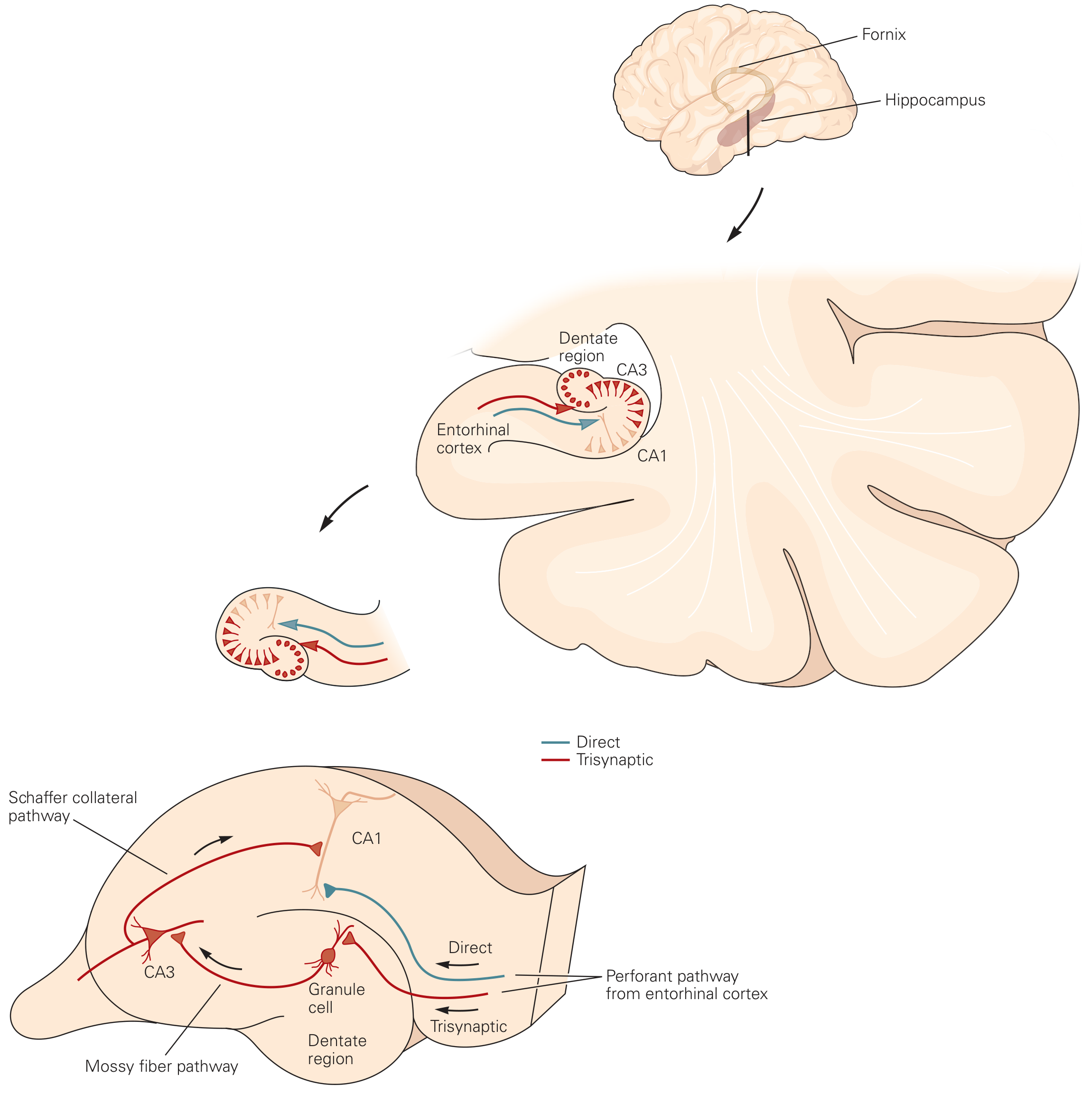
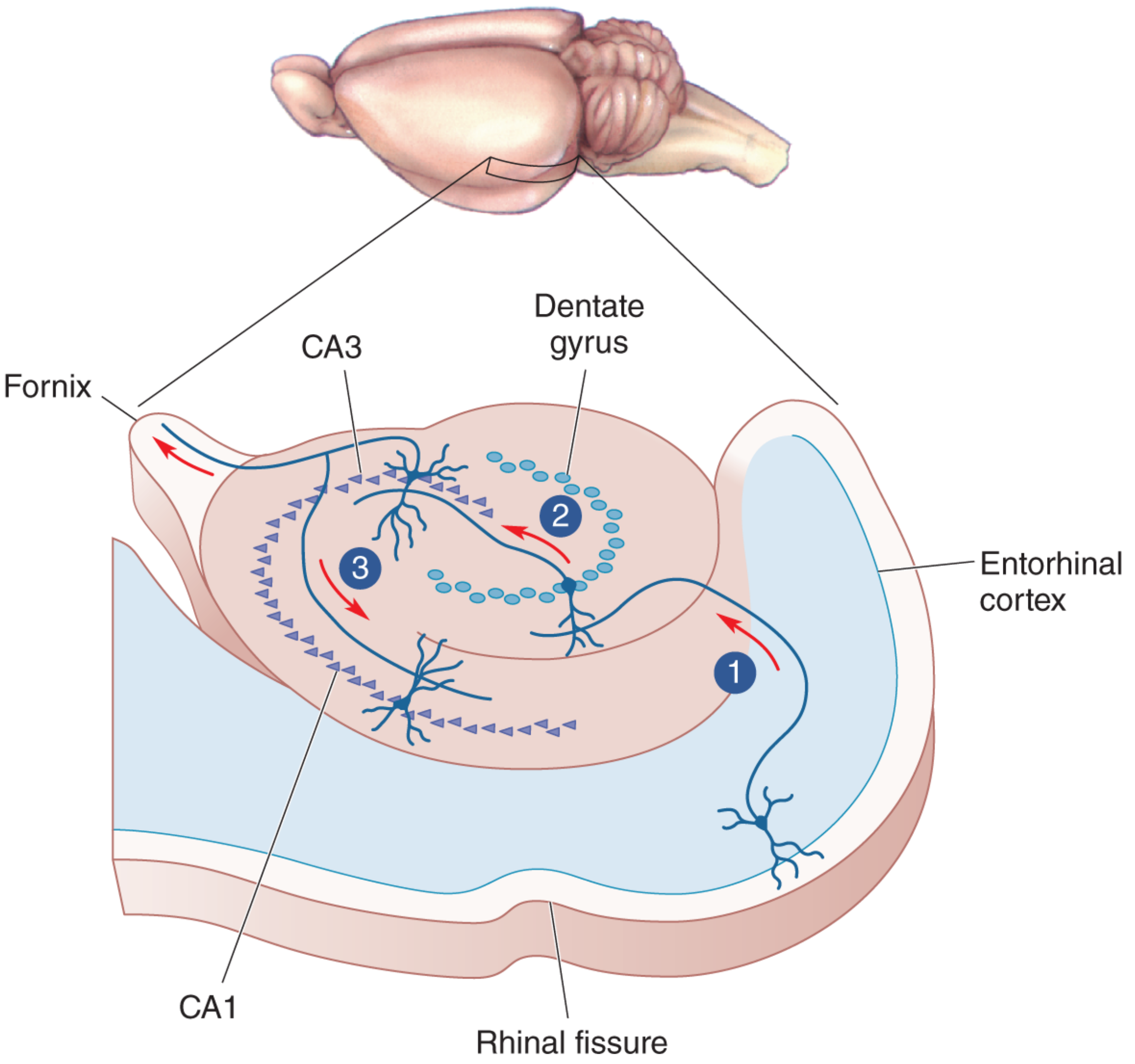
The EC sends axons to the hippocampus via the perforant pathway, forming two parallel routes:
1. Indirect (trisynaptic) pathway — from layer II neurons of the EC:
EC layer II → dentate gyrus granule cells (perforant path) → CA3 pyramidal cells (mossy fiber pathway) → CA1 pyramidal cells (Schaffer collateral pathway)
2. Direct (temporoammonic) pathway — from layer III neurons of the EC:
EC layer III → distal apical dendrites of CA1 pyramidal cells (perforant path), bypassing dentate gyrus and CA3
Both pathways converge on CA1, the principal output region of the hippocampus. CA3 neurons also form dense recurrent collaterals with each other — thought to support associative memory storage and recall, but also the substrate for seizure propagation.
Return (Output) Pathway
CA1 → subiculum → deep layers of entorhinal cortex → back to multimodal association cortex
The subiculum is also the main source of fornix fibers projecting to the diencephalon (mammillary bodies via fornix) and septal nuclei.
4. Functional Cell Types in the Medial Entorhinal Cortex
The MEC contains a remarkable set of navigation-related neurons that provide a spatial coordinate framework to the hippocampus:
Grid Cells (discovered 2005, Moser lab)
Neurons that fire whenever the animal occupies any of several regularly spaced locations forming a hexagonal grid across the environment. Key properties:
- Grid firing persists in complete darkness — intrinsic networks and self-motion cues drive the pattern, not just sensory landmarks
- Grid spacing increases topographically from dorsal to ventral MEC (30–40 cm spacing dorsally → meters ventrally), in a step-like, modular fashion
- This dorsoventral gradient mirrors the size gradient of hippocampal place fields (dorsal EC innervates dorsal hippocampus with fine-scale spatial maps; ventral EC innervates ventral hippocampus with coarser, more contextual/emotional maps)
- Grid cells are rigid: two co-localized grid cells maintain the same phase relationship across all environments — the MEC thus acts as a universal, context-independent spatial coordinate system
- Identified in rats, mice, bats, monkeys, and humans; in flying bats they encode 3D space
Head Direction Cells
- Fire selectively based on the direction the animal is facing, regardless of position
- Originally found in the presubiculum; present also in MEC
- Many MEC head direction cells are conjunctive — they have both grid-like fields and directional tuning (fire only when the animal traverses a grid vertex while facing a particular direction)
Border Cells
- Fire when the animal is near the geometric boundaries of the environment (walls, edges)
- Their firing fields deform when the enclosure is stretched, and new border fields appear when internal walls are introduced
- Encode environmental geometry to anchor the grid map
Speed Cells
- Firing rate tracks the animal's instantaneous running speed, independent of location or direction
- Thought to provide a velocity signal that updates the grid cell network via path integration
Together these four cell types form a network of feature detectors in the MEC — analogous to feature detectors in sensory cortex — allowing the hippocampus to build unique, context-sensitive place maps by combining this universal entorhinal coordinate input with environmental cues.
The lateral EC (LEC) is distinct: it carries non-spatial, object-related, and sensory information — more concerned with what and when than where.
5. Role in Memory
The EC is the critical relay for declarative (explicit) memory formation. The medial temporal lobe memory system — hippocampus + EC + perirhinal/parahippocampal cortex — enables:
- Encoding: association cortex information flows into the hippocampus via the EC for initial binding and encoding
- Storage/consolidation: interactions between hippocampal circuits and neocortex (mediated by the EC return pathway) allow memories to be gradually transferred to long-term cortical storage
- Retrieval: reactivation of cortical memory traces via hippocampal → EC → association cortex projections
The storage sites for long-term declarative memories are believed to be the association and primary cortices themselves, not the hippocampus — the medial temporal lobe enables their formation and retrieval. — Neuroanatomy through Clinical Cases, 3rd ed.
6. Clinical Relevance
Alzheimer's Disease
The earliest neuropathological changes in AD are neurofibrillary tangles and amyloid plaques accumulating in the entorhinal cortex and subiculum — the input and output relays of the hippocampal formation. This explains why episodic memory loss (inability to form new memories) is the hallmark early symptom: the hippocampus is functionally disconnected from the rest of the cortex before significant hippocampal neuronal loss occurs. — Kaplan & Sadock's Comprehensive Textbook of Psychiatry
Schizophrenia
Reduced entorhinal cortex volume and disrupted EC network activity have been reported in schizophrenia and are linked to cognitive impairment (working memory, episodic memory deficits). Early studies reported reduced neuron number in layer II of the EC, though findings remain controversial. — Kaplan & Sadock's Comprehensive Textbook of Psychiatry
Temporal Lobe Epilepsy
The EC's strong recurrent connectivity and its role as the seizure gateway to the hippocampus makes it a focus for temporal lobe epilepsy. Stimulation of the entorhinal–hippocampal circuit (deep brain stimulation) is being explored as a memory modulation tool.
Amnesia
Lesions of the medial temporal lobe — including the EC — produce severe anterograde amnesia (inability to form new declarative memories) with relative preservation of procedural memory and remote memories, as classically demonstrated in patient H.M.
Summary Table
| Feature | Detail |
|---|---|
| Location | Brodmann area 28; medial bank rhinal sulcus; anterior parahippocampal gyrus |
| Subdivisions | Medial EC (spatial), Lateral EC (object/sensory) |
| Key input | Association cortex via perirhinal/parahippocampal cortex; olfactory (piriform) cortex |
| Key output to hippocampus | Perforant pathway (layer II → trisynaptic; layer III → direct to CA1) |
| Return pathway | CA1 → subiculum → deep EC layers → neocortex |
| Functional cell types (MEC) | Grid cells, head direction cells, border cells, speed cells |
| Memory role | Gateway for encoding and retrieval of declarative memories |
| Disease relevance | Earliest AD pathology; schizophrenia cognition; temporal lobe epilepsy; amnesia |
Sources: Principles of Neural Science (Kandel, 6th ed.) • Neuroanatomy through Clinical Cases (Blumenfeld, 3rd ed.) • Neuroscience: Exploring the Brain (Bear, 5th ed.) • Kaplan & Sadock's Comprehensive Textbook of Psychiatry
This is a shared conversation. Sign in to Orris to start your own chat.